EduNinja

IGCSE Physics4.2.1 Electric chargeQuestion Bank

Question 23

[Maximum number: 1]

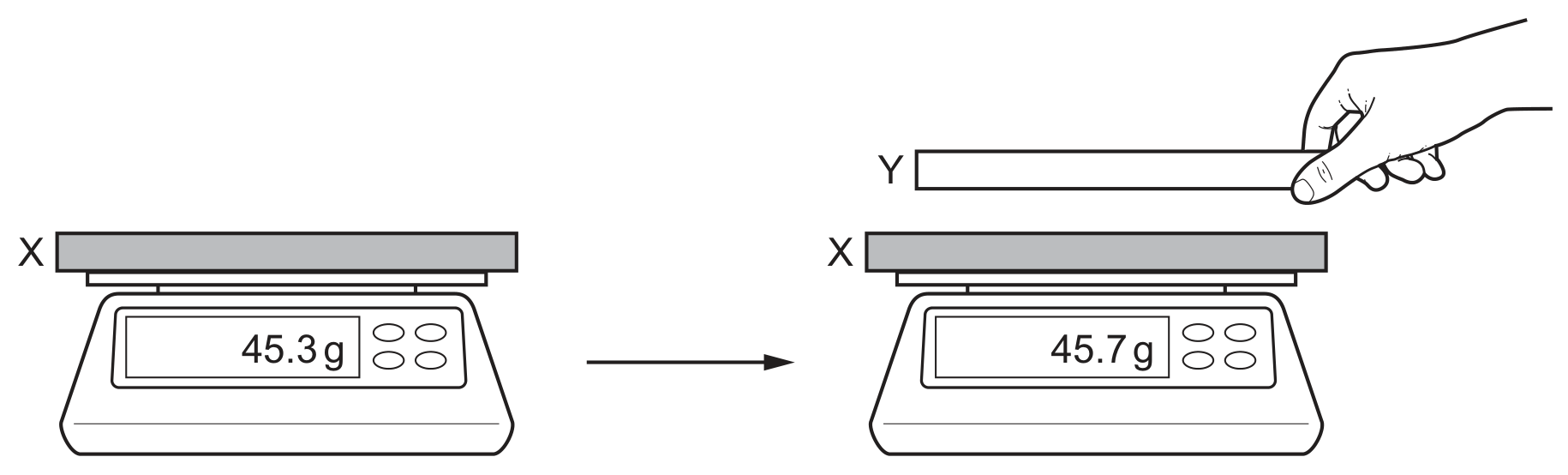
A charged rod X is placed on a balance and another rod Y is brought close to it, as shown.
Question image

Which combination of charges would cause the change in the balance reading shown?

X

Y

negative charge

negative charge

negative charge

positive charge

negative charge

no charge

positive charge

no charge
Question 5

[Maximum number: 9]

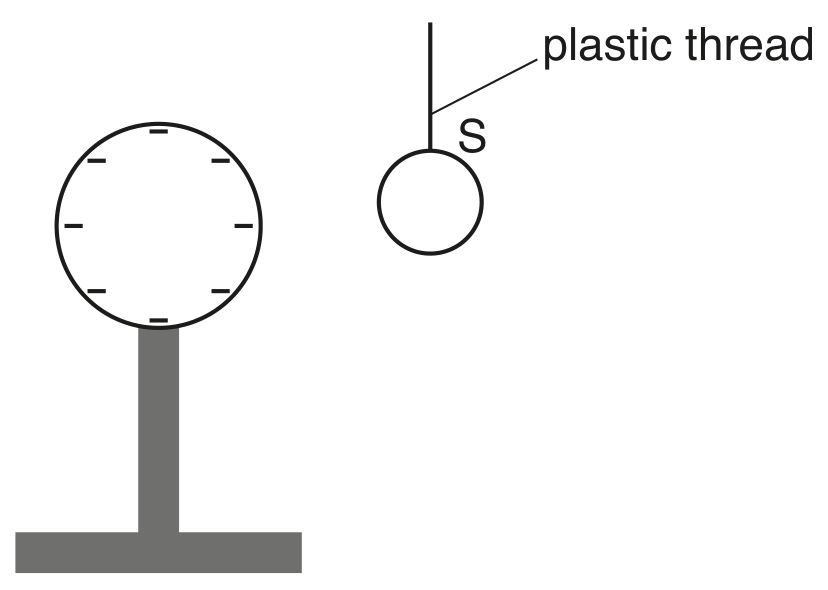
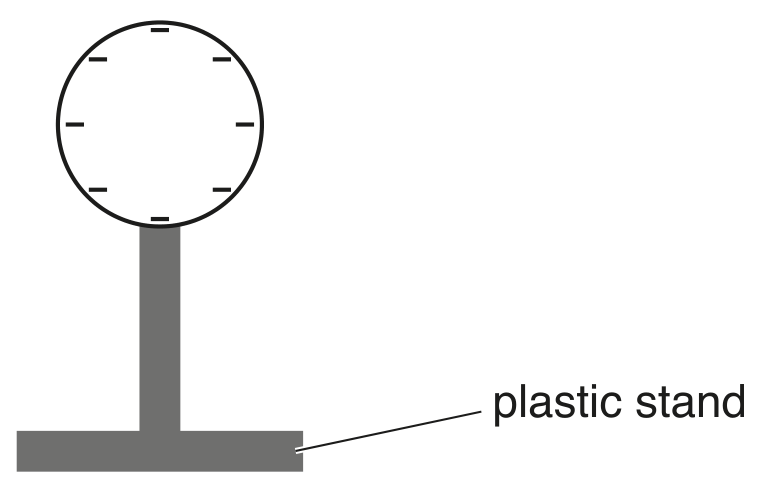
Fig. 5.1 shows a sphere that is negatively charged. The sphere is attached to a plastic stand.

Fig. 5.1

Fig. 5.1

Question 5(a)

(a)

On Fig. 5.1, draw arrows to indicate the pattern and direction of the electric field in the region surrounding the sphere.

[ 2 ]

Question 5(b)

(b)

A smaller, uncharged metal sphere S is suspended by a plastic thread and brought close to the negatively charged sphere. Fig. 5.2 shows the two spheres.

Fig. 5.2

Fig. 5.2

[ 5 ]

Question 5(b)(i)

(i)

By drawing on Fig. 5.2, indicate the distribution of charge on S .

[ 2 ]

Question 5(b)(ii)

(ii)

State what happens to S .

[ 1 ]

Question 5(b)(iii)

(iii)

An earth wire is then touched against S .

Describe what happens in the wire and state how this affects the charge on S .

[ 2 ]

Question 5(c)

(c)

The metal sphere S is an electrical conductor. The plastic thread is an electrical insulator.

Explain this difference by referring to the structures of the two materials.
[Total: 9]

[ 2 ]

Question 24

[Maximum number: 1]

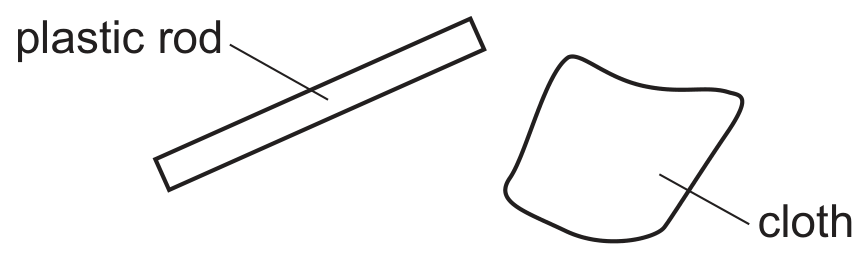
A plastic rod and a dry cloth are uncharged.
The rod is now rubbed with the cloth and they both become charged. The rod becomes negatively charged because some charged particles move from the cloth to the rod.

What is the charge on the cloth and which particles moved in the charging process?

charge

on cloth

particles

that moved

negative

electrons

negative

neutrons

positive

electrons

positive

neutrons

Question 24

[Maximum number: 1]

A plastic rod is rubbed with a dry cloth. The rod becomes positively charged.
Why has the rod become positively charged?

A

It has gained electrons.

B

It has gained neutrons.

C

It has lost electrons.

D

It has lost neutrons.

Question 24

[Maximum number: 1]

A plastic rod is rubbed with a cloth.

Question image

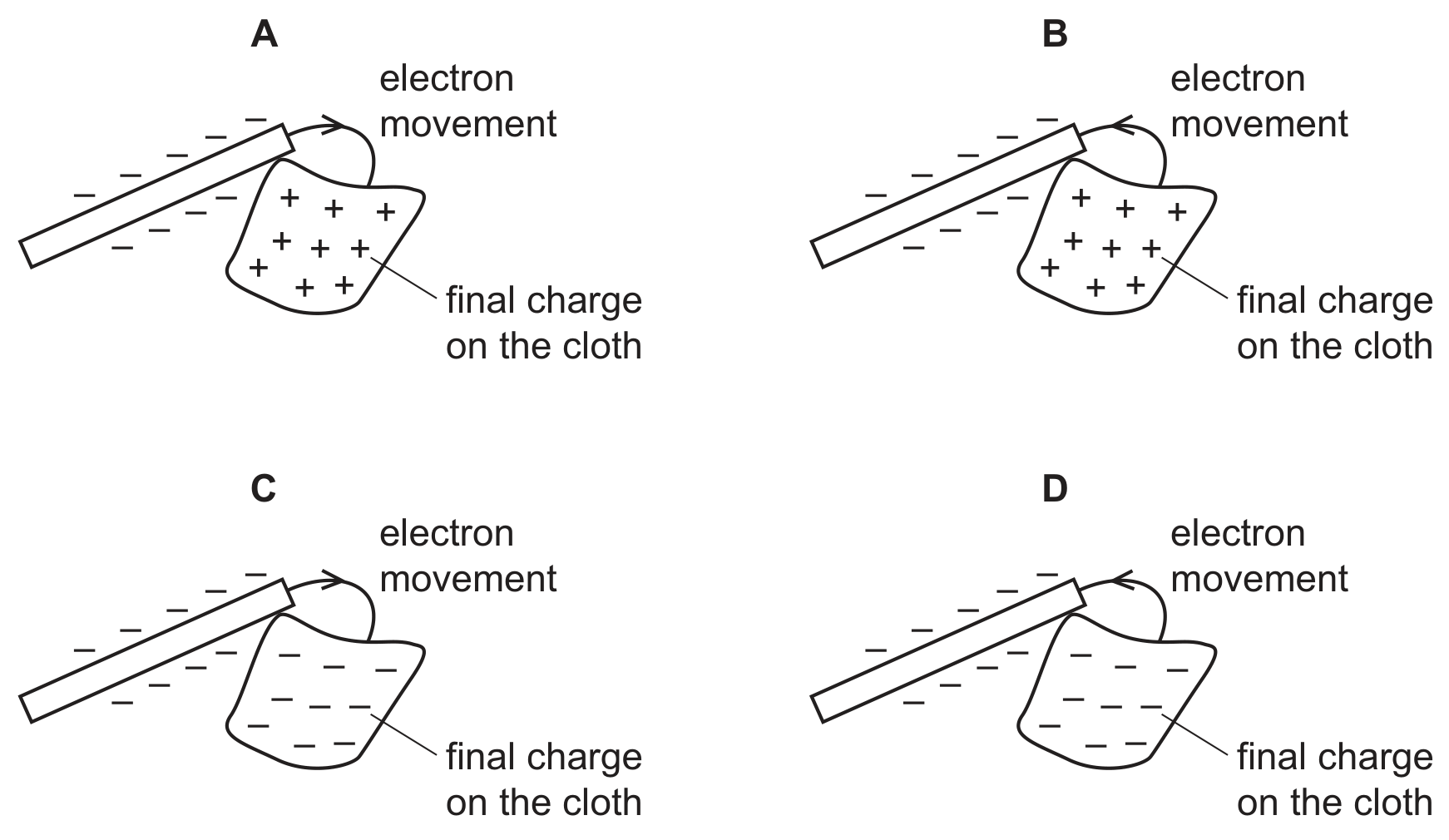
The rod and the cloth both become charged as electrons move between them.
The rod becomes negatively charged.
Which diagram shows how the rod becomes negatively charged and shows the final charge on the cloth?

Question image

Question 25

[Maximum number: 1]

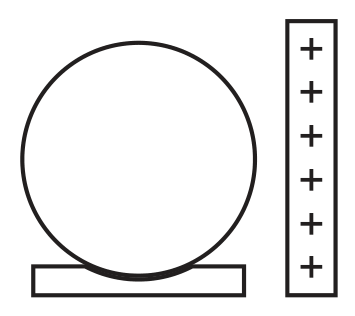
An uncharged, metal sphere is placed on an insulating support. A positively charged rod is brought close to the sphere, but does not touch it.

Question image

How do the charges in the sphere move and what is now the charge on the sphere?

movement of charges

charge on sphere

negative charges move
to the right of the sphere

positive

negative charges move
to the right of the sphere

neutral

positive charges move
to the left of the sphere

positive

positive charges move
to the left of the sphere

neutral

Question 25

[Maximum number: 1]

Which statement describes the direction of an electric field at a point?

A

the direction of the force on a negative charge

B

the direction of the force on an N pole

C

the direction of the force on a positive charge

D

the direction of the force on an S pole

Question 25

[Maximum number: 1]

Which diagram shows the electric field pattern and direction around a positive point charge?

Question 25

[Maximum number: 1]

Which diagram shows the electric field pattern between two oppositely charged parallel metal plates?

Question 25

[Maximum number: 1]

A stationary, charged particle is in a field.
Which fields can cause there to be a force on this particle due to its charge?
1 gravitational field
2 magnetic field
3 electric field

A

1 and 2

B

1 only

C

2 and 3

D

3 only

0 selected