EduNinja

IGCSE Physics3.4 SoundQuestion Bank

Question 3

[Maximum number: 6]

Fig. 3.1 shows a small submarine submerged below the surface of the sea.
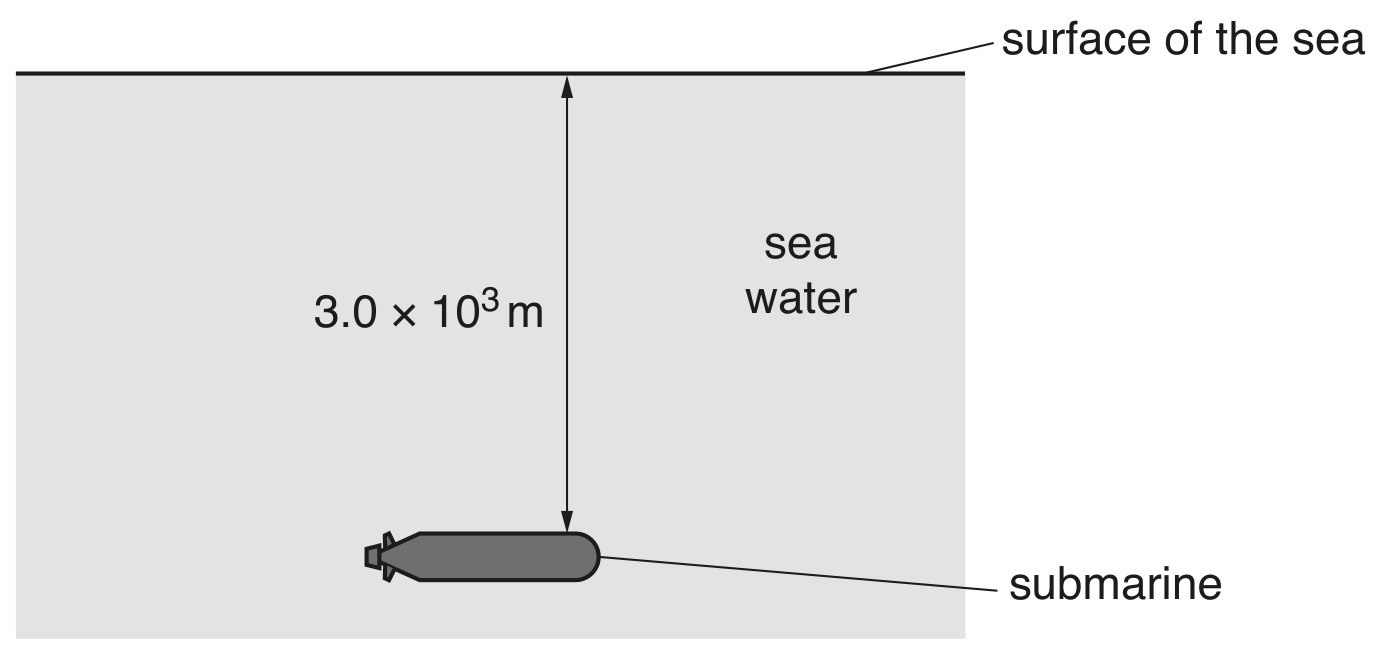
Fig. 3.1

Fig. 3.1

Question 3(b)

(a)

The submarine emits a pulse of sound to detect other objects in the sea. The speed of sound in sea water is 1500 m/s1500 \mathrm{~m} / \mathrm{s}. An echo is received with a time delay of 0.50 s after the original sound is emitted.

Question 3(b)(i)

(i)

Calculate the distance between the submarine and the other object.

distance =

Question 3(b)(ii)

(ii)

Another pulse of sound is emitted through the air when the submarine is on the surface.

An echo is received from a second object that is in the air. This echo is received 0.50 s after the pulse of sound is emitted.

Compare the distance of the second object from the submarine with the distance calculated in (b)(i). Tick one box. Give a reason for your answer.
distance is smaller
distance is the same
distance is larger

Reason
Question 18

[Maximum number: 1]

The range of audible frequencies for elephants is 10 Hz to 12000 Hz , and for horses is 55 Hz to 33000 Hz .

Which statement about the range of audible frequencies for a healthy human ear is correct?

A

The human ear can hear all sounds heard by both elephants and horses.

B

The human ear can hear all sounds heard by elephants but not all those heard by horses.

C

The human ear can hear all sounds heard by horses but not all those heard by elephants.

D

The human ear cannot hear all sounds heard by elephants nor those heard by horses.

Question 5

Question 5(a)

(a)

One difference between a longitudinal wave and a transverse wave is that a longitudinal wave consists of compressions and rarefactions.

[ 2 ]

Question 5(a)(i)

(i)

Explain the terms compression and rarefaction using ideas about particles.
compression
rarefaction

[ 2 ]

Question 5(b)

Question 5(b)(ii)

(b)
(i)

The wave travels from the rock into the air.

State and explain whether the wave will be audible to a healthy human ear.
statement
explanation

[ 2 ]

Question 4

[Maximum number: 3]

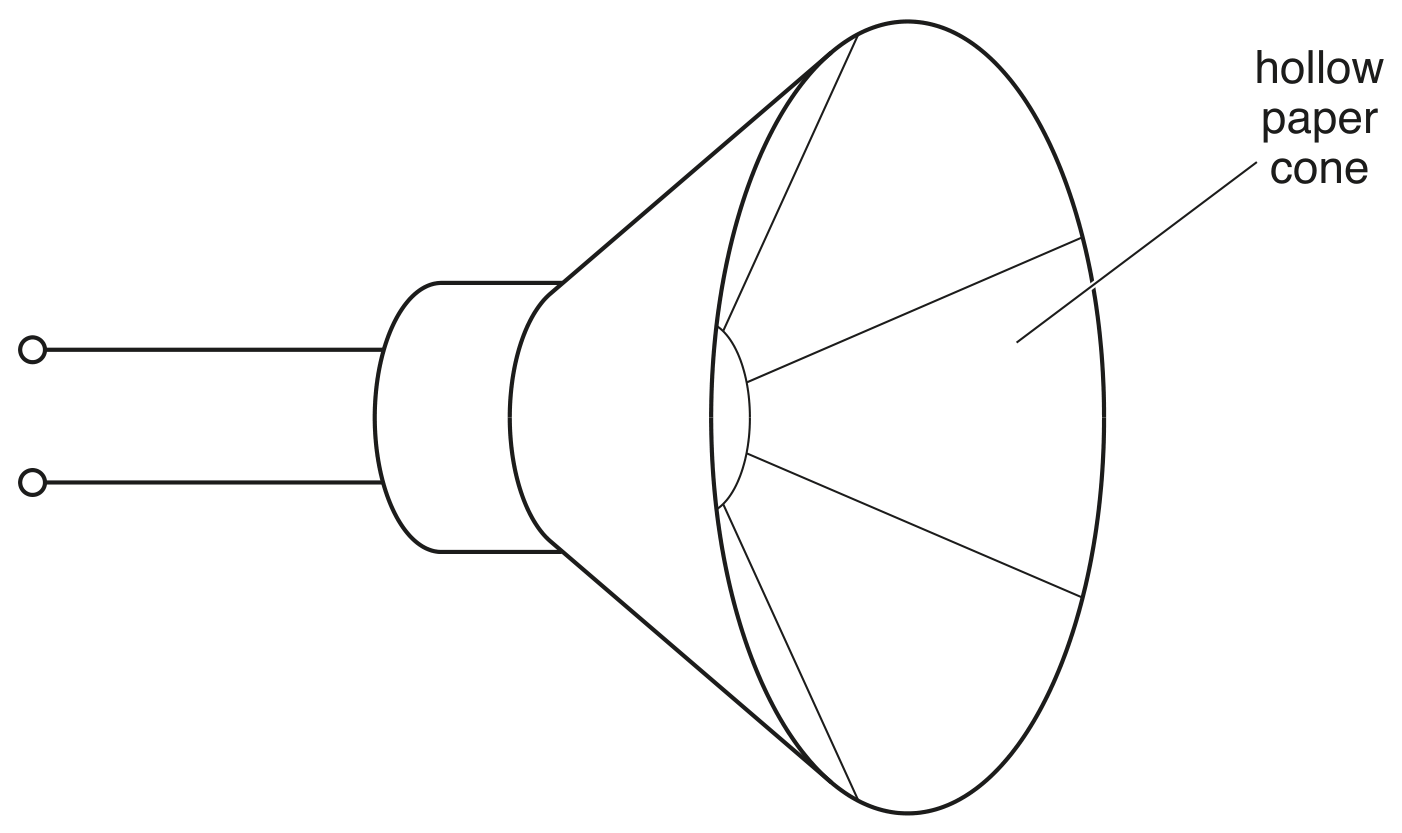
Fig. 4.1 shows a loudspeaker that is producing a sound wave in air of frequency 15000 Hz .

Fig. 4.1

Fig. 4.1

Question 4(a)

(a)

Describe how the cone of the loudspeaker produces this sound.

[ 3 ]

Question 5

[Maximum number: 2]

Sound waves are longitudinal and electromagnetic waves are transverse.

Question 5(a)

(a)

A sound wave used for a medical examination has a frequency of 1.5 MHz .

[ 2 ]

Question 5(a)(i)

(i)

State and explain what type of sound wave this is.

[ 2 ]

Question 22

[Maximum number: 1]

A healthy human ear is able to hear a range of frequencies.
What is this approximate range?

A

10 Hz to 1000 Hz

B

20 Hz to 2000 Hz

C

20 Hz to 20000 Hz

D

200 Hz to 200000 Hz

Question 22

[Maximum number: 1]

A ship sounds its horn when it is 790 m from a cliff. A passenger on the ship hears the echo 4.8 s later.

What is the speed of the sound?

A

165 m/s165 \mathrm{~m} / \mathrm{s}

B

330 m/s330 \mathrm{~m} / \mathrm{s}

C

340 m/s340 \mathrm{~m} / \mathrm{s}

D

1896 m/s1896 \mathrm{~m} / \mathrm{s}

Question 22

[Maximum number: 1]

The diagram shows the air molecules in part of a sound wave at a particular moment in time.

Which statement is not correct?

A

Earlier, there was compression at X .

B

Later, there will be a rarefaction at X .

C

This part of the wave is travelling horizontally across the page.

D

This part of the wave is travelling towards the top of the page.

Question 5

Question 5(a)

(a)

State the name of the reflection of a sound wave or ultrasound wave.

[ 1 ]

Question 6

[Maximum number: 8]

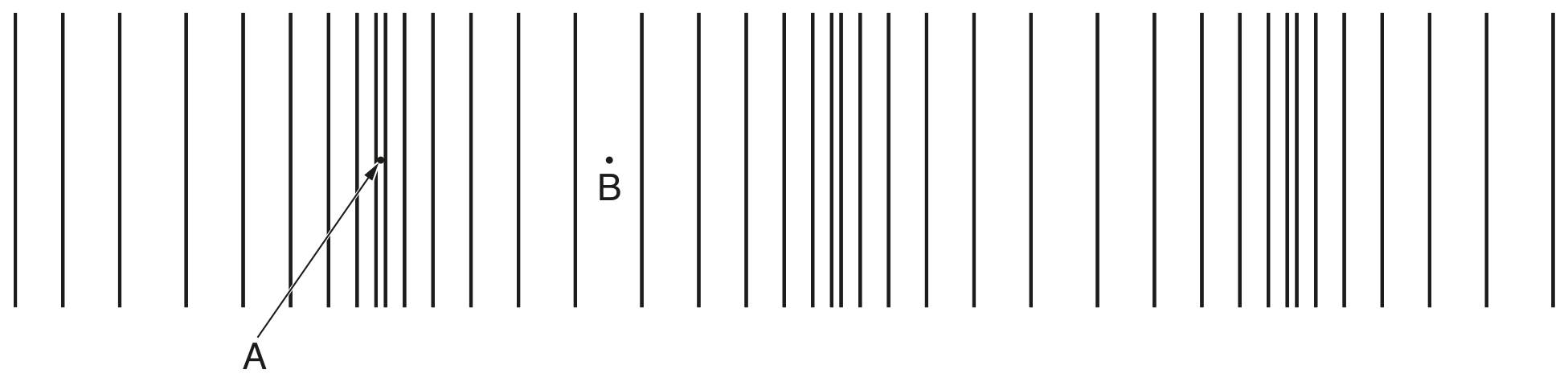
Fig. 6.1 represents wavefronts of a sound wave travelling in air from left to right.

Fig. 6.1

Fig. 6.1

Question 6(a)

(a)

State the name given to the:

[ 2 ]

Question 6(a)(i)

(i)

region around A in the diagram [1]

[ 1 ]

Question 6(a)(ii)

(ii)

region around B in the diagram.

[ 1 ]

Question 6(c)

(b)

The loudness of the sound increases at the same pitch.

State and explain any change there would be in the pattern of wavefronts shown in Fig. 6.1.

[ 3 ]

Question 6(d)

(c)

The wave passes into water.

State and explain any change in the pattern of wavefronts shown in Fig. 6.1.

[ 3 ]
0 selected