Question 16
[Maximum number: 1]
What is the name of the distance from one crest in a transverse wave to the next crest?
A
amplitude
B
period
C
wavefront
D
wavelength
 EduNinja
What is the name of the distance from one crest in a transverse wave to the next crest?
amplitude
period
wavefront
wavelength
Which statement about waves is correct?
Waves do not transfer either energy or matter.
Waves transfer both energy and matter.
Waves transfer energy without transferring matter.
Waves transfer matter without transferring energy.
The diagram shows a wave.
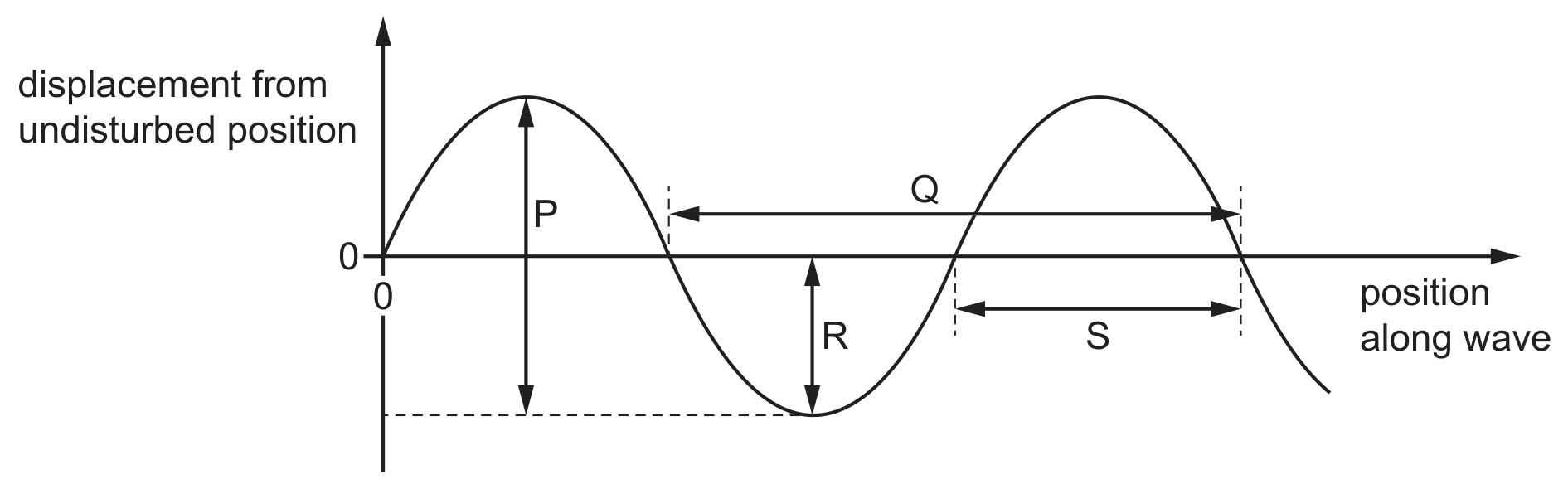
Which dimensions describe the properties of the wave?
P= amplitude, S= speed
P= speed, Q= wavelength
R= amplitude, Q= wavelength
R= amplitude, S= wavelength
A student writes down some facts about two transverse waves.
Wave 1 has a frequency f and a velocity v.
Wave 2 has four times the frequency of wave 1 and is travelling at a velocity of 2 v.
What is the wavelength of wave 2 in terms of f and v ?
8 f v
In the diagram, the mountaineer can hear the stream although he cannot see it. When he is closer to the gully, he can both hear and see the stream. When he is further from the gully, he can neither hear nor see the stream.
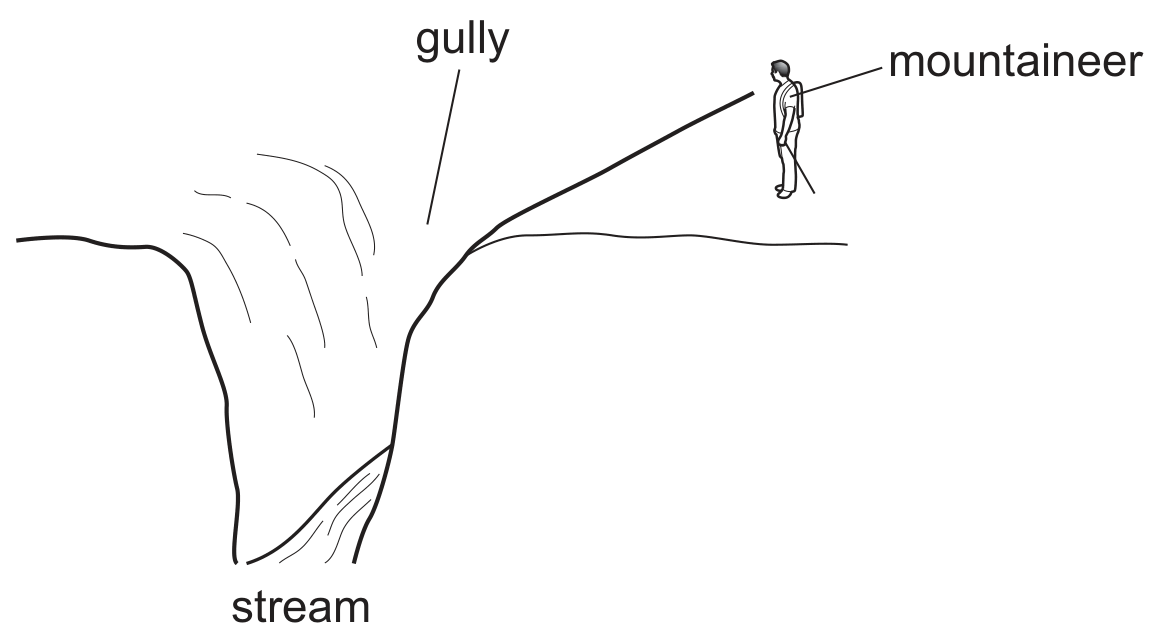
Which statement is not correct?
As he approaches the gully edge, he hears first the short wavelength, higher frequencies and then the long wavelength, lower frequencies.
As he approaches the gully edge, the sound becomes louder.
He hears the stream because some of the sound is diffracted.
He hears the stream because some of the sound is reflected from the opposite wall of the gully.
A wave source produces 3000 crests every minute. The wave has a speed of . What is the wavelength of the wave?
0.10 m
6.0 m
A passing boat causes a floating object on a lake to bob up and down 18 times in 12 s . The wavelength of the wave created by the boat is 48 cm .
What is the velocity of these water waves?
The diagrams show graphs of displacement against time for four waves. All the graphs are drawn to the same scale.
Which wave has the largest amplitude and the highest frequency?
The diagram shows a wave.
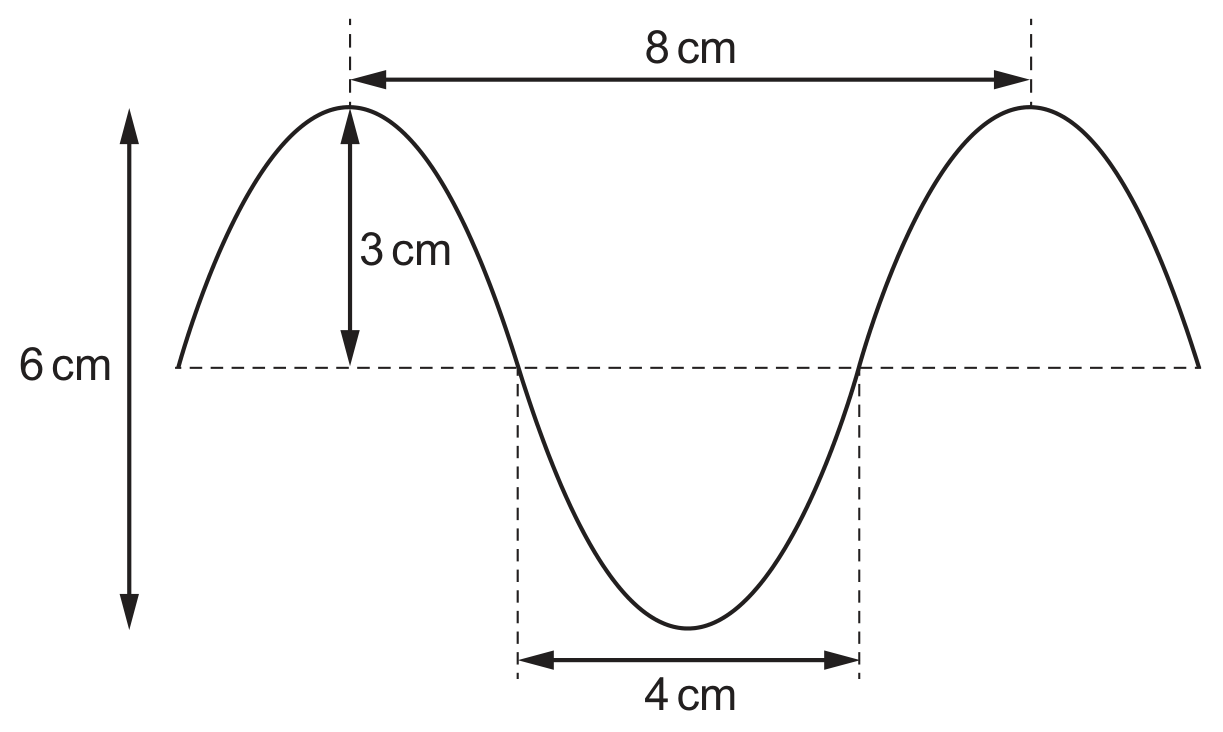
What are the amplitude and the wavelength of this wave?
amplitude
wavelength
3
4
3
8
6
4
6
8
Light diffracts when it enters a telescope. This causes the image to blur slightly. The amount of diffraction depends on the diameter of the hole through which the light enters the telescope and the wavelength of the light.
Which combination for diameter and wavelength will result in the sharpest image (least blurring)?
diameter
wavelength
large
long
large
short
small
long
small
short