EduNinja

IGCSE Physics2.2.2 Specific heat capacityQuestion Bank

Question 2

[Maximum number: 4]

A student carries out an experiment using a plastic beaker that contains 0.24 kg of water at 17C17^{\circ} \mathrm{C}. The thermal capacity (heat capacity) of the beaker is negligible.

Question 2(b)

(a)

Several ice cubes are at a temperature of 0C0^{\circ} \mathrm{C}. The ice cubes are dropped into the water and the internal energy of the water decreases.

[ 4 ]

Question 2(b)(i)

(i)

Give a simple molecular account of this decrease in internal energy.

[ 2 ]

Question 2(b)(ii)

(ii)

The specific heat capacity of water is 4200 J/(kgC)4200 \mathrm{~J} /\left(\mathrm{kg}^{\circ} \mathrm{C}\right).

Calculate the decrease in the internal energy of the water as its temperature decreases from 17C17^{\circ} \mathrm{C} to 0C0^{\circ} \mathrm{C}.

decrease in internal energy =
[ 2 ]
Question 12

[Maximum number: 1]

In a famous experiment, a scientist showed that, when water in an insulated tub is stirred, its temperature increases.

What can be concluded from this experiment?

A

Temperature is a store of energy.

B

The water absorbs heat from the surroundings.

C

Work done by stirring increases the internal energy of the water.

D

Energy is not conserved.

Question 3

[Maximum number: 4]

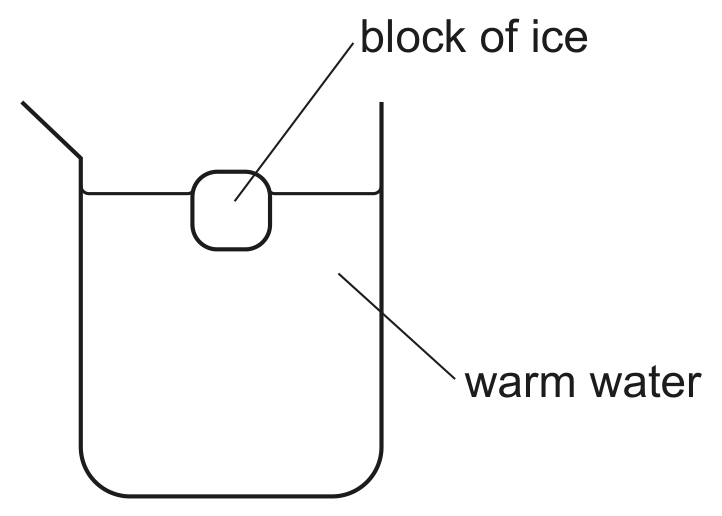
Fig. 3.1 shows a small block of ice floating in a beaker of warm water.

Fig. 3.1

Fig. 3.1

Question 3(b)

(a)

Energy is transferred from the water to the block of ice.

[ 4 ]

Question 3(b)(ii)

(i)

Initially, there is 0.34 kg of water in the beaker. The specific heat capacity of water is 4200 J/(kgC)4200 \mathrm{~J} /\left(\mathrm{kg}^{\circ} \mathrm{C}\right).

Calculate the energy transferred from this water as its temperature decreases from 28C28^{\circ} \mathrm{C} to 10C10^{\circ} \mathrm{C}.

energy transferred =
[ 2 ]

Question 3(b)(iv)

(ii)

State what happens to the internal energy of the water as the temperature of the water decreases.

Describe the change in terms of the energy of the particles.
[Total: 9]

[ 2 ]

Question 13

[Maximum number: 1]

The temperature of the water at the bottom of a waterfall is greater than the temperature of the water at the top.

The energy in the gravitational potential store of the water at the top is transferred to the thermal store at the bottom.

The specific heat capacity of water is 4200 J/(kgC)4200 \mathrm{~J} /\left(\mathrm{kg}^{\circ} \mathrm{C}\right).
What is the temperature difference for a waterfall of height 21 m ?

A

0.0050C0.0050^{\circ} \mathrm{C}

B

0.049C0.049^{\circ} \mathrm{C}

C

20C20^{\circ} \mathrm{C}

D

200C200^{\circ} \mathrm{C}

Question 3

Question 3(a)

(a)

A solar panel receives energy from the Sun at a rate of 5.0 kW .
Thermal energy is transferred from the solar panel to water with an efficiency of 20\%.
Cold water of mass 15 kg enters the solar panel every hour.
The specific heat capacity of water is 4200 J/(kgC)4200 \mathrm{~J} /\left(\mathrm{kg}^{\circ} \mathrm{C}\right).
Calculate the temperature increase of the water.
temperature increase = C{ }^{\circ} \mathrm{C} [4]

[ 4 ]

Question 4

[Maximum number: 4]

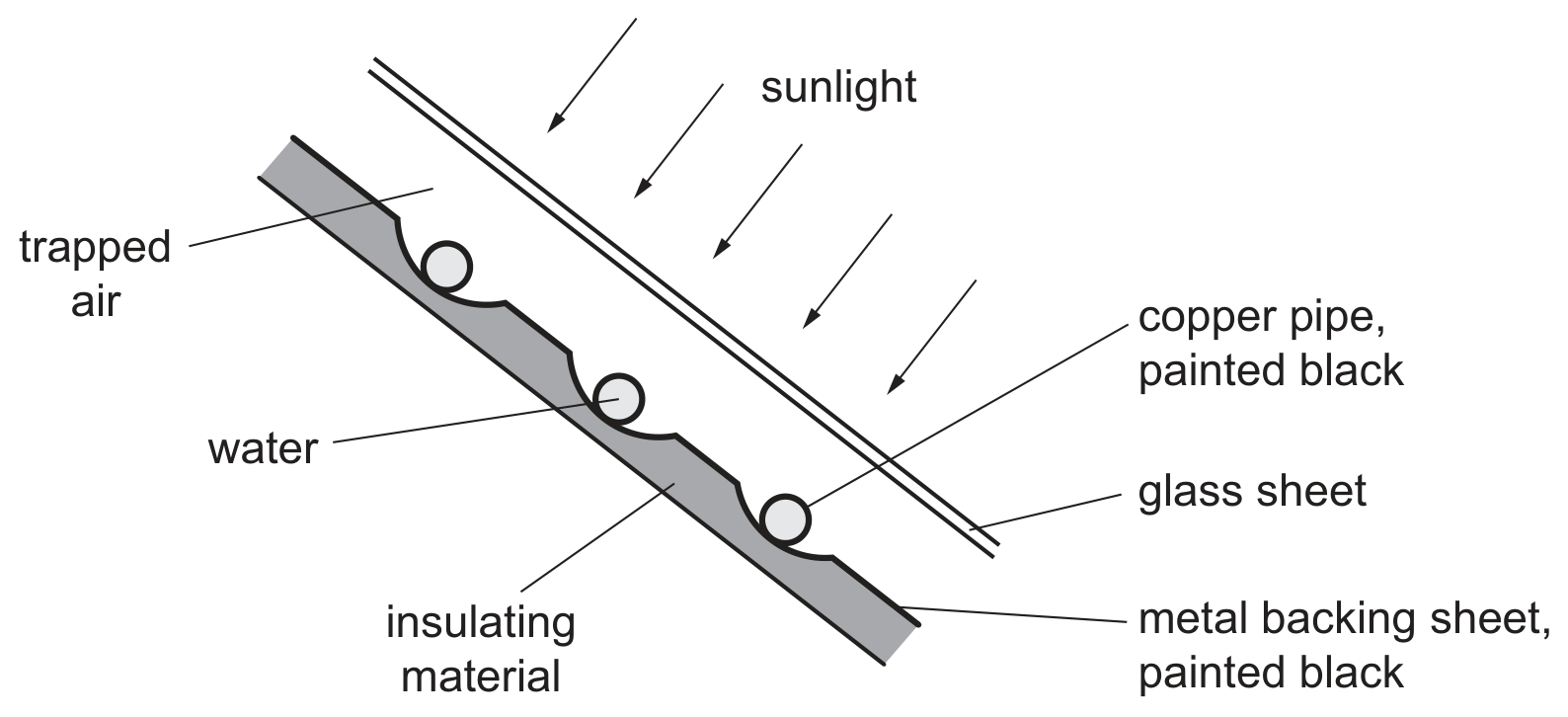
A solar panel is mounted on the roof of a house. Fig. 4.1 shows a section through part of the solar panel.

Fig. 4.1

Fig. 4.1

A pump makes water flow through the copper pipes. The water is heated by passing through the solar panel.

Question 4(b)

(a)

During one day, 250 kg of water is pumped through the solar panel. The temperature of this water rises from 16C16^{\circ} \mathrm{C} to 38C38^{\circ} \mathrm{C}.

The water absorbs 25% of the energy incident on the solar panel. The specific heat capacity of water is 4200 J/(kgC)4200 \mathrm{~J} /\left(\mathrm{kg}^{\circ} \mathrm{C}\right).

Calculate the energy incident on the solar panel during that day.
energy =

[ 4 ]

Question 4

[Maximum number: 4]

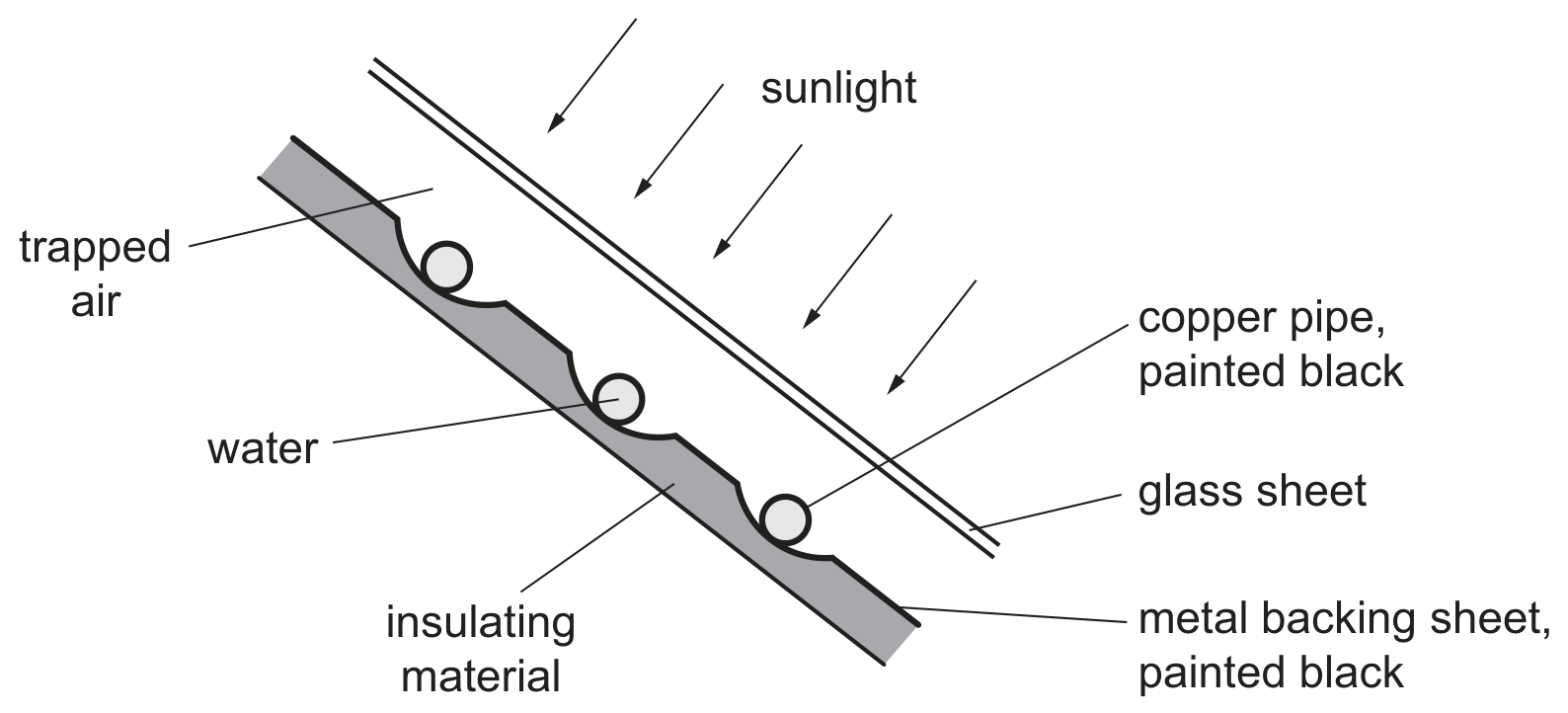
A solar panel is mounted on the roof of a house. Fig. 4.1 shows a section through part of the solar panel.

Fig. 4.1

Fig. 4.1

A pump makes water flow through the copper pipes. The water is heated by passing through the solar panel.

Question 4(b)

(a)

During one day, 250 kg of water is pumped through the solar panel. The temperature of this water rises from 16C16^{\circ} \mathrm{C} to 38C38^{\circ} \mathrm{C}.

The water absorbs 25% of the energy incident on the solar panel. The specific heat capacity of water is 4200 J/(kgC)4200 \mathrm{~J} /\left(\mathrm{kg}^{\circ} \mathrm{C}\right).

Calculate the energy incident on the solar panel during that day.
energy =

[ 4 ]

Question 14

[Maximum number: 1]

An aluminium block has a mass of 200 g .
The specific heat capacity of aluminium is 900 J/(kgC)900 \mathrm{~J} /\left(\mathrm{kg}^{\circ} \mathrm{C}\right).
How much energy is needed to increase the temperature of the block from 20C20^{\circ} \mathrm{C} to 110C110^{\circ} \mathrm{C} ?

A

2.0 J

B

2000J

C

16200J

D

16200000J

Question 14

[Maximum number: 1]

An aluminium block has a mass of 200 g .
The specific heat capacity of aluminium is 900 J/(kgC)900 \mathrm{~J} /\left(\mathrm{kg}^{\circ} \mathrm{C}\right).
How much energy is needed to increase the temperature of the block from 20C20^{\circ} \mathrm{C} to 110C110^{\circ} \mathrm{C} ?

A

2.0 J

B

2000J

C

16200J

D

16200000J

Question 4

[Maximum number: 4]

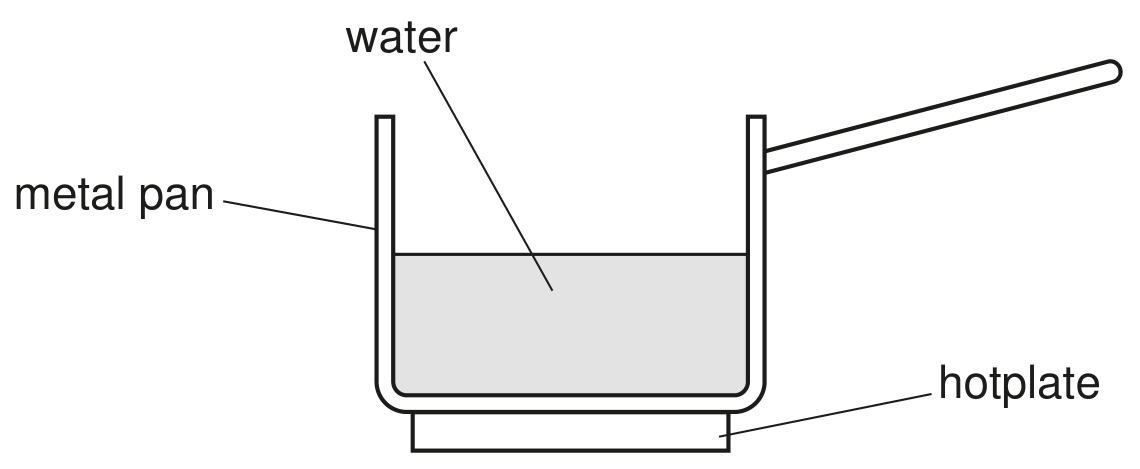
Fig. 4.1 shows a metal pan on an electric hotplate. The pan contains 200 cm3200 \mathrm{~cm}^{3} of water.

Fig. 4.1

Fig. 4.1

The pan is heated. The temperature of the water in the pan increases.

Question 4(c)

(a)

The water is replaced with 200 cm3200 \mathrm{~cm}^{3} of milk.

The initial temperature of the milk is 20.0C20.0^{\circ} \mathrm{C}. The boiling point of milk is 95.0C95.0^{\circ} \mathrm{C}.
The milk starts to boil when 60700 J of thermal energy has been transferred to it. The density of milk is 1.03 g/cm31.03 \mathrm{~g} / \mathrm{cm}^{3}.

Calculate the value of the specific heat capacity of milk. Give your answer to 3 significant figures.

[ 4 ]
0 selected