EduNinja

IGCSE Physics2.1.3 Gases and the absolute scale of temperatureQuestion Bank

Question 10

[Maximum number: 1]

Gas of volume 200 cm3200 \mathrm{~cm}^{3} is trapped inside a container by a piston.
The piston is pushed to the right and the volume of the gas decreases to 100 cm3100 \mathrm{~cm}^{3}.
The temperature of the gas remains constant.
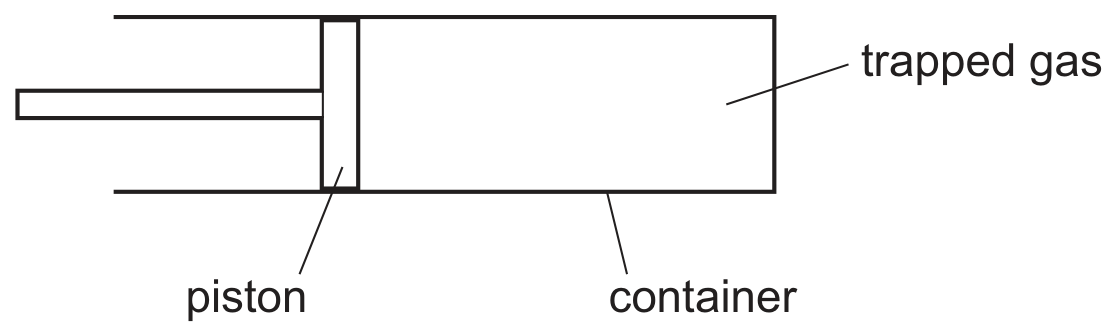
Question image

Which row states the effect that this has on the kinetic energy of the gas particles and the force per unit area exerted by the particles colliding with the inside walls of the container?

kinetic energy

force per unit area

doubles

doubles

doubles

stays the same

stays the same

doubles

stays the same

stays the same
Question 11

[Maximum number: 1]

Which graph shows the relationship between the pressure and volume of a fixed mass of gas at constant temperature?

Question 11

[Maximum number: 1]

Which graph shows how the volume of a fixed mass of gas at constant temperature varies with its pressure?

Question 11

[Maximum number: 1]

A fixed mass of air in a cylinder is compressed by a piston so that the volume of the air decreases at constant temperature.

How do the air particles now collide with the cylinder walls?

A

less often with a greater velocity

B

less often with the same velocity

C

more often with a greater velocity

D

more often with the same velocity

Question 11

[Maximum number: 1]

What is the relationship between temperatures in kelvin ( T ) and temperatures in degrees Celsius (θ)(\theta) ?

A

θ=T+273\theta=T+273

B

θ=T273\theta=T-273

C

θ=T+373\theta=T+373

D

θ=T373\theta=T-373

Question 3

Question 3(a)

(a)

A gas bubble is released at the bottom of a lake.
Atmospheric pressure is 1.0×10⁵ Pa1.0 \times 10^{5} \mathrm{~Pa}. The density of water is 1000 kg/m31000 \mathrm{~kg} / \mathrm{m}^{3}. The temperature of the water in the lake is constant.

[ 2 ]

Question 3(a)(i)

(i)

The gas bubble rises to the surface. The volume of the gas bubble increases as it rises higher in the water.

Explain why the volume of the bubble increases.

[ 2 ]

Question 3(a)(ii)

(ii)

The volume of the gas bubble is 0.40 cm30.40 \mathrm{~cm}^{3} when it is 3.0 m below the surface of the lake. Calculate the volume of the gas bubble when it is 0.50 m below the surface of the lake.
volume =

Question 3

[Maximum number: 3]

(a) A car has a weight of 13000 N . The car is supported by 4 tyres. The area of each tyre in contact with the road is 0.016 m20.016 \mathrm{~m}^{2}.

Question 3(b)

(a)

A gas cylinder contains helium gas at a pressure of 2.0×10⁶ Pa2.0 \times 10^{6} \mathrm{~Pa}. A volume of 0.026 m30.026 \mathrm{~m}^{3} of the compressed gas is released from the cylinder into balloons. Each balloon contains 0.015 m30.015 \mathrm{~m}^{3} of helium at atmospheric pressure ( 1.0×10⁵ Pa1.0 \times 10^{5} \mathrm{~Pa} ). The temperature remains constant.

Calculate the maximum number of balloons that can be filled.

[ 3 ]

Question 12

[Maximum number: 1]

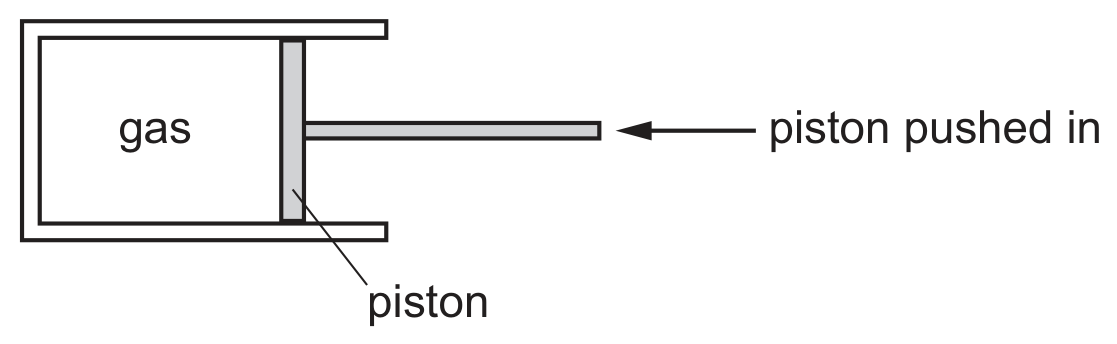
The diagram shows a quantity of gas trapped in a cylinder. The piston is pushed in slowly and the gas is compressed. The temperature of the gas does not change.

Question image

Which graph shows the relationship between the pressure and the volume of the gas?

Question 12

[Maximum number: 1]

The pressure of a fixed mass of gas in a cylinder is measured. The volume of the gas in the cylinder is slowly decreased. The temperature of the gas does not change.

Which graph shows how the pressure of the gas changes during this process?

Question 12

[Maximum number: 1]

A fixed mass of gas is trapped in a container. The temperature of the gas is increased but the volume of the gas is kept constant.

Question image

How does this change affect the average kinetic energy of the molecules and the pressure on the walls of the container?

average

kinetic energy

pressure

increases

increases

stays the same

increases

increases

decreases

decreases

increases

0 selected