Question 9
[Maximum number: 1]
In which process does a gas turn into a liquid?
A
boiling
B
condensing
C
freezing
D
melting
 EduNinja
In which process does a gas turn into a liquid?
boiling
condensing
freezing
melting
What are the correct terms for each change of state?
liquid to solid
liquid to gas
solidification
condensation
melting
condensation
solidification
evaporation
melting
evaporation
A man puts some ice into a glass of water on a warm day.
After a short time, he notices that the ice disappears and that water droplets appear on the outside of the glass.
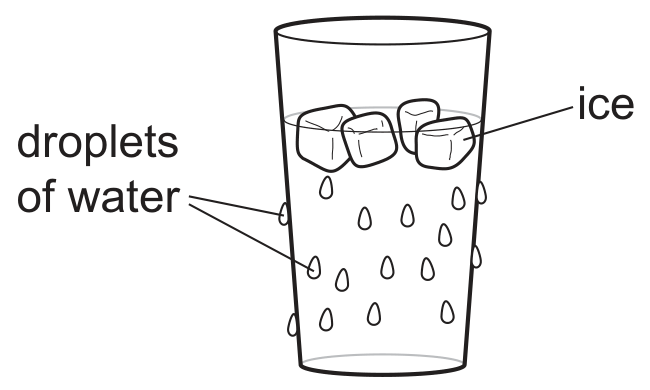
Which two changes of state are taking place?
condensation and freezing
condensation and melting
boiling and melting
freezing and evaporation
Which statement correctly describes a change of state?
A gas condenses to form a liquid.
A liquid melts to form a solid.
A solid condenses to form a liquid.
A solid boils to form a gas.
A substance can exist in three different states: solid, liquid or gas.
Each of the two statements below describes a change of state.
change 1: Particles move much closer together but continue to travel throughout the substance.
change 2: Particles stop travelling throughout the substance and just vibrate about fixed positions.
Which changes of state do these statements describe?
change 1
change 2
condensation
melting
condensation
solidification
solidification
condensation
solidification
melting
Fig. 4.1 shows a liquid-in-glass thermometer without a temperature scale. The liquid inside the thermometer has a melting point of .
A scientist is measuring temperatures at the South Pole. These temperatures have a minimum value of .
State why the liquid used in the thermometer in Fig. 4.1 would not be suitable for this scientist.
Give one example of a change of state which does not involve boiling or evaporation.