EduNinja

IGCSE Physics1.7.2 WorkQuestion Bank

Question 1

[Maximum number: 4]

A car accelerates uniformly in a straight line from rest at time t=0. At t=3.2 st=3.2 \mathrm{~s}, the speed of the car is 13.0 m/s13.0 \mathrm{~m} / \mathrm{s}.

Question 1(c)

(a)

The car decelerates from 13.0 m/s13.0 \mathrm{~m} / \mathrm{s} to 0 m/s0 \mathrm{~m} / \mathrm{s} at a constant deceleration. The mass of the car is 1350 kg . The car travels 13 m in 2.0 s as it decelerates.

Show that the work done by the car as it decelerates is approximately 1.1×10⁵ J1.1 \times 10^{5} \mathrm{~J}.

[ 4 ]

Question 2

[Maximum number: 2]

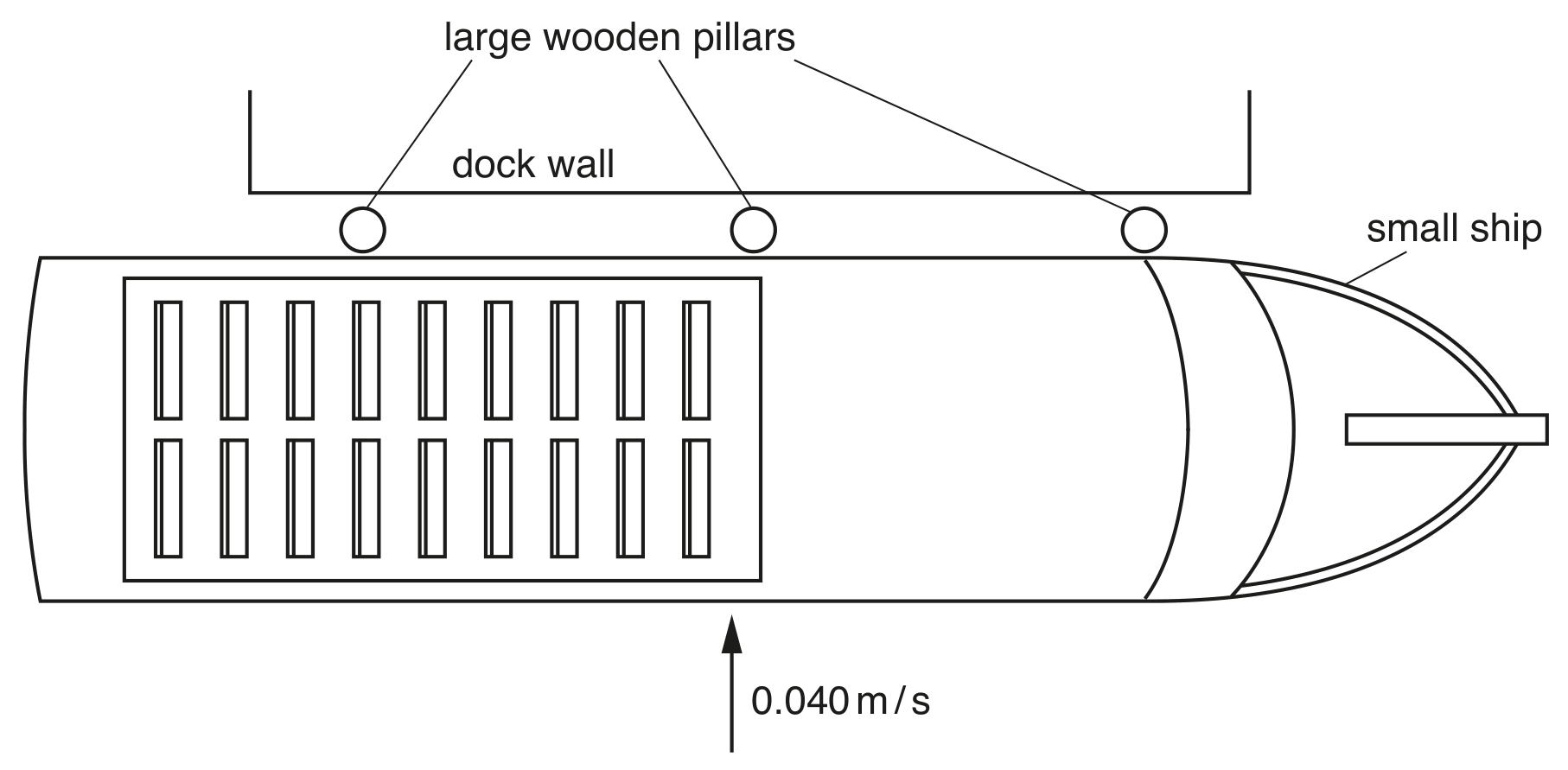
Fig. 2.1 is the top view of a small ship of mass 1.2×10⁶ kg1.2 \times 10^{6} \mathrm{~kg}. The ship is moving slowly sideways at 0.040 m/s0.040 \mathrm{~m} / \mathrm{s} as it comes in to dock.

Fig. 2.1

Fig. 2.1

The ship hits the wooden pillars which move towards the dock wall.

Question 2(c)

(a)

Assume that the kinetic energy calculated in (a) is used to do work moving the pillars. Calculate the distance moved by the pillars.
distance =

[ 2 ]

Question 2

[Maximum number: 3]

Fig. 2.1 shows a wooden trolley of mass 1.2 kg at rest on the rough surface of a bench.

Fig. 2.1

Fig. 2.1

A ball of mass 0.52 g travels horizontally towards the trolley. The ball embeds itself in the wood of the trolley. The trolley moves with an initial speed of 0.065 m/s0.065 \mathrm{~m} / \mathrm{s}.

Question 2(b)

(a)

As the trolley moves across the rough surface, it slows down and stops.

Explain, in terms of the work done, the energy change that takes place as the trolley slows down.

[ 3 ]

Question 9

[Maximum number: 1]

An object has kinetic energy of 200 J .
A constant resultant force of 190 N is applied in the direction of its motion through a distance of 10 m .

What is the final kinetic energy of the object?

A

390 J

B

1700J

C

2000J

D

2100J

Question 9

[Maximum number: 1]

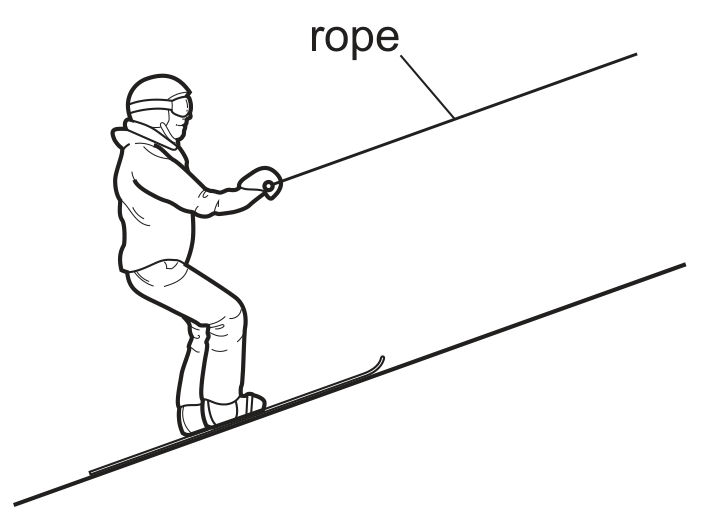
A skier is pulled up a short straight slope at constant speed by a rope.

Question image

The tension in the rope is 100 N and there is a combined frictional and air resistance force of 20 N acting on the skier.

The slope is 10 m long and the skier rises 1.5 m vertically.
How much work is done by the rope pulling the skier up the slope?

A

120 J

B

150J

C

1000J

D

1200J

Question 9

[Maximum number: 1]

A boy uses a rope to pull an object of mass m up a slope.
The rope is parallel to the slope.
The tension in the rope is constant and of value F.
The object moves a distance d along the slope and rises through a height h.
How much work is done by the boy?

A

F×dF \times d

B

F×hF \times h

C

m×g×h×dm \times g \times h \times d

D

m×g×h2m \times g \times h^{2}

Question 9

[Maximum number: 1]

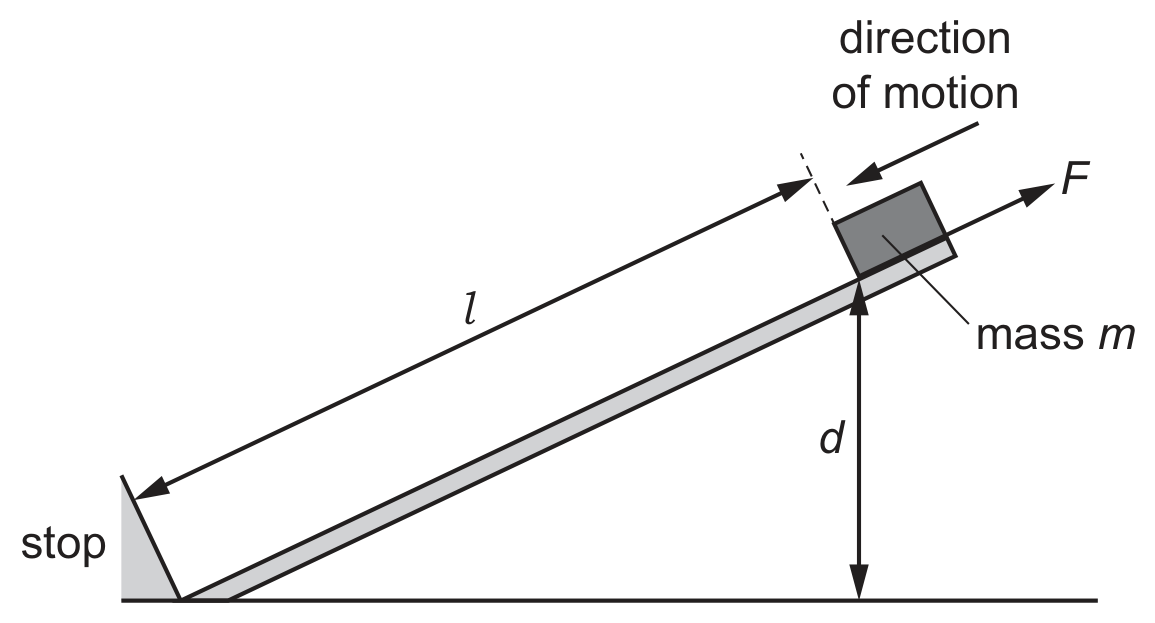
A box of mass m slides down a slope of length l against a frictional force F. It descends a vertical height d.

Question image

As the box slides down the slope, it loses gravitational potential energy and it does work against the friction.

Which row gives the loss in gravitational potential energy and the work done against friction?

loss in gravitational
potential energy

work done
against friction

m g d

Fl

m g d

Fd

mgl

Fl

mgl

F d

Question 9

[Maximum number: 1]

Which situation involves no work being done and no energy being transferred?

A

a car skidding to a stop on a road

B

a crane lifting a load

C

a heavy load hanging from a strong bar

D

a student dragging a big box over a rough floor

Question 9

[Maximum number: 1]

The diagrams show four bodies moving in the directions shown. The only forces acting on the bodies are shown in each diagram.

Which body gains the most kinetic energy when moving a distance of 1.0 m ?

Question 10

[Maximum number: 1]

In some situations, a force does work.
Which set of conditions increases the quantity of work done by the force?

magnitude

of force

distance moved

by the force

decreases

decreases

decreases

stays the same

increases

increases

stays the same

decreases

0 selected