EduNinja

IGCSE Physics1.7.1 EnergyQuestion Bank

Question 1

[Maximum number: 2]

A girl holds a rubber ball out of a window of a tall building. The mass of the ball is 0.20 kg . The ball is at rest 10 m above a concrete path.

Question 1(a)

(a)

Calculate the gravitational potential energy of the ball relative to the concrete path.

gravitational potential energy =
[ 2 ]

Question 1(b)

(b)

The girl releases the ball and it falls towards the path. The ball strikes the path and bounces vertically upwards.

Fig. 1.1 shows the ball falling towards the path.
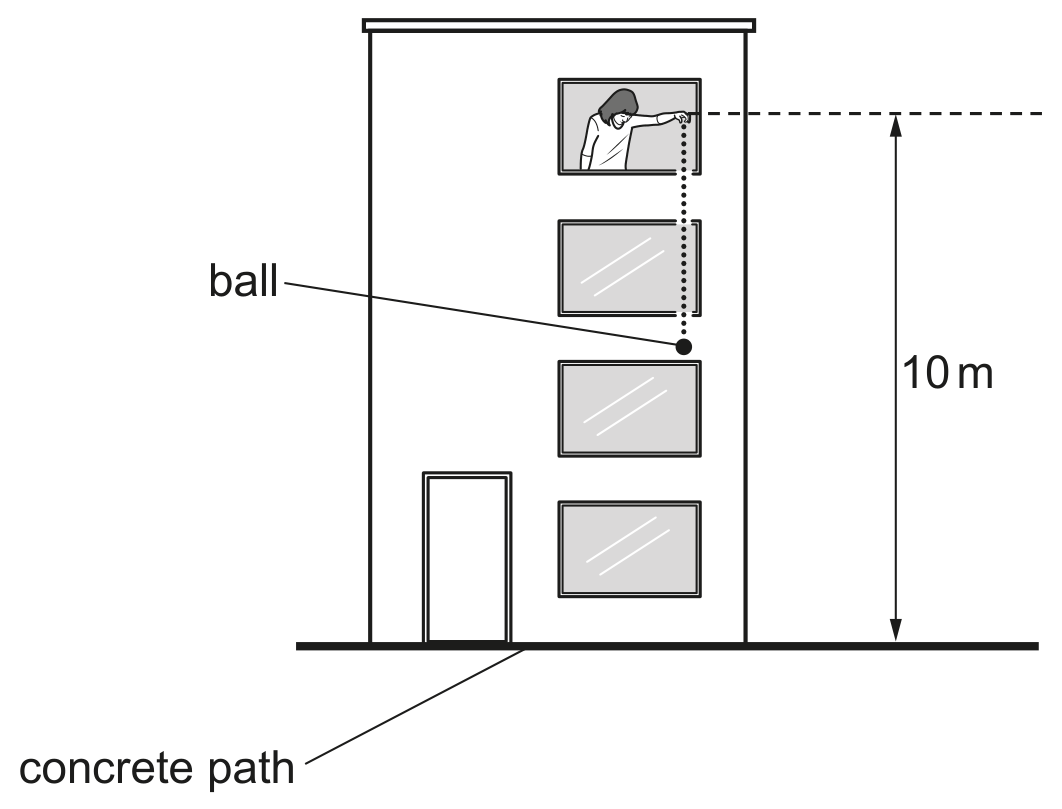
Fig. 1.1

Fig. 1.1

The speed of the ball immediately before it strikes the path is 14 m/s14 \mathrm{~m} / \mathrm{s}.
The speed of the ball immediately after it strikes the path is 12 m/s12 \mathrm{~m} / \mathrm{s}.

Question 1(b)(i)

(i)

Calculate the kinetic energy of the ball immediately after it strikes the concrete path.

kinetic energy =
Question 1

[Maximum number: 3]

A battery provides energy to an electric car.

Question 1(a)

(a)

The electric car has an acceleration of 2.9 m/s22.9 \mathrm{~m} / \mathrm{s}^{2} when it moves from rest. The combined mass of the car and its driver is 1600 kg .

[ 2 ]

Question 1(a)(iii)

(i)

Calculate the kinetic energy of the car when its speed is 28 m/s28 \mathrm{~m} / \mathrm{s}.

kinetic energy =
[ 2 ]

Question 1(c)

(b)

Under ideal conditions, the car can travel a maximum distance of 390 km when the battery is fully charged.

Suggest why, in normal use, the car needs to be recharged after travelling less than 390 km .

[ 1 ]

Question 1

Question 1(a)

Question 1(a)(ii)

(a)
(i)

State the form of energy stored by the battery.

[ 1 ]

Question 1

[Maximum number: 5]

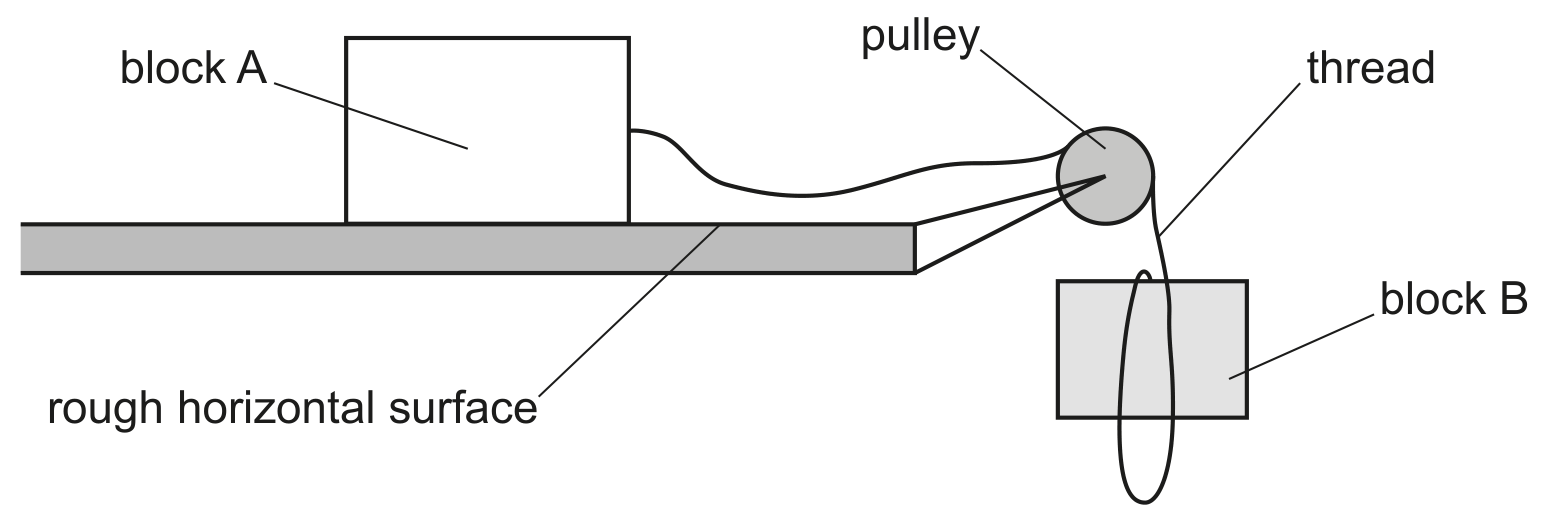
Two blocks, A and B, are joined by a thin thread that passes over a frictionless pulley. Block A is at rest on a rough horizontal surface and block B is held at rest, just below the pulley.

Fig. 1.1 shows the thread hanging loose.

Fig. 1.1 (not to scale)

Fig. 1.1 (not to scale)

Block B is released and it falls vertically. The thread remains loose until block B has fallen a distance of 0.45 m .

The mass of block B is 0.50 kg .

Question 1(a)

(a)

Calculate the change in the gravitational potential energy (g.p.e.) of block B as it falls through 0.45 m .
change in g.p.e.

[ 2 ]

Question 1(b)

(b)

The mass of block A is 2.0 kg.

When the thread tightens, it pulls on block A which moves to the right at a speed of 0.60 m/s0.60 \mathrm{~m} / \mathrm{s}.

[ 3 ]

Question 1(b)(ii)

(i)

Both of the blocks now move at a constant speed of 0.60 m/s0.60 \mathrm{~m} / \mathrm{s} until block B hits the ground and the thread becomes loose.

Explain the energy change that takes place in block A after block B stops moving.
[Total: 8]

[ 3 ]

Question 1

Question 1(a)

(a)

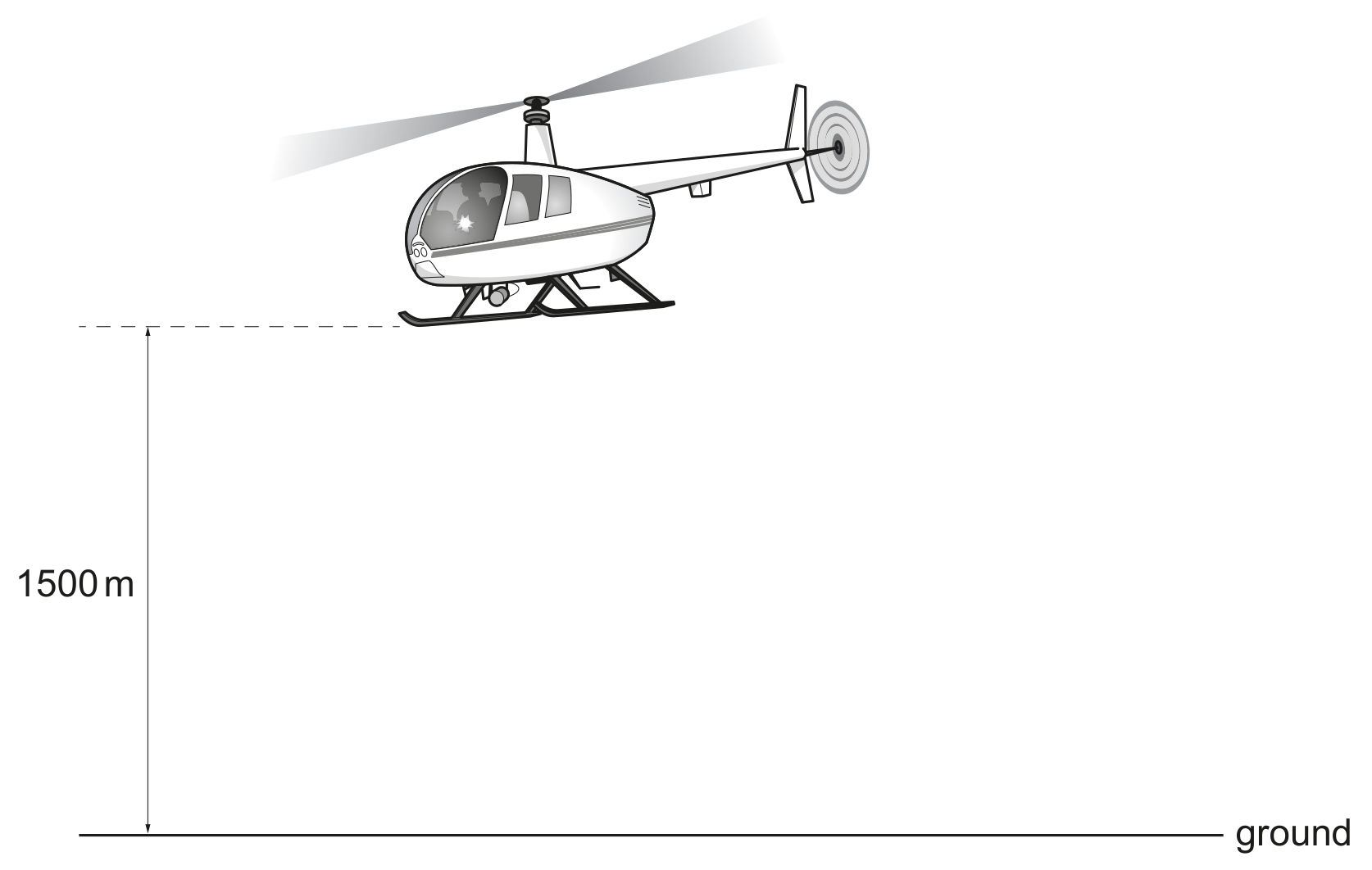
Fig. 1.1 shows a helicopter which is stationary at a height of 1500 m above the ground.

Fig. 1.1 (not to scale)

Fig. 1.1 (not to scale)

[ 2 ]

Question 1(a)(ii)

(i)

The mass of the helicopter is 3200 kg .

Calculate the change in the gravitational potential energy of the helicopter as it rises from the ground to 1500 m .
change in gravitational potential energy =

[ 2 ]

Question 1

Question 1(b)

(a)

Another bus travels at a speed of 8.9 m/s8.9 \mathrm{~m} / \mathrm{s}. The brakes apply a constant force and the bus stops in a distance of 23 m . This bus has a mass of 18000 kg .

[ 2 ]

Question 1(b)(i)

(i)

Calculate the kinetic energy of the bus before the brakes are applied.

kinetic energy =
[ 2 ]

Question 1

[Maximum number: 3]

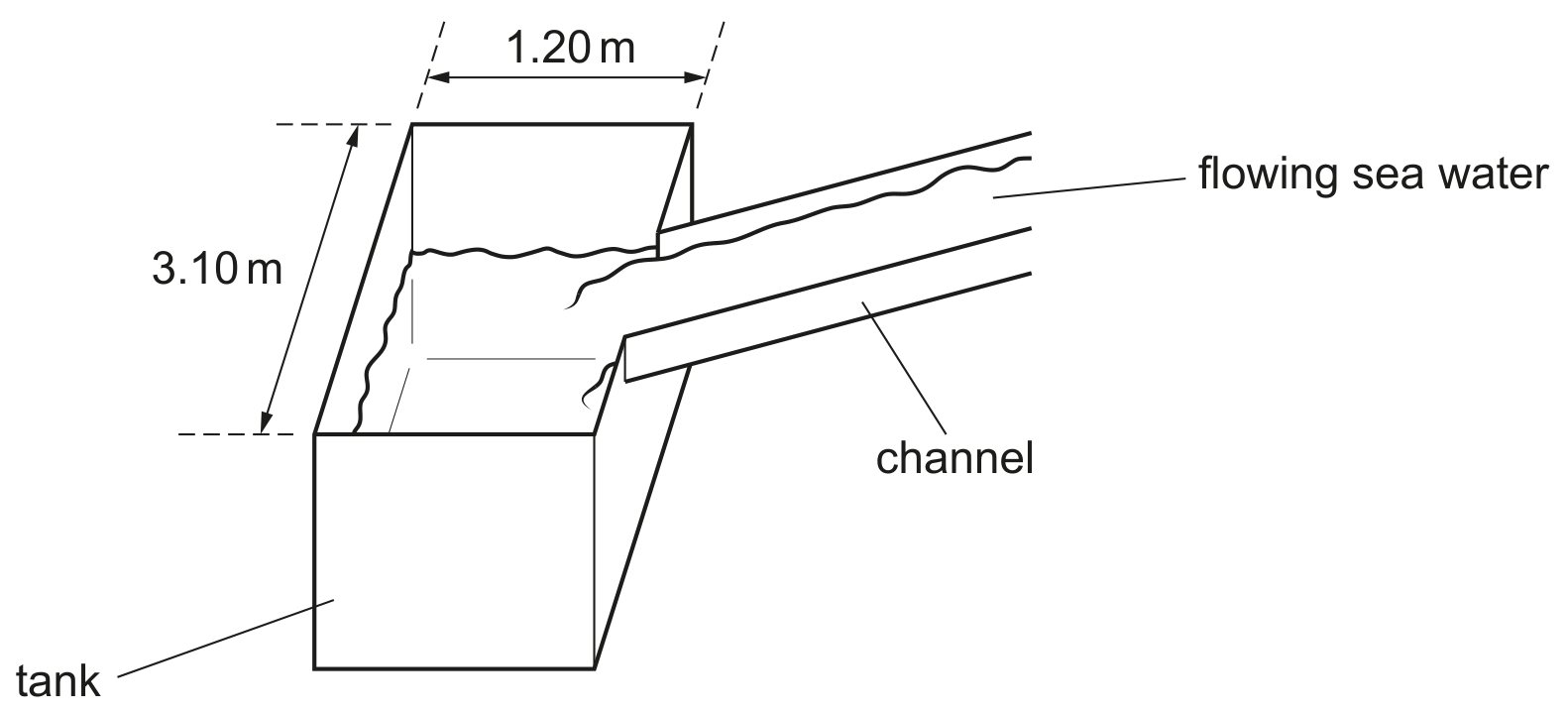
Fig. 1.1 shows sea water flowing down a channel into a tank without splashing. The water is flowing at a rate of 800 kg/min800 \mathrm{~kg} / \mathrm{min}. The length and width of the tank are 3.10 m and 1.20 m . The density of the sea water is 1020 kg/m31020 \mathrm{~kg} / \mathrm{m}^{3}.

Fig. 1.1 (not to scale)

Fig. 1.1 (not to scale)

Question 1(b)

(a)

The height of the water decreases by 0.420 m as it flows down the channel.

Calculate the decrease in gravitational potential energy of the water each second.

decrease in gravitational potential energy =
[ 3 ]

Question 1

[Maximum number: 3]

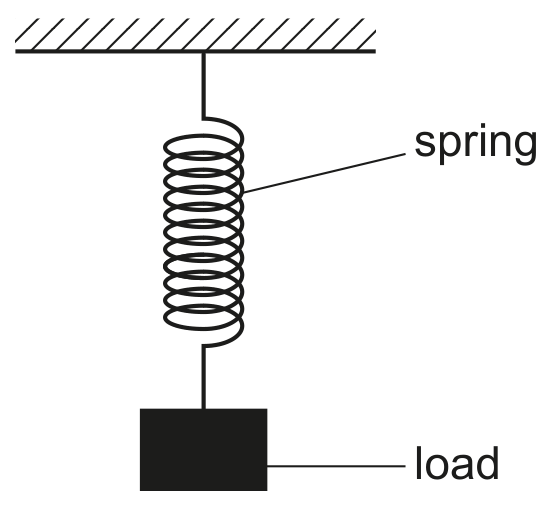
Fig. 1.1 shows a load suspended from a spring.

Fig. 1.1

Fig. 1.1

The value of the spring constant k of the spring is 0.20 N/cm0.20 \mathrm{~N} / \mathrm{cm}. The spring reaches its limit of proportionality when the load is 15 N.

Question 1(d)

(a)

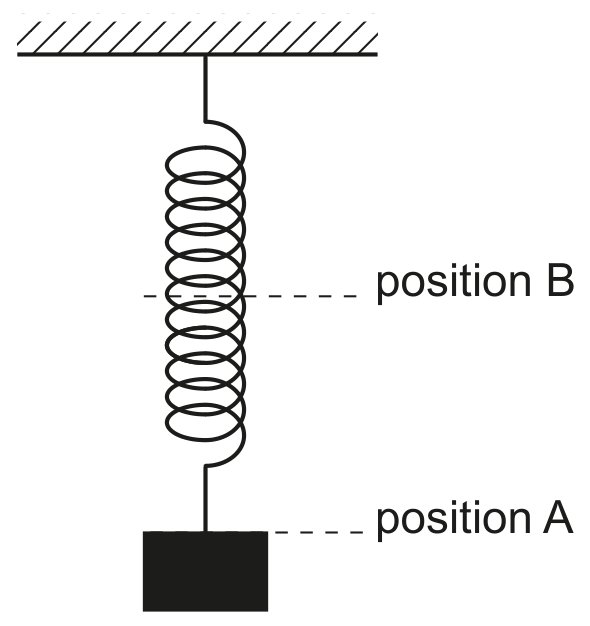
The load is pulled down a small distance below its equilibrium position to position A, as shown in Fig. 1.3. The load then moves up and down between position A and position B in Fig. 1.3.

Fig. 1.3

Fig. 1.3

Describe the energy transfers which occur as the load moves: from position A to the equilibrium position
from the equilibrium position to position B.

[ 3 ]

Question 1

[Maximum number: 1]

An aeroplane of mass 2.5×10⁵ kg2.5 \times 10^{5} \mathrm{~kg} lands with a speed of 62 m/s62 \mathrm{~m} / \mathrm{s}, on a horizontal runway at time t=0. The aeroplane decelerates uniformly as it travels along the runway in a straight line until it reaches a speed of 6.0 m/s6.0 \mathrm{~m} / \mathrm{s} at t=35 st=35 \mathrm{~s}.

Question 1(c)

(a)

As the aeroplane decelerates, its kinetic energy decreases.

Suggest what happens to this energy.
[Total: 10]

[ 1 ]

Question 3

[Maximum number: 1]

A ball is falling towards the ground.
Which transfer between energy stores is taking place?

A

elastic energy to kinetic energy

B

gravitational potential energy to elastic energy

C

gravitational potential energy to kinetic energy

D

kinetic energy to gravitational potential energy

0 selected