
Question 1
Question 1(a)
(a)
A straight line passes through the points (4,23) and (-8,29). Find the point of intersection, P, of this line with the line y=2x+5.
[ 5 ]
Question 1(b)
(b)
Find the distance of P from the origin.
[ 2 ]
 EduNinja
Practise straight-line and circle geometry, radians, sector measures and trigonometric graphs, identities and equations across coordinate and diagram-based problems.
A straight line passes through the points (4,23) and (-8,29). Find the point of intersection, P, of this line with the line y=2x+5.
Find the distance of P from the origin.
Write down the amplitude and period of .
Amplitude =
Period =
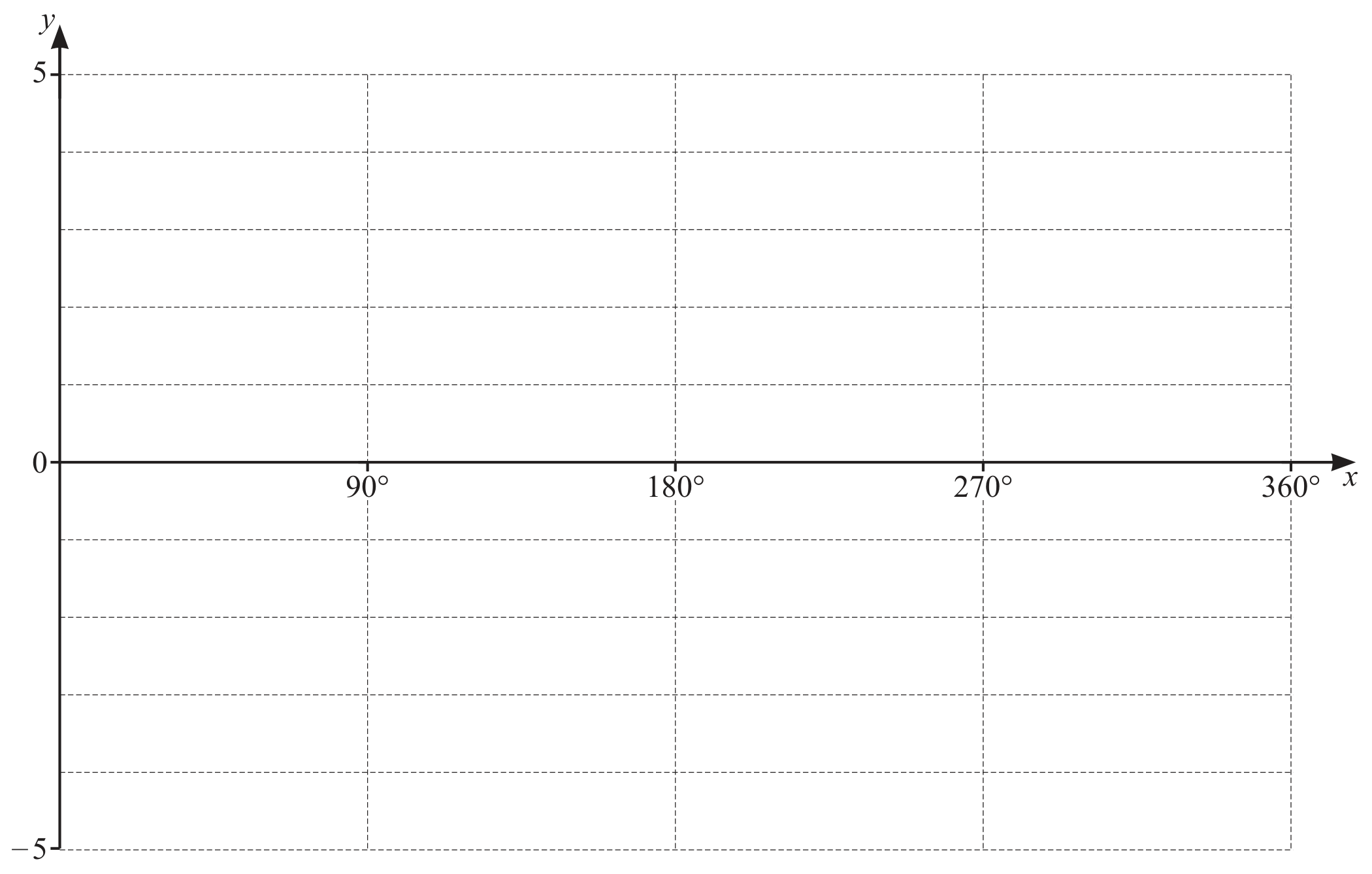
Sketch the graph of for .
A circle with centre C has the equation .
Show that the line y=2 x-3 is a tangent to this circle.
Given that this tangent touches the circle at the point P, find the coordinates of P.
Find the equation of the circle which has its centre at P and passes through the origin.
Point A has coordinates (3,-1).
A circle has equation .
Show that A lies on the circumference of the circle.
Given that AB is a diameter of the circle, find the coordinates of B.
Find the equation of the tangent to the circle at A.
4 The coordinates of points A, B, C and D are as follows.
The line L has equation y=11 x-75 .
The perpendicular bisector of the line A B meets L at the point E .
Find the area of triangle C D E .
In this question, all angles are in radians.
Write down the period of .
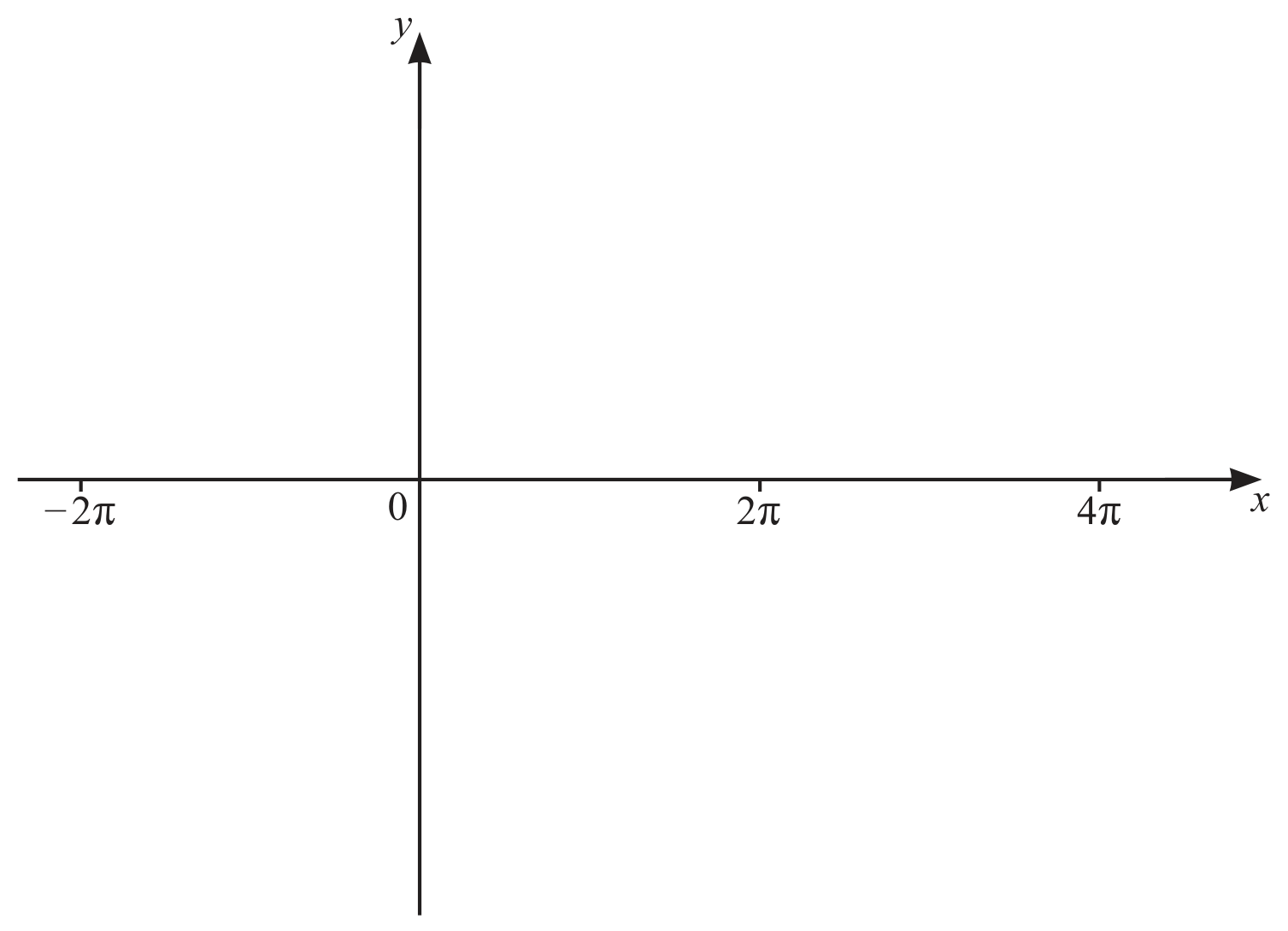
On the axes, sketch the graph of for .
State the intercept with the y-axis.
Show clearly the positions of any asymptotes.
Solutions to this question by accurate drawing will not be accepted.
A circle has centre (4,2) and meets the x-axis at (-2,0).
Find the equation of the circle.
Find, in exact form, the coordinates of the points where the circle meets the y-axis.
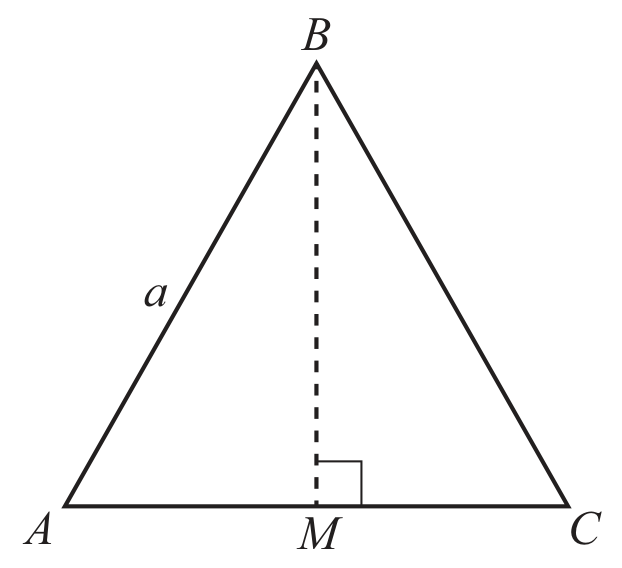
The diagram shows an equilateral triangle ABC with side a.
M is the midpoint of AC and angle .
Use the diagram to find .
Show that can be written as .
The coordinates of points A and B are (-5,6) and (4,-6) respectively. The point C lies on the line AB, between A and B, such that .
The line CD is perpendicular to AB. Find the equation of CD in the form y=mx+c.
The length of BD is . Find the coordinates of the two possible positions of point D.
In this question the units are metres.
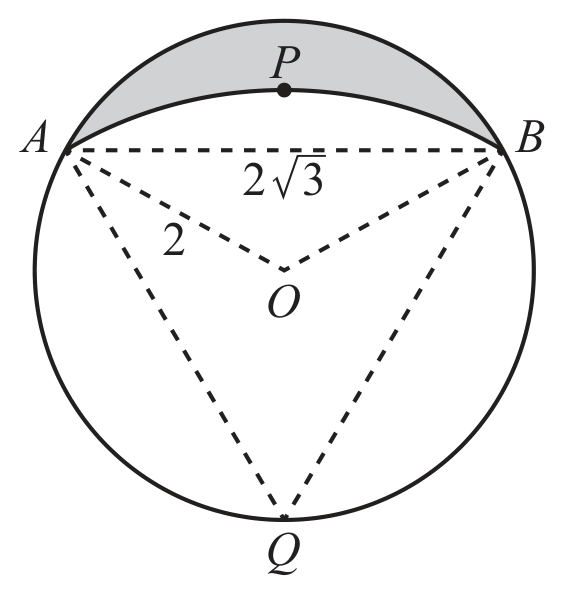
The diagram shows a circle, centre O and radius 2.
The chord AB has length .
The point Q lies on the circle such that AQ=BQ.
The arc APB is part of a circle, centre Q.
Find the exact value of angle AQB in radians.
Hence find the area of the shaded region. Give your answer in terms of .