

EduNinja

CAIE IGCSE Additional Mathematics Combinatorics, Series and Vectors Question Bank

CAIE IGCSE Additional Mathematics Combinatorics, Series and Vectors Question Bank
Cambridge IGCSE Additional Mathematics 0606 syllabus for exams in 2028, 2029 and 2030Exams 2028-2030

Practise counting arrangements and selections, binomial expansions, arithmetic and geometric series, and vector methods for geometry, motion and collision problems.

Question 3

Question 3(a)

(a)

3 men and 3 women are standing in a line.
The 3 men are standing next to each other.
Find how many different arrangements are possible.

[ 2 ]

Question 3(b)

(b)

In the 13-letter word MULTIBRANCHED, there are 4 vowels, U, I, A and E.

7 different letters are selected from these 13 letters.
Find how many different selections are possible if the selection includes at least 2 vowels.

[ 3 ]
Question 3

Question 3(a)

(a)
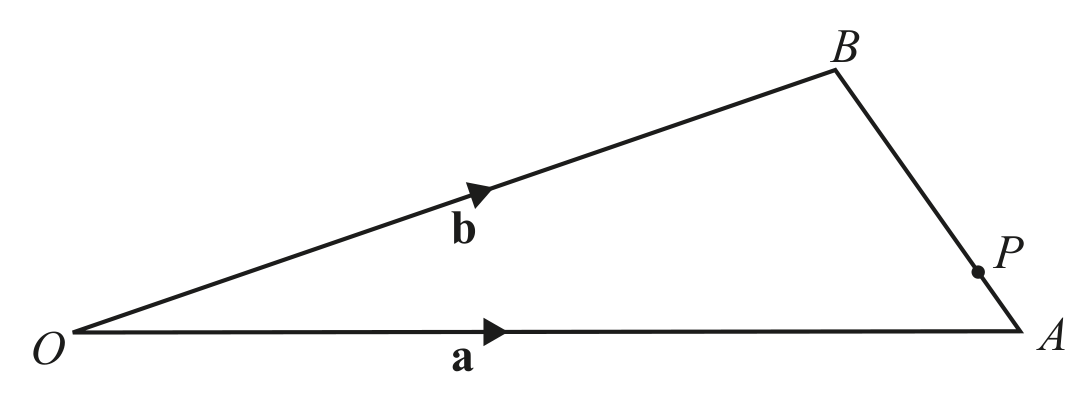
Figure for Question 3(a) — CAIE IGCSE Additional Math

The diagram shows a triangle OAB. The point P lies on AB. The ratio A P: P B is 1: 3.
Given that OA=a\overrightarrow{O A}=\mathbf{a} and OB=b\overrightarrow{O B}=\mathbf{b}, find an expression for OP\overrightarrow{O P} in terms of a and b. Simplify your answer.

[ 2 ]

Question 3(b)

(b)

Vector q has magnitude 12512 \sqrt{5} and direction (63)\binom{6}{-3}.

Vector r has magnitude 15215 \sqrt{2} and direction (55)\binom{-5}{5}.
Find the unit vector in the direction of q+r.

Question 3

[Maximum number: 6]

Find the exact value of the term independent of x in the expansion of (2+3x2)10(14x2)2\left(2+\frac{3}{x^{2}}\right)^{10}\left(1-4 x^{2}\right)^{2}.

Question 7

[Maximum number: 7]

The point O is the origin.
Two points P and Q are such that PQ\overrightarrow{PQ} is in the same direction as i+5j-\mathbf{i}+5\mathbf{j}.

Question 7(a)

(a)

The point R is such that OR\overrightarrow{OR} is in the same direction as PQ\overrightarrow{PQ} and the magnitude of OR\overrightarrow{OR} is 3263\sqrt{26}.
Find OR\overrightarrow{OR}.

[ 3 ]

Question 7(b)

(b)

OP\overrightarrow{OP} is in the same direction as 2i3j2\mathbf{i}-3\mathbf{j} and OQ=10i+6j\overrightarrow{OQ}=10\mathbf{i}+6\mathbf{j}.
Find OP\overrightarrow{OP}.

[ 4 ]

Question 5

Question 5(a)

(a)

In an arithmetic progression:
- the first term is 3
- the sum of the first 10 terms is 4 times the sum of the first 5 terms.

Find the common difference.

[ 3 ]

Question 5(b)

(b)

The 1st, 2nd and 5th terms of another arithmetic progression are the 1st, 2nd and 3rd terms of a geometric progression.

It is given that the 1st terms of the progressions are not 0.
Find the common ratio, r, where r1r \neq 1, of the geometric progression.

[ 4 ]

Question 6

[Maximum number: 8]

In this question lengths are in centimetres and time, t, is in seconds.
A particle P is moving in a straight line with a speed of 26 in the direction of the vector (512)\binom{5}{-12}.

Question 6(a)

(a)

Find the velocity vector of P.

When t=0, P passes through a point A which has position vector (36)\binom{3}{6}.

[ 2 ]

Question 6(b)

(b)

Write down the position vector of P at time t.

At the same time that P passes through A, a particle Q passes through a point B.
The position vector of Q at time t is given by (8t5225t)\binom{8 t-5}{2-25 t}.
The distance between P and Q at time t is d.

[ 2 ]

Question 6(c)

(c)

Show that d2=mt2+nt+rd^{2}=m t^{2}+n t+r, where m, n and r are integers to be found.

[ 3 ]

Question 6(d)

(d)

Hence show that P and Q do not collide.

[ 1 ]

Question 10

Question 10(a)

(a)

An arithmetic progression has first term a and common difference d.
Given that S20=3×S10S_{20}=3\times S_{10}, find a in terms of d.

[ 3 ]

Question 10(b)

(b)

A geometric progression, A, has common ratio r, where |r|<1.
The terms of this progression are a1,a2,a3,a_1, a_2, a_3, \ldots.
Another geometric progression, B, has terms b1,b2,b3,b_1, b_2, b_3, \ldots, where
b1=a2,b2=a4,b3=a6,b_1=a_2,\quad b_2=a_4,\quad b_3=a_6,\ldots
The sum to infinity of A is SAS_A and the sum to infinity of B is SBS_B.
Find SBSA\frac{S_B}{S_A} in terms of r.
Give your answer in its simplest form.

[ 5 ]

Question 11(a)

[Maximum number: 4]

The number of permutations of n items taken 4 at a time is equal to 16×\frac{1}{6} \times the number of permutations of 2 n items taken 3 at a time.

Show that n satisfies the equation 3n219n+20=03 n^{2}-19 n+20=0.

Question 10

[Maximum number: 5]

In this question a, b and n are constants.
When 5(2+ax)n5(2+a x)^{n} is written in ascending powers of x, the first three terms are 640+b2x+30240x2640+b^{2} x+30240 x^{2}. Find the value of a and the possible values of b.