EduNinja

IB Chemistry HL3.1 Proton transfer reactionsQuestion Bank

Question 1

[Maximum number: 5]

A student decided to determine the molecular mass of a solid monoprotic acid, HA, by titrating a solution of a known mass of the acid.

The following recordings were made.

Table

Question 1(e)

(a)

A solution of HA is a weak acid. Distinguish between a weak acid and a strong acid.

[ 1 ]

Question 1(f)

(b)

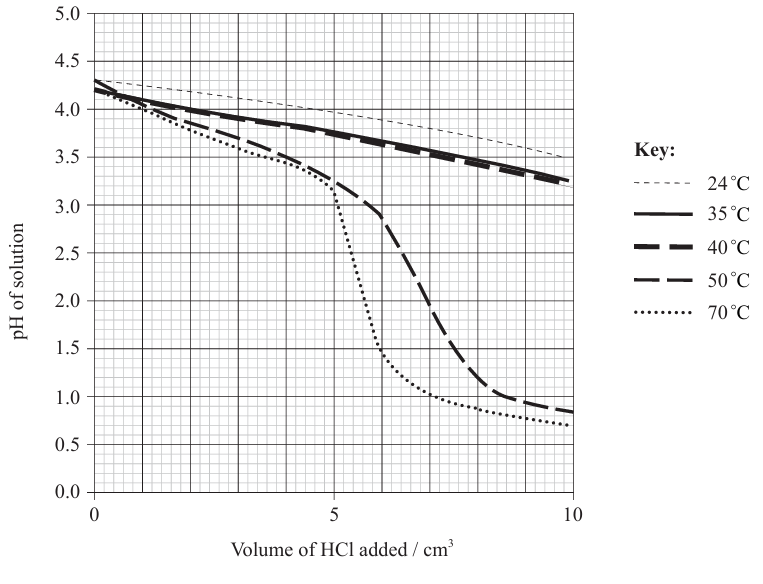
To investigate the effect of temperature on the effectiveness of a buffer solution, the student placed 20.0 cm320.0 \mathrm{~cm}^{3} of the buffer solution in a water bath at 24C24^{\circ} \mathrm{C}. He added small portions of hydrochloric acid, stirring after each addition, until a total of 10 cm310 \mathrm{~cm}^{3} was added, and measured the pH continuously during the addition. The procedure was repeated at different temperatures and the results are shown in the following graph.
Question image
[ 4 ]

Question 1(f)(i)

(i)

State what is meant by a buffer solution.

[ 2 ]

Question 1(f)(ii)

(ii)

With reference to the graph on page 4, describe the effect of increasing temperature on the effectiveness of the buffer solution.
[ 2 ]

Question 1

[Maximum number: 3]

Chlorine undergoes many reactions.

Question 1(c)

(a)

Chlorine gas reacts with water to produce hypochlorous acid and hydrochloric acid.

Cl2( g)+H2O(l)HClO(aq)+HCl(aq)\mathrm{Cl}_{2}(\mathrm{~g})+\mathrm{H}_{2} \mathrm{O}(\mathrm{l}) \rightleftharpoons \mathrm{HClO}(\mathrm{aq})+\mathrm{HCl}(\mathrm{aq})
[ 3 ]

Question 1(c)(i)

(i)

Hypochlorous acid is considered a weak acid. Outline what is meant by the term weak acid.

[ 1 ]

Question 1(c)(ii)

(ii)

State the formula of the conjugate base of hypochlorous acid.

[ 1 ]

Question 1(c)(iii)

(iii)

Calculate the concentration of H+(aq)\mathrm{H}^{+}(\mathrm{aq}) in a HClO(aq) solution with a pH=3.61.

[ 1 ]

Question 1

[Maximum number: 4]

A powder has the following percentage composition by mass:
30.0 % sucrose, C12H22O11\mathrm{C}_{12} \mathrm{H}_{22} \mathrm{O}_{11}
45.0 % citric acid, C6H8O7\mathrm{C}_{6} \mathrm{H}_{8} \mathrm{O}_{7}
25.0 \% sodium hydrogencarbonate, NaHCO3\mathrm{NaHCO}_{3}

In the presence of water, the powder effervesces as the citric acid reacts with the sodium hydrogencarbonate:

3NaHCO3( s)+C6H8O7(aq)Na3(C6H5O7)(aq)+3CO2( g)+3H2O(l)3 \mathrm{NaHCO}_{3}(\mathrm{~s})+\mathrm{C}_{6} \mathrm{H}_{8} \mathrm{O}_{7}(\mathrm{aq}) \rightarrow \mathrm{Na}_{3}\left(\mathrm{C}_{6} \mathrm{H}_{5} \mathrm{O}_{7}\right)(\mathrm{aq})+3 \mathrm{CO}_{2}(\mathrm{~g})+3 \mathrm{H}_{2} \mathrm{O}(\mathrm{l})

Question 1(b)

Question 1(b)(ii)

(a)
(i)

Deduce the structural formula of the conjugate base of citric acid.

[ 1 ]

Question 1(b)(iii)

(ii)

Predict, giving a reason, the strength of citric acid.

[ 1 ]

Question 1(b)(iv)

(iii)

Explain why sodium citrate solutions are basic.

[ 1 ]

Question 1(c)

(b)

Calculate the pH of a solution with a hydrogen ion concentration,
[H+]=0.0025 moldm3\left[\mathrm{H}^{+}\right]=0.0025 \mathrm{~mol} \mathrm{dm}^{-3}

[ 1 ]

Question 1

[Maximum number: 6]

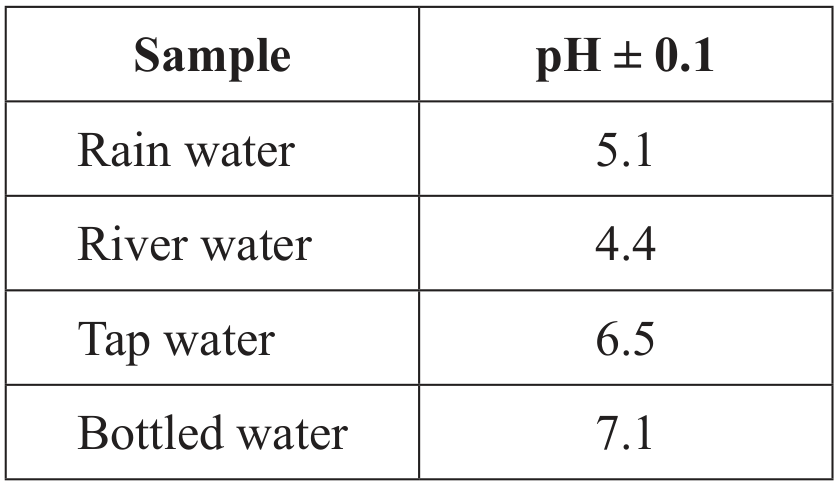
A student used a pH meter to measure the pH of different samples of water at 298 K .

Table

Question 1(a)

(a)

Use the data in the table to identify the most acidic water sample.

[ 1 ]

Question 1(c)

(b)

Determine the ratio of [H+]\left[\mathrm{H}^{+}\right]in bottled water to that in rain water.

[ 2 ]

Question 1(d)

(c)

Determine the concentration of hydroxide ions in the sample of river water.

[ 2 ]

Question 1(e)

(d)

The acidity of non-polluted rain water is caused by dissolved carbon dioxide. State an equation for the reaction of carbon dioxide with water.

[ 1 ]

Question 1

[Maximum number: 2]

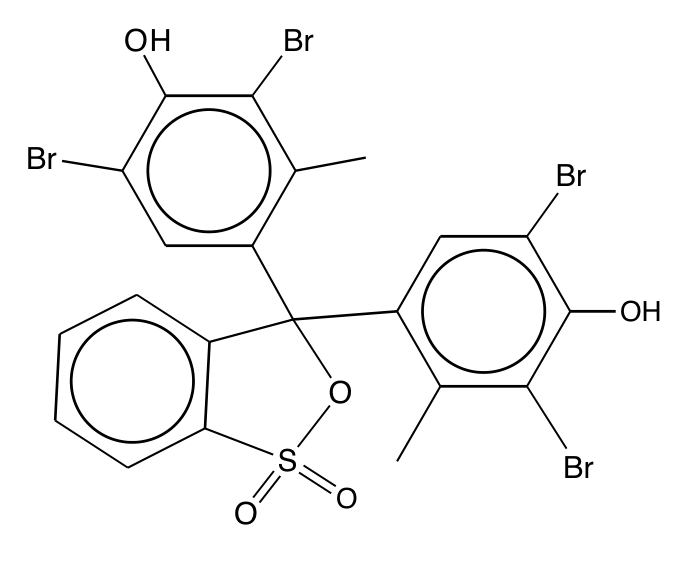
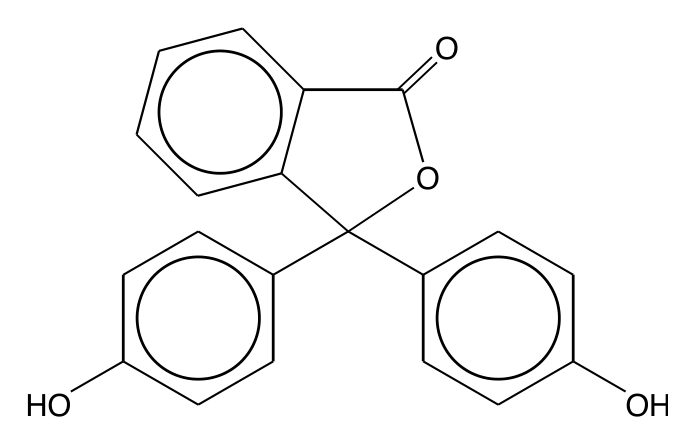
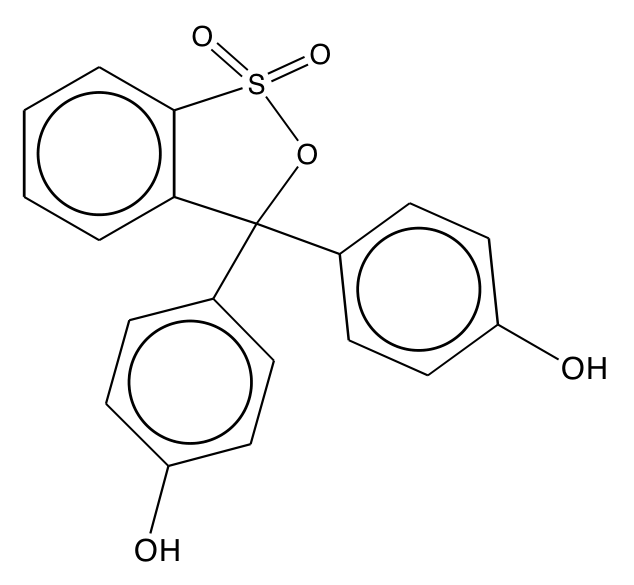
Phenol red, bromocresol green and phenolphthalein are acid-base indicators.

Phenol red

Phenol red

Bromoscresol green

Bromoscresol green

Phenolphthalein

Phenolphthalein

Question 1(d)

(a)

Explain how the indicator HInd, that is a weak acid, shows changes in pH using an equation.

[ 2 ]

Question 1

[Maximum number: 2]

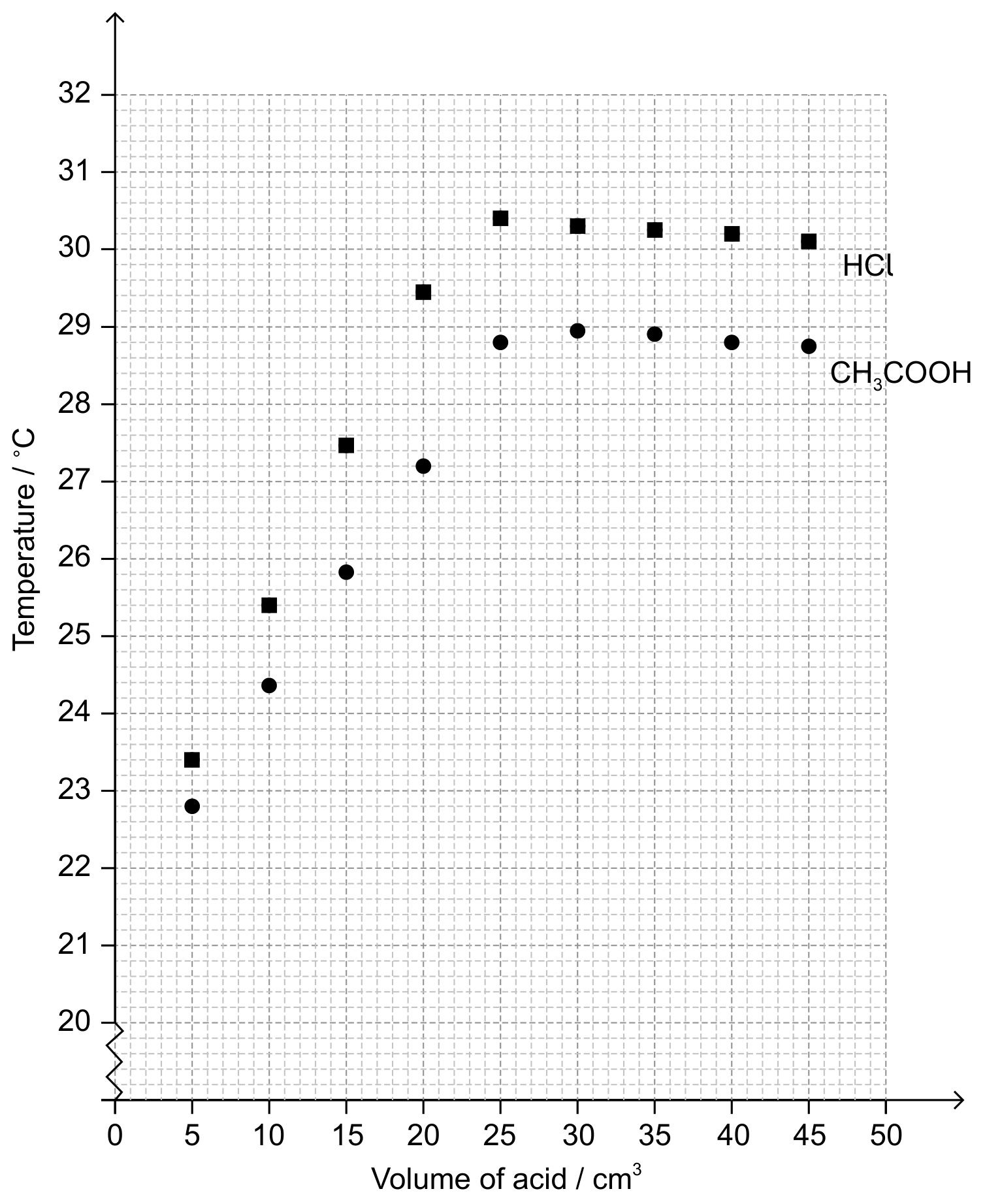
A student titrated two acids, hydrochloric acid, HCl(aq) and ethanoic acid, CH3COOH(aq)\mathrm{CH}_{3} \mathrm{COOH}(\mathrm{aq}), against 50.0 cm350.0 \mathrm{~cm}^{3} of 0.995 moldm30.995 \mathrm{~mol} \mathrm{dm}^{-3} sodium hydroxide, NaOH(aq), to determine their concentration. The temperature of the reaction mixture was measured after each acid addition and plotted against the volume of each acid.

Question image

Question 1(e)

(a)

Suggest why the enthalpy change of neutralization of CH3COOH\mathrm{CH}_{3} \mathrm{COOH} is less negative than that of HCl .

[ 2 ]

Question 1

[Maximum number: 1]

A student determined the percentage of the active ingredient magnesium hydroxide, Mg(OH)2\mathrm{Mg}(\mathrm{OH})_{2}, in a 1.24 g antacid tablet.

The antacid tablet was added to 50.00 cm350.00 \mathrm{~cm}^{3} of 0.100 moldm30.100 \mathrm{~mol} \mathrm{dm}^{-3} sulfuric acid, which was in excess.

Question 1(b)

(a)

Formulate the equation for the reaction of H2SO4\mathrm{H}_{2} \mathrm{SO}_{4} with Mg(OH)2\mathrm{Mg}(\mathrm{OH})_{2}.

[ 1 ]

Question 1

[Maximum number: 14]

This question is about acid-base properties.

Question 1(a)

Question 1(a)(i)

(a)
(i)

Deduce the ionic equation, including state symbols, for the reaction of hydrogen chloride gas with water.

[ 2 ]

Question 1(a)(ii)

(ii)

Calculate the pH of 0.50 moldm30.50 \mathrm{~mol} \mathrm{dm}^{-3} hydrochloric acid.

[ 1 ]

Question 1(a)(iii)

(iii)

Explain why a solution of ethanoic acid has a higher pH than hydrochloric acid of the same concentration.

[ 1 ]

Question 1(a)(iv)

(iv)

A pH probe can be used to distinguish between the acids in part (a)(iii). Identify another simple instrumental method that could be used in a school laboratory to distinguish between the two acids.

[ 1 ]

Question 1(a)(v)

(v)

Outline how the instrumental method identified in part (a)(iv) distinguishes between the acids in part (a)(iii).

[ 1 ]

Question 1(b)

(b)

Outline one chemical test, other than an indicator, that can distinguish between the two acids in part (a)(iii), and the expected result.

Chemical test:

Expected result:

[ 1 ]

Question 1(c)

(c)

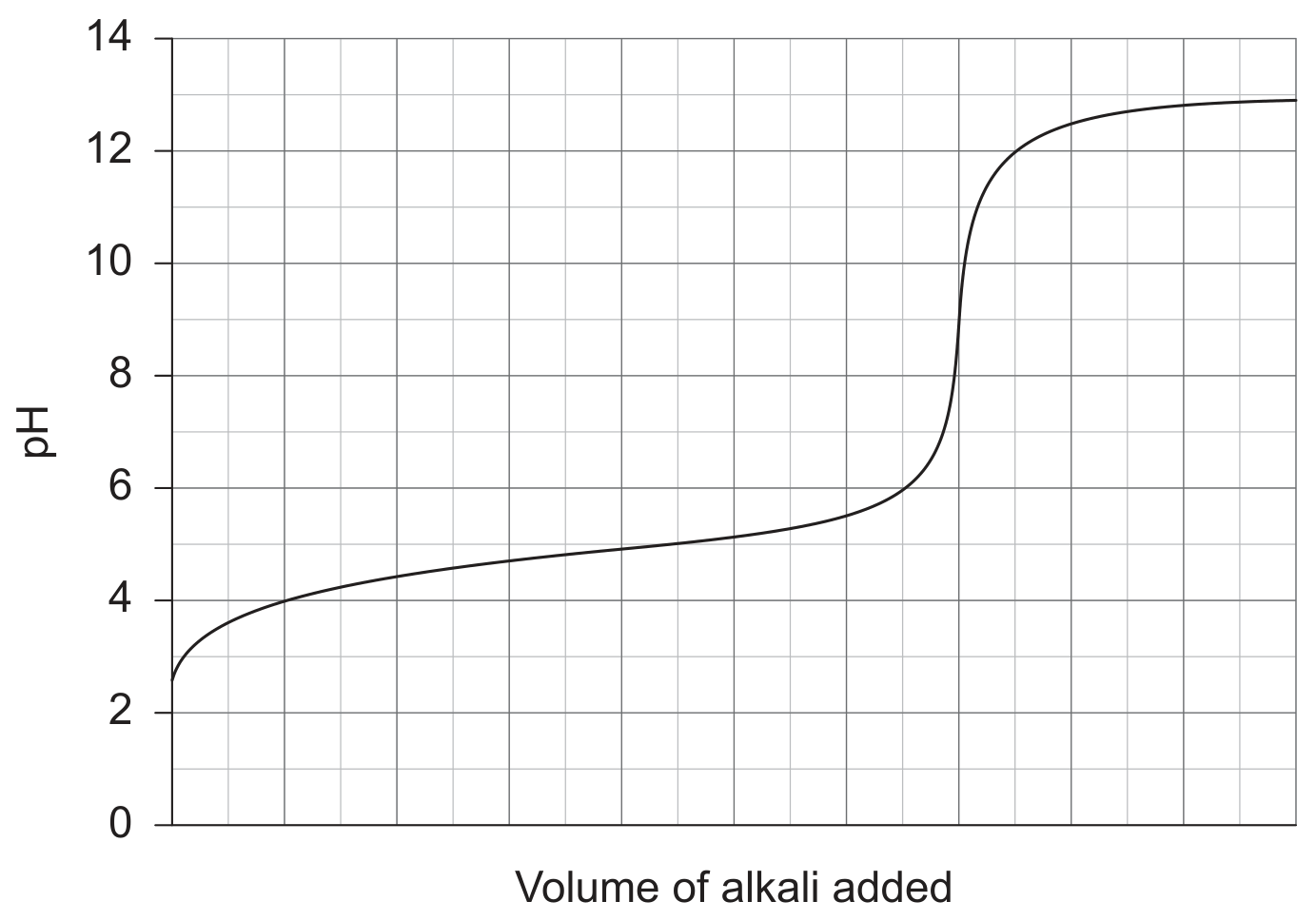
A neutralization curve for a weak acid, HA, and a strong base is given.

Question image
[ 7 ]

Question 1(c)(i)

(i)

Estimate the pKa\mathrm{p} K_{\mathrm{a}} of HA .

[ 1 ]

Question 1(c)(ii)

(ii)

Explain, using an equation, why adding a strong base to the weak acid, HA , leads to very little change in pH in the buffer zone of the graph.

In a separate experiment, 80 cm380 \mathrm{~cm}^{3} of 0.1 moldm30.1 \mathrm{~mol} \mathrm{dm}^{-3} ammonia, NH3(aq)\mathrm{NH}_{3}(\mathrm{aq}), was added to 40 cm340 \mathrm{~cm}^{3} of 0.1 moldm30.1 \mathrm{~mol} \mathrm{dm}^{-3} hydrochloric acid, HCl(aq).

[ 2 ]

Question 1(c)(iii)

(iii)

Determine the final pH of the solution. Use section 21 of the data booklet.

[ 4 ]

Question 1

[Maximum number: 5]

A student needed to make 500.0 cm3500.0 \mathrm{~cm}^{3} of a 0.2500 moldm30.2500 \mathrm{~mol} \mathrm{dm}^{-3} solution of sodium hydroxide, NaOH , from the solid for a titration.

Question 1(f)

(a)

The standardized sodium hydroxide solution from (c) was used to titrate a propanoic acid solution of unknown concentration.

[ 5 ]

Question 1(f)(ii)

(i)

Determine the pH of the propanoic acid from (f)(i). Propanoic acid has a pKa of 4.87.

If you did not determine a concentration for the propanoic acid in (f)(i) use 0.2755 moldm30.2755 \mathrm{~mol} \mathrm{dm}^{-3} although this is not the correct answer.

[ 2 ]

Question 1(f)(iii)

(ii)

Evaluate the use of an indicator versus a pH probe to determine the end point of the titration of propanoic acid with sodium hydroxide.

[ 3 ]

Question 1

[Maximum number: 10]

Ammonium nitrate, NH4NO3\mathrm{NH}_{4} \mathrm{NO}_{3}, is used as a high nitrogen fertilizer.

Question 1(b)

(a)

State, with a reason, whether the ammonium ion is a Brønsted-Lowry acid or base.

[ 1 ]

Question 1(c)

(b)

A 0.20 moldm30.20 \mathrm{~mol} \mathrm{dm}^{-3} solution of ammonium nitrate is prepared.

[ 9 ]

Question 1(c)(i)

(i)

Calculate the pH of an ammonium nitrate solution with
[H3O+]=1.07×10⁵ moldm3\left[\mathrm{H}_{3} \mathrm{O}^{+}\right]=1.07 \times 10^{-5} \mathrm{~mol} \mathrm{dm}{ }^{-3}. Use section 1 of the data booklet.

[ 1 ]

Question 1(c)(ii)

(ii)

Ammonium nitrate is neutralized with sodium hydroxide. Write the equation for the reaction.

[ 1 ]

Question 1(c)(iii)

(iii)

A 20.00 cm320.00 \mathrm{~cm}^{3} sample of the 0.20 moldm30.20 \mathrm{~mol} \mathrm{dm}^{-3} solution of ammonium nitrate is titrated with a 0.20 moldm30.20 \mathrm{~mol} \mathrm{dm}^{-3} solution of sodium hydroxide. Determine the pH at the equivalence point, to two decimal places using section 1 and 21 of the data booklet.

[ 4 ]

Question 1(c)(iv)

(iv)

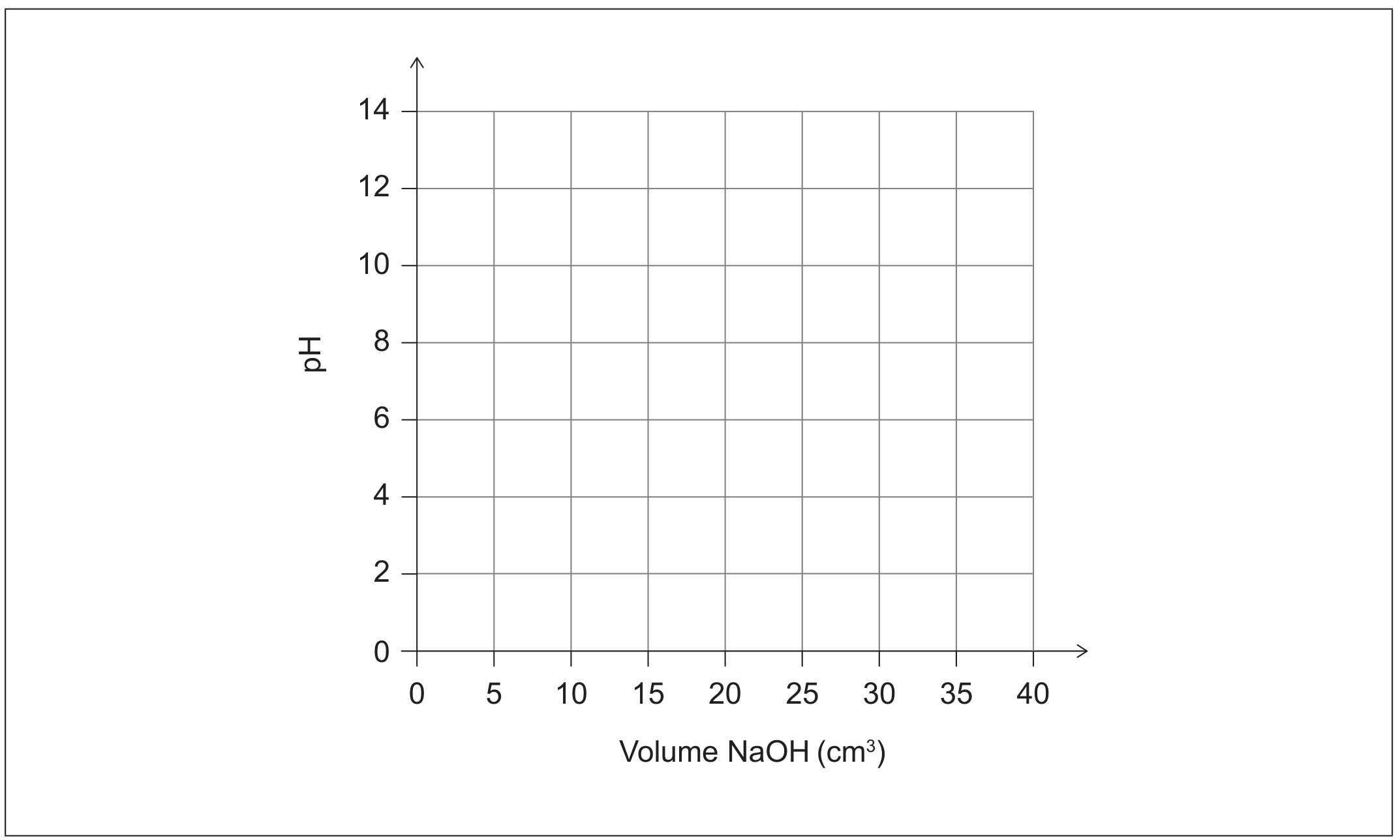
Sketch the pH curve that would result from the titration of a 0.20 moldm30.20 \mathrm{~mol} \mathrm{dm}^{-3} solution of ammonium nitrate with sodium hydroxide.

Question image
[ 2 ]

Question 1(c)(v)

(v)

State, with a reason, if bromothymol blue is an appropriate indicator for this titration. Use section 22 of the data booklet.

[ 1 ]
0 selected