

EduNinja

IB Chemistry 1.2 Energy cycles Questions

IB Chemistry 1.2 Energy cycles Questions
IB Chemistry syllabusChemistry SL/HLFirst assessment 2025

Work through Hess's law, bond enthalpy, and lattice enthalpy questions by combining data-booklet values with careful sign changes and clear chemical reasoning.

Exam points

  • calculate reaction ΔH by adding Hess cycle equations, reversing steps, and changing ΔH signs correctly
  • compare Hess and bond enthalpy values for ethanol + O2, noting average gaseous bonds cause differences
  • explain lower lattice enthalpy in CaCl2 than MgCl2 by the larger Ca2+ radius and greater ion separation

Question 2

[Maximum number: 4]

Nitrous acid, HNO2(aq)\mathrm{HNO}_{2}(\mathrm{aq}) and hydrochloric acid, HCl(aq) are both inorganic acids.

Question 2(c)

(a)

The overall reaction for the synthesis of ethyl ethanoate from ethane is:

2C2H6( g)+Cl2( g)+32O2( g)C4H8O2( g)+2HCl( g)+H2O( g)2 \mathrm{C}_{2} \mathrm{H}_{6}(\mathrm{~g})+\mathrm{Cl}_{2}(\mathrm{~g})+\frac{3}{2} \mathrm{O}_{2}(\mathrm{~g}) \rightarrow \mathrm{C}_{4} \mathrm{H}_{8} \mathrm{O}_{2}(\mathrm{~g})+2 \mathrm{HCl}(\mathrm{~g})+\mathrm{H}_{2} \mathrm{O}(\mathrm{~g})
[ 4 ]

Question 2(c)(i)

(i)

Calculate the enthalpy change for the reaction, ΔH\Delta H. Use section 12 of the data booklet.

[ 3 ]

Question 2(c)(ii)

(ii)

One student used bond enthalpy data and correctly calculated the enthalpy change for the reaction between ethanol and ethanoic acid as 0 kJ mol10 \mathrm{~kJ} \mathrm{~mol}^{-1}. Another student used Hess's law and correctly calculated the enthalpy change for the same reaction as 4 kJ mol1-4 \mathrm{~kJ} \mathrm{~mol}^{-1}.

C2H6O(l)+C2H4O2(l)C4H8O2(l)+H2O(l)\mathrm{C}_{2} \mathrm{H}_{6} \mathrm{O}(\mathrm{l})+\mathrm{C}_{2} \mathrm{H}_{4} \mathrm{O}_{2}(\mathrm{l}) \rightleftharpoons \mathrm{C}_{4} \mathrm{H}_{8} \mathrm{O}_{2}(\mathrm{l})+\mathrm{H}_{2} \mathrm{O}(\mathrm{l})

Explain how the two students can carry out a calculation for the same reaction and obtain different results when both calculations are correct.

[ 1 ]
Question 16

[Maximum number: 1]

Consider these equations:

S( s)+O2( g)SO2( g)ΔH=x kJ mol12SO2( g)+O2( g)2SO3( g)ΔH=y kJ mol1\begin{array}{ll} \mathrm{S}(\mathrm{~s})+\mathrm{O}_{2}(\mathrm{~g}) \rightarrow \mathrm{SO}_{2}(\mathrm{~g}) & \Delta H^{\ominus}=x \mathrm{~kJ} \mathrm{~mol}^{-1} \\ 2 \mathrm{SO}_{2}(\mathrm{~g})+\mathrm{O}_{2}(\mathrm{~g}) \rightarrow 2 \mathrm{SO}_{3}(\mathrm{~g}) & \Delta H^{\ominus}=y \mathrm{~kJ} \mathrm{~mol}^{-1} \end{array}

What is the value of ΔH\Delta H^{\ominus}, in kJmol1\mathrm{kJ} \mathrm{mol}^{-1}, for this reaction?

S( s)+32O2( g)SO3( g)\mathrm{S}(\mathrm{~s})+\frac{3}{2} \mathrm{O}_{2}(\mathrm{~g}) \rightarrow \mathrm{SO}_{3}(\mathrm{~g})
A

x+y

B

x+12yx+\frac{1}{2} y

C

x12yx-\frac{1}{2} y

D

x-y

Question 17

[Maximum number: 1]

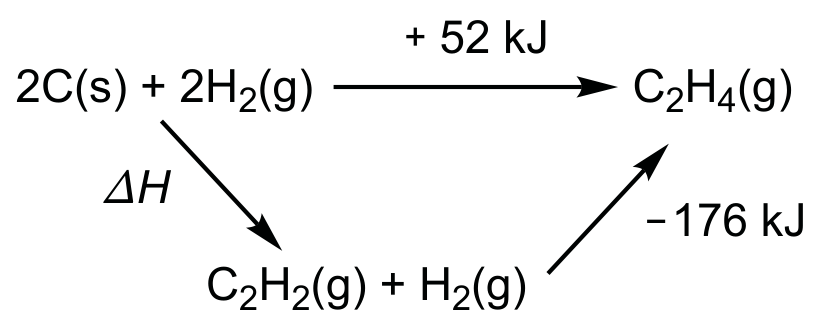
What is ΔH\Delta H, in kJ , in the energy cycle below?

Question image
A

+52-176

B

+52+176

C

-52+124

D

-5 2-1 7 6

Question 21

[Maximum number: 1]

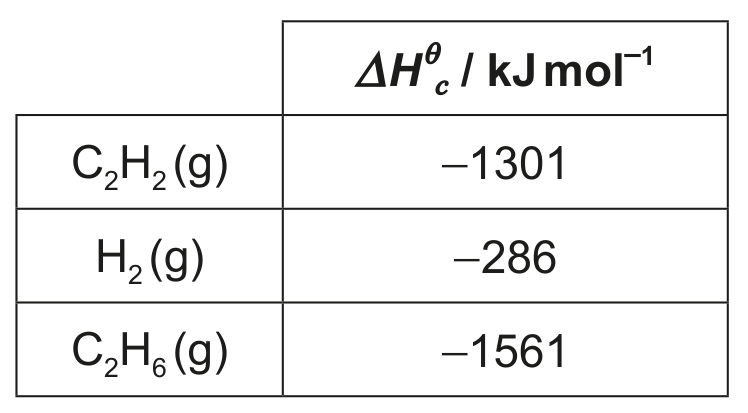
What is the enthalpy change for the reaction in kJmol1\mathrm{kJ} \mathrm{mol}^{-1} ?

C2H2( g)+2H2( g)C2H6( g)\mathrm{C}_{2} \mathrm{H}_{2}(\mathrm{~g})+2 \mathrm{H}_{2}(\mathrm{~g}) \rightarrow \mathrm{C}_{2} \mathrm{H}_{6}(\mathrm{~g})
Table
A

-1561-2(-286)-1301

B

-1561+2(-286)-1301

C

-1301+2(-286)+1561

D

-1301-2(-286)+1561

Question 3

[Maximum number: 6]

Nitrous acid, HNO2\mathrm{HNO}_{2}, is a weak acid which can be used to make acidic buffers.

Question 3(d)

(a)

The overall reaction for the synthesis of ethyl ethanoate from ethane is:

2C2H6( g)+Cl2( g)+32O2( g)C4H8O2( g)+2HCl( g)+H2O( g)2 \mathrm{C}_{2} \mathrm{H}_{6}(\mathrm{~g})+\mathrm{Cl}_{2}(\mathrm{~g})+\frac{3}{2} \mathrm{O}_{2}(\mathrm{~g}) \rightarrow \mathrm{C}_{4} \mathrm{H}_{8} \mathrm{O}_{2}(\mathrm{~g})+2 \mathrm{HCl}(\mathrm{~g})+\mathrm{H}_{2} \mathrm{O}(\mathrm{~g})
[ 6 ]

Question 3(d)(i)

(i)

Calculate the enthalpy change for the reaction, ΔH\Delta H. Use section 12 of the data booklet.

[ 3 ]

Question 3(d)(ii)

(ii)

One student used bond enthalpy data and correctly calculated the enthalpy change for the reaction between ethanol and ethanoic acid as 0 kJ mol10 \mathrm{~kJ} \mathrm{~mol}^{-1}. Another student used enthalpy of formation data and correctly calculated the enthalpy change for the same reaction as 4 kJ mol1-4 \mathrm{~kJ} \mathrm{~mol}^{-1}.

C2H6O(l)+C2H4O2(l)C4H8O2(l)+H2O(l)\mathrm{C}_{2} \mathrm{H}_{6} \mathrm{O}(\mathrm{l})+\mathrm{C}_{2} \mathrm{H}_{4} \mathrm{O}_{2}(\mathrm{l}) \rightleftharpoons \mathrm{C}_{4} \mathrm{H}_{8} \mathrm{O}_{2}(\mathrm{l})+\mathrm{H}_{2} \mathrm{O}(\mathrm{l})

Explain how the two students can carry out a calculation for the same reaction and obtain different results when both calculations are correct.

[ 1 ]
Question 3(d)(iii)

(iii)

Calculate the standard enthalpy change of formation, ΔHθf\Delta H^{\theta}{ }_{\mathrm{f}}, in kJmol1\mathrm{kJ} \mathrm{mol}^{-1}, of ethyl ethanoate, C4H8O2\mathrm{C}_{4} \mathrm{H}_{8} \mathrm{O}_{2}. Use sections 1 and 13 of the data booklet and the value of 4 kJ mol1-4 \mathrm{~kJ} \mathrm{~mol}^{-1} for the standard enthalpy change of reaction, ΔHθr\Delta H^{\theta}{ }_{\mathrm{r}}.

[ 2 ]

Question 22

[Maximum number: 1]

Which equation represents the enthalpy change of atomisation, ΔHθat\Delta H^{\theta}{ }_{a t}, of bromine?

A

Br2(l)Br2( g)\mathrm{Br}_{2}(\mathrm{l}) \rightarrow \mathrm{Br}_{2}(\mathrm{~g})

B

1/2Br2( g)Br(g)1 / 2 \mathrm{Br}_{2}(\mathrm{~g}) \rightarrow \mathrm{Br}(\mathrm{g})

C

1/2Br2(l)Br(g)1 / 2 \mathrm{Br}_{2}(\mathrm{l}) \rightarrow \mathrm{Br}(\mathrm{g})

D

Br2( g)2Br(g)\mathrm{Br}_{2}(\mathrm{~g}) \rightarrow 2 \mathrm{Br}(\mathrm{g})

Question 4

[Maximum number: 4]

Bromoethane, C2H5Br\mathrm{C}_{2} \mathrm{H}_{5} \mathrm{Br}, is produced by reacting ethene, C2H4\mathrm{C}_{2} \mathrm{H}_{4}, with hydrogen bromide, HBr .

C2H4( g)+HBr( g)C2H5Br(l)\mathrm{C}_{2} \mathrm{H}_{4}(\mathrm{~g})+\mathrm{HBr}(\mathrm{~g}) \rightarrow \mathrm{C}_{2} \mathrm{H}_{5} \mathrm{Br}(\mathrm{l})

Question 4(b)(i)

(a)

Determine the standard enthalpy change of the reaction, in kJmol1\mathrm{kJ} \mathrm{mol}^{-1}. Use section 12 of the data booklet.

[ 2 ]

Question 4(b)(ii)

(b)

State two reasons why the result using bond enthalpies is less accurate than one calculated from enthalpies of formation.

[ 2 ]
0 selected