
EduNinja

A-Level CAIE Mathematics AS4.4 Newton's laws of motionQuestion Bank

Question 1

[Maximum number: 4]

A particle P is projected vertically upwards with speed 20 m s120 \mathrm{~m} \mathrm{~s}^{-1} from a point on the ground.

Question 1(a)

(a)

Find the greatest height above the ground reached by P.

[ 2 ]

Question 1(b)

(b)

Find the total time from projection until P returns to the ground.

[ 2 ]
Question 1

[Maximum number: 4]

A particle of mass 0.2 kg is resting in equilibrium on a rough plane inclined at 2020^{\circ} to the horizontal.

Question 1(ii)

(a)

The coefficient of friction between the particle and the plane is 0.6 . A force of magnitude 0.9 N is applied to the particle down a line of greatest slope of the plane. The particle accelerates down the plane.

Find this acceleration.

[ 4 ]

Question 1

[Maximum number: 4]

A block of mass 3 kg is initially at rest on a smooth horizontal floor. A force of 12 N , acting at an angle of 2525^{\circ} above the horizontal, is applied to the block. Find the distance travelled by the block in the first 5 seconds of its motion.

Question 1

[Maximum number: 3]

A particle moves up a line of greatest slope of a rough plane inclined at an angle α\alpha to the horizontal, where sinα=0.28\sin \alpha=0.28. The coefficient of friction between the particle and the plane is 13\frac{1}{3}.

Question 1(i)

(a)

Show that the acceleration of the particle is 6 m s2-6 \mathrm{~m} \mathrm{~s}^{-2}.

[ 3 ]

Question 1

[Maximum number: 3]

A crate of mass 200 kg is being pulled at constant speed along horizontal ground by a horizontal rope attached to a winch. The winch is working at a constant rate of 4.5 kW and there is a constant resistance to the motion of the crate of magnitude 600 N .

Question 1(b)

(a)

The rope breaks after the crate has moved 15 m .

Find the time taken, after the rope breaks, for the crate to come to rest.

[ 3 ]

Question 1

[Maximum number: 3]

A particle of mass 2 kg is initially at rest on a rough horizontal plane. A force of magnitude 10 N is applied to the particle at 1515^{\circ} above the horizontal. It is given that 10 s after the force is applied, the particle has a speed of 3.5 m s13.5 \mathrm{~m} \mathrm{~s}^{-1}.

Question 1(i)

(a)

Show that the magnitude of the frictional force is 8.96 N , correct to 3 significant figures.

[ 3 ]

Question 1

[Maximum number: 4]
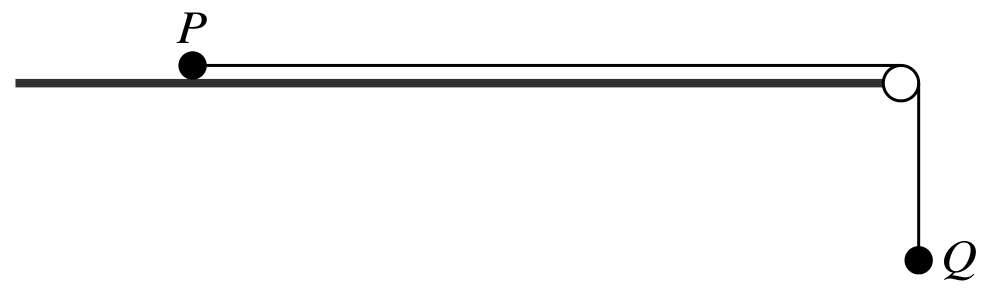
Question image

Two particles P and Q, of masses 0.6 kg and 0.4 kg respectively, are connected by a light inextensible string. The string passes over a small smooth light pulley fixed at the edge of a smooth horizontal table. Initially P is held at rest on the table and Q hangs vertically (see diagram). P is then released. Find the tension in the string and the acceleration of Q.

Question 1

[Maximum number: 2]

A car of mass 700 kg is travelling along a straight horizontal road. The resistance to motion is constant and equal to 600 N .

Question 1(i)

(a)

Find the driving force of the car's engine at an instant when the acceleration is 2 m s22 \mathrm{~m} \mathrm{~s}^{-2}.

[ 2 ]

Question 1

[Maximum number: 4]

A particle of mass 0.2 kg moving in a straight line experiences a constant resistance force of 1.5 N . When the particle is moving at speed 2.5 m s12.5 \mathrm{~m} \mathrm{~s}^{-1}, a constant force of magnitude F NF \mathrm{~N} is applied to it in the direction in which it is moving. Given that the speed of the particle 5 seconds later is 4.5 m s14.5 \mathrm{~m} \mathrm{~s}^{-1}, find the value of F.

Question 1

[Maximum number: 8]

A particle P is released from rest at a point on a smooth plane inclined at 3030^{\circ} to the horizontal. Find the speed of P

Question 1(i)

(a)

when it has travelled 0.9 m ,

[ 4 ]

Question 1(ii)

(b)

0.8 s after it is released.

[ 4 ]
0 selected