EduNinja

A-Level CAIE Chemistry A226.2 Homogeneous and heterogeneous catalystsQuestion Bank

Question 1

Question 1(c)

Question 1(c)(i)

(a)
(i)

Catalysts can be heterogeneous or homogeneous.

Explain what is meant by a homogeneous catalyst.

[ 1 ]

Question 1(c)(ii)

(ii)

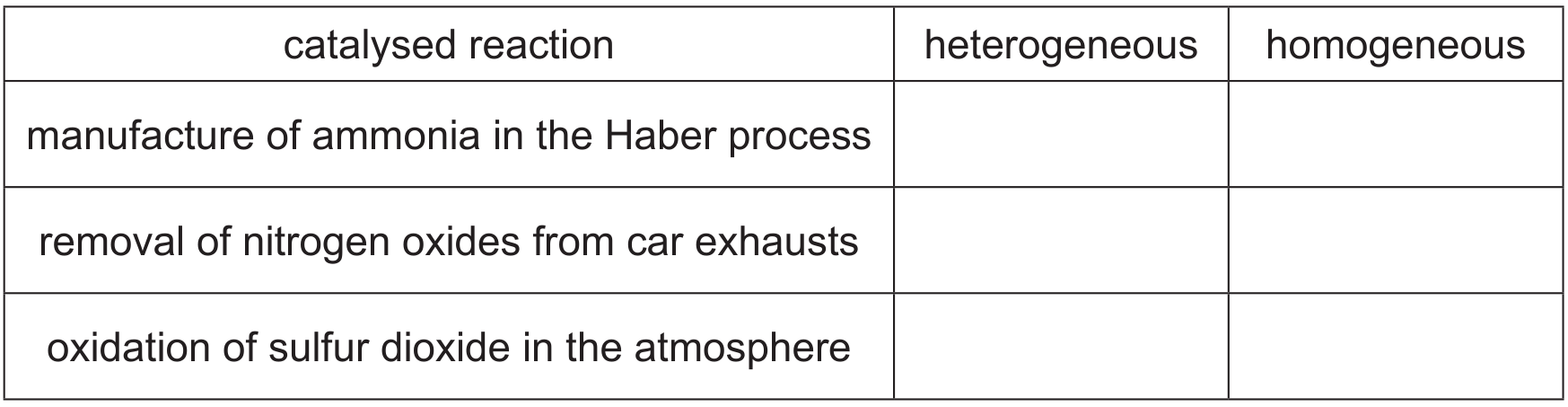
Complete the table by placing one tick ()(\checkmark) in each row to indicate the mode of action of the catalyst in each reaction.
Table
[ 1 ]

Question 2

Question 2(b)

(a)

Nitrous oxide, N2O\mathrm{N}_{2} \mathrm{O}, decomposes into its elements.

2 N2O( g)2 N2( g)+O2( g)2 \mathrm{~N}_{2} \mathrm{O}(\mathrm{~g}) \rightarrow 2 \mathrm{~N}_{2}(\mathrm{~g})+\mathrm{O}_{2}(\mathrm{~g})

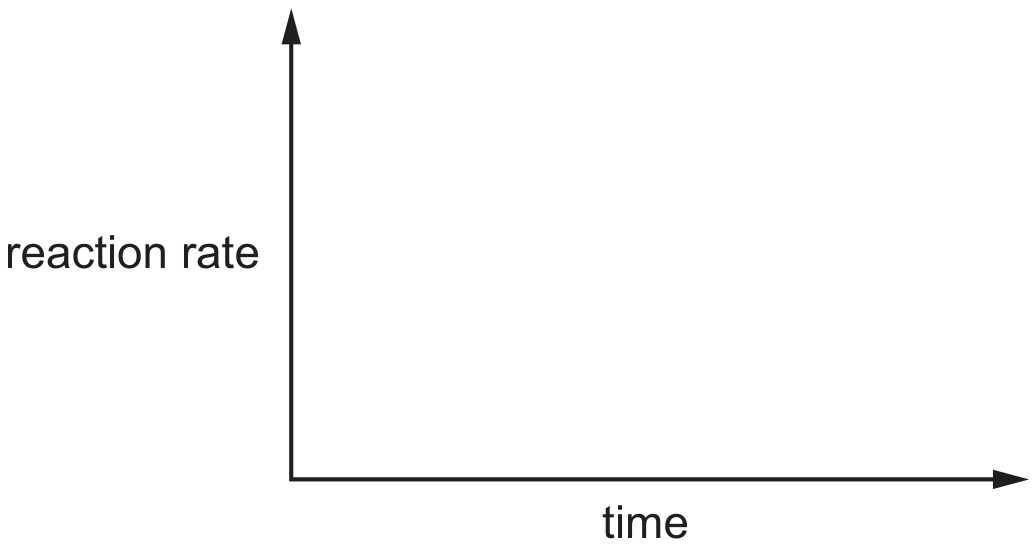
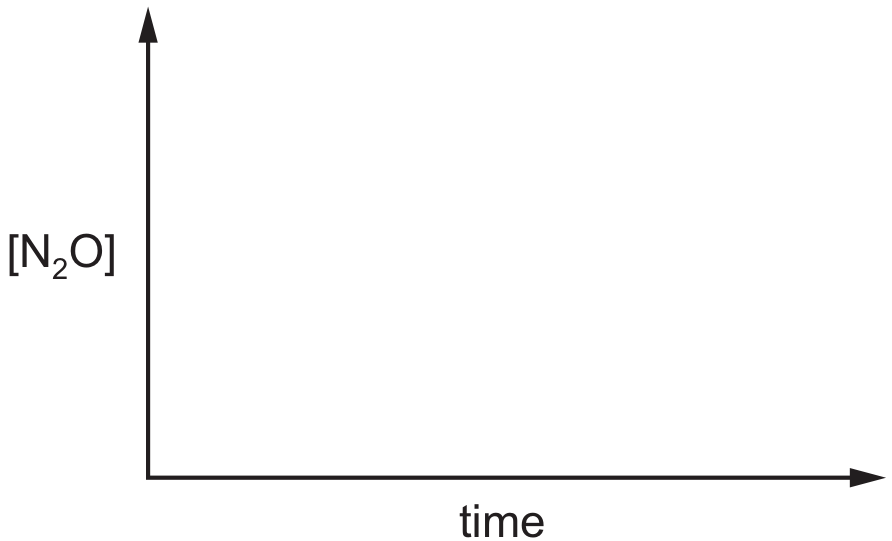
At a high temperature, a small amount of platinum wire is added to a large amount of nitrous oxide. The reaction follows zero order kinetics. The platinum wire behaves as a catalyst.

[ 5 ]

Question 2(b)(i)

(i)

Sketch a graph, on the axes below, of reaction rate against time for the catalysed decomposition of N2O\mathrm{N}_{2} \mathrm{O} under these conditions.

Question image
[ 1 ]

Question 2(b)(ii)

(ii)

Sketch a graph, on the axes below, of [N2O]\left[\mathrm{N}_{2} \mathrm{O}\right] against time for this reaction.

Question image
[ 1 ]

Question 2(b)(iii)

(iii)

Platinum behaves as a heterogeneous catalyst in this reaction.

Describe the mode of action of a heterogeneous catalyst.

[ 3 ]

Question 2

Question 2(c)

(a)

Manganese(IV) oxide, MnO2\mathrm{MnO}_{2}, acts as a heterogeneous catalyst in the decomposition of hydrogen peroxide, H2O2\mathrm{H}_{2} \mathrm{O}_{2}.

[ 4 ]

Question 2(c)(i)

(i)

Explain what is meant by a heterogeneous catalyst.

[ 1 ]

Question 2(c)(ii)

(ii)

Describe the mode of action of a heterogeneous catalyst in a reaction.

[ 3 ]

Question 2

Question 2(a)

Question 2(a)(i)

(a)
(i)

Explain what is meant by the following terms:
homogeneous catalyst
heterogeneous catalyst

[ 1 ]

Question 2(a)(ii)

(ii)

Iodide ions react with peroxydisulfate ions.

2I+S2O82I2+2SO422 \mathrm{I}^{-}+\mathrm{S}_{2} \mathrm{O}_{8}^{2-} \rightarrow \mathrm{I}_{2}+2 \mathrm{SO}_{4}^{2-}

This reaction is slow, but it is catalysed by Fe2+\mathrm{Fe}^{2+} ions.
Write two equations to explain how this reaction is catalysed by Fe2+\mathrm{Fe}^{2+} ions.
1

2

[ 2 ]

Question 2(a)(iii)

(iii)

Suggest why the alternative route in the presence of Fe2+\mathrm{Fe}^{2+} ions has a lower activation energy than the route in the absence of a catalyst.

[ 1 ]

Question 2

Question 2(a)

Question 2(a)(i)

(a)
(i)

Explain what is meant by the following terms:
homogeneous catalyst
heterogeneous catalyst

[ 1 ]

Question 2(a)(ii)

(ii)

Iodide ions react with peroxydisulfate ions.

2I+S2O82I2+2SO422 \mathrm{I}^{-}+\mathrm{S}_{2} \mathrm{O}_{8}^{2-} \rightarrow \mathrm{I}_{2}+2 \mathrm{SO}_{4}^{2-}

This reaction is slow, but it is catalysed by Fe2+\mathrm{Fe}^{2+} ions.
Write two equations to explain how this reaction is catalysed by Fe2+\mathrm{Fe}^{2+} ions.
1

2

[ 2 ]

Question 2(a)(iii)

(iii)

Suggest why the alternative route in the presence of Fe2+\mathrm{Fe}^{2+} ions has a lower activation energy than the route in the absence of a catalyst.

[ 1 ]

Question 2

[Maximum number: 2]

Hypophosphorous acid is an inorganic acid.
The conjugate base of hypophosphorous acid is H2PO2\mathrm{H}_{2} \mathrm{PO}_{2}^{-}.

Question 2(d)

(a)

A student suggests that the reaction between H2PO2(aq)\mathrm{H}_{2} \mathrm{PO}_{2}^{-}(\mathrm{aq}) and OH(aq)\mathrm{OH}^{-}(\mathrm{aq}) might happen more quickly in the presence of a heterogeneous catalyst.

Describe the mode of action of a heterogeneous catalyst.

[ 2 ]

Question 18

[Maximum number: 1]

Elements and their compounds are important as catalysts.
In which process is a compound used, rather than an element?

A

catalytic converters

B

Contact process

C

Haber process

D

hydrogenation of alkenes

Question 3

Question 3(c)

(a)

The reaction between S2O82(aq)\mathrm{S}_{2} \mathrm{O}_{8}{ }^{2-}(\mathrm{aq}) and I(aq)\mathrm{I}^{-}(\mathrm{aq}) is catalysed by adding a few drops of Fe3+(aq)\mathrm{Fe}^{3+}(\mathrm{aq}).

[ 2 ]

Question 3(c)(i)

(i)

Use equations to show the catalytic role of Fe3+\mathrm{Fe}^{3+} in this reaction.

[ 2 ]

Question 3(d)

(b)

When aqueous solutions of S2O82\mathrm{S}_{2} \mathrm{O}_{8}{ }^{2-} and tartrate ions are mixed the reaction proceeds very slowly. However, this reaction proceeds quickly in the presence of an Fe3+(aq)\mathrm{Fe}^{3+}(\mathrm{aq}) catalyst. The overall equation for this reaction is shown.
tartrate ions

Question image
[ 1 ]

Question 3(d)(i)

(i)

Suggest why this reaction is slow without the Fe3+\mathrm{Fe}^{3+} catalyst.

[ 1 ]

Question 3

[Maximum number: 4]

Iron has atomic number 26.

Question 3(b)

(a)

Fe3+\mathrm{Fe}^{3+} can act as a homogeneous catalyst in the reaction between peroxodisulfate ions (S2O82)\left(\mathrm{S}_{2} \mathrm{O}_{8}{ }^{2-}\right) and iodide ions.

[ 4 ]

Question 3(b)(i)

(i)

What is meant by a homogeneous catalyst?

[ 1 ]

Question 3(b)(iii)

(ii)

Suggest why, in the absence of a catalyst, the activation energy for this reaction is high.

[ 1 ]

Question 3(b)(iv)

(iii)

Write two equations to show how Fe3+(aq)\mathrm{Fe}^{3+}(\mathrm{aq}) ions can catalyse the reaction between S2O82(aq)\mathrm{S}_{2} \mathrm{O}_{8}{ }^{2-}(\mathrm{aq}) ions and I(aq)\mathrm{I}^{-}(\mathrm{aq}) ions.
equation 1 equation 2

[ 2 ]

Question 4

Question 4(b)

Question 4(b)(i)

(a)
(i)

Explain the difference between heterogeneous and homogeneous catalysts.

[ 1 ]

Question 4(b)(ii)

(ii)

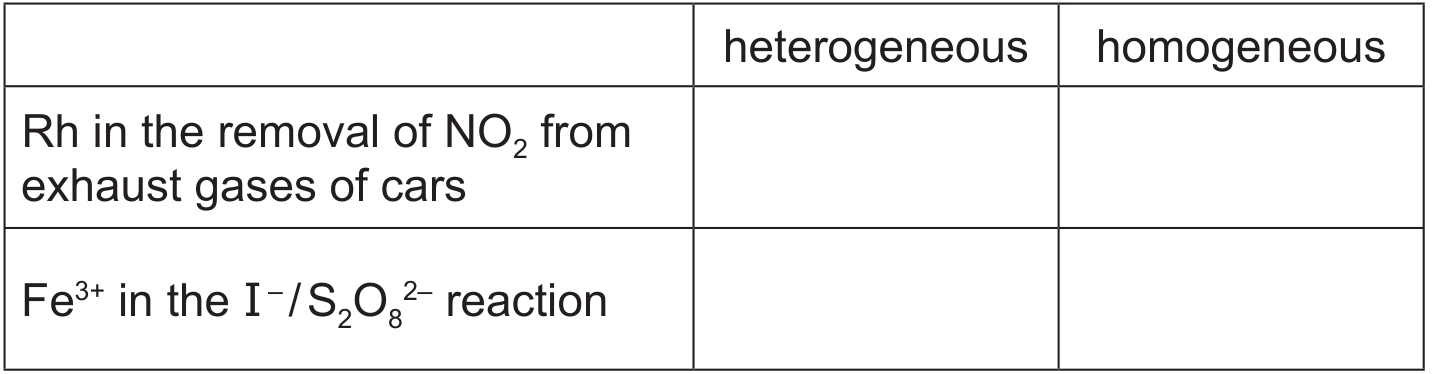
Complete the table using ticks ()(\checkmark) to indicate whether the catalyst used in the reaction is heterogeneous or homogeneous.

Table
[ 2 ]
0 selected