EduNinja

A-Level CAIE Chemistry A225.1 Acids and basesQuestion Bank

Question 1

Question 1(c)

(a)

The solubility product, KspK_{\mathrm{sp}}, of BaSO4\mathrm{BaSO}_{4} is 1.08×10¹⁰ mol2dm61.08 \times 10^{-10} \mathrm{~mol}^{2} \mathrm{dm}^{-6} at 298 K .

Calculate the solubility of BaSO4\mathrm{BaSO}_{4} in g per 100 cm3100 \mathrm{~cm}^{3} of solution.
solubility of BaSO4=\mathrm{BaSO}_{4}= g per 100 cm3100 \mathrm{~cm}^{3} of solution

[ 2 ]

Question 1

[Maximum number: 1]

Propanone, CH3COCH3\mathrm{CH}_{3} \mathrm{COCH}_{3}, reacts with iodine, I2\mathrm{I}_{2}, in the presence of an acid catalyst.

CH3COCH3+I2CH3COCH2I+H++I\mathrm{CH}_{3} \mathrm{COCH}_{3}+\mathrm{I}_{2} \rightarrow \mathrm{CH}_{3} \mathrm{COCH}_{2} \mathrm{I}+\mathrm{H}^{+}+\mathrm{I}^{-}

The rate equation for this reaction is shown.

 rate =k[CH3COCH3][H+]\text { rate }=k\left[\mathrm{CH}_{3} \mathrm{COCH}_{3}\right]\left[\mathrm{H}^{+}\right]

Question 1(e)

(a)

A four-step mechanism is suggested for the overall reaction.

CH3COCH3+I2CH3COCH2I+H++I rate =k[CH3COCH3][H+]\mathrm{CH}_{3} \mathrm{COCH}_{3}+\mathrm{I}_{2} \rightarrow \mathrm{CH}_{3} \mathrm{COCH}_{2} \mathrm{I}+\mathrm{H}^{+}+\mathrm{I}^{-} \quad \text { rate }=k\left[\mathrm{CH}_{3} \mathrm{COCH}_{3}\right]\left[\mathrm{H}^{+}\right]

Part of this mechanism is shown.

step 1: CH3COCH3+H+CH3C+(OH)CH3\mathrm{CH}_{3} \mathrm{COCH}_{3}+\mathrm{H}^{+} \rightarrow \mathrm{CH}_{3} \mathrm{C}^{+}(\mathrm{OH}) \mathrm{CH}_{3}

step 2: CH3C+(OH)CH3CH3C(OH)=CH2+H+\quad \mathrm{CH}_{3} \mathrm{C}^{+}(\mathrm{OH}) \mathrm{CH}_{3} \rightarrow \mathrm{CH}_{3} \mathrm{C}(\mathrm{OH})=\mathrm{CH}_{2}+\mathrm{H}^{+}

step 3: →

step 4: CH3C+(OH)CH2ICH3COCH2I+H+\quad \mathrm{CH}_{3} \mathrm{C}^{+}(\mathrm{OH}) \mathrm{CH}_{2} \mathrm{I} \rightarrow \mathrm{CH}_{3} \mathrm{COCH}_{2} \mathrm{I}+\mathrm{H}^{+}

[ 1 ]

Question 1(e)(iii)

(i)

Identify one conjugate acid-conjugate base pair in the mechanism. conjugate acid conjugate base

[ 1 ]

Question 1

Question 1(b)

(a)

The solubility of Sr(OH)2\mathrm{Sr}(\mathrm{OH})_{2} is 3.37×10² moldm33.37 \times 10^{-2} \mathrm{~mol} \mathrm{dm}^{-3} at 0C0^{\circ} \mathrm{C}.

[ 3 ]

Question 1(b)(i)

(i)

Write an expression for the solubility product of Sr(OH)2\mathrm{Sr}(\mathrm{OH})_{2}.

Ksp=K_{s p}=
[ 1 ]

Question 1(b)(ii)

(ii)

Calculate the value of KspK_{\mathrm{sp}} at 0C0^{\circ} \mathrm{C}. Include units in your answer.

Ksp=K_{s p}=

units =

[ 2 ]

Question 1

[Maximum number: 2]

Potassium iodide, KI, is used as a reagent in both inorganic and organic chemistry.

Question 1(b)

(a)

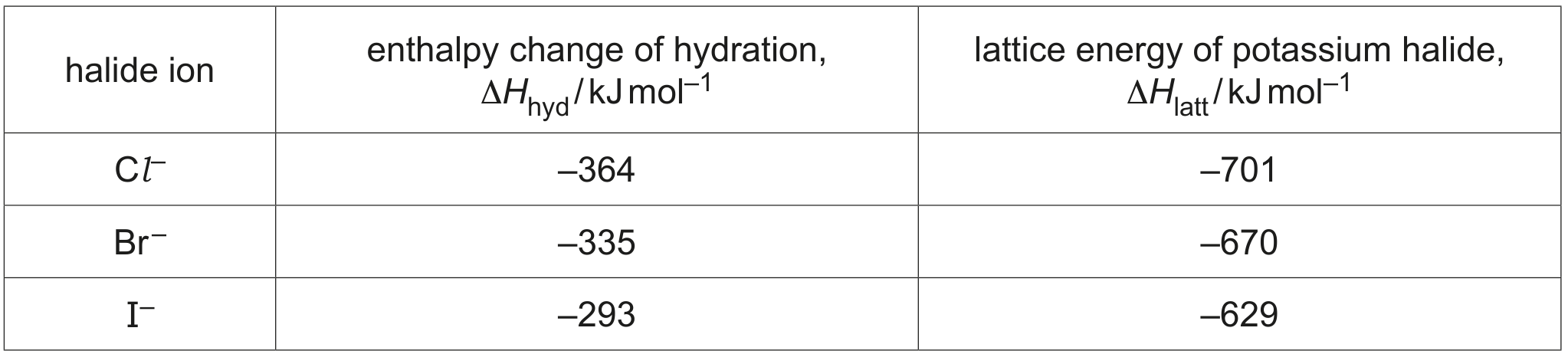
Table 1.1 gives some data about the halide ions, Cl,Br\mathrm{Cl}^{-}, \mathrm{Br}^{-}and I\mathrm{I}^{-}, and their potassium salts.

Table 1.1

Table 1.1

[ 2 ]

Question 1(b)(iv)

(i)

Solid PbI2\mathrm{PbI}_{2} forms when KI(aq) is mixed with Pb2+(aq)\mathrm{Pb}^{2+}(\mathrm{aq}) ions.

The solubility product, KspK_{\mathrm{sp}}, of PbI2\mathrm{PbI}_{2} is 7.1×10⁹ mol3dm97.1 \times 10^{-9} \mathrm{~mol}^{3} \mathrm{dm}^{-9} at 25C25^{\circ} \mathrm{C}.
Calculate the solubility, in moldm3\mathrm{moldm}^{-3}, of PbI2( s)\mathrm{PbI}_{2}(\mathrm{~s}).

 solubility of PbI2( s)=\text { solubility of } \mathrm{PbI}_{2}(\mathrm{~s})=

mol dm 3{ }^{-3}

[ 2 ]

Question 1

Question 1(a)

(a)

Hydrogen fluoride, HF , behaves as a weak acid in water, with Ka=5.6×10⁴moldm3K_{\mathrm{a}}=5.6 \times 10^{-4} \mathrm{moldm}^{-3}.
Calculate the pH of a 0.050 moldm30.050 \mathrm{~mol} \mathrm{dm}^{-3} solution of HF .

pH=\mathrm{pH}=
[ 2 ]

Question 1

Question 1(b)

(a)

Barium hydroxide, Ba(OH)2\mathrm{Ba}(\mathrm{OH})_{2}, is a strong base.

A 250.0 cm3250.0 \mathrm{~cm}^{3} solution of Ba(OH)2\mathrm{Ba}(\mathrm{OH})_{2} with a pH of 12.2 is made by dissolving Ba(OH)2\mathrm{Ba}(\mathrm{OH})_{2} in distilled water.

Calculate the mass of Ba(OH)2\mathrm{Ba}(\mathrm{OH})_{2} required to make this solution.
Show your working.
[Mr:Ba(OH)2,171.3]\left[M_{\mathrm{r}}: \mathrm{Ba}(\mathrm{OH})_{2}, 171.3\right]

 mass of Ba(OH)2=\text { mass of } \mathrm{Ba}(\mathrm{OH})_{2}=
[ 3 ]

Question 1(c)

(b)

The solubility of iron(II) hydroxide, Fe(OH)2\mathrm{Fe}(\mathrm{OH})_{2}, is 5.85×10⁶moldm35.85 \times 10^{-6} \mathrm{moldm}^{-3} at 298 K .

[ 4 ]

Question 1(c)(i)

(i)

Write the expression for the solubility product, Ksp\mathrm{K}_{\mathrm{sp}}, of Fe(OH)2\mathrm{Fe}(\mathrm{OH})_{2}.

Ksp=K_{s p}=
[ 1 ]

Question 1(c)(ii)

(ii)

Calculate the value of KspK_{\mathrm{sp}} of Fe(OH)2\mathrm{Fe}(\mathrm{OH})_{2}. Include its units.

Ksp= units =\begin{gathered} K_{s p}= \\ \text { units }= \end{gathered}
[ 3 ]

Question 1

[Maximum number: 3]

Sodium oxide, Na2O\mathrm{Na}_{2} \mathrm{O}, is a white crystalline solid with a high melting point.

Question 1(c)

(a)

When sodium oxide reacts with water an alkaline solution is obtained.

[ 3 ]

Question 1(c)(ii)

(i)

Calculate the pH of the solution obtained when 3.10 g of sodium oxide are added to 400 cm3400 \mathrm{~cm}^{3} of water.

[ 3 ]

Question 1

[Maximum number: 1]

Sulfides are compounds that contain sulfur but not oxygen.

Question 1(c)

(a)

Hydrogen sulfide gas, H2 S( g)\mathrm{H}_{2} \mathrm{~S}(\mathrm{~g}), is slightly soluble in water. It acts as a weak acid in aqueous solution.

[ 1 ]

Question 1(c)(ii)

(i)

Give the formula of the conjugate base of H2 S\mathrm{H}_{2} \mathrm{~S}.

[ 1 ]

Question 1

Question 1(c)

(a)

Consider the following two equilibria and associated data values at 298 K .

AgBr( s)Ag+(aq)+Br(aq) equilibrium 1Ksp=5.0×10¹³ mol2dm6Ag+(aq)+2NH3(aq)[Ag(NH3)2]+(aq) equilibrium 2Kstab =1.7×10⁷ mol2dm6\begin{array}{ccc} \mathrm{AgBr}(\mathrm{~s}) \rightleftharpoons \mathrm{Ag}^{+}(\mathrm{aq})+\mathrm{Br}^{-}(\mathrm{aq}) & \text { equilibrium } 1 \quad K_{\mathrm{sp}}=5.0 \times 10^{-13} \mathrm{~mol}^{2} \mathrm{dm}^{-6} \\ \mathrm{Ag}^{+}(\mathrm{aq})+2 \mathrm{NH}_{3}(\mathrm{aq}) \rightleftharpoons\left[\mathrm{Ag}\left(\mathrm{NH}_{3}\right)_{2}\right]^{+}(\mathrm{aq}) & \text { equilibrium } 2 \quad K_{\text {stab }}=1.7 \times 10^{7} \mathrm{~mol}^{-2} \mathrm{dm}^{6} \end{array}

The equilibrium constant for equilibrium 1 is the solubility product, KspK_{\mathrm{sp}}, of AgBr(s). The equilibrium constant for equilibrium 2 is the stability constant, Kstab K_{\text {stab }}, for the formation of [Ag(NH3)2]+(aq)\left[\mathrm{Ag}\left(\mathrm{NH}_{3}\right)_{2}\right]^{+}(\mathrm{aq}).

[ 1 ]

Question 1(c)(i)

(i)

Calculate the solubility of AgBr at 298 K in moldm3\mathrm{moldm}^{-3}.
solubility of AgBr= moldm3\mathrm{mol} \mathrm{dm}^{-3}

[ 1 ]

Question 1

Question 1(b)

(a)

Calcium hydroxide is slightly soluble in water.

[ 4 ]

Question 1(b)(i)

(i)

Write an equation to show the dissociation of calcium hydroxide, Ca(OH)2( s)\mathrm{Ca}(\mathrm{OH})_{2}(\mathrm{~s}), in aqueous solution. Include state symbols. ⇌

[ 1 ]

Question 1(b)(ii)

(ii)

Calculate the solubility, in moldm3\mathrm{mol} \mathrm{dm}^{-3}, of Ca(OH)2\mathrm{Ca}(\mathrm{OH})_{2}.
[Ksp:Ca(OH)2,5.02×106 mol3dm9]\left[K_{\mathrm{sp}}: \mathrm{Ca}(\mathrm{OH})_{2}, 5.02 \times 10^{-6} \mathrm{~mol}^{3} \mathrm{dm}^{-9}\right]
solubility = moldm3\mathrm{mol} \mathrm{dm}^{-3}

[ 2 ]

Question 1(b)(iii)

(iii)

Suggest how the solubility of Ca(OH)2\mathrm{Ca}(\mathrm{OH})_{2} in aqueous NaOH compares to its solubility in water.

Explain your reasoning.

[ 1 ]
0 selected