EduNinja

IGCSE Math a3.2 Function notationTopic Practice

3.2 Function notation

Edexcel IGCSE Math a 3.2 Function notation question practice helps you revise this syllabus point with the course map in view. Use this page to focus on one topic, check the style of questions available, and connect each attempt back to the knowledge area it is testing.

EduNinja keeps Math a practice aligned to Edexcel, so you can move from topic review into exam-style question bank work without losing the syllabus structure. Start with a small set, mark the weak steps, then return to nearby topic links when a definition, graph, calculation, or explanation needs repair.

Question 16

[Maximum number: 9]

The functions f and g are defined as

f:x5x7 g:x5xx+4\begin{aligned} & \mathrm{f}: x \mapsto 5 x-7 \\ & \mathrm{~g}: x \mapsto \frac{5 x}{x+4} \end{aligned}

Question 16(a)

(a)

Write down the value of x that must be excluded from any domain of g

[ 1 ]

Question 16(b)

(b)

Find gf(2.6)\operatorname{gf(2.6)}

[ 2 ]

Question 16(c)

(c)

Solve fg(x)=2

x=
[ 3 ]

Question 16(d)

(d)

Express the inverse function g1\mathrm{g}^{-1} in the form g1:x\mathrm{g}^{-1}: x \mapsto \ldots

g1:x\mathrm{g}^{-1}: x \mapsto
[ 3 ]

Question 19

[Maximum number: 7]

The functions f and g are such that

f:x5x+7 g:x52x9\begin{aligned} & \mathrm{f}: x \mapsto 5 x+7 \\ & \mathrm{~g}: x \mapsto \frac{5}{2 x-9} \end{aligned}

Question 19(a)

(a)

State which value of x cannot be included in any domain of g

[ 1 ]

Question 19(b)

(b)

Find fg(4)

The function h is such that

h:x3x212x+8 where x>2\mathrm{h}: x \mapsto 3 x^{2}-12 x+8 \quad \text { where } x>2
[ 2 ]

Question 19(c)

(c)

Express the inverse function h1\mathrm{h}^{-1} in the form h1:x\mathrm{h}^{-1}: x \mapsto \ldots

h1:x\mathrm{h}^{-1}: x \mapsto
[ 4 ]

Question 18

[Maximum number: 4]

The function f is such that f(x)=kx\mathrm{f}(x)=\frac{k}{x} where x0x \neq 0 and k is an integer.

Question 18(a)

(a)

Express the inverse function f1\mathrm{f}^{-1} in the form f1(x)=\mathrm{f}^{-1}(x)=\ldots

f1(x)=\mathrm{f}^{-1}(x)=

The function g is such that g(x)=23x4\mathrm{g}(x)=2-3 x^{4} where x0x \neq 0
The function h is such that h(x)=3x2x\mathrm{h}(x)=\frac{3 x}{2-x} where x2x \neq 2

[ 1 ]

Question 18(b)(i)

(b)

Find g(-2)

[ 1 ]

Question 18(b)(ii)

(c)

Express the composite function hg in the form hg(x)=\mathrm{hg}(x)=\ldots

Give your answer in its simplest form.

hg(x)=\operatorname{hg}(x)=
[ 2 ]

Question 16

[Maximum number: 3]

The function f is such that

f(x)=23x5 where x53f(x)=\frac{2}{3 x-5} \quad \text { where } x \neq \frac{5}{3}

Question 16(a)

(a)

Find f(13)\mathrm{f}\left(\frac{1}{3}\right)

[ 1 ]

Question 16(b)

(b)

Find f1(x)f^{-1}(x)

f1(x)=\mathrm{f}^{-1}(x)=

The function g is such that

g(x)=5x220x+23g(x)=5 x^{2}-20 x+23
[ 2 ]

Question 17

[Maximum number: 4]

f is the function such that f(x)=4-3 x

Question 17(a)

(a)

Work out f(5)
g is the function such that g(x)=112x\mathrm{g}(x)=\frac{1}{1-2 x}

[ 1 ]

Question 17(b)

(b)

Find the value of x that cannot be included in any domain of g

[ 1 ]

Question 17(c)

(c)

Work out fg(-1.5)

[ 2 ]

Question 15

[Maximum number: 4]

The function f is defined as

f:x3x+1x2\mathrm{f}: x \mapsto \frac{3 x+1}{x-2}

Question 15(a)

(a)

State the value of x that cannot be included in any domain of the function f

[ 1 ]

Question 15(b)

(b)

Express the inverse function f1\mathrm{f}^{-1} in the form f1(x)=\mathrm{f}^{-1}(x)=\ldots

f1(x)=\mathrm{f}^{-1}(x)=
[ 3 ]

Question 17

[Maximum number: 4]

The function f is such that f(x)=(x4)2\mathrm{f}(x)=(x-4)^{2} for all values of x.

Question 17(a)

(a)

Find f(1)

[ 1 ]

Question 17(b)

(b)

State the range of the function f .

The function g is such that g(x)=4x+3x3\mathrm{g}(x)=\frac{4}{x+3} \quad x \neq-3

[ 1 ]

Question 17(c)

(c)

Work out fg(2)

[ 2 ]

Question 19

[Maximum number: 3]

The functions f and g are such that

f(x)=3x4 where x>2g(x)=x2x+1\begin{aligned} & f(x)=3 x-4 \text { where } x>2 \\ & g(x)=\frac{x}{2 x+1} \end{aligned}

Question 19(a)

(a)

State the value of x that cannot be included in any domain of g

[ 1 ]

Question 19(b)

(b)

Find gf(x)\operatorname{gf}(x)

Give your answer in its simplest form.

gf(x)=\operatorname{gf}(x)=
[ 2 ]

Question 18

[Maximum number: 6]

The functions f and g are defined as

f(x)=x4x3 and g(x)=x5\mathrm{f}(x)=\frac{x}{4 x-3} \text { and } \mathrm{g}(x)=x-5

Question 18(a)

(a)

State which value of x must be excluded from any domain of the function f.

[ 1 ]

Question 18(b)

(b)

Find fg(x).

Simplify your answer.

fg(x)=\operatorname{fg}(x)=
[ 2 ]

Question 18(c)

(c)

Express the inverse function f1\mathrm{f}^{-1} in the form f1(x)=\mathrm{f}^{-1}(x)=\ldots

f1(x)=\mathrm{f}^{-1}(x)=

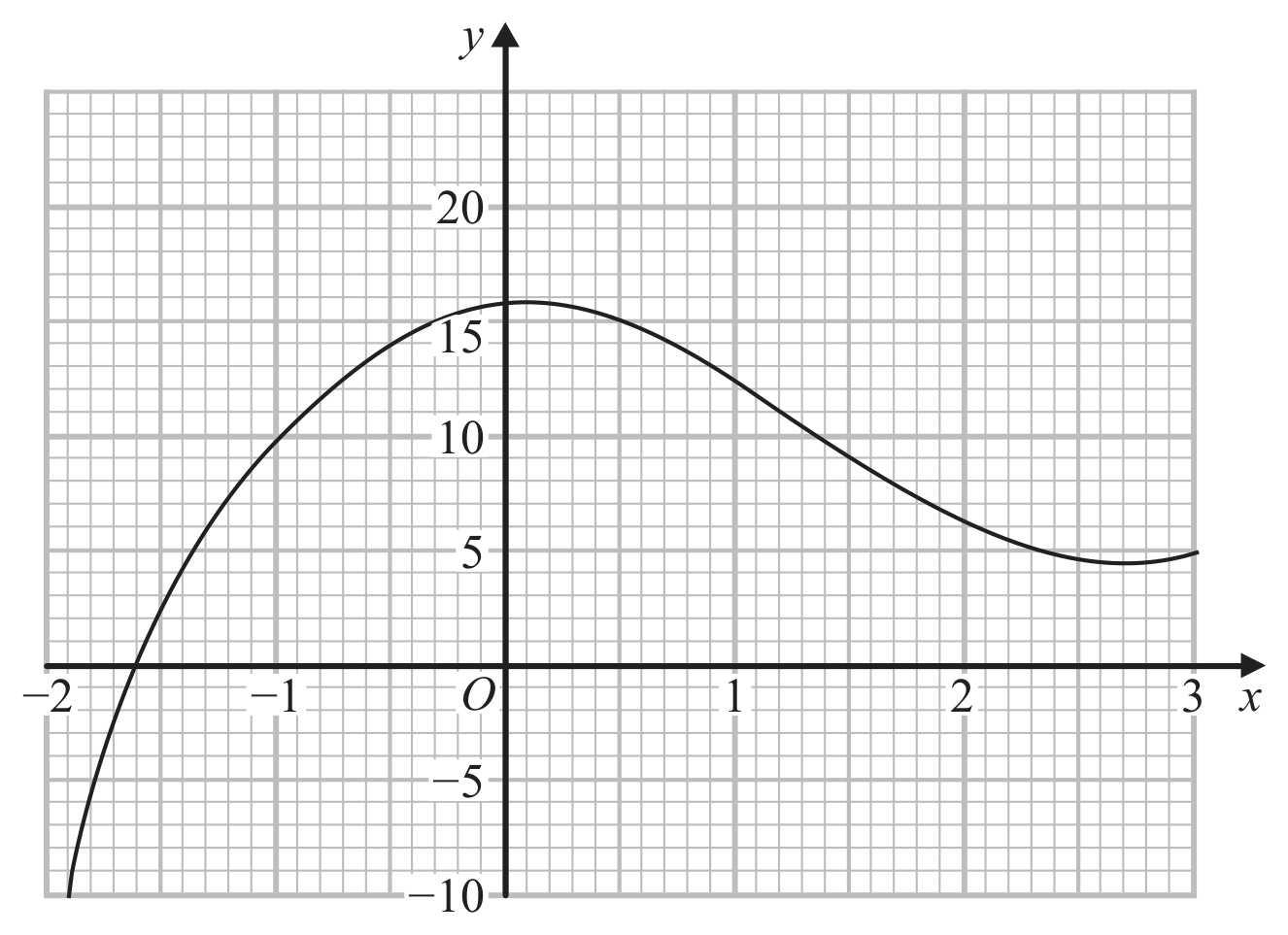
Part of the curve with equation y=h(x) is shown on the grid.

Question image
[ 3 ]

Question 17

[Maximum number: 9]

The functions f and g are defined as

f(x)=x2+6g(x)=x10\begin{aligned} & f(x)=x^{2}+6 \\ & g(x)=x-10 \end{aligned}

Question 17(a)

(a)

Find fg(3)

[ 2 ]

Question 17(b)

(b)

Solve the equation fg(x)=f(x)

Show clear algebraic working.

The function h is defined as

h(x)=2x4x\mathrm{h}(x)=\frac{2 x-4}{x}
[ 3 ]

Question 17(c)

(c)

State the value of x that cannot be included in the domain of h

[ 1 ]

Question 17(d)

(d)

Express the inverse function h1\mathrm{h}^{-1} in the form h1(x)=\mathrm{h}^{-1}(x)=\ldots

h1(x)=\mathrm{h}^{-1}(x)=
[ 3 ]
0 selected