EduNinja

IGCSE Math a1.5 Set language and notationTopic Practice

1.5 Set language and notation

Edexcel IGCSE Math a 1.5 Set language and notation question practice helps you revise this syllabus point with the course map in view. Use this page to focus on one topic, check the style of questions available, and connect each attempt back to the knowledge area it is testing.

EduNinja keeps Math a practice aligned to Edexcel, so you can move from topic review into exam-style question bank work without losing the syllabus structure. Start with a small set, mark the weak steps, then return to nearby topic links when a definition, graph, calculation, or explanation needs repair.

Question 1

[Maximum number: 3]

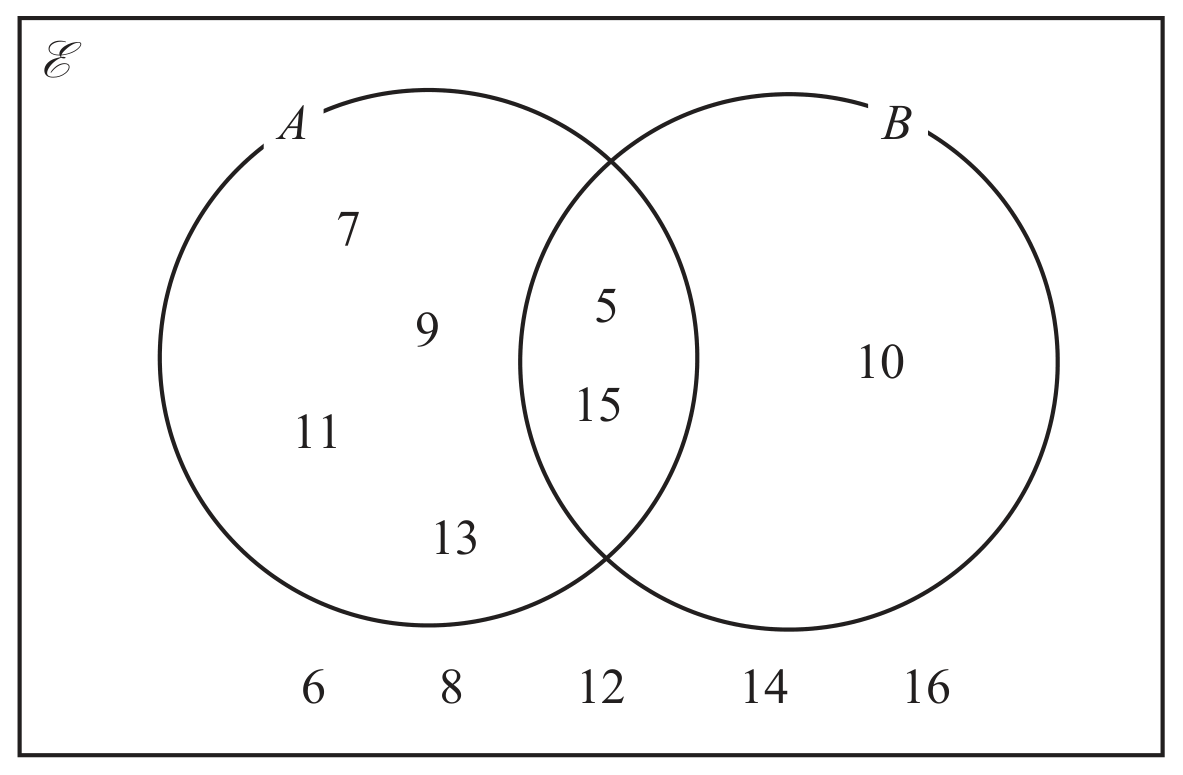
Here is a Venn diagram.
Question image

List the members of the set

Question 1(a)

(a)

A

[ 1 ]

Question 1(b)

(b)

ABA \cap B

[ 1 ]

Question 1(c)

(c)

(AB)(A \cup B)^{\prime}

[ 1 ]

Question 1

[Maximum number: 3]

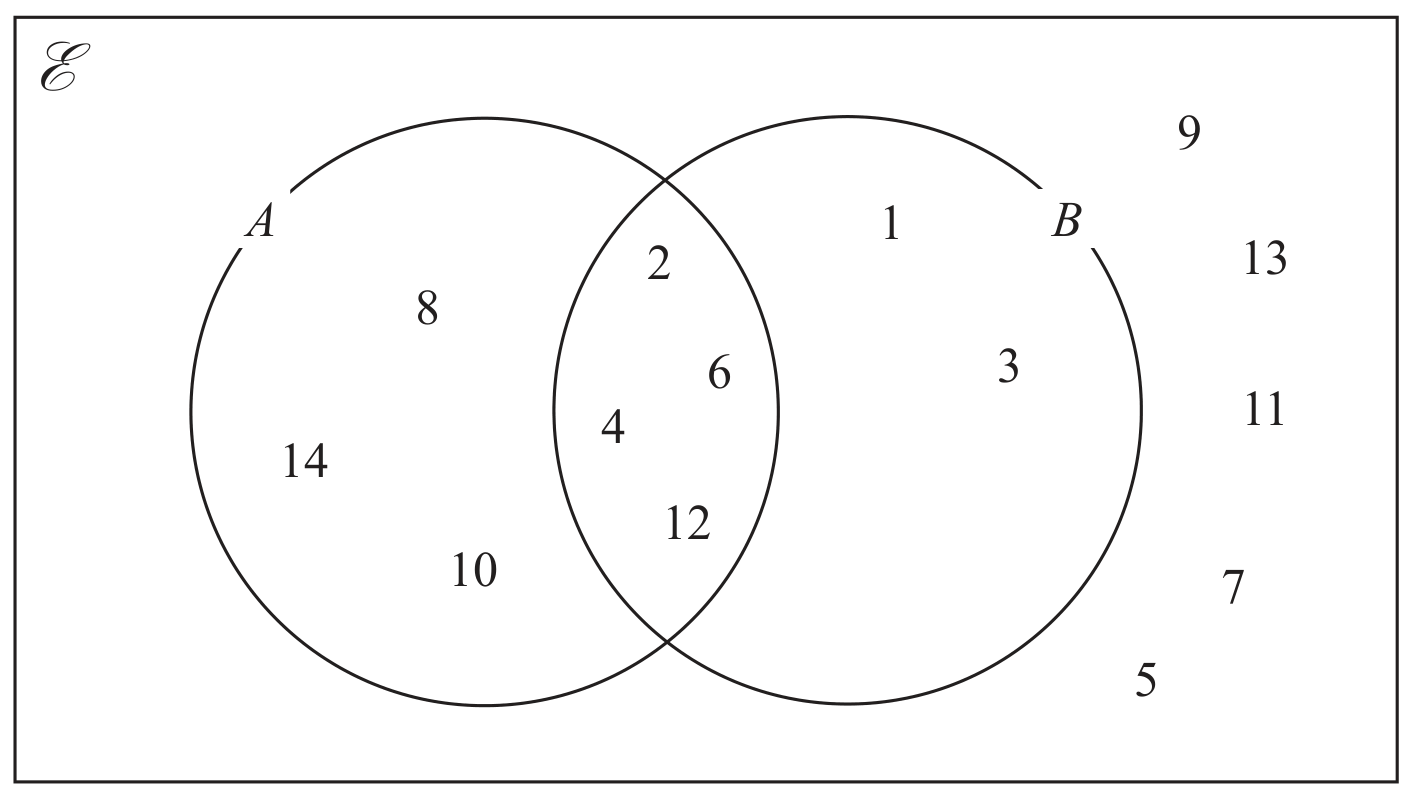
The numbers from 1 to 14 are shown in the Venn diagram.
Question image

Question 1(a)

(a)

```
(a) List the members of the set ABA \cap B
```

```
A number is picked at random from the numbers in the Venn diagram.

[ 1 ]

Question 1(b)

(b)

List the members of the set BB^{\prime}

[ 2 ]

Question 4

[Maximum number: 1]

4E={4 \mathscr{E}=\{ letters of the alphabet }\}B={b,r,a,z,i,l}B=\{\mathrm{b}, \mathrm{r}, \mathrm{a}, \mathrm{z}, \mathrm{i}, \mathrm{l}\}I={i,r,e,l,a,n,d}I=\{\mathrm{i}, \mathrm{r}, \mathrm{e}, \mathrm{l}, \mathrm{a}, \mathrm{n}, \mathrm{d}\}

Question 4(a)

(a)

List the members of the set

[ 2 ]

Question 4(a)(i)

(i)

BIB \cup I

Question 4(a)(ii)

(ii)

BIB \cap I^{\prime}K={k,e,n,y,a}K=\{\mathrm{k}, \mathrm{e}, \mathrm{n}, \mathrm{y}, \mathrm{a}\}
Cody writes down the statement BK=B \cap K=\varnothing Cody's statement is wrong.

Question 4(b)

(b)

Explain why.

[ 1 ]

Question 4

4E={1,2,3,4,5,6,7,8,9,10,11,12}4 \mathscr{E}=\{1,2,3,4,5,6,7,8,9,10,11,12\}A={A=\{ odd numbers }\}AB={1,3}A \cap B=\{1,3\}AB={1,2,3,4,5,6,7,9,11,12}A \cup B=\{1,2,3,4,5,6,7,9,11,12\}
Draw a Venn diagram to show this information.

Question 4

[Maximum number: 2]

4E={20,21,22,23,24,25,26,27,28,29}4 \mathscr{E}=\{20,21,22,23,24,25,26,27,28,29\}A={A=\{ odd numbers }\}B={B=\{ multiples of 3}\}
List the members of the set

Question 4(i)

(a)

ABA \cap B

[ 1 ]

Question 4(ii)

(b)

ABA \cup B

[ 1 ]

Question 4

[Maximum number: 5]

4E={1,2,3,4,5,6,7,8,9,10}4 \mathscr{E}=\{1,2,3,4,5,6,7,8,9,10\}A={A=\{ factors of 6}\}B={B=\{ prime numbers }\}

Question 4(a)

(a)

List the members of the set

[ 2 ]

Question 4(a)(i)

(i)

ABA \cup B

[ 1 ]

Question 4(a)(ii)

(ii)

AA^{\prime}

Harpreet states that AB=A \cap B=\varnothing
Harpreet is incorrect.

[ 1 ]

Question 4(b)

(b)

Explain why.
C is a set with 4 members such that
the set ACA \cap C has 2 members
the set BCB \cap C has 2 members
Set ACA \cap C and set BCB \cap C have no members in common.

[ 1 ]

Question 4(c)

(c)

List the 4 members of set C

[ 2 ]

Question 3

[Maximum number: 1]

3E={21,22,23,24,25,26,27,28,29,30}3 \mathscr{E}=\{21,22,23,24,25,26,27,28,29,30\}A={22,24,26,28,30}A=\{22,24,26,28,30\}B={21,24,27,30}B=\{21,24,27,30\}

Question 3(a)

(a)

List the members of the set

[ 2 ]

Question 3(a)(i)

(i)

ABA \cap B

Question 3(a)(ii)

(ii)

AA^{\prime}C={23,25,29}C=\{23,25,29\}

Question 3(b)

(b)

Using set notation, find an expression for C in terms of A and B.

[ 1 ]

Question 4

[Maximum number: 3]

4B={b,l,u,e}4 B=\{\mathrm{b}, \mathrm{l}, \mathrm{u}, \mathrm{e}\}G={g,r,e,y}G=\{\mathrm{g}, \mathrm{r}, \mathrm{e}, \mathrm{y}\}W={w,h,i,t,e}W=\{\mathrm{w}, \mathrm{h}, \mathrm{i}, \mathrm{t}, \mathrm{e}\}

Question 4(a)

(a)

List all the members of the set

[ 2 ]

Question 4(a)(i)

(i)

BGB \cup G

Question 4(a)(ii)

(ii)

WGW \cap G^{\prime}

Serena writes down the statement BGW=B \cap G \cap W=\varnothing

[ 2 ]

Question 4(b)

(b)

Is Serena's statement correct?

You must give a reason for your answer.

[ 1 ]

Question 5

[Maximum number: 4]

5E={1,2,3,4,5,6,7,8,9,10,11,12}5 \mathscr{E}=\{1,2,3,4,5,6,7,8,9,10,11,12\}A={2,4,6,8,10,12}A=\{2,4,6,8,10,12\}B={3,6,9,12}B=\{3,6,9,12\}C={1,3,5,7,9,11}C=\{1,3,5,7,9,11\}

Question 5(a)

(a)

List the members of the set

[ 2 ]

Question 5(a)(i)

(i)

ABA \cup B

Question 5(a)(ii)

(ii)

BB^{\prime}E={1,2,3,4,5,6,7,8,9,10,11,12}\mathscr{E}=\{1,2,3,4,5,6,7,8,9,10,11,12\}A={2,4,6,8,10,12}A=\{2,4,6,8,10,12\}B={3,6,9,12}B=\{3,6,9,12\}C={1,3,5,7,9,11}C=\{1,3,5,7,9,11\}

Table

Question 5(b)

(b)

Write a symbol from the box on each dotted line to make each of the following a true statement.

[ 2 ]

Question 5(b)(i)

(i)

AC=A \cap C=

Question 5(b)(ii)

(ii)

13 E\mathscr{E}

Question 7

[Maximum number: 5]

7E={23,24,25,26,27,28,29,30,31,32,33,34}7 \mathscr{E}=\{23,24,25,26,27,28,29,30,31,32,33,34\}A={A=\{ even numbers }\}B={23,29,31}B=\{23,29,31\}C={C=\{ multiples of 3}\}

Question 7(a)

(a)

List the members of the set

[ 2 ]

Question 7(a)(i)

(i)

BCB \cup C

[ 1 ]

Question 7(a)(ii)

(ii)

ACA^{\prime} \cap C

[ 1 ]

Question 7(b)

(b)

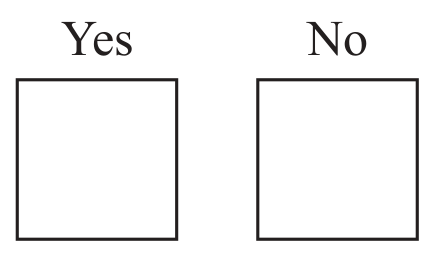
Is it true that BC=B \cap C=\varnothing ?

Tick ( ✓ ) one of the boxes below.

Question image

Give a reason for your answer.

The set D has 4 members and is such that D(AC)=D \cap(A \cup C)=\varnothing

[ 1 ]

Question 7(c)

(c)

List the members of set D

[ 2 ]
0 selected