EduNinja

IB Economics SL4.8 Measuring developmentQuestion Bank

Question 3

[Maximum number: 4]

Study the extract and data below and answer the questions that follow.
Ethiopia

(1) Ethiopia has the second-highest population in Sub-Saharan Africa, with a population of 96.9 million, and a fairly high population growth rate of 3 %. Ethiopia is also one of the world's poorest countries. The country's gross domestic product (GDP) per capita is substantially lower than the regional average.

(2) However, the economy has experienced strong economic growth over the past decade, more than double the regional average of 5.3 %. Currently, agriculture is the major sector of the economy: 80 % of the labour force is engaged in agriculture and it contributes about 50 % to the nation's GDP.

(3) The World Bank says that Ethiopia needs to diversify its economy so that more employment is generated by the manufacturing sector. Although small scale enterprises are doing well, their rapid growth is negatively affected by many obstacles. Access to credit is very difficult, and so domestically funded investment is hard to achieve, causing a significant investment gap. There are also problems with the provision of infrastructure like electricity, telecommunications and access to roads, particularly in rural areas.

(4) The government has been encouraging foreign direct investment from multinational corporations (MNCs) to attempt to solve some of Ethiopia's economic problems and to break the poverty cycle. Much of the investment has come from China, whose total investment in the country has reached almost US$17 billion.

(5) China has established Ethiopia as one of its six "special economic zones" in Africa. The two countries have signed five cooperation deals relating to technologies, electric power, finance, energy and aviation.

(6) Last year, the Huajian Group, a Chinese shoe manufacturer, announced a US $ 2.2 billion investment plan in Ethiopia. They intend to set up an industrial zone, which is expected to contain approximately 45 textile and garment, leather and leather-products, chemical and pharmaceuticals, agricultural-processing and metal engineering factories. In the first year of the project, there should be 3000 jobs created. By the end of the project, approximately 30000 workers are expected to find employment there.

(7) Worries exist in Ethiopia about the country's large trade imbalance with China and the influx of Chinese goods - China accounts for 21 % of total imports into the country but only 11 % of Ethiopia's exports go to China. There are also concerns relating to the over-use of resources.
Removed for copyright reasons

Question 3(c)

(a)

Using data from Figure 1, explain why there is a difference between Ethiopia's HDI world ranking and its GNI per capita world ranking.
[ 4 ]

Question 3

Question 3(b)

(a)

Using real-world examples, evaluate the view that the level of real gross domestic product (GDP) is the best measure of economic development.

[ 15 ]

Question 3

Question 3(b)

(a)

Using real-world examples, discuss the view that economic growth will always lead to economic development.

[ 15 ]

Question 4

[Maximum number: 2]

Study the extract below and answer the questions that follow.
Aid to Papua New Guinea (PNG)

(1) A group of Australian politicians is visiting Papua New Guinea (PNG), a former colony, to see first-hand where Australia's AU$477 million in foreign aid is being used. The aid is being spent on women and children who are crime victims, immunizations for young children to protect them from diseases such as polio, efforts to eradicate tuberculosis, provision of free education for girls, pre-school and early learning, and training for the next generation of PNG police officers. There is a lot of aid money being spent but it is making very little difference.

(2) Though PNG is close to Australia, it is very far away in terms of economic development. One non-governmental organization (NGO), Save the Children, reported that "the level of need in PNG is astonishing. Children are far more likely to die before their fifth birthday here in PNG than most other places in the world. There is a huge amount of violence against women and children". The value of its Human Development Index (HDI) is 0.466 , ranking it 156 out of 187 countries.

(3) One of the Australian politicians is concerned that corruption is so widespread that it is preventing efforts to get PNG's educational, health and justice systems to operate effectively. "Make no mistake, there are many problems, including problems with security, family violence and many other socio-economic concerns," he said. "However, I think corruption is the largest issue confronting the challenges of PNG. You have to question whether you can address these issues without dealing with the issue of corruption first."

(4) "These challenges cannot be met without a system of government that is functioning properly. This is a society that has been propped up by aid and the actions of NGOs. The government simply does not work."

(5) Another member of the visiting group thinks improving agricultural productivity is a way forward for PNG economically and socially, with great potential for economic growth. A project spokesperson said that increased foreign aid could lift productivity and improve growth, by assisting PNG farmers to improve irrigation* and supply routes. He also said that research and development, in addition to training local farmers could help. Another project that the group is visiting runs a programme to encourage women to be more involved in decision-making in the growing and selling of coffee, a crop that is important to the PNG economy.
6 The leader of the visiting group says that "our aid money here should ensure that more children are born in environments with supervised medical care, and that there is a police and justice system that protects the rights of children. Children should have the right to be free from violence and free from sexual assault, and should have access to the great transformative power of education".
* irrigation: a method for regularly supplying water to plants. It is used to assist in the growing of agricultural crops particularly during periods of low rainfall.

Question 4(a)

Question 4(a)(i)

(a)
(i)

List two components of the Human Development Index (HDI) (paragraph 2).

[ 2 ]

Question 4

[Maximum number: 12]

Study the extract and data below and answer the questions that follow.
Economic growth and poverty in India

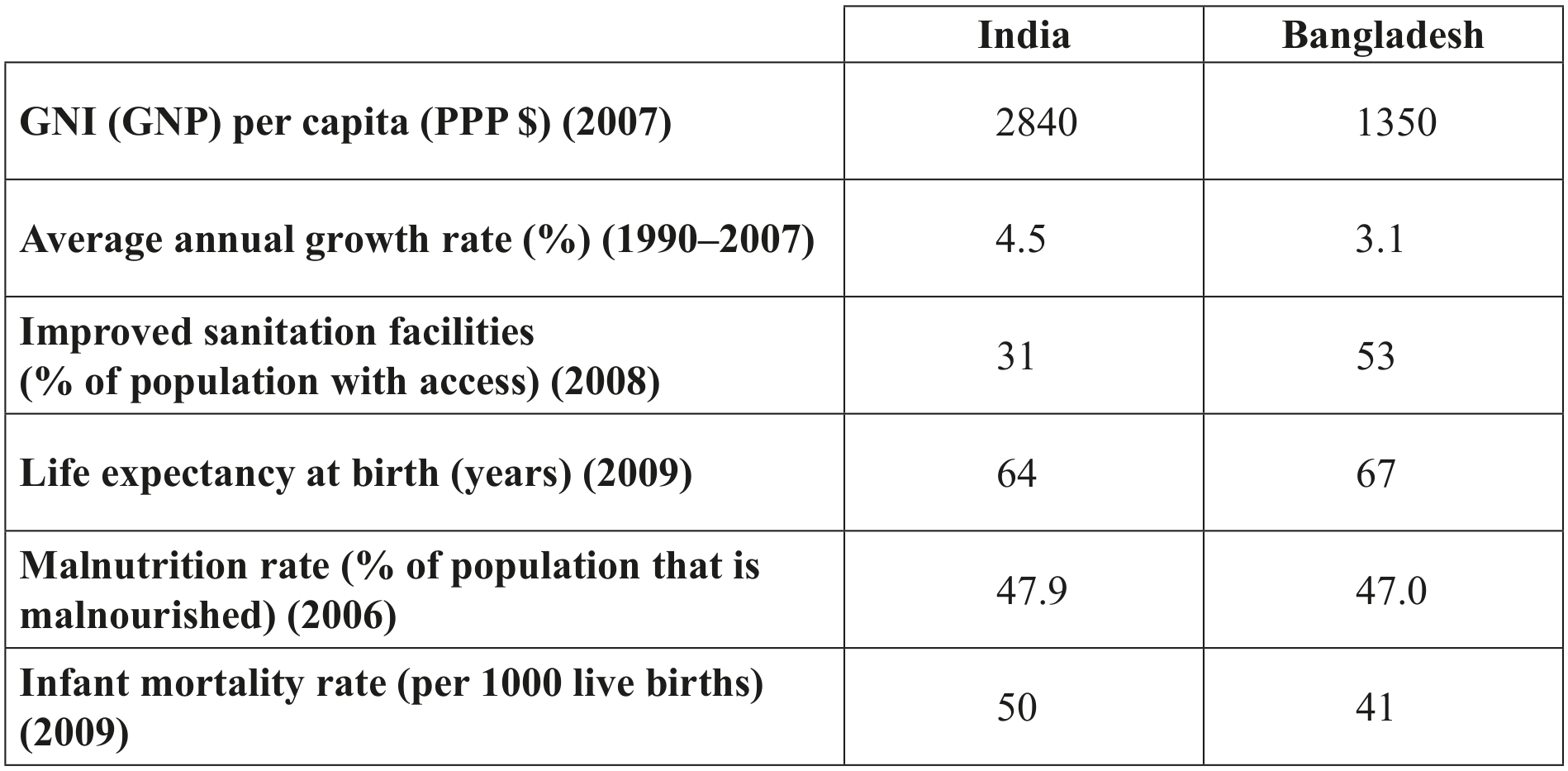
(1) Although India has one of the fastest growing economies in the world, it is unlikely that the Millennium Development Goal of halving the rate of poverty by 2015 will be achieved. An important factor is growing income inequality. Calculations of Gini coefficients show that inequality increased by about 14 % between 2001 and 2011.

(2) India has about one third of the world's population living in extreme poverty (living on less than $ 1.25 a day). Three quarters of its population live in moderate poverty (less than $ 2 a day). It is estimated that nearly half the Indian population suffers from malnutrition. Part of India's poverty problem is a result of poor governance and failure to address the underlying causes of poverty.

(3) Growth averaged 8.6 % per year in the years 2005-2011 compared with the 10 % needed over 20 years to lift the poor out of their poverty. The central bank governor says that the lack of steps to improve the supply-side of the economy will make it difficult for India to maintain its high growth rates.

(4) The Indian Nobel Prize winner Amartya Sen argues that economic growth should not be "our ultimate objective, but a very useful means to achieve … a better quality of life".
"Poverty reduction in India briefing", uk.oneworld.net, May 2011 and "Addressing income distribution", The Financial Express, 15 January 2011]

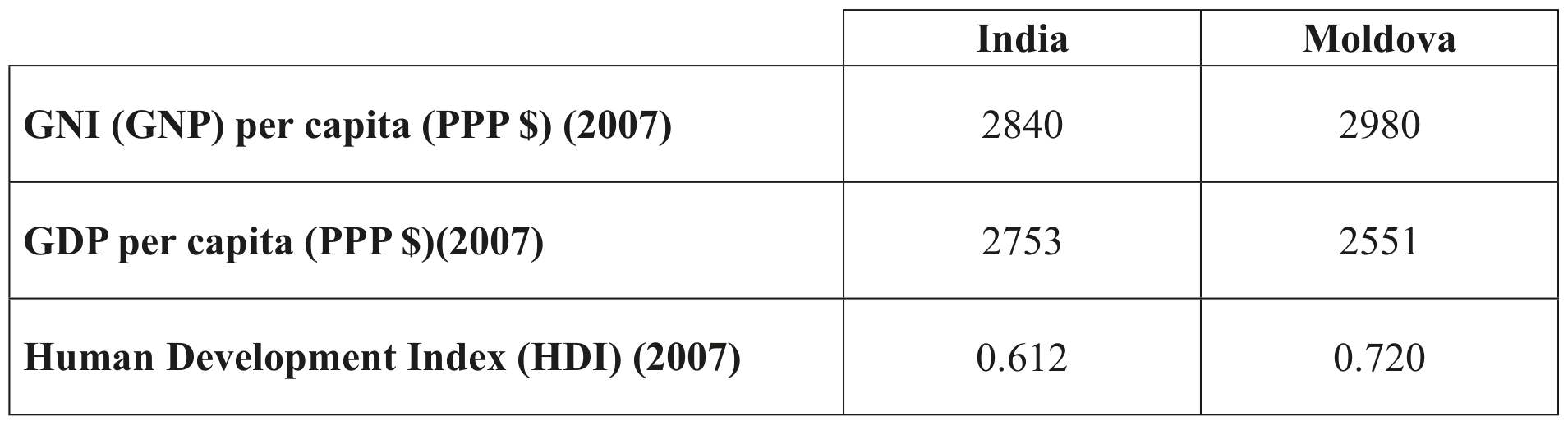
Table 1

Table 1

"Human Development Reports", United Nations Development Programme, accessed 2011]

Table 2

Table 2

Question 4(b)

(a)

Referring to Table 1, explain two possible reasons why India and Moldova have different Human Development Index (HDI) values from each other.

[ 4 ]

Question 4(d)

(b)

Using information from the text/data in Table 2 and your knowledge of economics, examine Amartya Sen's argument that economic growth should not be "our ultimate objective, but a very useful means to achieve ... a better quality of life" (paragraph (4).

[ 8 ]

Question 2

[Maximum number: 2]

Read the extracts and answer the questions that follow.
Text D - Overview of Sierra Leone

(1) Sierra Leone is located on the west coast of Africa. Economic activity is concentrated on agriculture and mining, which together contribute 70 % of gross domestic product (GDP) and 77 % of export revenue.

(2) Economic growth rates fluctuated from +20.1 % in 2013 to -21.5 % in 2015. The economic slowdown in China contributed to a significant drop in mining activities and a fall in Sierra Leone's export revenue. China is Sierra Leone's largest market for exported minerals.

(3) Economic growth rates in Sierra Leone have improved in recent years due to increased activity in agriculture, mining and construction. Increased employment in these labour-intensive sectors could help reduce poverty, which remains widespread in the country. Sierra Leone's ranking in the Inequality adjusted Human Development Index (IHDI) is very low.

(4) The fall in export revenue has led to a 50 % depreciation of the leone (Sierra Leone's currency) over the past five years. Even recent increases in the price of commodities have not been sufficient to offset the high import expenditure on food, medication, cars and capital equipment.

(5) The depreciation of the leone has led to inflationary pressures. The removal of a fuel subsidy resulted in an increase in the price of fuel and pushed the inflation rate from 16.8 % in 2018 to 17.2 \% in 2019.

(6) To make matters worse, access to essential, life-saving health care services in Sierra Leone is often disrupted by regional conflicts. Healthcare in Sierra Leone is generally charged for and is provided by a mixture of government, private and non-governmental organizations (NGOs). NGOs are relied on to protect the health and wellbeing of citizens. NGOs help to achieve this by distributing medicine and teaching families about hygiene and proper sanitation.

(7) Another area of concern is the government debt, which stood at 62 % of GDP in 2019. The government has reduced its budget deficit from 5.7 % to 3.4 % of GDP by minimizing non-payment of taxes and implementing cost-saving measures such as the automation of some government services.

(8) The newly elected government has made good progress in its fight against corruption, but it is facing many macroeconomic challenges. Foreign aid has been reduced, infrastructure is inadequate and many economic activities remain untaxed. Youth unemployment is also high due to low literacy rates and a lack of skills required in the job market.
Text E - Sierra Leone's new development plan

(1) In 2019, the government of Sierra Leone introduced a new five-year development plan. The plan includes policies aimed at increasing the welfare of Sierra Leone's citizens by working towards the Sustainable Development Goals.

(2) The development plan ensures access to free primary and secondary education in all public schools. The cost of education is the main reason that many households are not sending their children, particularly girls, to school. For those paying private education fees, switching to public education would allow more of their household income to be spent on other essential services and farming equipment.

(3) The expected increase in human capital should facilitate economic activities and lead to investment. Schools now teach modern farming practices, such as those involving the use of farm machinery and fertilizers. These would benefit rice farmers and help achieve food security (ensuring people have access to enough food).

(4) The provision of technical education should not only increase agricultural output but also allow for the diversification of the economy. The manufacturing sector contributes only 2 % of the country's GDP and could provide an alternative source of employment. The five-year plan also addresses the lack of infrastructure, in particular for electricity generation, which has so far restricted the development of the manufacturing sector.
Text F - Investment in Sierra Leone

(1) The World Bank ranked Sierra Leone 160th among 190 countries in 2018 for the ease of doing business, citing difficulties in accessing electricity and in obtaining loans and business permits. Government borrowing from the banking sector has increased in recent years, resulting in high interest rates and limited credit availability for the private sector. Foreign investors, however, usually bring capital from abroad.

(2) Despite the challenges, Sierra Leone offers significant opportunities for investment. Foreign investors are involved in the energy sector, infrastructure, agriculture, tourism, and natural resources. Reduced tax rates on corporate income are offered for investments in agriculture and tourism.

Table 3: Economic data for Sierra Leone

Table 3: Economic data for Sierra Leone

Question 2(a)

Question 2(a)(ii)

(a)
(i)

List two dimensions of the Inequality adjusted Human Development Index (IHDI) (Text D, paragraph 3).

[ 2 ]

Question 3

[Maximum number: 4]

Study the extract below and answer the questions that follow.
Urban farms to feed Cuban cities

(1) The Cuban government has launched a project to surround its cities and towns with thousands of organic farms to make the growing of fruit, vegetables and the raising of livestock low cost and environmentally friendly.

(2) The government hopes this new approach to urban farming will make food cheaper and more abundant. It is also hoped that transport and fuel costs will be reduced and that urban dwellers will be encouraged to leave their city jobs and work in the farming sector. The farms are mostly privately-owned with some cooperatives, and more land has been leased to them. These private farmers and cooperatives own about 40 % of Cuba's farmland and produce about 70 % of food grown.

(3) In the past farmers had to purchase their subsidized resources from the government. However, they can now purchase their own seed, equipment and other materials directly from suppliers. They can choose what they want to grow. Farmers are also allowed to sell some of their produce to licensed government sellers or sell directly to consumers at roadside stands. Farmers can also vary the price of the products they sell. These changes allow for greater reliance on the price mechanism and for a more efficient allocation of resources.

(4) However, the Cuban government still plays a major role in production and support of the rest of the agricultural economy. It continues to hold a monopoly over essential foods such as rice, beans, pork and bananas by controlling the production, distribution and land use for these foods. Prices for these commodities are set by the government, which also provides infrastructure, schooling and overall direction to the economy. Nevertheless, poor planning and corruption continue to be obstacles to economic development.

(5) Not all urban farmers can see the long term benefits of this and are concerned about greater competition between producers and the possibility of rising input prices which may result if subsidies end. However, they are encouraged that the reforms allow them to make more decisions about what to produce and how to sell. They believe that more food will be available for sale and consumption. Foreign and local experts welcome the project and expect that as the market mechanism becomes more important, economic growth and economic development will be stimulated.

Question 3(c)

(a)

Explain the relationship between economic growth and economic development.

[ 4 ]

Question 3

[Maximum number: 8]

Study the extract and data below and answer the questions that follow.
Singapore

(1) Singapore is a high-income economy in South-East Asia. The country provides the world's most business-friendly regulatory environment for local entrepreneurs and is ranked among the world's most competitive economies. Presently, the strong manufacturing and services sectors have become the main drivers of the Singapore economy. There is a wide range of businesses, with a particular focus on high value added goods and services.
Timor-Leste (East Timor)

(2) Timor-Leste (formerly known as East Timor) is a developing economy in South-East Asia. Timor-Leste gained independence from Indonesia in 2002. The country and families were torn apart by violence in the years before independence. Nearly 70 % of all buildings, homes and schools were destroyed. An estimated 75 % of the population were forced to move due to the violence.

(3) After serious challenges, Timor-Leste has progressed, particularly due to its endowment of natural resources, especially oil. With the petroleum revenue boom, fiscal policy has been expansionary and the economy has grown rapidly as a result of government spending, focusing on major infrastructure, development of skills, and other institutional changes. A main goal was to generate increased and sustainable private sector investment as a means to increased job opportunities and to reduce poverty. These developments are starting to contribute to poverty reduction and improved social outcomes.

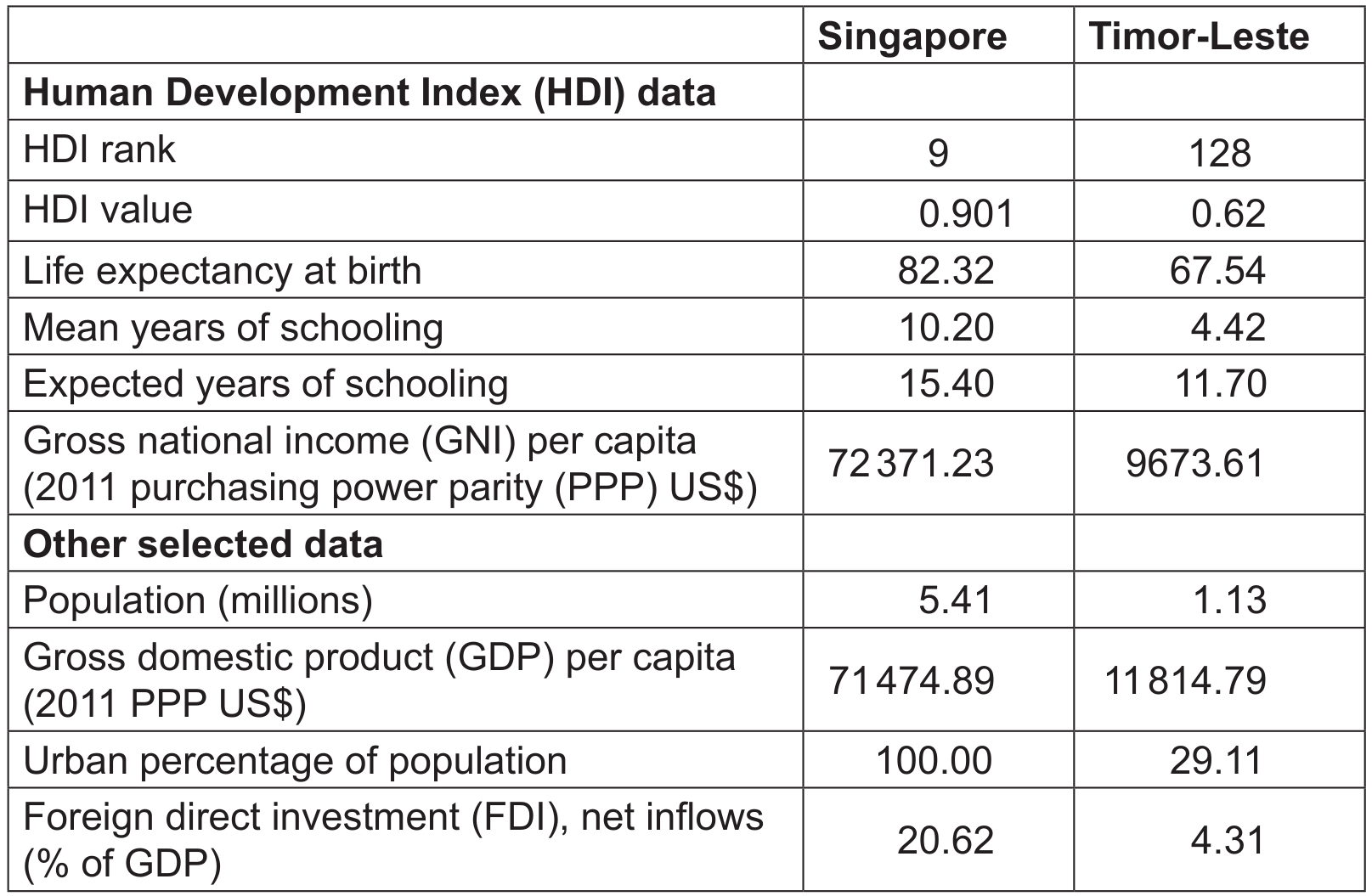
Figure 1 - Selected economic data for Singapore and Timor-Leste - 2013

Figure 1 - Selected economic data for Singapore and Timor-Leste - 2013

Question 3(d)

(a)

Using information from the text/data and your knowledge of economics, compare and contrast the Human Development Index (HDI) data for Singapore and Timor-Leste in terms of their relevance for economic development.

[ 8 ]

Question 3

[Maximum number: 12]

Study the extract below and answer the questions that follow.
Democratic Republic of Congo - development affected by conflict

(1) The Democratic Republic of the Congo (DRC) is a nation with many natural resources. It is slowly recovering after decades of decline. Corruption since independence in 1960, combined with political instability and conflict that began in the mid 1990s, has dramatically affected national output and government revenue.

(2) Much economic activity occurs in the informal sector. However, activity in the mining sector, the source of most export income, has boosted the government's fiscal position and gross domestic product (GDP) growth in recent years. Mining companies are exploiting the large reserves of copper, diamonds and gold, in particular Chinese companies. In 2012, 53 % of DRC exports went to China.

(3) The greatest challenge confronting the DRC is conflict. The conflict is due to rival groups fighting to control the country's resources. Five million people have died. More than 90 % of those who died were indirect victims of violence - in other words these were people made homeless by violence who then died due to diarrhoea, malaria and pneumonia. The Human Development Index (HDI) value for the DRC was 0.304 in 2012, which was the lowest ranking in the world.

(4) However, there is hope. The DRC provides 80 % of the minerals used to make satellites and mobile phones (cell phones) and it has the agricultural potential to feed the rest of Africa. It has also averaged more than 6 % annual growth in GDP since 2004 and the World Bank has forecast economic growth of 9.6 % in 2012, with even higher growth in 2013.

(5) To add to the DRC's challenges there has been more forest clearance in the Congo Basin since 2010, much of it for palm-oil plantations. Annual rates of deforestation in the Congo Basin have doubled since 1990, according to a new study. This study lists population growth, migration, economic development and global demand for natural resources as the major pressures on the forests. http://cifor.org/mediamultimedia, accessed 28 July 2013; http://newscientist.com, accessed 28 July 2013 and http://www.spyghana.com, accessed 28 July 2013]

Question 3(b)

(a)

Explain why the Human Development Index (HDI) is considered to be a useful indicator of economic development (paragraph (3).

[ 4 ]

Question 3(d)

(b)

Using information from the text/data and your knowledge of economics, discuss the extent to which economic growth has led to economic development in the Democratic Republic of the Congo (DRC).

[ 8 ]

Question 3

[Maximum number: 2]

Study the extract and data below and answer the questions that follow.
Mozambique to produce its own antiretroviral (ARV) drugs

(1) Mozambique's health minister announced that the first ARV drugs produced in Mozambique, in partnership with Brazil, will be ready by July 2012. In doing so, it will be the first African country - rather than private sector supplier - to produce its own supply of the drug, which can allow people who have HIV to live for many years.

(2) Until 2011, a handful of drug multinational corporations have battled to keep in place patents that give drug companies the exclusive right to manufacture and sell the ARV drugs. This has allowed them to control the highly profitable market. Although most African countries aim to provide free ARV drugs to their citizens, the high costs of importing them, along with a recent cut in funding from international foundations, means that many are struggling.

(3) A total of 10.6 million people in Sub-Saharan Africa are in need of ARV treatment but only 37 % currently have it. In Mozambique, 15 % of people aged 15 to 49 have HIV. Brazil has been producing its own ARV drugs since 1993 and now provides free versions of the drugs to everyone in the country suffering from HIV.

(4) Mozambique is the biggest beneficiary of aid from Brazil, which has invested heavily in its infrastructure, mining, health, agriculture and educational sectors.

(5) The health minister signed an agreement with Brazil to co-produce ARV drugs in a factory in the southern city of Matola, Mozambique. Brazil will provide training for Mozambican staff in the production, management and quality control of the drugs. He was pleased because more people in Mozambique will soon have access to the ARV drugs.

(6) Other countries in Africa are also taking steps to produce their own drugs. As new international agreements on intellectual property are going to make drugs more expensive, countries are now trying to produce the ARV drugs themselves. This is a positive move for Mozambique.

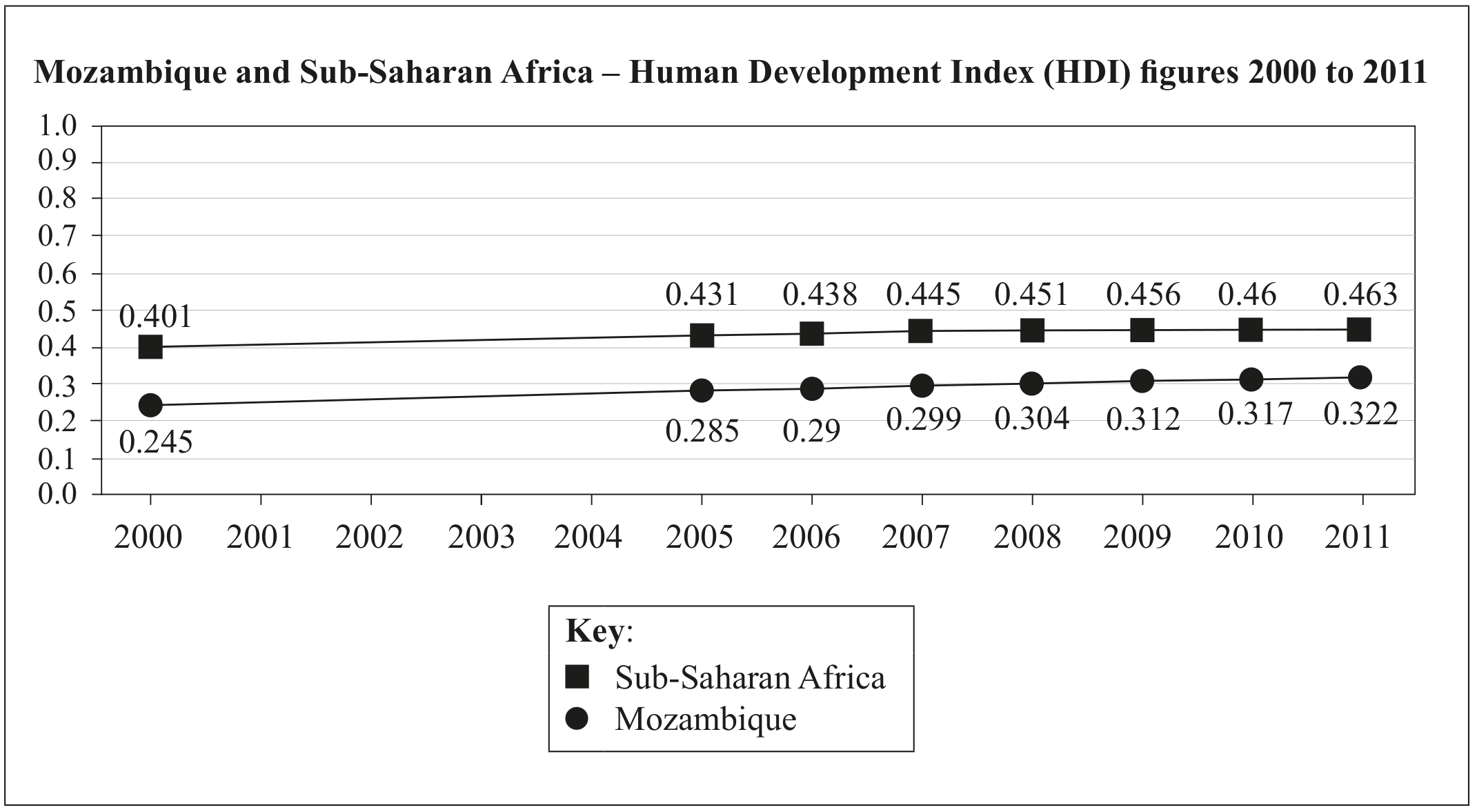
Figure 1

Figure 1

Question 3(a)

Question 3(a)(ii)

(a)
(i)

With reference to the data in Figure 1, describe the HDI trend for Mozambique from 2000 to 2011.

[ 2 ]
0 selected