
EduNinja

IB Economics SL4.2 Types of trade protectionQuestion Bank

Question 1

[Maximum number: 4]

Read the extracts and answer the questions that follow.
Text A — Bangladesh: the economic role of women

(1) Bangladesh is a densely populated country in Asia. Its currency is the Bangladeshi taka (BDT). The annual rate of growth of gross domestic product (GDP) has steadily increased from 5.6 % in 2010 to 8.1 % in 2019. Absolute poverty has declined, but inequality has risen, partly due to higher unemployment rates for women than men. Moreover, the labour force participation rate for women is much lower than the rate for men. Over 80 % of the women's jobs are in the informal economy, and these jobs are low paid and insecure. Women need regular paid work, which not only raises household income but also improves economic well-being in terms of education and health.

(2) The structure of the economy is changing. The growth of cities is due to the expansion of the manufacturing sector, which now contributes a larger share to GDP than the agricultural sector. These changes have increased the number of women in the labour force. In particular, the growth of the ready-made garments (RMG) industry (mass-produced clothing) has given women the opportunity to move into formal employment. The RMG industry provides jobs for almost 4 million low-skilled and semi-skilled workers, accounting for over 40 % of total manufacturing employment. The majority of these jobs are being filled by women, with the result that the gap between the wages of men and women is gradually being reduced.

(3) There are concerns about working and safety conditions in the RMG factories. After an accident in a factory in 2013, reforms are being implemented, partly in response to criticisms from overseas retailers and consumers who purchase the garments. The minimum wage has been increased, inspections are carried out, and there are fewer small, unsafe factories.

(4) While working conditions are improving, such reforms raise the costs of manufacturing garments. Furthermore, the international garment market is becoming more competitive, putting pressure on Bangladeshi factories to reduce costs.

(5) The overseas demand for Bangladeshi garments had been rising strongly until 2019. However, demand has recently fallen, reducing firms' revenue. The reduction in revenue and the need to lower costs have forced certain firms to reduce the size of their labour force by dismissing some of their female workers.

(6) The number of ethically and environmentally concerned consumers is increasing globally. Rather than trying to lower costs, firms can be more successful if they produce "green ready-made garments" by implementing sustainable practices. About 100 garment factories in Bangladesh have already been certified as producers that meet specified environmental standards. In addition, global retailers and fashion brands are supporting recycling initiatives through the Circular Fashion Partnership.
Text B - Trade prospects for exports of ready-made garments (RMG)

(1) Exports of RMG account for over 84 % of Bangladesh's total exports. At present, Bangladesh is the world's second largest garment exporter after China. Bangladeshi exports could further increase as Chinese garments become more expensive due to rising wages in China.

(2) Bangladesh is designated as an Economically Least Developed Country (ELDC) and is therefore able to sell goods in Europe and China without any quotas or tariffs being imposed. However, Bangladesh will graduate from ELDC status by 2026 and will then no longer be eligible for preferential trade agreements. Moreover, the USA, which is the largest export market for Bangladeshi garments, has applied a 15 % tariff on imports from Bangladesh since 2013, citing concerns about working conditions in factories.
Text C - Role of foreign direct investment in the RMG sector

(1) Vietnam and Myanmar have significantly increased their garment exports to China due to foreign direct investment (FDI) from China. Chinese investors have set up factories that import raw materials from China and re-export the finished goods back to China.

(2) Consequently, to compete successfully in the huge Chinese market, Bangladesh needs to attract more FDI from China. Bangladesh is developing the required infrastructure, such as transport links. It is also necessary to diversify into expensive high-end fashion, market more aggressively, and use branding strategies.

(3) The funds from additional FDI would be helpful, because the relative contribution of Official Development Assistance (ODA) to Bangladesh's budget is declining. Furthermore, the foreign exchange obtained from foreign investors assists in financing the current account deficit.
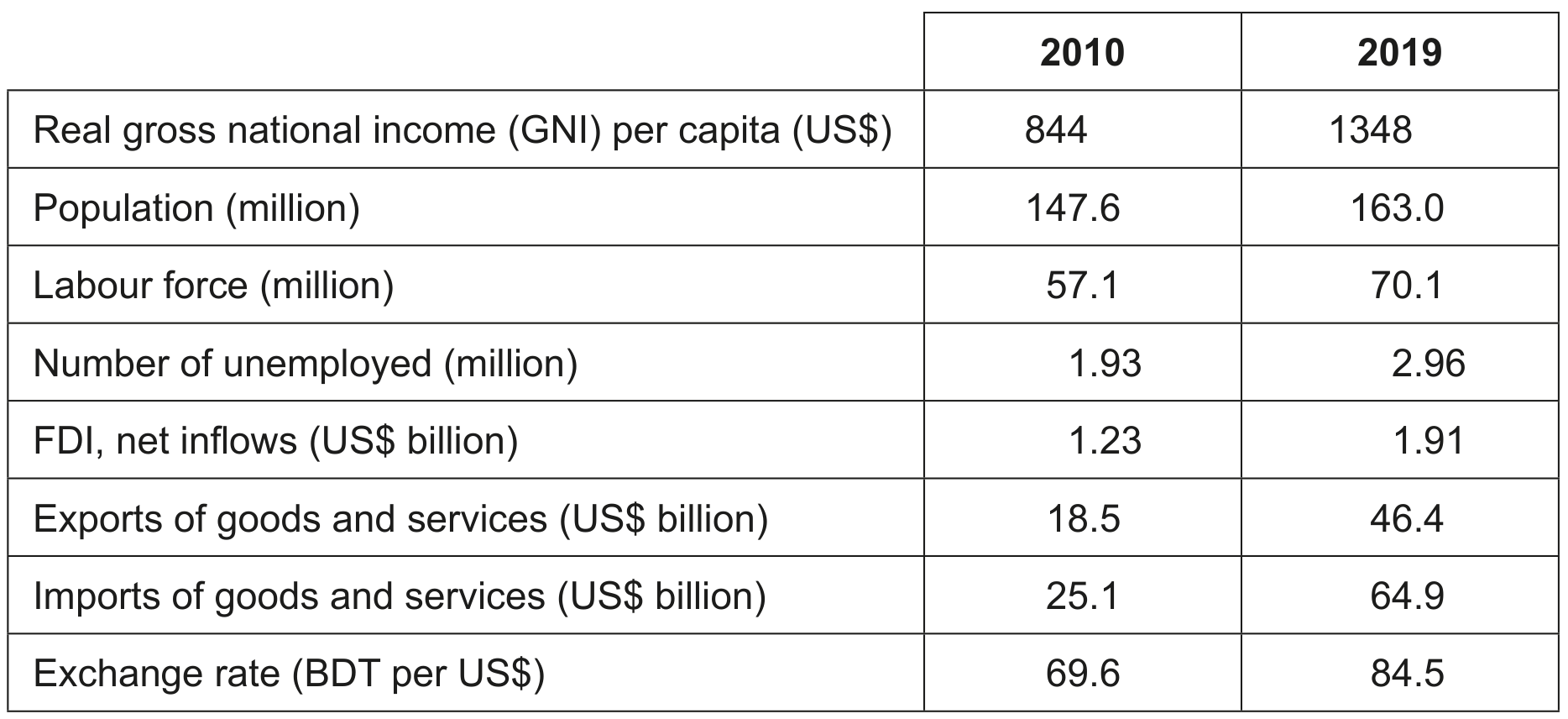
Table 1: Economic data for Bangladesh
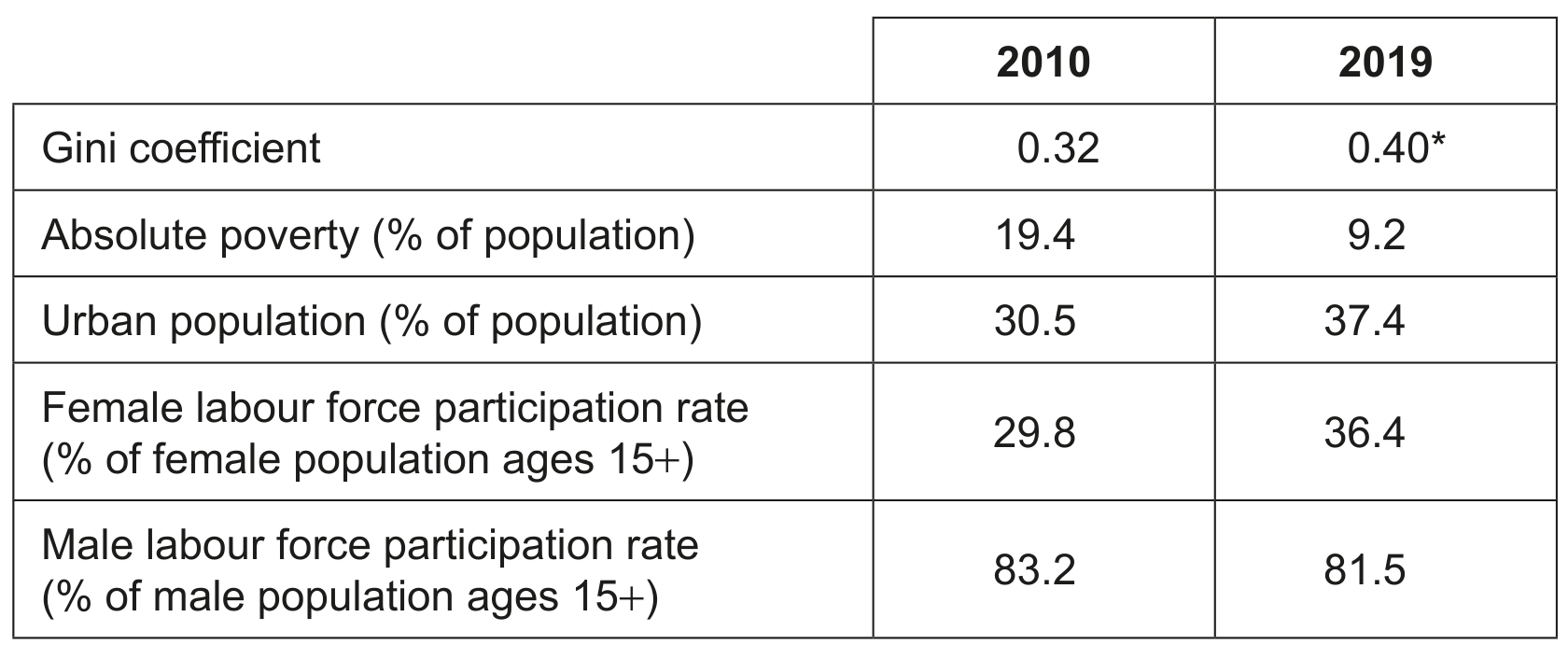
Table 1: Economic data for Bangladesh

Table 2: Development data for Bangladesh

Table 2: Development data for Bangladesh

*estimate

Question 1(d)

(a)

Using an international trade diagram for the US market, explain how the imposition of a 15 % tariff on imported garments from Bangladesh would affect the revenue earned by Bangladeshi producers (Text B, paragraph 2).
[ 4 ]

Question 1

[Maximum number: 12]

Study the following extract and answer the questions that follow.
China and global trade

(1) On 15 January 2020, the United States (US) and China signed a deal that reduced some tariffs and required China to buy more from US producers. This was a first step towards resolving a trade war, which had reduced bilateral trade flows by 9 % and investment flows by 60 %. However, critics argued that the deal left most tariffs unchanged and did not deal with deeper disagreements.

(2) The US, the European Union (EU) and Japan are calling for tougher World Trade Organization (WTO) rules on government support for firms that manufacture items such as steel or solar panels. The support, which is often in the form of subsidies, has allegedly undermined competing firms overseas, either by promoting exports or by decreasing imports, and therefore distorted global trade. Other governments also give subsidies, but there are claims that China uses them more extensively.

(3) The proposed WTO rule change would require governments to prove that subsidies do not give domestic firms an unfair advantage over foreign firms and that they do not lead to excess supply in the global market. If the rules are implemented, the WTO may regain some of the authority that it has lost in recent years.

(4) One of the US government's goals when imposing huge tariffs on Chinese-made goods was to bring back manufacturing jobs to the US. Therefore, despite the new deal, the 25 % tariff on Chinese-made furniture will stay. As a result, many US furniture firms that had used overseas factories to make their US company-branded products have reduced their imports of Chinese-made furniture.

(5) Meanwhile, Vietnam, Cambodia and Bangladesh are benefitting because US manufacturers of wood furniture are setting up factories there. Therefore, some other US producers are asking for the tariff on Chinese-made wooden furniture to apply to all wooden furniture imported into the US, regardless of where it is manufactured.

(6) China is becoming less dominant as an exporter and more integrated into the global trading system. Its current account surplus was over 10 % of gross domestic product (GDP) in 2007, but it declined to just 0.4 % in 2018 . Chinese producers are increasingly buying raw materials and other inputs from overseas producers. Although most electronic devices sold in the US are assembled in China, Chinese firms are often dependent on foreign suppliers. If the US and China tried to be less interdependent, it would take more than 10 years for China to become self-sufficient in the production of computer semiconductors and for the US to shift to other suppliers of electronic devices.

Question 1(b)

(a)

Using a tariff diagram, explain the likely effect on consumer surplus of a 25 % tariff on all wooden furniture imported into the US (paragraph 5).

[ 4 ]

Question 1(d)

(b)

Using information from the text/data and your knowledge of economics, evaluate China's use of subsidies as a form of trade protection.

[ 8 ]

Question 1

[Maximum number: 4]

Study the following extract and answer the questions that follow.
China's trade reforms

(1) The Chinese government has announced a set of free trade measures, including lower import tariffs on cars, soybeans and pharmaceuticals, in an attempt to end a trade war with the United States (US).

(2) The US government has long accused China of engaging in unfair trade practices to maintain their current account surplus. The trade dispute between the two largest economies intensified when the US said it would impose anti-dumping tariffs on Chinese steel and aluminium.

(3) The trade war with the US comes at a bad time given the slowdown in China's domestic demand. In recent years, China's economic growth has relied less on investment and exports and more on consumption expenditure.

(4) Producers of many Chinese manufactured goods currently benefit from protectionist measures. In particular, imports of industrial equipment, medical devices, tractors and vehicles are subject to high tariffs.
5 Automobile production capacity in China is growing. However, the domestic market is becoming oversupplied, with more cars being offered for sale than Chinese consumers want to buy. For this reason, Chinese car manufacturers are seeking to export their cars to other markets. They are therefore eager to see reduced trade tensions as increased US tariffs would make it harder to export Chinese cars to the US.

(6) Some Chinese car manufacturers are already focusing on adding advanced capabilities to their cars in order to be more competitive in global markets. China is increasing its efforts to become a world leader in self-driving cars. These will be intelligent cars that will improve transport efficiency and meet energy-saving and emission-reduction targets. Many believe that Chinese companies are so innovative that they no longer require protection from international enterprises.

(7) However, many Chinese firms remain dependent on imported factors of production. Approximately 30 % of Chinese exports are manufactured using imported equipment and components. The reduction of tariffs would therefore lower prices not only for producers but also for consumers of Chinese goods.

Question 1(b)

(a)

Using an international trade diagram, explain how US tariffs could affect the export of Chinese steel and aluminium to the US (paragraph (2).

[ 4 ]

Question 1

[Maximum number: 6]

Study the following extract and answer the questions that follow.
Japan-European Union Economic Partnership Agreement (JEEPA)

(1) In July 2017, the Japan-European Union Economic Partnership Agreement (JEEPA) was announced and it may come into force in 2019. Jointly, Japan and the European Union (EU) currently account for 28 % of global gross domestic product (GDP). The trade agreement could raise the EU's exports to Japan by 34 % and Japan's exports to the EU by 29 %. Economists say that this trade agreement marks a determined effort to combat rising protectionism and sends a powerful signal that cooperation, not trade protection, is the way to tackle global challenges.

(2) The largest benefit to Japan will be for Japanese car manufacturers, as Europe will gradually lower tariffs from 10 % on Japanese cars. Car tariffs are a big concern for Japanese car manufacturers, who struggle to compete with South Korean car manufacturers. South Korean cars are sold to the EU tariff-free thanks to a free trade agreement signed in 2011. Within Europe, car manufacturers are one of the largest sources of jobs. Car manufacturers in the EU are concerned that cutting tariffs on car imports from Japan may lead to a large increase of Japanese cars into the European market.

(3) The trade agreement will also resolve non-tariff barriers, such as technical requirements and regulations. More importantly, however, the EU and Japan will make their environmental and safety standards on cars the same, which will make trade easier.

(4) Japanese politicians have been defending their relatively inefficient farmers for a long time. Now, Japan will lower tariffs on European meat, dairy products and wine, cutting 85 % of the tariffs on food products coming into Japan. This includes removing the current 30 % tariff on some European cheeses, such as cheddar and gouda cheese. However, imported camembert cheese will face a quota. This may be because Japan produces some camembert cheese.

(5) JEEPA is particularly alarming for United States (US) beef and pork farmers because Japan has been the biggest export market for US beef and the second biggest export market for US pork. Any preferential tariff that EU farmers receive will make it much tougher for American farmers to sell meat in Japan.

(6) With this trade agreement, the EU and Japan are trying to promote the values of economic cooperation and environmental conservation, which are both important for long-term economic growth and sustainability. However, JEEPA faces significant challenges because it will have to be passed by the Japanese Parliament, the European Parliament and European national governments. There is no guarantee that all governments will agree to the economic partnership. 15 July 2017; Japan-EU trade agreement may hurt U.S. meat producers, by Katherine Hyunjung Lee, Jul 12, 2017, Medill News Service, https://dc.medill.northwestern.edu; and A new trade deal between the EU and Japan, The Economist (London, England), Jul 8th 2017, https://www.economist.com/finance-and-economics/2017/07/08/a-new-trade-deal-between-the-eu-and
japan. © The Economist Newspaper Limited, London, July 8th 2017]
}

Question 1(a)

Question 1(a)(i)

(a)
(i)

Define the term quota indicated in bold in the text (paragraph (4).

[ 2 ]

Question 1(c)

(b)

Using an international trade diagram, explain the likely impact of Japan "removing the current 30 % tariff" on the level of cheddar cheese imports (paragraph (4).

[ 4 ]

Question 1

[Maximum number: 12]

Study the following extract and answer the questions that follow.
United States (US) tin can manufacturers seek tariff exemption on tinplate steel

(1) The Can Manufacturers Institute (CMI) has asked the US Department of Commerce to take away tariffs and other trade protection measures that are currently applied to imports of tinplate steel. Tinplate steel is used to make tin cans as packaging for food. The CMI represents the tin can manufacturing industry and its suppliers in the US.

(2) The tin can manufacturing industry accounts for the annual domestic production of approximately 124 billion tin cans. The industry employs more than 28000 people, with factories in 33 US states, Puerto Rico and American Samoa. It generates revenue of around US$17.8 billion. The CMI claims that the tariff on imports of tinplate steel has a severe economic impact on the tin can manufacturing industry.

(3) Approximately 2 % of all US steel is tinplate. Currently, there is excess demand that is causing a disequilibrium in the domestic US tinplate steel market. In 2016, US demand for tinplate steel was 2.1 million tons, while domestic supply was 1.2 million tons, meaning that only 57 % of domestic demand was met by US tinplate steel producers. Not only is there a domestic shortage of tinplate steel, but also the CMI claims that there has been a noticeable decline in the quality of domestically-produced tinplate steel.

(4) The CMI claims that even a small increase in the price of raw materials could create a competitive disadvantage, forcing some tin can manufacturing plants to shut down. This would create structural unemployment for 10000 workers in regionally-based factories. The CMI also claims that the tariff puts food can producers at a competitive disadvantage with other food packaging substitutes, such as plastic and glass. These substitutes are not subject to tariffs.

(5) According to the CMI, canned fruits and vegetables cost 20 % less than fresh food. Because of this, people on low incomes consume canned foods at a higher rate than the average American. Canned food offers a low-cost solution to feeding the nation; especially the 42 million Americans who live in low-income households. The figure includes 13 million children. The CMI further claims that tariffs, or any trade barriers, have harsh consequences for those living in relative poverty.

Question 1(c)

(a)

Using an international trade diagram, explain the effect of a tariff on the imports of tinplate steel (paragraph (1)).

[ 4 ]

Question 1(d)

(b)

Using information from the text/data and your knowledge of economics, discuss possible economic impacts of the tariff on tinplate steel.

[ 8 ]

Question 1

[Maximum number: 6]

Study the extract below and answer the questions that follow.
Relief as Kenya raises tariff for steel and iron imports

(1) Steel manufacturers in Kenya are set to benefit as the government moves to protect the local manufacturing industry from cheap steel and iron imports.

(2) In 2014 a government official announced an increased tariff on steel and iron imports. "Our steel mills are closing down due to unfair competition from cheaper imported iron and steel products," he explained. "To protect and create more jobs in the iron and steel industries, tariffs on a wide range of imported iron and steel products will be increased from 0 % and 10 % to 25 %," he said. The government official further stated that as well as protecting the local industries from cheaper imports, the protectionist measures would raise an additional 2.6 billion Kenyan shillings (Kenya's currency) annually in government revenue and support economic growth.

(3) The potential of local industries to expand and create jobs through trade has been held back by a number of administrative barriers. The government remains focused on improving the business environment. Over the past six months, the government has made it easier to register a company and trade across borders. The time taken to move goods out of the main harbour has fallen sharply; non-tariff barriers such as roadblocks have also been reduced. Importers of refined industrial sugar and wheat are also pleased after the government scrapped requirements to pay unnecessary administrative charges.

(4) However, there is a belief among manufacturers that there is a need for more deregulation to lower their costs of production and in effect reduce the cost of doing business.
Kenya sees gross domestic product (GDP) growth picking up but current account a concern

(5) Good economic growth rates in neighbouring countries like Uganda help to boost Kenyan exports, particularly for agriculture that makes up nearly a quarter of the Kenyan economy. The government suggests that the main risks to growth are the slow performance of developed economies that are key export markets for Kenyan goods and services, and Kenya's large and persistent current account deficit of over 10 % of gross domestic product (GDP) in the last three years. This is a major concern for sustained economic growth and the value of the Kenyan shilling.
[Sources: adapted from www.standardmedia.co.ke, 13 June 2014; www.af.reuters.com, 25 July 2014 and www.cnbcafrica.com, 25 November 2013]

Question 1(a)

Question 1(a)(i)

(a)
(i)

Define the term tariff indicated in bold in the text (paragraph 2).

[ 2 ]

Question 1(b)

(b)

Using an international trade diagram, explain the impact on the Kenyan government of implementing a tariff on steel imports.

[ 4 ]

Question 1

[Maximum number: 12]

Study the extract below and answer the questions that follow.
US steel

(1) With trans-Pacific and trans-Atlantic trade talks missing deadline after deadline, the United States (US) government is putting new tariffs on steel imports. This action will raise prices for many US firms, threaten domestic energy production, and upset trading partners worldwide.

(2) Last week, the US Department of Commerce imposed tariffs on hundreds of millions of US dollars worth of annual trade with South Korea and eight other countries, including India, Taiwan, Turkey and Vietnam. As punishment for allegedly dumping steel into the US market, South Korea's exporters will face tariffs of about 10 % to 16 %, while smaller producers from other countries face rates up to 118 %.

(3) In a preliminary review, the US International Trade Commission found a "reasonable indication" that US steel firms are being "injured" by foreign competitors' low prices.

(4) Low-priced steel from South Korea is good for American buyers but annoying for American producers who would rather have the market to themselves and charge higher prices.

(5) Spokespersons for US Steel Corporation complain that steel imports rose 113 % between 2010 and 2012, with South Korean products accounting for half the increase. They blame dumping, but the better explanation is related to America's energy revolution, where producers have taken advantage of two newly viable technologies: horizontal drilling and "fracking" to release gas and oil from rock formations. The resulting increase in energy production has been dramatic. Between 2007 and 2012, fracking generated an 18-fold increase in US production of what is known as light tight oil. This has created even more demand for steel, as steel products are needed in the gas energy market.

(6) The US steel tariffs will encourage other countries to raise trade barriers against American goods. The World Trade Organization (WTO) has already ruled against US tariffs imposed on Chinese steel and solar panels as well as Indian steel from 2007-2012. In the China case, the WTO ruled that the US had not provided enough evidence that the Chinese steel exporters received government subsidies.

(7) When the US imposes tariffs, it raises prices for many stakeholders to benefit the protected few. Copyright © 2014 Dow Jones \& Company Inc. All Rights Reserved Worldwide]

Question 1(b)

(a)

Using an international trade diagram, explain how the imposition of "tariffs of about 10 % to 16 % " will affect the revenues of foreign steel exporters in the US market (paragraph 2).

[ 4 ]

Question 1(d)

(b)

Using information from the text/data and your knowledge of economics, discuss the possible impact of the US steel tariffs on the different economic stakeholders.

[ 8 ]

Question 1

[Maximum number: 8]

Study the extract below and answer the questions that follow.
Clean energy products

(1) In a speech on climate change, President Obama announced a plan for the United States (US) to work with trading partners and the World Trade Organization (WTO) towards global free trade in clean energy products, such as solar panels and wind towers.

(2) The US will build on the Asia-Pacific Economic Cooperation (APEC)* agreement where member economies agreed to remove quotas and reduce tariffs to 5 % or less by 2015 on a negotiated list of 54 clean energy products.

(3) However, the APEC agreement does not include reducing anti-dumping tariffs. Such tariffs are allowed under WTO rules. When importers are suspected of dumping clean energy products on the domestic market, industries seek protection by putting pressure on government to impose anti-dumping tariffs.

(4) In recent years, anti-dumping tariffs on clean energy products have increased. In 2011 China was found to be subsidizing and dumping wind towers on the US market. In retaliation, the US imposed an anti-dumping tariff of between 45 % and 71 %. In addition, a similar tariff was imposed on Vietnamese wind tower imports.

(5) In the solar industry in 2012, a group of seven US solar panel manufacturers sought protection from cheap Chinese imports. After investigating claims of dumping, the US imposed anti-dumping tariffs ranging from 24 % to 36 % on Chinese solar panel producers.

(6) The Coalition for Affordable Solar Energy (CASE), which represents importers, installers and solar power generators, supports the President's strategy to address climate change by making imports of environmental goods more affordable and giving consumers choice. However, the National Association of Manufacturers (NAM), representing domestic producers of clean energy products, are hostile, claiming that the strategy "runs a serious risk of punishing Americans with higher energy bills, fewer jobs, and a weaker economy, while delivering negligible benefits to the environment".

(7) Similar trade issues have arisen between China and the European Union (EU). In 2011, solar panels made up 6.5 % of China's exports to Europe at a value of around US $ 27 billion. In 2012, Belgian solar panel manufacturers claimed that these products were being dumped in the EU market. In June 2013, the EU announced that it would impose anti-dumping tariffs of up to 47 % on Chinese solar products. In retaliation China threatened to impose a tariff on EU wine, arguing that EU farm subsidies had resulted in European countries dumping wine in China. After these Chinese threats of retaliatory trade measures the EU reduced the solar panel tariff to 12 %.
http://economist-pick-research.hktdc.com, accessed 20 August 2013 and
http://bbc.co.uk/news, accessed 6 October 2013]
* Asia-Pacific Economic Cooperation (APEC): member economies are Australia, Brunei Darussalam, Canada, Chile, China, Chinese Taipei, Hong Kong, Indonesia, Japan, Malaysia, Mexico, New Zealand, Papua New Guinea, People's Republic of China, Peru, Republic of Korea, Russia, Singapore, Thailand, The Philippines, The United States and Vietnam

Question 1(b)

(a)

Using an international trade diagram, explain the effects on individual APEC "member economies" of removing a quota on the market for clean energy products (paragraph (2).

[ 4 ]

Question 1(c)

(b)

Using a demand and supply diagram, explain how a tariff on solar panels would affect the market for solar power electricity (paragraph (5).

[ 4 ]

Question 1

[Maximum number: 4]

Read the extracts and answer the questions that follow.
Text A — Overview of North Macedonia

(1) North Macedonia is a small, landlocked nation that shares borders with five countries, including Bulgaria and Greece. Bulgaria and Greece are members of the European Union (EU) common market, which North Macedonia hopes to join soon. Since the country began negotiating for EU membership, trade with the EU has increased rapidly and now accounts for 75 % of North Macedonia's exports and 62 % of its imports.

(2) Despite its small market, with a population of approximately 2 million, North Macedonia's proximity to the EU, low wages and expected entry into the common market have attracted foreign investors. Greece, its richest neighbour, was its third highest source of foreign investment in 2019. The lower cost of living also appeals to Greek tourists.

(3) EU companies have invested in the financial, telecommunication, energy and food processing industries in North Macedonia. Many of the most profitable companies are from the EU. If EU membership is granted, foreign direct investment (FDI) inflows may increase as firms located in North Macedonia will be allowed to bypass all custom checks and enjoy tariff-free trade within the common market. One particular challenge for North Macedonia, however, is that most of the profits of foreign companies are likely to be repatriated (sent back to the companies' home countries).

(4) In 2018, North Macedonia's export revenue was US $ 7.57 billion and its import expenditure was US$9.56 billion. The country's main exports are iron and steel, clothing and accessories, and food products. Food, livestock and consumer goods account for 33 % of imports while the remainder are machinery, petroleum and other materials needed for the industrial production process.

(5) The manufacturing sector, which now employs 31 % of the labour force, has gained more importance. The agricultural sector remains strong, contributes over 10 % of North Macedonia's gross domestic product (GDP) and employs about 16 % of the country's workforce.

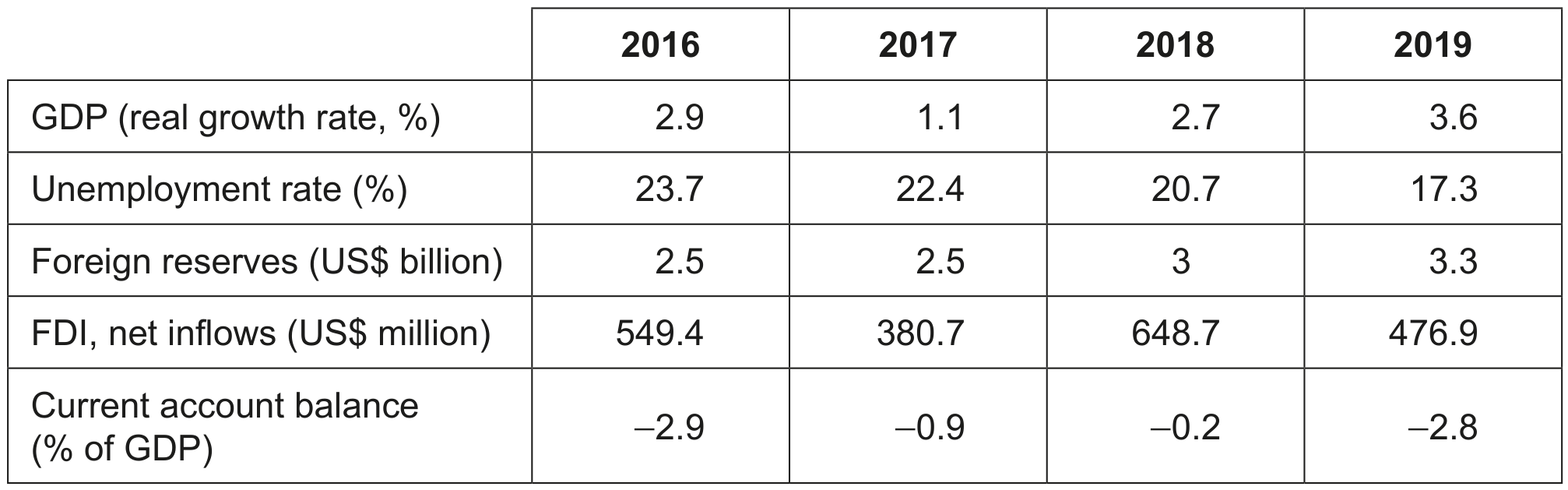
(6) The unemployment rate decreased from over 30 % in 2010 to 17.3 % in 2019. However, youth unemployment is almost 40 %. Over 20 % of the population lives below the poverty line. Unemployment and poverty contribute to high rates of emigration. More than 20 % of the North Macedonian population have emigrated since 1994, mostly to the EU. As a member of the EU, North Macedonia will enjoy free movement of labour which will make it easy for its citizens to live and work in other EU countries.
Text B - North Macedonia's economic reforms

(1) To be considered for EU membership, North Macedonia implemented a series of supply-side policies to reform its economy. The EU imposes strict requirements for membership but provides financial assistance to countries preparing for membership. North Macedonia has received 633 million euros (the currency of the EU) to help with the reforms.

(2) Most of the supply-side policies seek to improve the international competitiveness of North Macedonia's industries. The authorities are increasing access to education and training for workers. The expansion of the transport network and other infrastructure is also expected to increase efficiency.

(3) Protection of the environment is also on the list of requirements for EU membership. North Macedonia aims to reduce its dependence on coal and to instead promote the use of solar, wind and hydropower technologies. These low-carbon energy sources would help decrease its air pollution, which is among the worst in Europe.

(4) The reforms, which started in 2014, have shown progress. Exports and manufacturing output are more diversified and more concentrated on high-value products. To attract FDI, North Macedonia maintains one of the lowest tax rates on corporate income in the region. The central bank also prevents the denar (North Macedonia's currency) from appreciating against the euro through managing foreign reserves. However, skill shortages and a mismatch of skills with those required by companies discourage foreign firms from investing. Important investment gaps in public infrastructure also remain.
Text C - North Macedonia's trade agreements
North Macedonia participates in five free trade agreements (FTAs), that together cover 95 % of its exports and 78 % of its imports. Most of its trade with the EU is already free but imports of wine, beef and fish products are still subject to quotas. North Macedonia is currently a net importer of agricultural and food products. All protectionist measures on EU products would be removed upon entry into the common market.

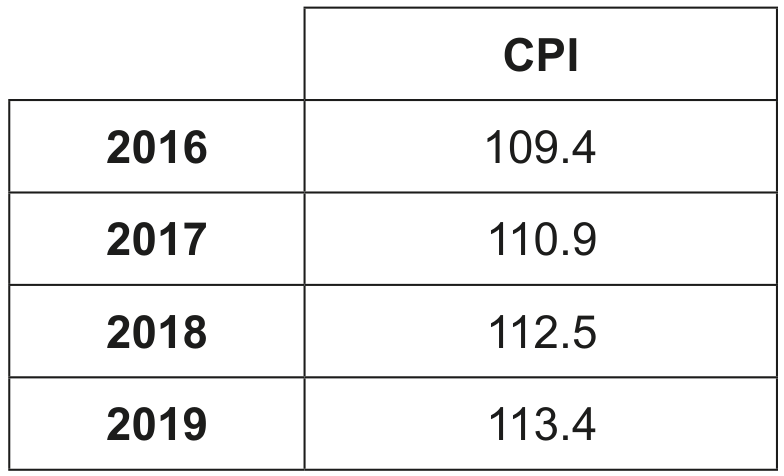
Table 1: Consumer Price Index (CPI) for North Macedonia (base year = 2010)

Table 1: Consumer Price Index (CPI) for North Macedonia (base year = 2010)

Table 2: Economic data for North Macedonia

Table 2: Economic data for North Macedonia

Question 1(f)

(a)

Using an international trade diagram, explain the likely impact of the removal of import quotas on North Macedonia's production of wine (Text C).

[ 4 ]

Question 1

[Maximum number: 4]

Study the following extract and answer the questions that follow.
South Africa's grain millers oppose corn tariff

(1) A battle is taking place between South African corn farmers and the corn millers who process corn. Grain South Africa (Grain SA) is the organization that represents the interests of corn farmers. It has asked the country's International Trade Administration Commission (ITAC) to protect local corn farmers from low global corn prices by imposing a tariff on corn imports.

(2) South Africa's corn millers are opposing the request by Grain SA to implement the tariff on corn imports. The corn millers argue that a tariff will cause a burden for consumers and cattle farmers. In South Africa, corn is an essential food and also a source of feed for livestock.

(3) According to Reuters news service, South Africa is "Africa's largest corn producer and is relied upon by neighboring Sub-Saharan nations to [reinforce] their own corn supplies and feed their people." A drought in South Africa has dramatically increased the price of corn. In addition, the reduced supply has prompted the need for imports. "South Africa [has traditionally been] a net exporter of corn ... [but] for the second year in a row, [the economy] will become a net importer of corn." The need to import corn has shocked both the corn farmers and the government.

(4) The United States (US) is the world's largest corn producer. An unusually large harvest has increased US supply and more than halved the price of US corn to its current price of US$145 a ton. However, in South Africa, because of the drought, prices for domestically produced corn have more than doubled to reach an all-time high of US$348 a ton. The low import prices of US corn have made it very difficult for South African corn farmers to earn sufficient income to survive the drought, which is why they have asked ITAC for protection.

(5) However, a spokesperson for the corn millers said "we are strongly opposed to any attempt to apply a tariff. Why do we need protection for a commodity in which we are so self-sufficient?" However, Grain SA have claimed that corn farmers cannot compete with the big corn-exporting countries, such as the US and Mexico, because their governments are subsidizing corn farmers. According to Grain SA, South African farmers get almost no assistance. This is why they have requested that ITAC implement the tariff to protect corn farmers from these unfair trade practices.

(6) According to economists, South Africa will probably need to import about 970000 tons of corn this year and a further 3.8 million tons in the following 12 months. To make matters worse, the rand (South Africa's currency) has experienced a sharp depreciation against the US dollar. Combined, the need to import corn and the depreciation are likely to negatively impact South Africa's current account. Van Vuuren, http://www.bloomberg.com/news/articles/2016-02-21/grain-millers-oppose-south-african-corn-import-tariff-review, accessed 28 August 2016, used with permission of Bloomberg L.P. Copyright©2017. All rights reserved, and "South Africa's corn crop dilemma and the likely fixes: Braun," by Karen Braun, 8 April 2016, reuters.com, © 2016 reuters.com, http://www.reuters. com/article/us-safrica-maize-braun-corn-idUSKCN0X51QY. All rights reserved.]
}

Question 1(c)

(a)

Using a demand and supply diagram, explain the effect of government subsidies on the US corn market (paragraph (5).

[ 4 ]
0 selected