
EduNinja

IB Economics SL3.7 Supply-side policiesQuestion Bank

Question 1

[Maximum number: 4]

Read the extracts and answer the questions that follow.
Text A - Overview of Uruguay

(1) With a population of only 3.5 million, Uruguay is one of the smallest nations in South America. Its membership of the MERCOSUR common market allows Uruguayan producers tariff-free access to 290 million consumers in Argentina, Brazil and Paraguay.

(2) Agriculture accounts for 8 % of Uruguay's gross domestic product (GDP) and 65 % of its export revenue. Exports have increased since the early 2000s, partly due to China's rising demand for commodities. In particular, Uruguay's soybean producers benefitted from significantly higher prices during the commodity boom. China is now Uruguay's most important export destination, with soybeans accounting for over 50 % of its exports to China.

(3) Uruguay's real GDP increased by an average of 5.39 % per year from 2005 to 2014. However, the economy slowed considerably when the commodity boom ended in 2015. It slowed further because of decreased regional demand when the largest members of MERCOSUR, Argentina and Brazil, faced a recession in 2017. Uruguay's real GDP grew on average by 1.04 % per year from 2015 to 2018.

(4) With the increasing importance of China and the European Union (EU) as export markets, Uruguay has managed to reduce its dependency on MERCOSUR. However, attempts to diversify its exports away from agriculture have not been successful. The end of the commodity boom contributed to a fall in export revenue and the depreciation of the peso (Uruguay's currency). The currency has lost over 25\% of its value since 2015.

(5) Inflation stayed at a relatively high rate of 8 % in 2018 due to the weaker currency. The unemployment rate also increased to 7.9 % as a result of the economic slowdown. The higher cost of living and the lower rates of employment could inhibit efforts to reduce inequality and poverty levels.

(6) Despite rising inflation and unemployment, Uruguay's minimal corruption, abundant natural resources and access to a large common market continue to attract foreign direct investment (FDI). Investments in the paper and wood industries have made forestry one of the country's fastest growing industries. Increased FDI inflows have also prevented the peso from depreciating further.
Text B - The EU-MERCOSUR free trade agreement

(1) The EU and MERCOSUR are finalizing the terms of a free trade agreement, which would enable Uruguay to increase its exports to the 27 EU member states. The EU currently buys 11 % of all Uruguayan exports, mostly animal products, paper, vegetables and wood.

(2) Once the free trade agreement comes into effect, almost all agricultural and industrial tariffs between the EU and MERCOSUR will be removed. The imports of beef, poultry and sugar will not be included in the list of tariff-free products but will be subject to very large quotas. This will allow increased exports of these products to EU countries.

(3) The free trade agreement may cause bankruptcies in the manufacturing sector and higher structural unemployment in Uruguay. EU exports to Uruguay largely consist of manufactured goods, such as chemicals, machinery, transport equipment and plastics, which are in high demand despite the current tariffs of up to 35 %.

(4) One third of FDI into Uruguay comes from the EU. Anticipation of the free trade agreement has led to more EU investments in Uruguay's forestry sector. Environmental organizations have warned that the free trade agreement could be a threat to sustainability as South American forests are cleared to create land for cattle farming, paper and wood production. The deforestation might also disrupt water sources that supply rural villages, depriving the villagers of clean water.
Text C — Uruguay seeks trade agreements outside MERCOSUR

(1) Members of MERCOSUR have differing views on trade policies. Brazil, Paraguay and Uruguay believe in trade liberalization and want to increase competition through a reduction of the common external tariff. On the other hand, Argentina wants to maintain the high external tariff to protect industries from cheap imports from China and to avoid prolonging its current recession.

(2) Uruguay has expressed its desire to seek trade agreements apart from MERCOSUR, which is prohibited by the common market's rules. If Uruguay pursues separate bilateral agreements, it is likely to lose its MERCOSUR membership and the benefits of any existing free trade agreement.
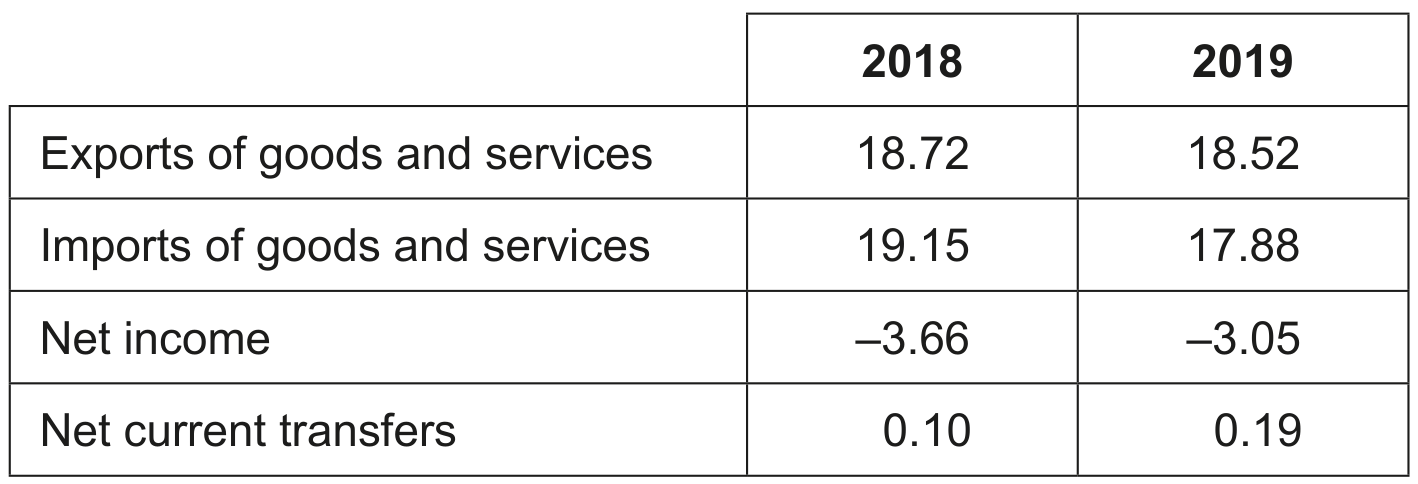
Table 1: Current account data for Uruguay (US\$ billion)

Table 1: Current account data for Uruguay (US\$ billion)

Table 2: Selected income data for Uruguay

Table 2: Selected income data for Uruguay

Question 1(f)

(a)

Using an AD/AS diagram, explain the likely impact of the reduction of the common external tariff on Uruguay's potential (long-term) output (Text C, paragraph 1).
[ 4 ]

Question 1

[Maximum number: 4]

Read the extracts and answer the questions that follow.
Text A — Overview of North Macedonia

(1) North Macedonia is a small, landlocked nation that shares borders with five countries, including Bulgaria and Greece. Bulgaria and Greece are members of the European Union (EU) common market, which North Macedonia hopes to join soon. Since the country began negotiating for EU membership, trade with the EU has increased rapidly and now accounts for 75 % of North Macedonia's exports and 62 % of its imports.

(2) Despite its small market, with a population of approximately 2 million, North Macedonia's proximity to the EU, low wages and expected entry into the common market have attracted foreign investors. Greece, its richest neighbour, was its third highest source of foreign investment in 2019. The lower cost of living also appeals to Greek tourists.

(3) EU companies have invested in the financial, telecommunication, energy and food processing industries in North Macedonia. Many of the most profitable companies are from the EU. If EU membership is granted, foreign direct investment (FDI) inflows may increase as firms located in North Macedonia will be allowed to bypass all custom checks and enjoy tariff-free trade within the common market. One particular challenge for North Macedonia, however, is that most of the profits of foreign companies are likely to be repatriated (sent back to the companies' home countries).

(4) In 2018, North Macedonia's export revenue was US $ 7.57 billion and its import expenditure was US$9.56 billion. The country's main exports are iron and steel, clothing and accessories, and food products. Food, livestock and consumer goods account for 33 % of imports while the remainder are machinery, petroleum and other materials needed for the industrial production process.

(5) The manufacturing sector, which now employs 31 % of the labour force, has gained more importance. The agricultural sector remains strong, contributes over 10 % of North Macedonia's gross domestic product (GDP) and employs about 16 % of the country's workforce.

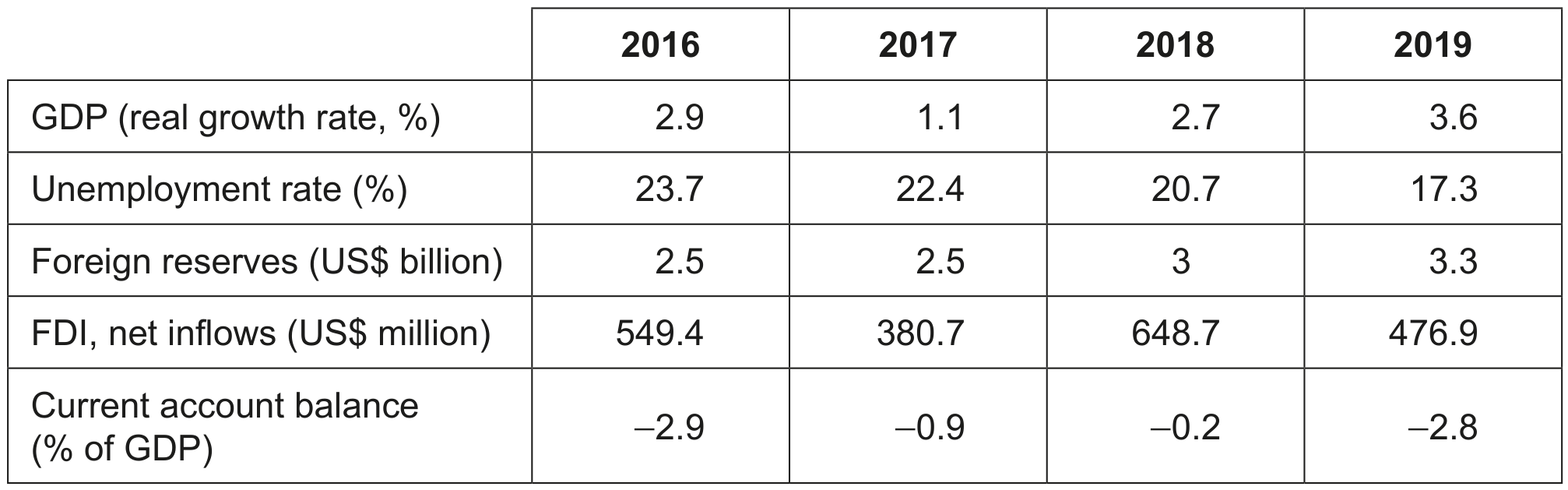
(6) The unemployment rate decreased from over 30 % in 2010 to 17.3 % in 2019. However, youth unemployment is almost 40 %. Over 20 % of the population lives below the poverty line. Unemployment and poverty contribute to high rates of emigration. More than 20 % of the North Macedonian population have emigrated since 1994, mostly to the EU. As a member of the EU, North Macedonia will enjoy free movement of labour which will make it easy for its citizens to live and work in other EU countries.
Text B - North Macedonia's economic reforms

(1) To be considered for EU membership, North Macedonia implemented a series of supply-side policies to reform its economy. The EU imposes strict requirements for membership but provides financial assistance to countries preparing for membership. North Macedonia has received 633 million euros (the currency of the EU) to help with the reforms.

(2) Most of the supply-side policies seek to improve the international competitiveness of North Macedonia's industries. The authorities are increasing access to education and training for workers. The expansion of the transport network and other infrastructure is also expected to increase efficiency.

(3) Protection of the environment is also on the list of requirements for EU membership. North Macedonia aims to reduce its dependence on coal and to instead promote the use of solar, wind and hydropower technologies. These low-carbon energy sources would help decrease its air pollution, which is among the worst in Europe.

(4) The reforms, which started in 2014, have shown progress. Exports and manufacturing output are more diversified and more concentrated on high-value products. To attract FDI, North Macedonia maintains one of the lowest tax rates on corporate income in the region. The central bank also prevents the denar (North Macedonia's currency) from appreciating against the euro through managing foreign reserves. However, skill shortages and a mismatch of skills with those required by companies discourage foreign firms from investing. Important investment gaps in public infrastructure also remain.
Text C - North Macedonia's trade agreements
North Macedonia participates in five free trade agreements (FTAs), that together cover 95 % of its exports and 78 % of its imports. Most of its trade with the EU is already free but imports of wine, beef and fish products are still subject to quotas. North Macedonia is currently a net importer of agricultural and food products. All protectionist measures on EU products would be removed upon entry into the common market.

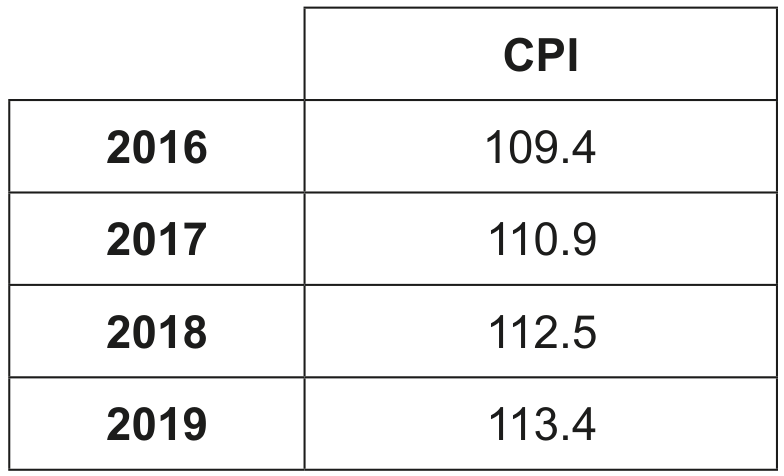
Table 1: Consumer Price Index (CPI) for North Macedonia (base year = 2010)

Table 1: Consumer Price Index (CPI) for North Macedonia (base year = 2010)

Table 2: Economic data for North Macedonia

Table 2: Economic data for North Macedonia

Question 1(c)

(a)

Using an AD/AS diagram, explain the likely impact of North Macedonia's supply-side policies on its full employment level of output (Text B, paragraph 2).

[ 4 ]

Question 2

Question 2(a)

(a)

Explain how the use of supply-side policies might encourage greater domestic competition and improve the international competitiveness of a country.

[ 10 ]

Question 2(b)

(b)

Using real-world examples, evaluate the view that the use of interventionist supply-side policies is the most effective way of reducing a country's rate of unemployment.

[ 15 ]

Question 2

Question 2(a)

(a)

Explain how supply-side policies may have both supply-side and demand-side effects on the level of GDP.

[ 10 ]

Question 2(b)

(b)

Using real-world examples, evaluate whether the benefits of supply-side policies for the economy will always outweigh their limitations.

[ 15 ]

Question 2

Question 2(b)

(a)

Using real-world examples, evaluate the effectiveness of supply-side policies in reducing unemployment.

[ 15 ]

Question 3

Question 3(b)

(a)

Discuss the view that the best way to reduce unemployment is through education and training.

[ 15 ]

Question 3

Question 3(a)

(a)

Explain how increased investment by the government in education and training can affect both aggregate demand and aggregate supply.

[ 10 ]

Question 3(b)

(b)

Evaluate the view that inflationary pressures in an economy are best reduced using supply-side policies.

[ 15 ]

Question 3

Question 3(b)

(a)

Evaluate the effectiveness of interventionist supply-side policies in reducing the level of unemployment in an economy.

[ 15 ]

Question 4

Question 4(a)

(a)

Explain how labour market reforms may be used to promote economic growth.

[ 10 ]

Question 4(b)

(b)

"Market-oriented supply-side policies will always be more effective in promoting economic growth than demand-side policies." To what extent do you agree with this statement?

[ 15 ]

Question 4

Question 4(b)

(a)

To what extent can supply-side policies help in fighting inflation?

[ 15 ]
0 selected