
EduNinja

IB Economics SL3.6 Demand management - fiscal policyQuestion Bank

Question 1

[Maximum number: 2]

Study the following extract and data and answer the questions that follow.
Argentina's currency keeps falling

(1) The year 2018 started badly for Argentina when the worst drought in 50 years negatively affected its export revenues from maize and soybeans, both important exports. The economy suffered several additional problems: a stronger United States dollar (US$), international investors selling Argentinian assets due to a lack of confidence in the economy, rising inflation from 25 % to nearly 50 % (Figure 1) and a significant depreciation of the peso, Argentina's currency (Figure 2).

(2) When Argentina's president was elected in 2015, inflation was at 25 %. He gave the central bank freedom to raise interest rates, which encouraged foreign investors to buy government bonds. The government had borrowed a lot of money from overseas to finance the persistent budget deficit, but by 2018, foreign investors were interested in other markets.

(3) As the peso was overvalued in 2015, it kept demand for imports high and made it hard for exports to compete. The current account deficit rose to more than 5 % of gross domestic product (GDP) but slowly narrowed in 2018, because the president allowed the peso to float freely.

(4) In May 2018, in an attempt to control the inflation rate and stop the fall in the peso's value, the Argentinian central bank raised interest rates to 40 %. In addition, it started selling foreign currency reserves. However, there were concerns that if the selling of foreign currency reserves continued, they would be depleted quickly. To address this concern, the president negotiated a US$50 billion loan from the International Monetary Fund (IMF). Yet the peso continued to fall. The IMF loan means that most of Argentina's debt-servicing requirements are covered until 2020. However, under IMF loan conditions, the budget deficit must be cut by postponing infrastructure projects, subsidies must be cut, and government jobs must be cut.

(5) A spokesperson from the IMF said "Argentina has a floating, market-determined exchange rate, and the IMF fully supports that. The exchange rate should continue to be determined by market forces."

(6) The peso's weakness causes imported oil prices to go up, further raising inflation. The falling real incomes of households combined with higher interest rates will affect the economy negatively, possibly leading to a recession. Interest rates will remain high for some time, discouraging investment. Economists expect Argentina to fall into recession, for the fifth time in a decade.
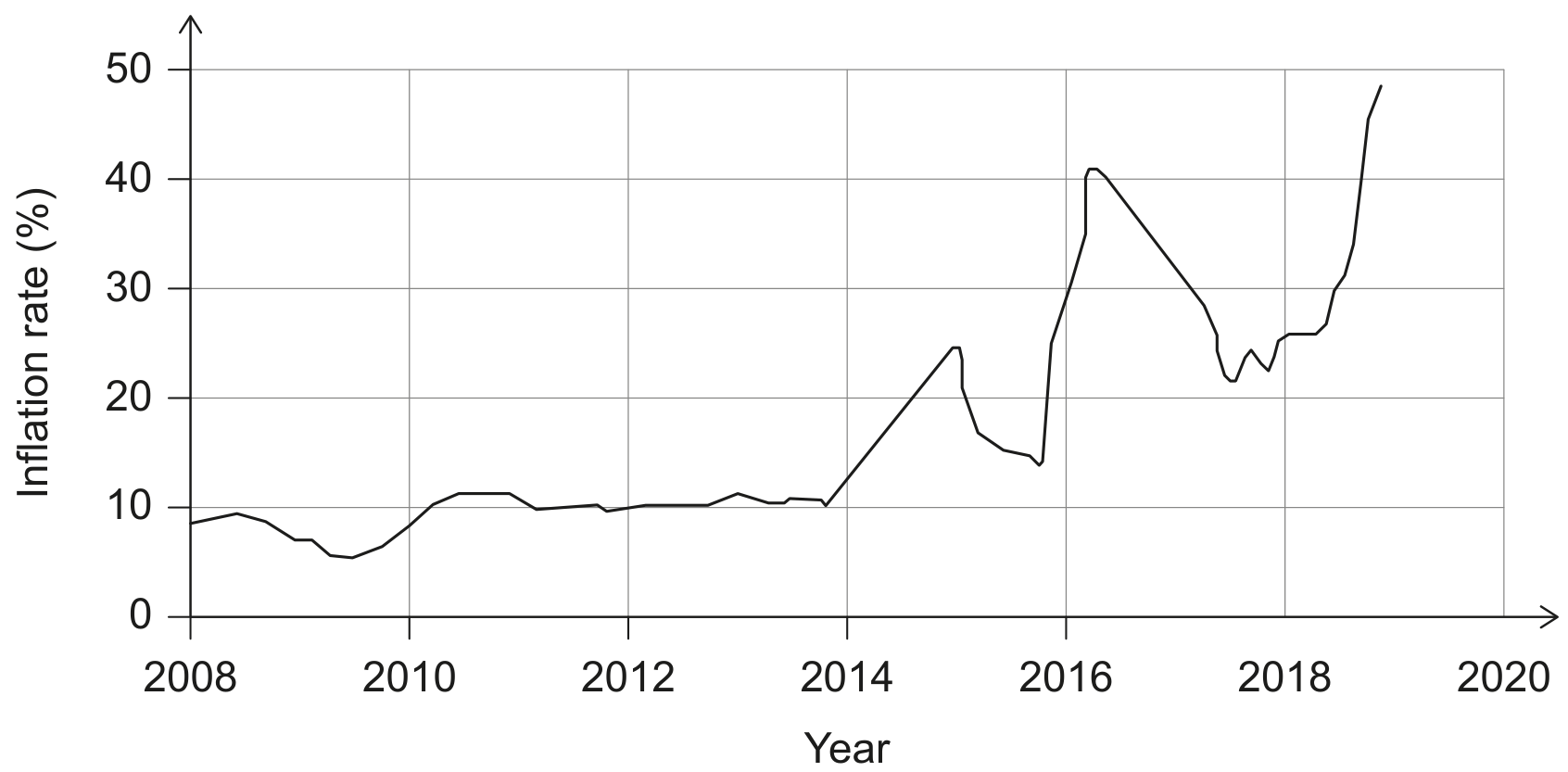
Figure 1: Argentina's inflation rate

Figure 1: Argentina's inflation rate

Gallas, G., 2018. Why confidence in Argentina's economy is dwindling. BBC, available at: https://www.bbc.co.uk/news/world-latin-america-44107630

Removed for copyright reasons

Question 1(a)

Question 1(a)(i)

(a)
(i)

Define the term budget deficit indicated in bold in the text (paragraph 2).

[ 2 ]

Question 1

[Maximum number: 2]

Study the extract below and answer the questions that follow.
Latvia to join the eurozone monetary union

(1) Latvia will become the 18th country to adopt the euro after being approved for membership by the European Commission. The country has met the criteria for eurozone membership, including low inflation, low long-term interest rates, a stable exchange rate, low public debt and low budget deficits.

(2) Latvia joined the European Union (EU) customs union in 2004. This resulted in a large increase in the availability of credit and strong economic growth in Latvia. However, the 2008 global financial crisis resulted in the collapse of one of its leading banks and massive economic instability. Economic output fell by about 20 % and Latvia had to accept a bailout (loans) from the International Monetary Fund (IMF) and the EU.

(3) Latvia kept the lat (the Latvian currency) pegged to the euro throughout the crisis. At the time, some economists argued that devaluation would have been a better way to improve the economy. However, Latvia followed the path of other countries such as Greece and Ireland, and chose to improve competitiveness through austerity measures. This involved increasing direct taxes and cutting government spending and public sector wages.

(4) By late 2010, the economy was growing again and Latvia had repaid the loans to the IMF and the EU. In 2012, the economy expanded by 5.6 %, the fastest of any country in the EU, although output was still 12 % below its pre-crisis peak. In addition unemployment was falling, but it remained high at 12.4 %.

(5) For Latvia, which shares a border with Russia, the attraction of the euro is about economics and security. Entering the eurozone in January 2014 is part of a process of shifting away from the influence of Russia, and following its northern neighbour Estonia which joined the eurozone in 2011. Lithuania hopes to join the eurozone in 2015.

(6) Public support for joining the eurozone has been low. Evidence from one survey suggests that a small majority of Latvia's population opposes membership, fearing that prices will rise and Latvians will be drawn into the problems facing Europe's struggling economies.

(7) Nonetheless, there are signs that support is growing. The Latvian prime minister said that "switching to the euro will help economic growth and bring increased foreign investment. Unlike countries that can afford to ignore the euro and additional integration, Latvia cannot easily stand on its own. This is good news, not only for Latvia, but also for the eurozone. It shows that there is still confidence in the single currency".
www.theguardian.com, 16 July 2013]

Question 1(a)

Question 1(a)(ii)

(a)
(i)

Define the term direct taxes indicated in bold in the text (paragraph (3).

[ 2 ]

Question 2

Question 2(b)

(a)

Using real-world examples, evaluate the view that fiscal policy is the most effective way of reducing a country's level of unemployment.

[ 15 ]

Question 2

Question 2(b)

(a)

Evaluate the view that demand-side policies are the most effective method of increasing the level of national income.

[ 15 ]

Question 2

Question 2(a)

(a)

Explain two goals of fiscal policy.

[ 10 ]

Question 2(b)

(b)

Using real-world examples, evaluate the use of fiscal policy to close a deflationary/recessionary gap.

[ 15 ]

Question 3

Question 3(b)

(a)

Evaluate the effectiveness of fiscal policy as a means of achieving long-term economic growth.

[ 15 ]

Question 3

Question 3(b)

(a)

To what extent is expansionary fiscal policy the best policy to achieve a reduction in the rate of unemployment?

[ 15 ]

Question 3

Question 3(b)

(a)

Evaluate the view that fiscal policy is the best way to reduce unemployment.

[ 15 ]

Question 3

Question 3(a)

(a)

Explain the effect of a rise in taxation and a fall in government expenditure on the circular flow of income of an economy.

[ 10 ]

Question 3(b)

(b)

Evaluate the effectiveness of fiscal policy to reduce the rate of inflation.

[ 15 ]

Question 3

Question 3(b)

(a)

Discuss whether the use of fiscal policy is the most effective way to bring an economy out of a recession.

[ 15 ]
0 selected