
EduNinja

IB Economics SL2.3 Competitive market equilibriumQuestion Bank

Question 1

[Maximum number: 4]

Read the extracts and answer the questions that follow.
Text A — Bangladesh: the economic role of women

(1) Bangladesh is a densely populated country in Asia. Its currency is the Bangladeshi taka (BDT). The annual rate of growth of gross domestic product (GDP) has steadily increased from 5.6 % in 2010 to 8.1 % in 2019. Absolute poverty has declined, but inequality has risen, partly due to higher unemployment rates for women than men. Moreover, the labour force participation rate for women is much lower than the rate for men. Over 80 % of the women's jobs are in the informal economy, and these jobs are low paid and insecure. Women need regular paid work, which not only raises household income but also improves economic well-being in terms of education and health.

(2) The structure of the economy is changing. The growth of cities is due to the expansion of the manufacturing sector, which now contributes a larger share to GDP than the agricultural sector. These changes have increased the number of women in the labour force. In particular, the growth of the ready-made garments (RMG) industry (mass-produced clothing) has given women the opportunity to move into formal employment. The RMG industry provides jobs for almost 4 million low-skilled and semi-skilled workers, accounting for over 40 % of total manufacturing employment. The majority of these jobs are being filled by women, with the result that the gap between the wages of men and women is gradually being reduced.

(3) There are concerns about working and safety conditions in the RMG factories. After an accident in a factory in 2013, reforms are being implemented, partly in response to criticisms from overseas retailers and consumers who purchase the garments. The minimum wage has been increased, inspections are carried out, and there are fewer small, unsafe factories.

(4) While working conditions are improving, such reforms raise the costs of manufacturing garments. Furthermore, the international garment market is becoming more competitive, putting pressure on Bangladeshi factories to reduce costs.

(5) The overseas demand for Bangladeshi garments had been rising strongly until 2019. However, demand has recently fallen, reducing firms' revenue. The reduction in revenue and the need to lower costs have forced certain firms to reduce the size of their labour force by dismissing some of their female workers.

(6) The number of ethically and environmentally concerned consumers is increasing globally. Rather than trying to lower costs, firms can be more successful if they produce "green ready-made garments" by implementing sustainable practices. About 100 garment factories in Bangladesh have already been certified as producers that meet specified environmental standards. In addition, global retailers and fashion brands are supporting recycling initiatives through the Circular Fashion Partnership.
Text B - Trade prospects for exports of ready-made garments (RMG)

(1) Exports of RMG account for over 84 % of Bangladesh's total exports. At present, Bangladesh is the world's second largest garment exporter after China. Bangladeshi exports could further increase as Chinese garments become more expensive due to rising wages in China.

(2) Bangladesh is designated as an Economically Least Developed Country (ELDC) and is therefore able to sell goods in Europe and China without any quotas or tariffs being imposed. However, Bangladesh will graduate from ELDC status by 2026 and will then no longer be eligible for preferential trade agreements. Moreover, the USA, which is the largest export market for Bangladeshi garments, has applied a 15 % tariff on imports from Bangladesh since 2013, citing concerns about working conditions in factories.
Text C - Role of foreign direct investment in the RMG sector

(1) Vietnam and Myanmar have significantly increased their garment exports to China due to foreign direct investment (FDI) from China. Chinese investors have set up factories that import raw materials from China and re-export the finished goods back to China.

(2) Consequently, to compete successfully in the huge Chinese market, Bangladesh needs to attract more FDI from China. Bangladesh is developing the required infrastructure, such as transport links. It is also necessary to diversify into expensive high-end fashion, market more aggressively, and use branding strategies.

(3) The funds from additional FDI would be helpful, because the relative contribution of Official Development Assistance (ODA) to Bangladesh's budget is declining. Furthermore, the foreign exchange obtained from foreign investors assists in financing the current account deficit.
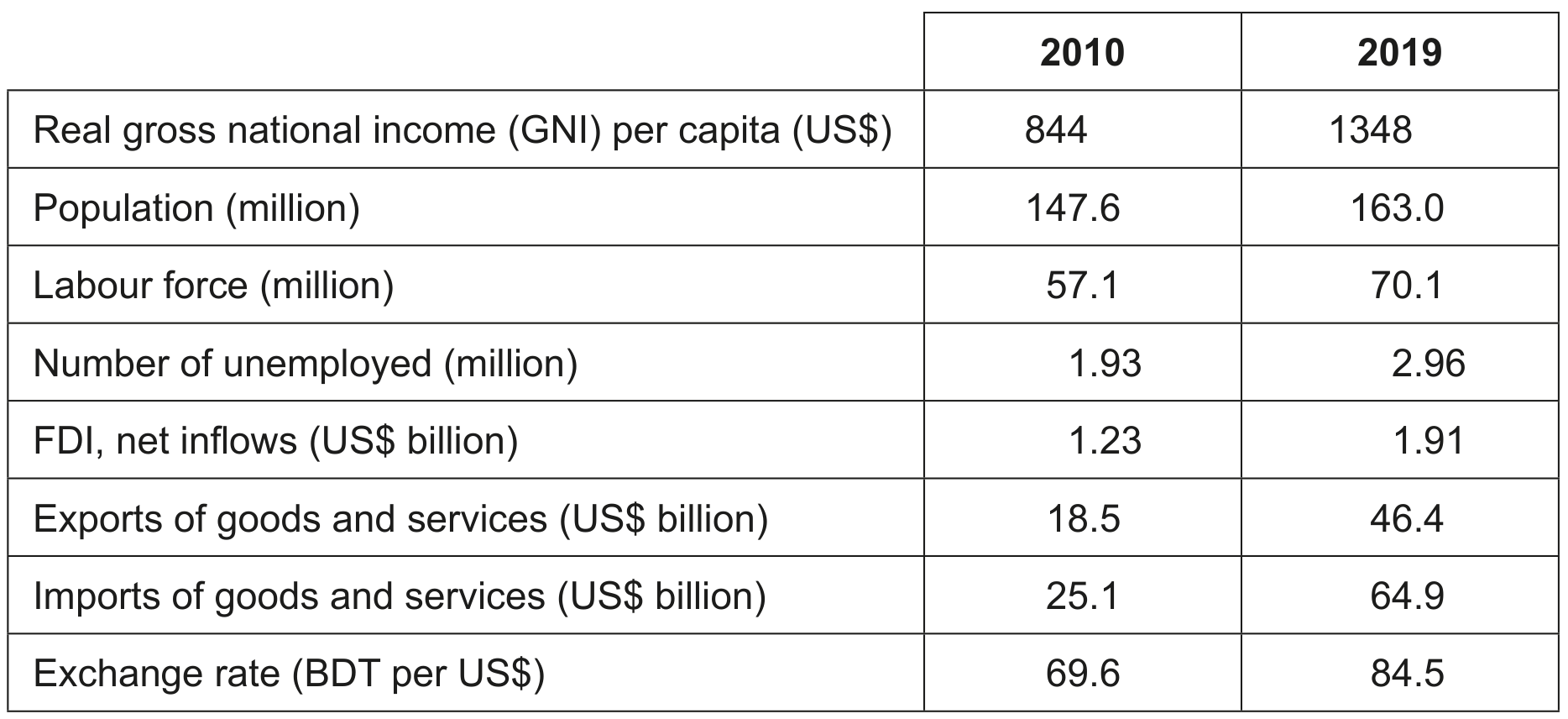
Table 1: Economic data for Bangladesh
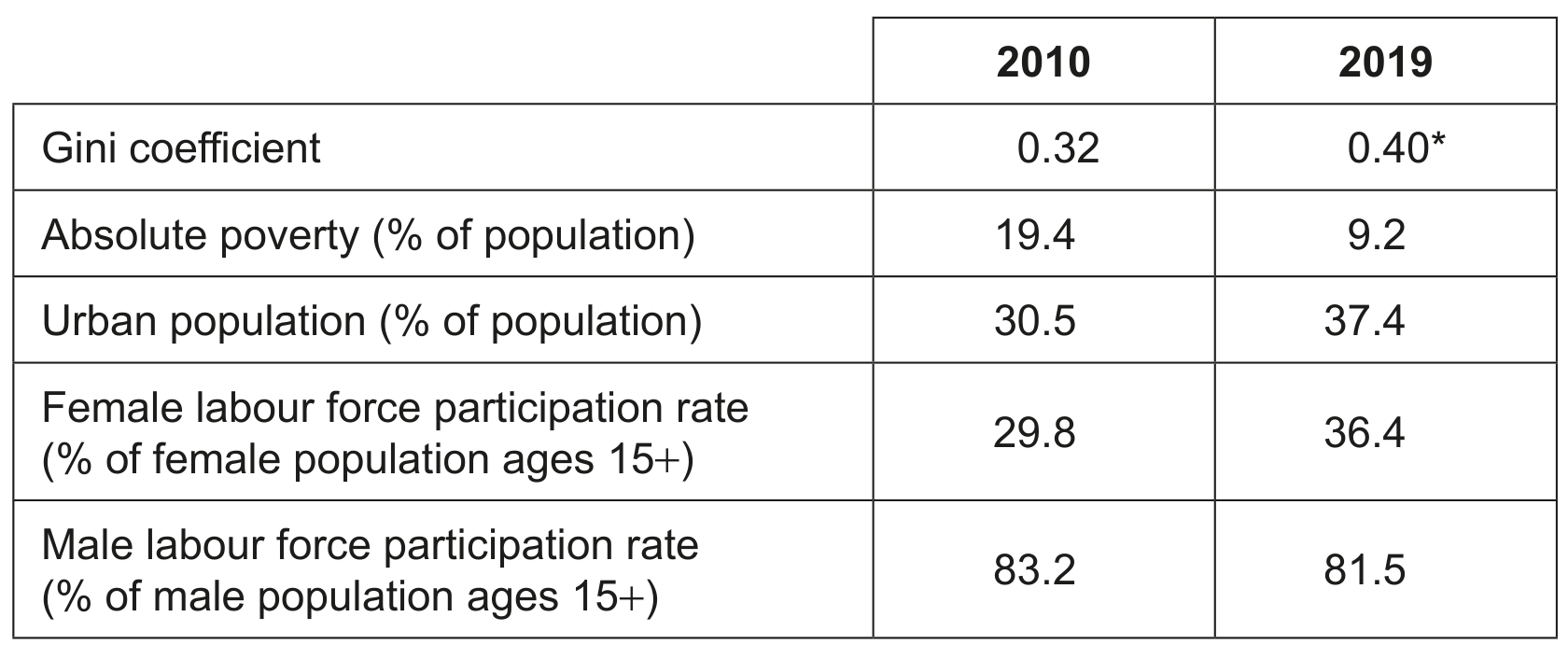
Table 1: Economic data for Bangladesh

Table 2: Development data for Bangladesh

Table 2: Development data for Bangladesh

*estimate

Question 1(c)

(a)

Using a demand and supply diagram, explain why falling demand will reduce Bangladeshi firms' revenue (Text A, paragraph 5).

[ 4 ]

Question 1

Question 1(a)

(a)

Explain the concepts of consumer surplus and producer surplus.

[ 10 ]

Question 1

Question 1(a)

(a)

Explain how, in a market system, changes in demand and supply allocate scarce resources through the signalling and incentive functions of price.

[ 10 ]

Question 1

Question 1(a)

(a)

Explain how the price mechanism allocates resources in an economy.

[ 10 ]

Question 1

Question 1(a)

(a)

Explain how the price mechanism reallocates resources when there is an increase in demand for a good or service.

[ 10 ]

Question 1

Question 1(a)

(a)

Explain how the price mechanism reallocates resources when there is a decrease in the supply of a good.

[ 10 ]

Question 1

Question 1(a)

(a)

Explain how one determinant of demand might lead to a decrease in the price of wheat and how one determinant of supply might lead to an increase in the price of wheat.

[ 10 ]

Question 1

Question 1(a)

(a)

Explain why an increase in the demand for a good would normally lead to an increase in its price, while an increase in the price of a good would normally lead to less of it being demanded.

[ 10 ]

Question 1

[Maximum number: 4]

Study the extract below and answer the questions that follow.
EU court rules minimum price for cigarettes illegal

(1) The European Court of Justice has ruled that Ireland cannot impose a minimum price on cigarettes. It said that member countries would have to find other ways to combat smoking. This could be achieved by increasing indirect tax on tobacco, but imposing a minimum price would distort fair competition in the market. The ruling is designed to maintain the freedom of manufacturers and importers to benefit from lower costs and greater efficiency.

(2) The judgment said the aim of ensuring that tobacco prices are high can be "adequately" achieved by increasing tax, since any indirect tax rises are, sooner or later, reflected in an increased retail price, without removing the freedom of manufacturers to set prices.

(3) The Irish government had claimed that it needed to fix a high minimum price to discourage smoking. This followed government legislation to ban tobacco advertising and promotion in July 2009. According to a spokesperson from the anti-smoking group ASH (Action on Smoking and Health), this measure helped to prevent retail outlets from making young people feel attracted to buying cigarettes. "Close to 30 % of our population still smoke and 7000 die from tobacco-related disease each year," he said.

(4) It has been argued that increasing the price of cigarettes is one of the most effective ways of curbing harmful smoking and there is a need to make cigarettes less appealing, particularly to young people. The evidence is that banning advertising, introducing minimum pricing and increasing health warnings can all work.

(5) The head of a major retail organization has attacked the idea of minimum pricing for cigarettes. He argued that artificially fixing a minimum price would not be effective. Also, since the demand for tobacco is inelastic, raising the price would not work. Moreover, it was against the free market for a government to set prices for any product available to consumers, limiting their freedom to choose.

Question 1(b)

(a)

Using an appropriate diagram, explain the possible effect on the market for cigarettes of the ban on tobacco advertising in Ireland.

[ 4 ]

Question 1

[Maximum number: 6]

Study the following extract and answer the questions that follow.
United States (US) tin can manufacturers seek tariff exemption on tinplate steel

(1) The Can Manufacturers Institute (CMI) has asked the US Department of Commerce to take away tariffs and other trade protection measures that are currently applied to imports of tinplate steel. Tinplate steel is used to make tin cans as packaging for food. The CMI represents the tin can manufacturing industry and its suppliers in the US.

(2) The tin can manufacturing industry accounts for the annual domestic production of approximately 124 billion tin cans. The industry employs more than 28000 people, with factories in 33 US states, Puerto Rico and American Samoa. It generates revenue of around US$17.8 billion. The CMI claims that the tariff on imports of tinplate steel has a severe economic impact on the tin can manufacturing industry.

(3) Approximately 2 % of all US steel is tinplate. Currently, there is excess demand that is causing a disequilibrium in the domestic US tinplate steel market. In 2016, US demand for tinplate steel was 2.1 million tons, while domestic supply was 1.2 million tons, meaning that only 57 % of domestic demand was met by US tinplate steel producers. Not only is there a domestic shortage of tinplate steel, but also the CMI claims that there has been a noticeable decline in the quality of domestically-produced tinplate steel.

(4) The CMI claims that even a small increase in the price of raw materials could create a competitive disadvantage, forcing some tin can manufacturing plants to shut down. This would create structural unemployment for 10000 workers in regionally-based factories. The CMI also claims that the tariff puts food can producers at a competitive disadvantage with other food packaging substitutes, such as plastic and glass. These substitutes are not subject to tariffs.

(5) According to the CMI, canned fruits and vegetables cost 20 % less than fresh food. Because of this, people on low incomes consume canned foods at a higher rate than the average American. Canned food offers a low-cost solution to feeding the nation; especially the 42 million Americans who live in low-income households. The figure includes 13 million children. The CMI further claims that tariffs, or any trade barriers, have harsh consequences for those living in relative poverty.

Question 1(a)

Question 1(a)(i)

(a)
(i)

Define the term excess demand indicated in bold in the text (paragraph (3).

[ 2 ]

Question 1(b)

(b)

Using a supply and demand diagram and data from the text, explain how a "disequilibrium in the domestic US tinplate steel market" would occur if there were no imports (paragraph 3 ).

[ 4 ]
0 selected