
EduNinja

IB Economics SL2.2 SupplyQuestion Bank

Question 1

[Maximum number: 4]

Study the following extract and answer the questions that follow.
China's trade reforms

(1) The Chinese government has announced a set of free trade measures, including lower import tariffs on cars, soybeans and pharmaceuticals, in an attempt to end a trade war with the United States (US).

(2) The US government has long accused China of engaging in unfair trade practices to maintain their current account surplus. The trade dispute between the two largest economies intensified when the US said it would impose anti-dumping tariffs on Chinese steel and aluminium.

(3) The trade war with the US comes at a bad time given the slowdown in China's domestic demand. In recent years, China's economic growth has relied less on investment and exports and more on consumption expenditure.

(4) Producers of many Chinese manufactured goods currently benefit from protectionist measures. In particular, imports of industrial equipment, medical devices, tractors and vehicles are subject to high tariffs.
5 Automobile production capacity in China is growing. However, the domestic market is becoming oversupplied, with more cars being offered for sale than Chinese consumers want to buy. For this reason, Chinese car manufacturers are seeking to export their cars to other markets. They are therefore eager to see reduced trade tensions as increased US tariffs would make it harder to export Chinese cars to the US.

(6) Some Chinese car manufacturers are already focusing on adding advanced capabilities to their cars in order to be more competitive in global markets. China is increasing its efforts to become a world leader in self-driving cars. These will be intelligent cars that will improve transport efficiency and meet energy-saving and emission-reduction targets. Many believe that Chinese companies are so innovative that they no longer require protection from international enterprises.

(7) However, many Chinese firms remain dependent on imported factors of production. Approximately 30 % of Chinese exports are manufactured using imported equipment and components. The reduction of tariffs would therefore lower prices not only for producers but also for consumers of Chinese goods.

Question 1(c)

(a)

Using a demand and supply diagram, explain how reduced tariffs on "imported factors of production" would affect the price of Chinese goods (paragraph (7).
[ 4 ]

Question 1

Question 1(a)

(a)

Explain two factors which could shift a firm's supply curve to the left.

[ 10 ]

Question 1

[Maximum number: 4]

Study the extract below and answer the questions that follow.
US steel

(1) With trans-Pacific and trans-Atlantic trade talks missing deadline after deadline, the United States (US) government is putting new tariffs on steel imports. This action will raise prices for many US firms, threaten domestic energy production, and upset trading partners worldwide.

(2) Last week, the US Department of Commerce imposed tariffs on hundreds of millions of US dollars worth of annual trade with South Korea and eight other countries, including India, Taiwan, Turkey and Vietnam. As punishment for allegedly dumping steel into the US market, South Korea's exporters will face tariffs of about 10 % to 16 %, while smaller producers from other countries face rates up to 118 %.

(3) In a preliminary review, the US International Trade Commission found a "reasonable indication" that US steel firms are being "injured" by foreign competitors' low prices.

(4) Low-priced steel from South Korea is good for American buyers but annoying for American producers who would rather have the market to themselves and charge higher prices.

(5) Spokespersons for US Steel Corporation complain that steel imports rose 113 % between 2010 and 2012, with South Korean products accounting for half the increase. They blame dumping, but the better explanation is related to America's energy revolution, where producers have taken advantage of two newly viable technologies: horizontal drilling and "fracking" to release gas and oil from rock formations. The resulting increase in energy production has been dramatic. Between 2007 and 2012, fracking generated an 18-fold increase in US production of what is known as light tight oil. This has created even more demand for steel, as steel products are needed in the gas energy market.

(6) The US steel tariffs will encourage other countries to raise trade barriers against American goods. The World Trade Organization (WTO) has already ruled against US tariffs imposed on Chinese steel and solar panels as well as Indian steel from 2007-2012. In the China case, the WTO ruled that the US had not provided enough evidence that the Chinese steel exporters received government subsidies.

(7) When the US imposes tariffs, it raises prices for many stakeholders to benefit the protected few. Copyright © 2014 Dow Jones \& Company Inc. All Rights Reserved Worldwide]

Question 1(c)

(a)

Using a demand and supply diagram, explain how the tariffs will affect the gas energy market (paragraph (5).

[ 4 ]

Question 1

Question 1(a)

(a)

Explain two non-price determinants that could increase the market supply of a good.

[ 10 ]

Question 1

Question 1(a)

(a)

Explain the view that an increase in price will lead to an increase in the quantity supplied whilst an increase in supply will lead to a decrease in price.

[ 10 ]

Question 1

Question 1(a)

(a)

Explain why a decrease in the supply of a good would normally lead to an increase in its price, while an increase in the price of a good would normally lead to more of it being produced.

[ 10 ]

Question 2

Question 2(a)

(a)

Explain the likely effects of falling costs of factors of production on price and output in agricultural markets.

[ 10 ]

Question 4

[Maximum number: 4]

Study the extract below and answer the questions that follow.
Aid to Papua New Guinea (PNG)

(1) A group of Australian politicians is visiting Papua New Guinea (PNG), a former colony, to see first-hand where Australia's AU$477 million in foreign aid is being used. The aid is being spent on women and children who are crime victims, immunizations for young children to protect them from diseases such as polio, efforts to eradicate tuberculosis, provision of free education for girls, pre-school and early learning, and training for the next generation of PNG police officers. There is a lot of aid money being spent but it is making very little difference.

(2) Though PNG is close to Australia, it is very far away in terms of economic development. One non-governmental organization (NGO), Save the Children, reported that "the level of need in PNG is astonishing. Children are far more likely to die before their fifth birthday here in PNG than most other places in the world. There is a huge amount of violence against women and children". The value of its Human Development Index (HDI) is 0.466 , ranking it 156 out of 187 countries.

(3) One of the Australian politicians is concerned that corruption is so widespread that it is preventing efforts to get PNG's educational, health and justice systems to operate effectively. "Make no mistake, there are many problems, including problems with security, family violence and many other socio-economic concerns," he said. "However, I think corruption is the largest issue confronting the challenges of PNG. You have to question whether you can address these issues without dealing with the issue of corruption first."

(4) "These challenges cannot be met without a system of government that is functioning properly. This is a society that has been propped up by aid and the actions of NGOs. The government simply does not work."

(5) Another member of the visiting group thinks improving agricultural productivity is a way forward for PNG economically and socially, with great potential for economic growth. A project spokesperson said that increased foreign aid could lift productivity and improve growth, by assisting PNG farmers to improve irrigation* and supply routes. He also said that research and development, in addition to training local farmers could help. Another project that the group is visiting runs a programme to encourage women to be more involved in decision-making in the growing and selling of coffee, a crop that is important to the PNG economy.
6 The leader of the visiting group says that "our aid money here should ensure that more children are born in environments with supervised medical care, and that there is a police and justice system that protects the rights of children. Children should have the right to be free from violence and free from sexual assault, and should have access to the great transformative power of education".
* irrigation: a method for regularly supplying water to plants. It is used to assist in the growing of agricultural crops particularly during periods of low rainfall.

Question 4(b)

(a)

Using a demand and supply diagram, explain how the market for coffee in Papua New Guinea could be affected by improved irrigation (paragraph (5).

[ 4 ]

Question 2

[Maximum number: 4]

Read the extracts and answer the questions that follow.
Text D - Overview of Sierra Leone

(1) Sierra Leone is located on the west coast of Africa. Economic activity is concentrated on agriculture and mining, which together contribute 70 % of gross domestic product (GDP) and 77 % of export revenue.

(2) Economic growth rates fluctuated from +20.1 % in 2013 to -21.5 % in 2015. The economic slowdown in China contributed to a significant drop in mining activities and a fall in Sierra Leone's export revenue. China is Sierra Leone's largest market for exported minerals.

(3) Economic growth rates in Sierra Leone have improved in recent years due to increased activity in agriculture, mining and construction. Increased employment in these labour-intensive sectors could help reduce poverty, which remains widespread in the country. Sierra Leone's ranking in the Inequality adjusted Human Development Index (IHDI) is very low.

(4) The fall in export revenue has led to a 50 % depreciation of the leone (Sierra Leone's currency) over the past five years. Even recent increases in the price of commodities have not been sufficient to offset the high import expenditure on food, medication, cars and capital equipment.

(5) The depreciation of the leone has led to inflationary pressures. The removal of a fuel subsidy resulted in an increase in the price of fuel and pushed the inflation rate from 16.8 % in 2018 to 17.2 \% in 2019.

(6) To make matters worse, access to essential, life-saving health care services in Sierra Leone is often disrupted by regional conflicts. Healthcare in Sierra Leone is generally charged for and is provided by a mixture of government, private and non-governmental organizations (NGOs). NGOs are relied on to protect the health and wellbeing of citizens. NGOs help to achieve this by distributing medicine and teaching families about hygiene and proper sanitation.

(7) Another area of concern is the government debt, which stood at 62 % of GDP in 2019. The government has reduced its budget deficit from 5.7 % to 3.4 % of GDP by minimizing non-payment of taxes and implementing cost-saving measures such as the automation of some government services.

(8) The newly elected government has made good progress in its fight against corruption, but it is facing many macroeconomic challenges. Foreign aid has been reduced, infrastructure is inadequate and many economic activities remain untaxed. Youth unemployment is also high due to low literacy rates and a lack of skills required in the job market.
Text E - Sierra Leone's new development plan

(1) In 2019, the government of Sierra Leone introduced a new five-year development plan. The plan includes policies aimed at increasing the welfare of Sierra Leone's citizens by working towards the Sustainable Development Goals.

(2) The development plan ensures access to free primary and secondary education in all public schools. The cost of education is the main reason that many households are not sending their children, particularly girls, to school. For those paying private education fees, switching to public education would allow more of their household income to be spent on other essential services and farming equipment.

(3) The expected increase in human capital should facilitate economic activities and lead to investment. Schools now teach modern farming practices, such as those involving the use of farm machinery and fertilizers. These would benefit rice farmers and help achieve food security (ensuring people have access to enough food).

(4) The provision of technical education should not only increase agricultural output but also allow for the diversification of the economy. The manufacturing sector contributes only 2 % of the country's GDP and could provide an alternative source of employment. The five-year plan also addresses the lack of infrastructure, in particular for electricity generation, which has so far restricted the development of the manufacturing sector.
Text F - Investment in Sierra Leone

(1) The World Bank ranked Sierra Leone 160th among 190 countries in 2018 for the ease of doing business, citing difficulties in accessing electricity and in obtaining loans and business permits. Government borrowing from the banking sector has increased in recent years, resulting in high interest rates and limited credit availability for the private sector. Foreign investors, however, usually bring capital from abroad.

(2) Despite the challenges, Sierra Leone offers significant opportunities for investment. Foreign investors are involved in the energy sector, infrastructure, agriculture, tourism, and natural resources. Reduced tax rates on corporate income are offered for investments in agriculture and tourism.

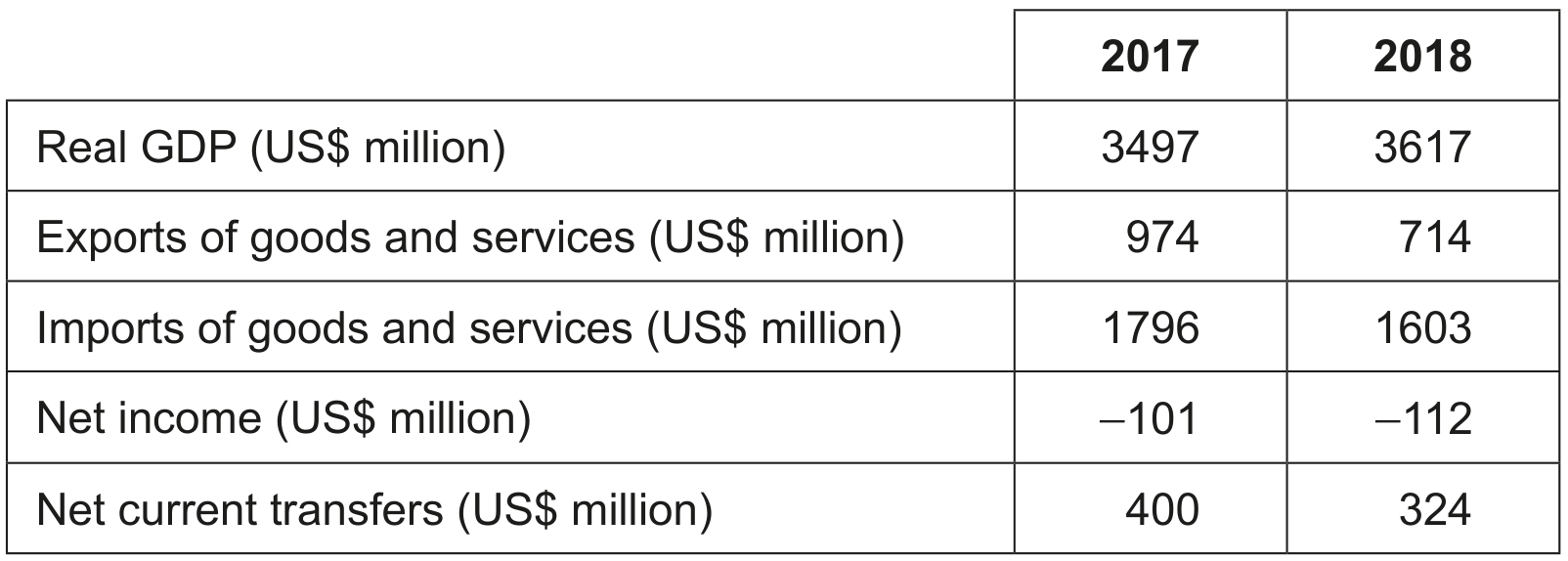
Table 3: Economic data for Sierra Leone

Table 3: Economic data for Sierra Leone

Question 2(f)

(a)

Using a demand and supply diagram, explain how modern farming practices could affect the market for rice (Text E, paragraph 3 ).

[ 4 ]
0 selected