EduNinja

IB Chemistry HL3.3 Electron sharing reactions (Radicals)Question Bank

Question 1

[Maximum number: 1]

Chlorine undergoes many reactions.

Question 1(d)

Question 1(d)(i)

(a)
(i)

State the type of reaction occurring when ethane reacts with chlorine to produce chloroethane.

[ 1 ]

Question 1

[Maximum number: 1]

Alkanes are commonly occurring organic compounds.

Question 1(b)

(a)

Ethane can be converted to chloroethane by reacting with chlorine gas, Cl2( g)\mathrm{Cl}_{2}(\mathrm{~g}), in the presence of UV light.

State the type of reaction and the name of the mechanism by which it occurs.

[ 1 ]

Question 4

[Maximum number: 2]

Halogenoalkanes are used as refrigerants and solvents.

Question 4(d)

(a)

The reaction between substance X and sodium hydroxide depends on their concentrations.

[ 2 ]

Question 4(d)(iii)

(i)

Contrast homolytic and heterolytic fission.

Homolytic fission:

Heterolytic fission:

[ 2 ]

Question 3

[Maximum number: 1]

Nitrous acid, HNO2\mathrm{HNO}_{2}, is a weak acid which can be used to make acidic buffers.

Question 3(c)

Question 3(c)(ii)

(a)
(i)

Ethyl ethanoate can be produced by the reaction of ethanol with ethanoic acid. Both reactants can be synthesized from ethane through a series of reactions, the first of which is shown.

C2H6( g)+Cl2( g)C2H5Cl( g)+HCl( g)\mathrm{C}_{2} \mathrm{H}_{6}(\mathrm{~g})+\mathrm{Cl}_{2}(\mathrm{~g}) \rightarrow \mathrm{C}_{2} \mathrm{H}_{5} \mathrm{Cl}(\mathrm{~g})+\mathrm{HCl}(\mathrm{~g})

The first step in this reaction, initiation, is given by the following equation.

Cl22Cl\mathrm{Cl}_{2} \rightarrow 2 \mathrm{Cl} \cdot

State an essential condition for this reaction.

[ 1 ]

Question 34

[Maximum number: 1]

Which equation represents a propagation step in the mechanism for the reaction between ethane, C2H6\mathrm{C}_{2} \mathrm{H}_{6}, and chlorine, Cl2\mathrm{Cl}_{2}, in the presence of sunlight/UV?

A

C2H6+ClC2H5+HCl\mathrm{C}_{2} \mathrm{H}_{6}+\mathrm{Cl} \bullet \rightarrow \mathrm{C}_{2} \mathrm{H}_{5} \bullet+\mathrm{HCl}

B

C2H6+ClC2H5Cl+H\mathrm{C}_{2} \mathrm{H}_{6}+\mathrm{Cl} \bullet \rightarrow \mathrm{C}_{2} \mathrm{H}_{5} \mathrm{Cl}+\mathrm{H} \bullet

C

Cl22Cl\mathrm{Cl}_{2} \rightarrow 2 \mathrm{Cl} \cdot

D

C2H5+ClC2H5Cl\mathrm{C}_{2} \mathrm{H}_{5} \bullet+\mathrm{Cl} \bullet \rightarrow \mathrm{C}_{2} \mathrm{H}_{5} \mathrm{Cl}

Question 35

[Maximum number: 1]

Which reaction involves homolytic fission?

A

CH4+Cl2\mathrm{CH}_{4}+\mathrm{Cl}_{2}

B

CH3Br+NaOH\mathrm{CH}_{3} \mathrm{Br}+\mathrm{NaOH}

C

(CH3)3CBr+NaOH\left(\mathrm{CH}_{3}\right)_{3} \mathrm{CBr}+\mathrm{NaOH}

D

C6H6+HNO3+H2SO4\mathrm{C}_{6} \mathrm{H}_{6}+\mathrm{HNO}_{3}+\mathrm{H}_{2} \mathrm{SO}_{4}

Question 35

Which is the correct combination of substitution reaction mechanisms?
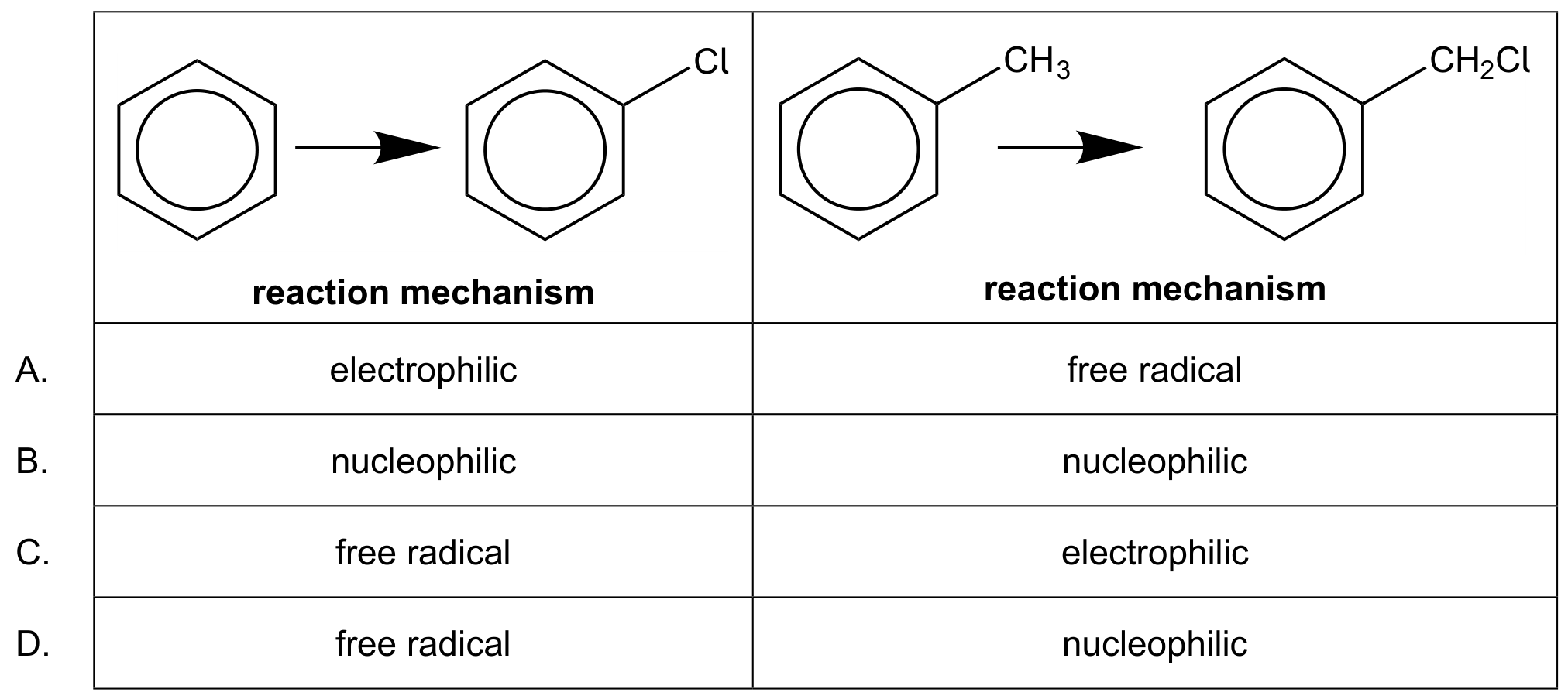
Question image

Question 35

[Maximum number: 1]

Which equation represents a propagation step in the reaction of methane with bromine?

A

CH4CH3+H\mathrm{CH}_{4} \rightarrow \mathrm{CH}_{3} \bullet+\mathrm{H} \bullet

B

CH4+BrCH3+HBr\mathrm{CH}_{4}+\mathrm{Br} \bullet \rightarrow \mathrm{CH}_{3} \bullet+\mathrm{HBr}

C

CH4+BrCH3Br+H\mathrm{CH}_{4}+\mathrm{Br} \bullet \rightarrow \mathrm{CH}_{3} \mathrm{Br}+\mathrm{H} \bullet

D

CH3+BrCH3Br\mathrm{CH}_{3} \bullet+\mathrm{Br} \bullet \rightarrow \mathrm{CH}_{3} \mathrm{Br}

Question 3

[Maximum number: 2]

Phosgene (carbonyl dichloride, Cl2CO\mathrm{Cl}_{2} \mathrm{CO} ) is an important industrial intermediate.

Question 3(a)

(a)

Phosgene may be formed by the free-radical reaction between carbon monoxide, CO, and chlorine, Cl2\mathrm{Cl}_{2}, which is initiated by UV light.

[ 2 ]

Question 3(a)(i)

(i)

Write an equation for the initiation reaction.

[ 1 ]

Question 3(a)(ii)

(ii)

State the type of bond fission that is occurring.

[ 1 ]

Question 6

[Maximum number: 1]

Bromomethane was used as a pesticide until it was found to be ozone-depleting.

Question 6(a)

(a)

State the equation for the reaction between methane and bromine to form bromomethane.

[ 1 ]
0 selected