EduNinja

IB Chemistry HL3.2 Electron transfer reactionsQuestion Bank

Question 1

[Maximum number: 2]

Hydrogen cyanide, HCN , is a very toxic compound.

Question 1(c)

(a)

The cyanide ion, CN\mathrm{CN}^{-}, can form complex ions, such as [Fe(CN)6]4\left[\mathrm{Fe}(\mathrm{CN})_{6}\right]^{4-}.

[ 2 ]

Question 1(c)(v)

(i)

Outline, giving a reason, whether [Fe(CN)6]3\left[\mathrm{Fe}(\mathrm{CN})_{6}\right]^{3-} is a stronger or weaker oxidizing agent than Fe3+\mathrm{Fe}^{3+} (aq).

Use E[Fe(CN)6]3(aq)+e[Fe(CN)6]4(aq)=+0.37 VE^{\ominus}\left[\mathrm{Fe}(\mathrm{CN})_{6}\right]^{3-}(\mathrm{aq})+\mathrm{e}^{-} \rightleftharpoons\left[\mathrm{Fe}(\mathrm{CN})_{6}\right]^{4-}(\mathrm{aq})=+0.37 \mathrm{~V} and section 19 of the data booklet.

[ 2 ]
Question 1

[Maximum number: 1]

Ethane-1,2-diol, HOCH2CH2OH\mathrm{HOCH}_{2} \mathrm{CH}_{2} \mathrm{OH}, has a wide variety of uses including the removal of ice from aircraft and heat transfer in a solar cell.

Question 1(e)

(a)

Ethane-1,2-diol can be oxidized first to ethanedioic acid, (COOH)2(\mathrm{COOH})_{2}, and then to carbon dioxide and water. Suggest the reagents needed to oxidize ethane-1,2-diol.

[ 1 ]

Question 1

[Maximum number: 2]

Ethyne, C2H2\mathrm{C}_{2} \mathrm{H}_{2}, reacts with oxygen in welding torches.

Question 1(d)

(a)

Product B,CH3CHO\mathbf{B}, \mathrm{CH}_{3} \mathrm{CHO}, can also be synthesized from ethanol.

[ 2 ]

Question 1(d)(i)

(i)

Suggest the reagents and conditions required to ensure a good yield of product B.

Reagents:

Conditions:

[ 2 ]

Question 1

[Maximum number: 2]

Hydrogen peroxide, H2O2(aq)\mathrm{H}_{2} \mathrm{O}_{2}(\mathrm{aq}), releases oxygen gas, O2( g)\mathrm{O}_{2}(\mathrm{~g}), as it decomposes according to the equation below.

2H2O2(aq)2H2O(l)+O2( g)2 \mathrm{H}_{2} \mathrm{O}_{2}(\mathrm{aq}) \rightarrow 2 \mathrm{H}_{2} \mathrm{O}(\mathrm{l})+\mathrm{O}_{2}(\mathrm{~g})

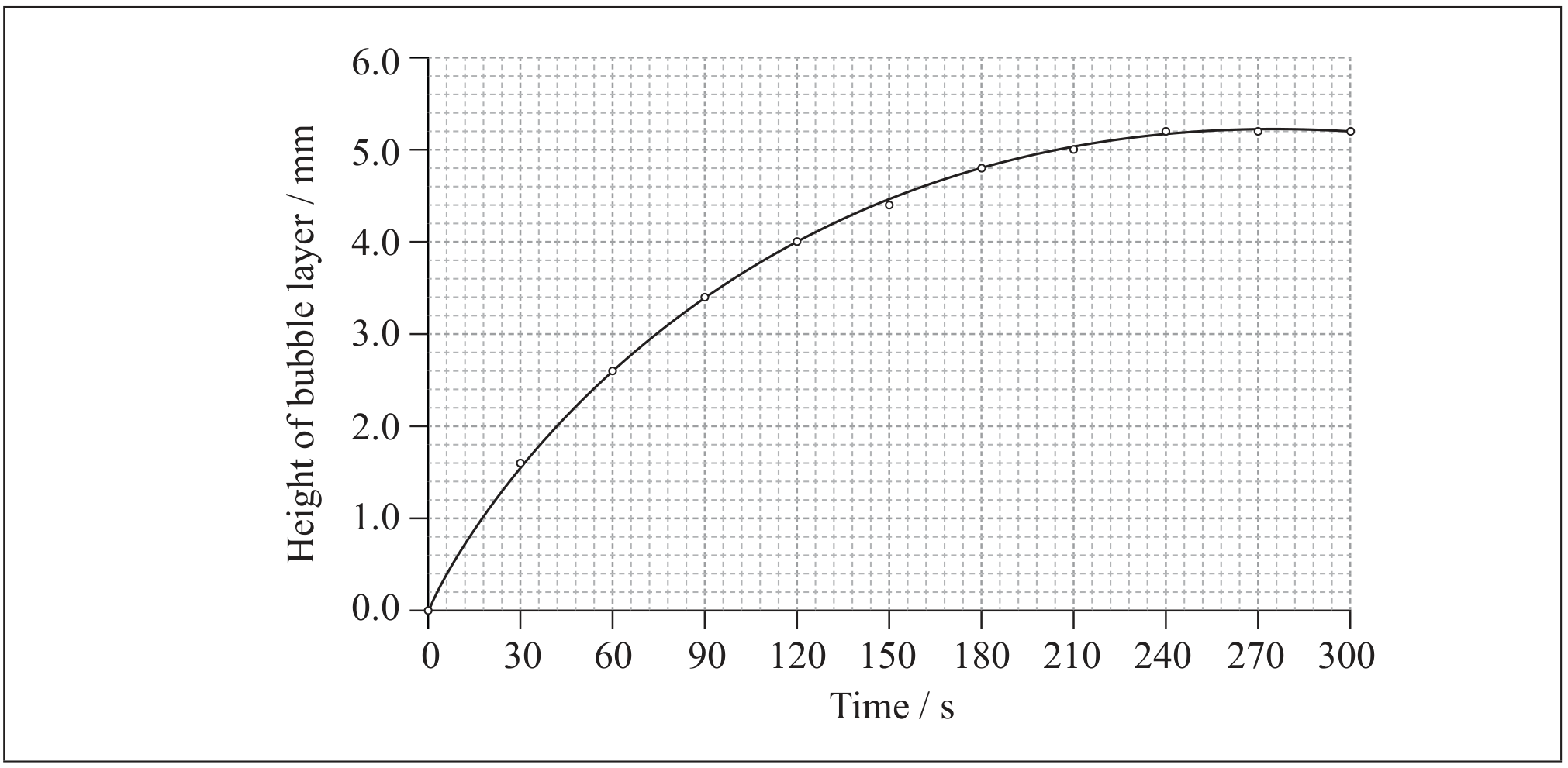
50.0 cm350.0 \mathrm{~cm}^{3} of hydrogen peroxide solution was placed in a boiling tube, and a drop of liquid detergent was added to create a layer of bubbles on the top of the hydrogen peroxide solution as oxygen gas was released. The tube was placed in a water bath at 75C75^{\circ} \mathrm{C} and the height of the bubble layer was measured every thirty seconds. A graph was plotted of the height of the bubble layer against time.

Question image

Question 1(c)

(a)

The decomposition of hydrogen peroxide to form water and oxygen is a redox reaction.

[ 2 ]

Question 1(c)(ii)

(i)

State two half-equations for the decomposition of hydrogen peroxide.

Oxidation:

Reduction:

[ 2 ]

Question 1

[Maximum number: 1]

A student used the technique of titration to determine the concentration of ascorbic acid (C6H8O6)\left(\mathrm{C}_{6} \mathrm{H}_{8} \mathrm{O}_{6}\right) in a sample of orange juice. Excess potassium iodide, KI(aq), was added to acidified orange juice. The resulting solution was titrated with potassium iodate, KIO3(aq)\mathrm{KIO}_{3}(\mathrm{aq}), in the presence of starch as an indicator. The end-point of the titration was shown by a blue-black colour.

Step 1IO3(aq)+5I(aq)+6H+(aq)3I2(aq)+3H2O(l)1 \quad \mathrm{IO}_{3}{ }^{-}(\mathrm{aq})+5 \mathrm{I}^{-}(\mathrm{aq})+6 \mathrm{H}^{+}(\mathrm{aq}) \rightarrow 3 \mathrm{I}_{2}(\mathrm{aq})+3 \mathrm{H}_{2} \mathrm{O}(\mathrm{l})

lodine is only slightly soluble in water; but in the presence of excess iodide ions, I(aq)\mathrm{I}^{-}(\mathrm{aq}), it forms the soluble tri-iodide ion, I3\mathrm{I}_{3}{ }^{-}(aq).

Step 2I2(aq)+I(aq)I3(aq)2 \quad \mathrm{I}_{2}(\mathrm{aq})+\mathrm{I}^{-}(\mathrm{aq}) \rightleftharpoons \mathrm{I}_{3}{ }^{-}(\mathrm{aq})
Ascorbic acid reacts with tri-iodide ions as follows.

Step 3C6H8O6(aq)+I3(aq)C6H6O6(aq)+2H+(aq)+3I(aq)3 \quad \mathrm{C}_{6} \mathrm{H}_{8} \mathrm{O}_{6}(\mathrm{aq})+\mathrm{I}_{3}{ }^{-}(\mathrm{aq}) \rightarrow \mathrm{C}_{6} \mathrm{H}_{6} \mathrm{O}_{6}(\mathrm{aq})+2 \mathrm{H}^{+}(\mathrm{aq})+3 \mathrm{I}^{-}(\mathrm{aq})

Question 1(a)

Question 1(a)(ii)

(a)
(i)

Identify the oxidizing and reducing agents in step 1.

Oxidizing agent:

Reducing agent:

[ 1 ]

Question 1

[Maximum number: 2]

Iron tablets are often prescribed to patients. The iron in the tablets is commonly present as iron(II) sulfate, FeSO4\mathrm{FeSO}_{4}.

Question 1(e)

(a)

This experiment involves the following redox reaction.

5Fe2+(aq)+MnO4(aq)+8H+(aq)5Fe3+(aq)+Mn2+(aq)+4H2O(l)5 \mathrm{Fe}^{2+}(\mathrm{aq})+\mathrm{MnO}_{4}^{-}(\mathrm{aq})+8 \mathrm{H}^{+}(\mathrm{aq}) \rightarrow 5 \mathrm{Fe}^{3+}(\mathrm{aq})+\mathrm{Mn}^{2+}(\mathrm{aq})+4 \mathrm{H}_{2} \mathrm{O}(\mathrm{l})
[ 1 ]

Question 1(e)(i)

(i)

Define the term reduction in terms of electrons.

[ 1 ]

Question 1(h)

Question 1(h)(i)

(b)
(i)

Following the experiment, the students proposed the following hypothesis:
"Since sulfuric acid is a strong acid, two other strong acids such as nitric acid, HNO3(aq)\mathrm{HNO}_{3}(\mathrm{aq}) or hydrochloric acid, HCl(aq), could also be used in this experiment".

Suggest one problem with this hypothesis.

[ 1 ]

Question 1

[Maximum number: 1]

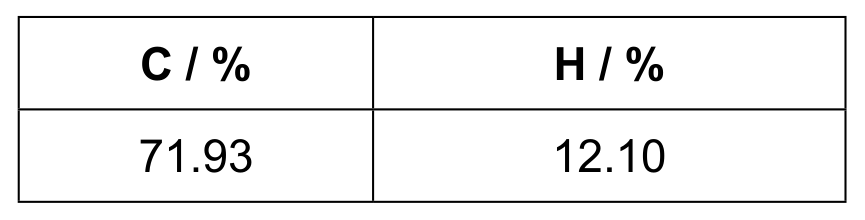
An organic compound, A, has the following composition by mass when its only combustion products, carbon dioxide and water, are analysed.

Table

Question 1(e)

(a)

A can be converted to compound E, which has a higher molecular mass, by heating it under reflux with acidified potassium dichromate(VI), K2Cr2O7\mathrm{K}_{2} \mathrm{Cr}_{2} \mathrm{O}_{7}.

Identify one functional group present in E based on this information only.

[ 1 ]

Question 1

[Maximum number: 2]

3.26 g of iron powder are added to 80.0 cm380.0 \mathrm{~cm}^{3} of 0.200 moldm30.200 \mathrm{~mol} \mathrm{dm}^{-3} copper(II) sulfate solution. The following reaction occurs:

Fe( s)+CuSO4(aq)FeSO4(aq)+Cu( s)\mathrm{Fe}(\mathrm{~s})+\mathrm{CuSO}_{4}(\mathrm{aq}) \rightarrow \mathrm{FeSO}_{4}(\mathrm{aq})+\mathrm{Cu}(\mathrm{~s})

Question 1(d)

(a)

A student electrolyzed aqueous iron(II) sulfate, FeSO4(aq)\mathrm{FeSO}_{4}(\mathrm{aq}), using platinum electrodes. State half-equations for the reactions at the electrodes, using section 24 of the data booklet.

Anode (positive electrode):

Cathode (negative electrode):

[ 2 ]

Question 1

[Maximum number: 1]

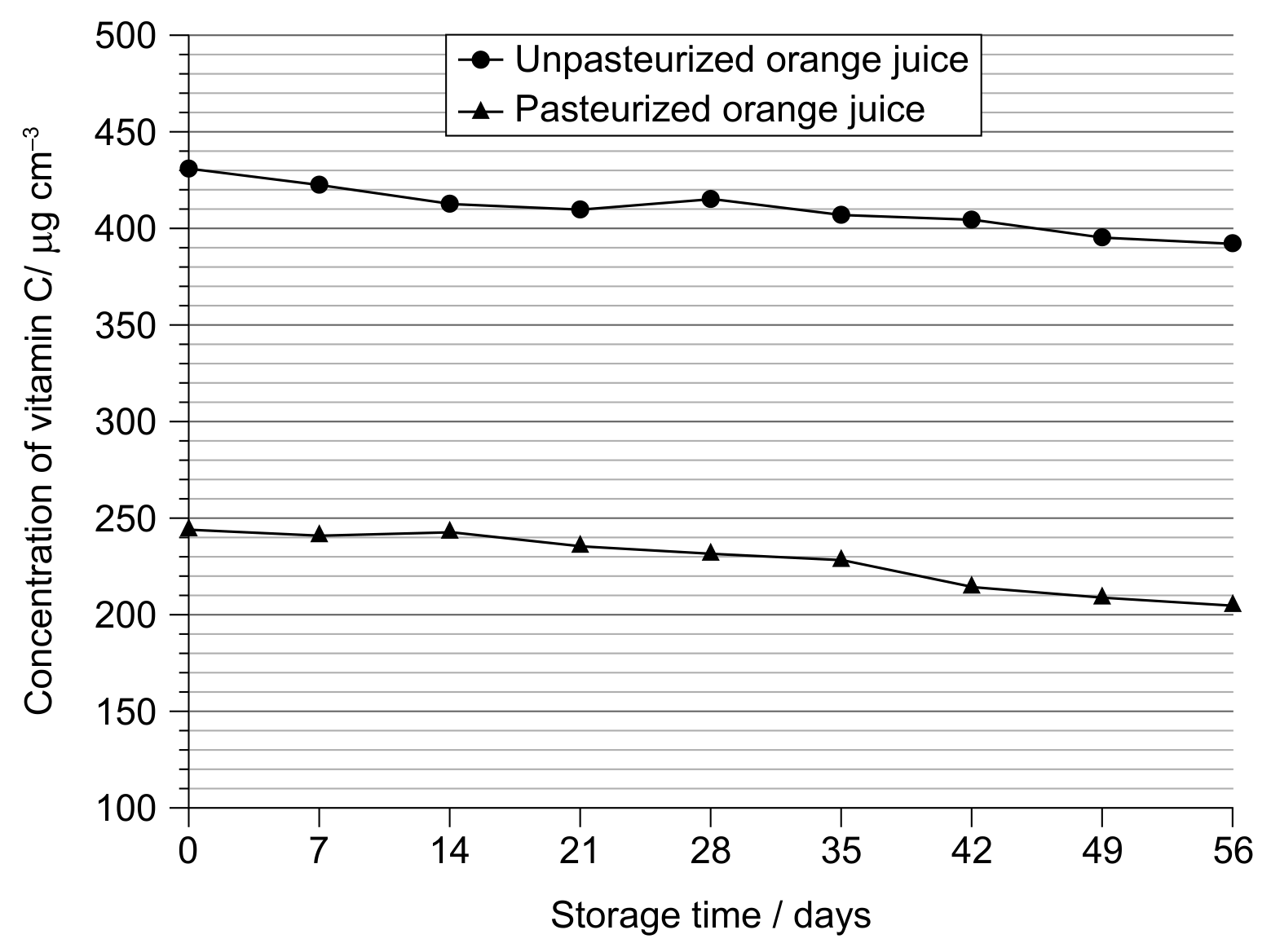
Pasteurization is used to eliminate pathogenic bacteria. The concentration of vitamin C was monitored over a period of time in pasteurized and unpasteurized orange juice.

Question image

Question 1(d)

(a)

The concentration of vitamin C (ascorbic acid) can be measured by performing a redox titration using acidified iodate, IO3\mathrm{IO}_{3}{ }^{-}, and iodide ions. Starch reacts with excess iodine once the vitamin C is consumed to produce a dark-blue complex.

Reaction 1: IO3(aq)+5I(aq)+6H+(aq)3I2(aq)+3H2O(l)\mathrm{IO}_{3}{ }^{-}(\mathrm{aq})+5 \mathrm{I}^{-}(\mathrm{aq})+6 \mathrm{H}^{+}(\mathrm{aq}) \rightarrow 3 \mathrm{I}_{2}(\mathrm{aq})+3 \mathrm{H}_{2} \mathrm{O}(\mathrm{l})

Reaction 2: ascorbic acid (aq) +I2(aq)2I(aq)++\mathrm{I}_{2}(\mathrm{aq}) \rightarrow 2 \mathrm{I}^{-}(\mathrm{aq})+ dehydroascorbic acid (aq)

[ 1 ]

Question 1(d)(i)

(i)

Identify the oxidizing agent in reaction 1 .

[ 1 ]

Question 1

[Maximum number: 2]

Ammonium nitrate, NH4NO3\mathrm{NH}_{4} \mathrm{NO}_{3}, is used as a high nitrogen fertilizer.

Question 1(e)

(a)

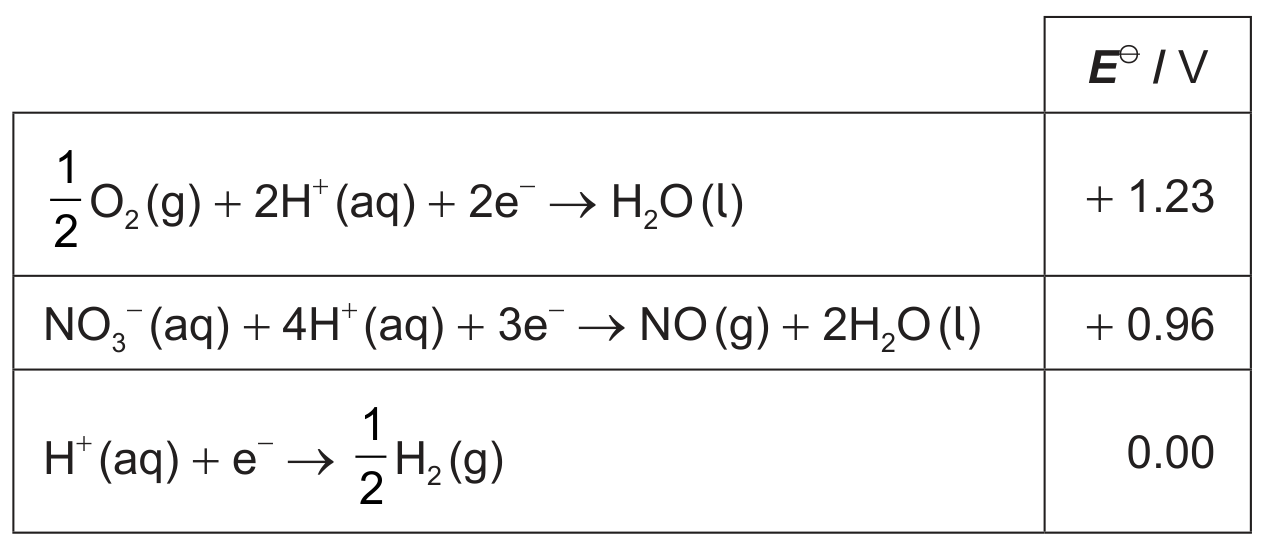
Predict, using the given values, the reaction that would take place at the anode and cathode for the electrolysis of an aqueous solution of ammonium nitrate using graphite electrodes.

Table

Anode:

Cathode:

[ 2 ]
0 selected