EduNinja

IB Chemistry HL3.1 The periodic tableQuestion Bank

Question 1

[Maximum number: 3]

Iron tablets are often prescribed to patients. The iron in the tablets is commonly present as iron(II) sulfate, FeSO4\mathrm{FeSO}_{4}.

Question 1(e)

(a)

This experiment involves the following redox reaction.

5Fe2+(aq)+MnO4(aq)+8H+(aq)5Fe3+(aq)+Mn2+(aq)+4H2O(l)5 \mathrm{Fe}^{2+}(\mathrm{aq})+\mathrm{MnO}_{4}^{-}(\mathrm{aq})+8 \mathrm{H}^{+}(\mathrm{aq}) \rightarrow 5 \mathrm{Fe}^{3+}(\mathrm{aq})+\mathrm{Mn}^{2+}(\mathrm{aq})+4 \mathrm{H}_{2} \mathrm{O}(\mathrm{l})
[ 1 ]

Question 1(e)(ii)

(i)

Deduce the oxidation number of manganese in the MnO4\mathrm{MnO}_{4}^{-}(aq) ion.

[ 1 ]

Question 1(g)

(b)

During the rough titration, the students found that a brown precipitate, X, formed.

[ 2 ]

Question 1(g)(i)

(i)

When the students discussed the nature of the precipitate with their teacher, they were told that X is the same compound as that used as a catalyst in the decomposition of hydrogen peroxide, H2O2(aq)\mathrm{H}_{2} \mathrm{O}_{2}(\mathrm{aq}), to prepare oxygen, O2( g)\mathrm{O}_{2}(\mathrm{~g}). Suggest the chemical formula and name of X.

Chemical formula:

Name:

[ 2 ]
Question 1

[Maximum number: 5]

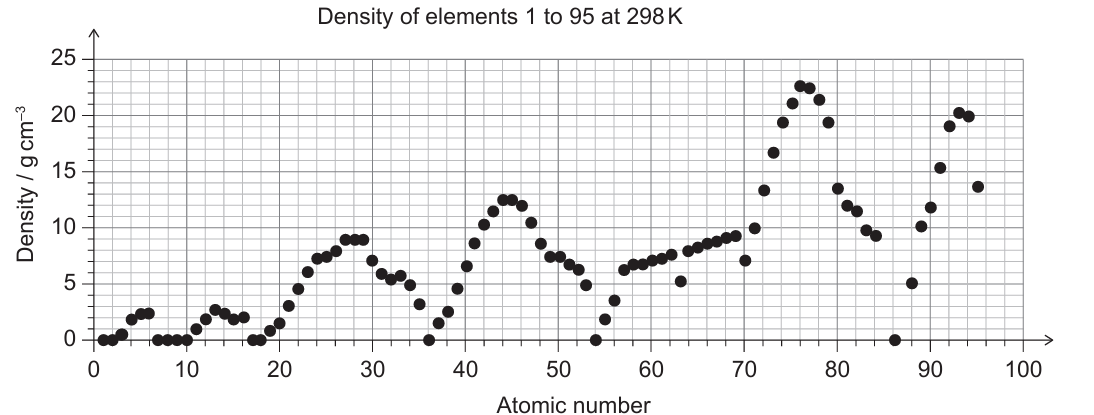
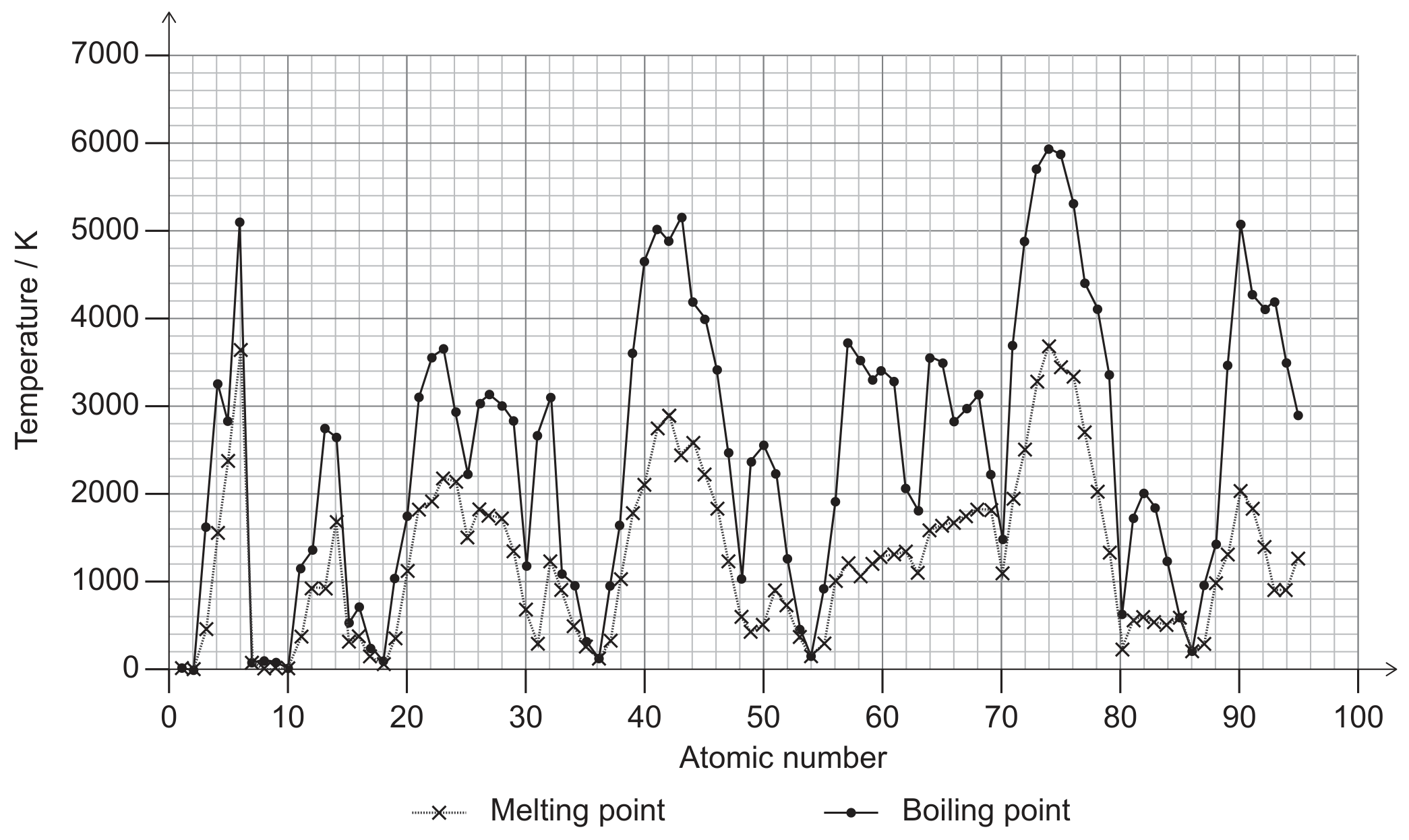
Physical properties of elements vary according to atomic number. Sections 6 to 9 of the data booklet list some of these properties.

Melting points and boiling points of elements 1 to 95

Question image

Question 1(b)

Question 1(b)(i)

(a)
(i)

Describe the density trend across periods 4 and 5 of the periodic table.

Question image
[ 1 ]

Question 1(b)(ii)

(ii)

Suggest, with a reason, whether the lanthanoids or actinoids of the f-block would have the higher density.

[ 1 ]

Question 1(b)(iii)

(iii)

Compare the ease of oxidation of s-block and d-block metals to their melting points and densities. Use section 25 of the data booklet.

[ 2 ]

Question 1(b)(iv)

(iv)

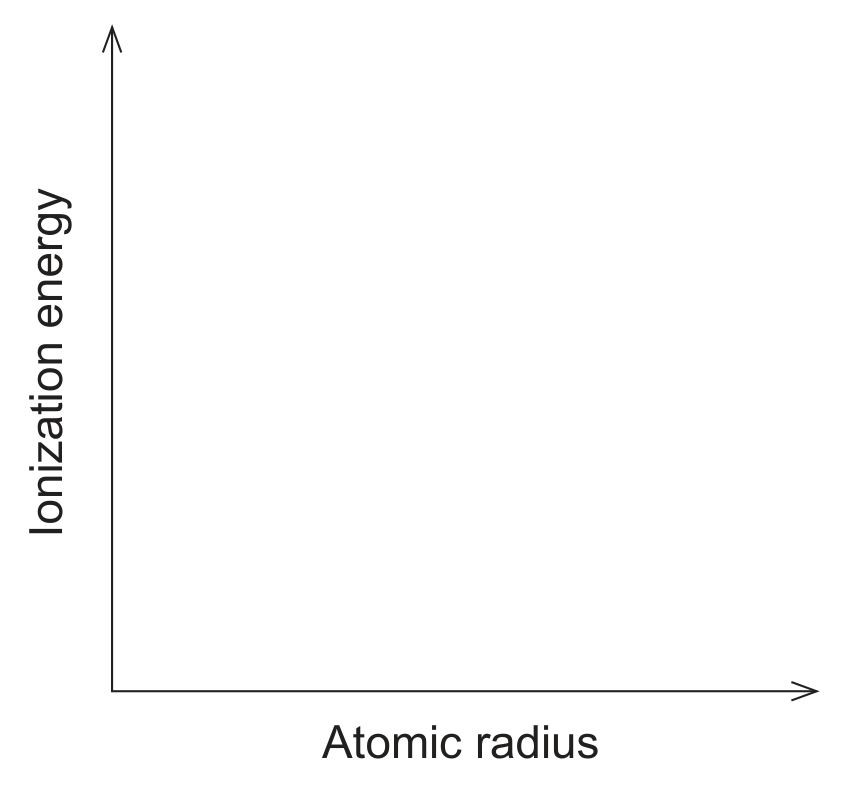
Sketch how the first ionization energies of elements vary with their atomic radius.

Question image
[ 1 ]

Question 1

[Maximum number: 2]

Phosphorus is an element that is an essential part of the biological molecules involved in both respiration and photosynthesis.

Question 1(a)

Question 1(a)(iii)

(a)
(i)

Explain why the first ionization energy decreases as you descend group 15 from nitrogen to bismuth.

[ 2 ]

Question 1

[Maximum number: 1]

Two groups of students (Group A and Group B) carried out a project* on the chemistry of some group 7 elements (the halogens) and their compounds.

Question 1(f)

(a)

In this project the students explored several aspects of the chemistry of the halogens. In the original preparation of ICl(1)\operatorname{ICl}(1), they observed the yellow-green colour of chlorine gas, Cl2( g)\mathrm{Cl}_{2}(\mathrm{~g}), reacting with solid iodine, I2( s)\mathrm{I}_{2}(\mathrm{~s}).

[ 1 ]

Question 1(f)(ii)

(i)

Chlorine can also react with water. State the balanced chemical equation for the reaction of Cl2( g)\mathrm{Cl}_{2}(\mathrm{~g}) with water.

[ 1 ]

Question 1

[Maximum number: 3]

There are many oxides of silver with the formula AgxOy.\mathrm{Ag}_{x} \mathrm{O}_{y^{.}}All of them decompose into their elements when heated strongly.

Question 1(c)

Question 1(c)(i)

(a)
(i)

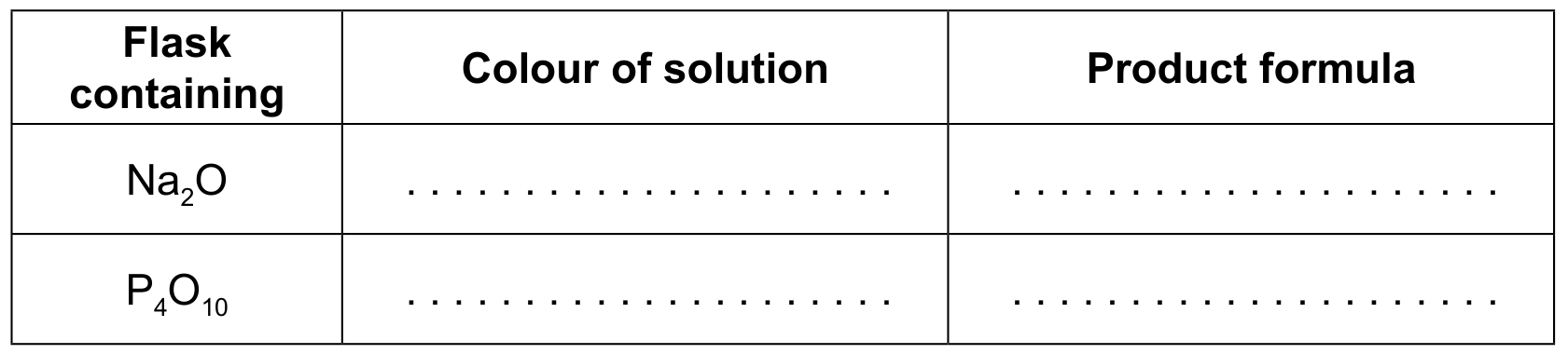
Some oxides of period 3, such as Na2O\mathrm{Na}_{2} \mathrm{O} and P4O10\mathrm{P}_{4} \mathrm{O}_{10}, react with water. A spatula measure of each oxide was added to a separate 100 cm3100 \mathrm{~cm}^{3} flask containing distilled water and a few drops of bromothymol blue indicator.
The indicator is listed in section 22 of the data booklet.
Deduce the colour of the resulting solution and the chemical formula of the product formed after reaction with water for each oxide.

Table
[ 3 ]

Question 1

[Maximum number: 5]

Chlorine undergoes many reactions.

Question 1(a)

Question 1(a)(ii)

(a)
(i)

State, giving a reason, whether the chlorine atom or the chloride ion has a larger radius.

[ 1 ]

Question 1(a)(iii)

(ii)

Outline why the chlorine atom has a smaller atomic radius than the sulfur atom.

[ 2 ]

Question 1(b)

(b)

2.67 g of manganese(IV) oxide was added to 200.0 cm3200.0 \mathrm{~cm}^{3} of 2.00 moldm3HCl2.00 \mathrm{~mol} \mathrm{dm}^{-3} \mathrm{HCl}.

MnO2( s)+4HCl(aq)Cl2( g)+2H2O(l)+MnCl2(aq)\mathrm{MnO}_{2}(\mathrm{~s})+4 \mathrm{HCl}(\mathrm{aq}) \rightarrow \mathrm{Cl}_{2}(\mathrm{~g})+2 \mathrm{H}_{2} \mathrm{O}(\mathrm{l})+\mathrm{MnCl}_{2}(\mathrm{aq})
[ 2 ]

Question 1(b)(v)

(i)

State the oxidation state of manganese in MnO2\mathrm{MnO}_{2} and MnCl2\mathrm{MnCl}_{2}.
MnO2:\mathrm{MnO}_{2}:MnCl2\mathrm{MnCl}_{2} :

[ 2 ]

Question 1

[Maximum number: 4]

Iron may be extracted from iron (II) sulfide, FeS.

Question 1(b)

(a)

Justify why sulfur is classified as a non-metal by giving two of its chemical properties.

[ 2 ]

Question 1(d)

(b)

Iron (II) sulfide, FeS, is ionically bonded.

[ 1 ]

Question 1(d)(iv)

(i)

Outline, in terms of their electronic structures, why the ionic radius of the sulfide ion is greater than that of the oxide ion.

[ 1 ]

Question 1(e)

(c)

The first step in the extraction of iron from iron (II) sulfide is to roast it in air to form iron (III) oxide and sulfur dioxide.

[ 1 ]

Question 1(e)(ii)

(i)

Deduce the change in the oxidation state of sulfur.

[ 1 ]

Question 1

[Maximum number: 4]

Hydrogen cyanide, HCN , is a very toxic compound.

Question 1(c)

(a)

The cyanide ion, CN\mathrm{CN}^{-}, can form complex ions, such as [Fe(CN)6]4\left[\mathrm{Fe}(\mathrm{CN})_{6}\right]^{4-}.

[ 4 ]

Question 1(c)(ii)

(i)

Deduce the oxidation state of iron in the complex ion.

[ 1 ]

Question 1(c)(iii)

(ii)

Explain why transition element ions, such as [Fe(CN)6]4\left[\mathrm{Fe}(\mathrm{CN})_{6}\right]^{4-}, are usually coloured.

[ 3 ]

Question 1

[Maximum number: 1]

Ethyne, C2H2\mathrm{C}_{2} \mathrm{H}_{2}, reacts with oxygen in welding torches.

Question 1(d)

(a)

Product B,CH3CHO\mathbf{B}, \mathrm{CH}_{3} \mathrm{CHO}, can also be synthesized from ethanol.

[ 1 ]

Question 1(d)(ii)

(i)

Deduce the average oxidation state of carbon in product B.

[ 1 ]

Question 1

[Maximum number: 2]

Ethane-1,2-diol, HOCH2CH2OH\mathrm{HOCH}_{2} \mathrm{CH}_{2} \mathrm{OH}, has a wide variety of uses including the removal of ice from aircraft and heat transfer in a solar cell.

Question 1(c)

(a)

Determine the average oxidation state of carbon in ethene and in ethane-1,2-diol.

Ethene:

Ethane-1,2-diol:

[ 2 ]
0 selected