EduNinja

IB Chemistry HL2.4 From models to materialsQuestion Bank

Question 1

[Maximum number: 3]

Iron may be extracted from iron (II) sulfide, FeS.

Question 1(d)

(a)

Iron (II) sulfide, FeS, is ionically bonded.

[ 1 ]

Question 1(d)(v)

(i)

Suggest why chemists find it convenient to classify bonding into ionic, covalent and metallic.

[ 1 ]

Question 1(f)

(b)

Explain why the addition of small amounts of carbon to iron makes the metal harder.

[ 2 ]
Question 1

[Maximum number: 2]

Two groups of students (Group A and Group B) carried out a project* on the chemistry of some group 7 elements (the halogens) and their compounds.

Question 1(f)

(a)

In this project the students explored several aspects of the chemistry of the halogens. In the original preparation of ICl(1)\operatorname{ICl}(1), they observed the yellow-green colour of chlorine gas, Cl2( g)\mathrm{Cl}_{2}(\mathrm{~g}), reacting with solid iodine, I2( s)\mathrm{I}_{2}(\mathrm{~s}).

[ 2 ]

Question 1(f)(iii)

(i)

One important use of chlorine is in the synthesis of poly(chloroethene), PVC. Identify the monomer used to make PVC and state one of the uses of PVC.

Monomer:

Use:

[ 2 ]

Question 1

[Maximum number: 1]

Alloys containing at least 60 % copper reduce the presence of bacteria on their surface. The percentage of copper in brass, an alloy of copper and zinc, can be determined by UV-vis spectrometry.

A sample of brass is dissolved in concentrated nitric acid and then made up to 250.0 cm3250.0 \mathrm{~cm}^{3} with water before analysis.

Cu( s)+4HNO3(aq)Cu(NO3)2(aq)+2NO2( g)+2H2O(l)3Zn( s)+8HNO3(aq)3Zn(NO3)2(aq)+2NO( g)+4H2O(l)\begin{aligned} & \mathrm{Cu}(\mathrm{~s})+4 \mathrm{HNO}_{3}(\mathrm{aq}) \rightarrow \mathrm{Cu}\left(\mathrm{NO}_{3}\right)_{2}(\mathrm{aq})+2 \mathrm{NO}_{2}(\mathrm{~g})+2 \mathrm{H}_{2} \mathrm{O}(\mathrm{l}) \\ & 3 \mathrm{Zn}(\mathrm{~s})+8 \mathrm{HNO}_{3}(\mathrm{aq}) \rightarrow 3 \mathrm{Zn}\left(\mathrm{NO}_{3}\right)_{2}(\mathrm{aq})+2 \mathrm{NO}(\mathrm{~g})+4 \mathrm{H}_{2} \mathrm{O}(\mathrm{l}) \end{aligned}

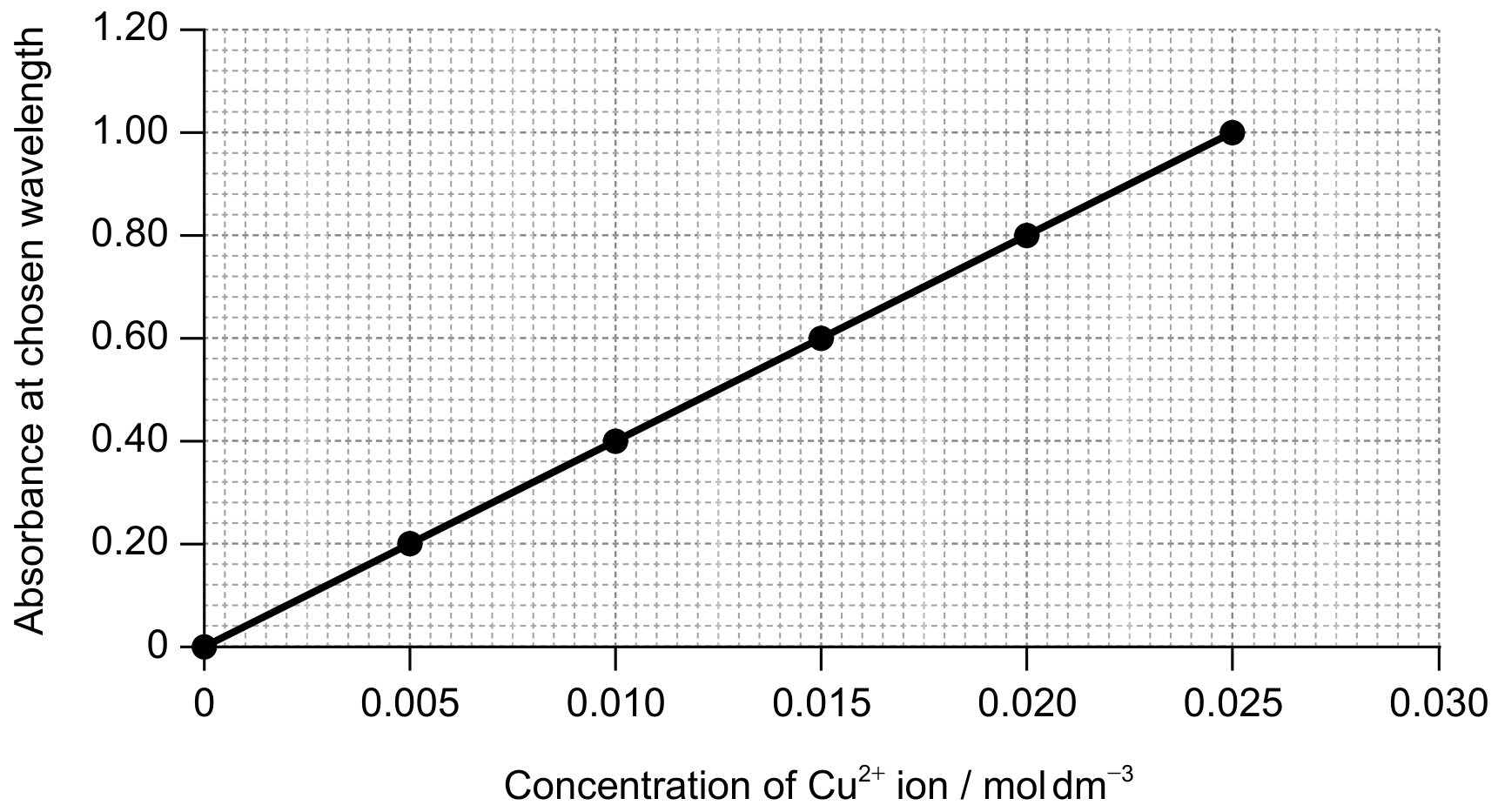
The concentration of copper(II) ions in the resulting solution is then determined from a calibration curve, which is plotted by measuring the light absorbance of standard solutions.

Calibration curve

Calibration curve

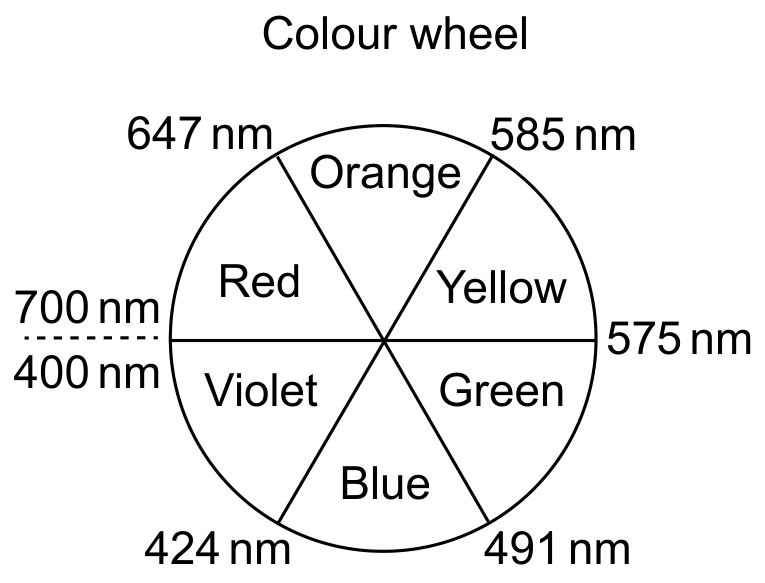
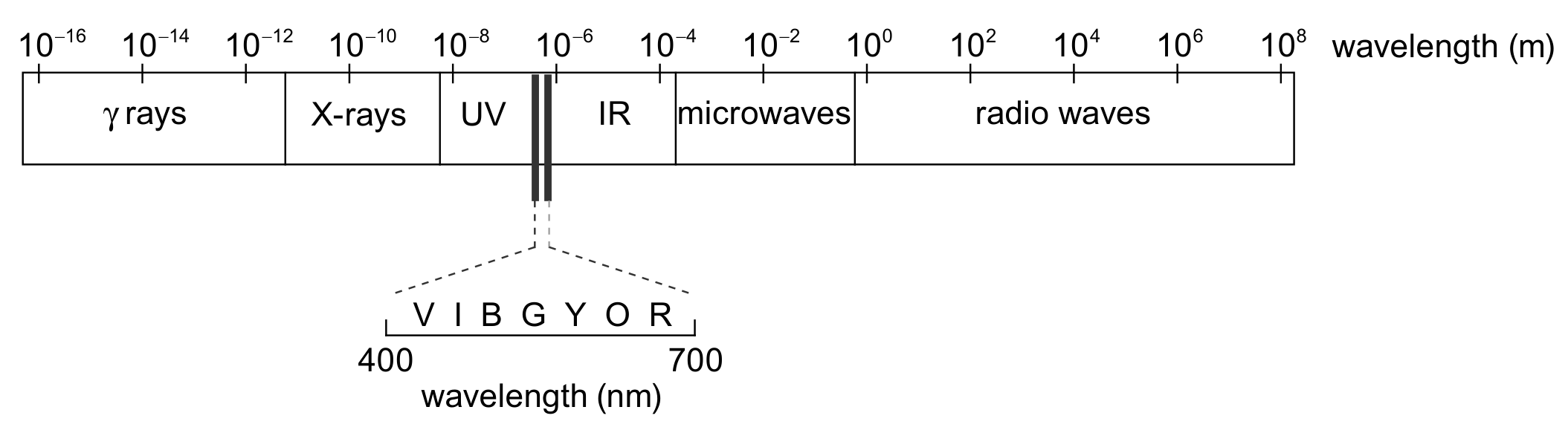
You may find the following chart and diagram helpful.

Question image
The electromagnetic spectrum
energy

The electromagnetic spectrum energy

Question 1(f)

Question 1(f)(ii)

(a)
(i)

Suggest another property of brass that makes it suitable for door handles.

[ 1 ]

Question 2

[Maximum number: 2]

Titanium and vanadium are consecutive elements in the first transition metal series.

Question 2(d)

Question 2(d)(iv)

(a)
(i)

Explain why an aluminium-titanium alloy is harder than pure aluminium.

[ 2 ]

Question 10

[Maximum number: 1]

Which compound is predominantly covalent?

A

LiCl

B

Al2O3\mathrm{Al}_{2} \mathrm{O}_{3}

C

ClF

D

ZnCl2\mathrm{ZnCl}_{2}

Question 2

[Maximum number: 5]

One way of classifying materials is based on the type of bonding present.

Question 2(a)

(a)

Outline why this type of classification is not entirely satisfactory by using magnesium diboride, MgB2\mathrm{MgB}_{2}, as an example. Refer to sections 8 and 29 of the data booklet.

[ 2 ]

Question 2(b)

(b)

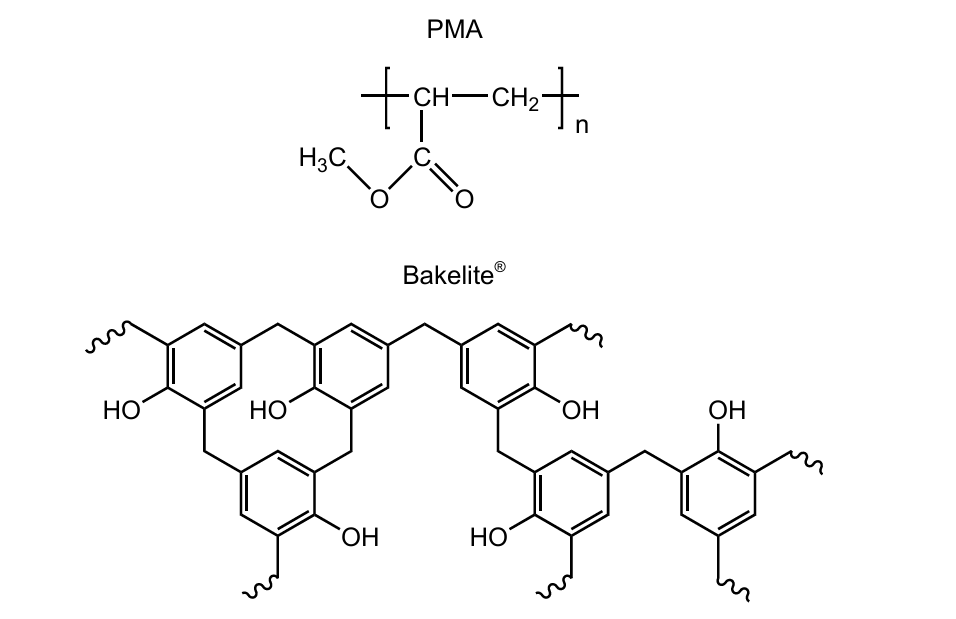
Structures of poly(methyl acrylate), PMA, and Bakelite ®{ }^{\circledR} are shown.

Question image

Suggest, giving reasons, which is the thermoplastic polymer and which is the thermosetting polymer.

Thermoplastic polymer:

Thermosetting polymer:

[ 2 ]

Question 2(d)

(c)

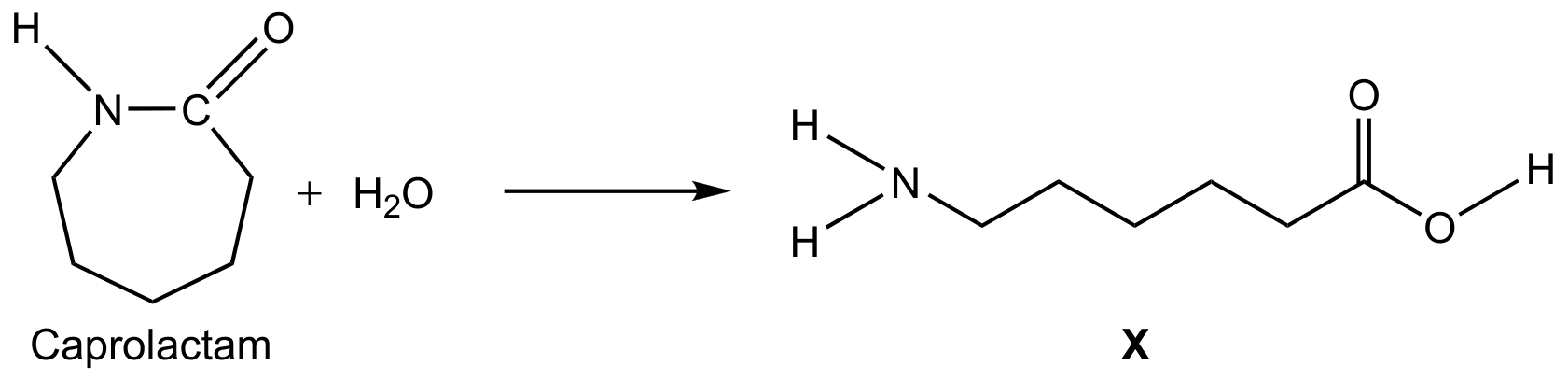
Caprolactam reacts with water to form compound X, a monomer.

Question image
[ 1 ]

Question 2(d)(ii)

(i)

Deduce the repeating unit of the polymer of X.

[ 1 ]

Question 3

[Maximum number: 2]

Inductively Coupled Plasma (ICP) used with Mass Spectrometry (MS) or Optical Emission Spectrometry (OES) can be used to identify and quantify elements in a sample.

Question 3(a)

(a)

ICP-OES/MS can be used to analyse alloys and composites. Distinguish between alloys and composites.

[ 2 ]

Question 14

[Maximum number: 1]

Which statements are correct for alloys?

I. They are homogeneous mixtures of metals with other metals or non-metals.
II. The different sizes of atoms in alloys prevent layers of metallic cations sliding over each other easily.
III. Adding carbon to iron produces an alloy that is stronger than pure iron.

A

I and II only

B

I and III only

C

II and III only

D

I, II and III

Question 2

[Maximum number: 2]

Consider the two-stage reaction pathway below.

Question image

Question 2(c)

(a)

The final product can react with ethane-1,2-diol, HOCH2CH2OH\mathrm{HOCH}_{2}-\mathrm{CH}_{2} \mathrm{OH}, to produce a polymer.

[ 2 ]

Question 2(c)(i)

(i)

State the type of polymerization involved.

[ 1 ]

Question 2(c)(ii)

(ii)

Draw the structure of a section of the polymer produced containing two molecules of each monomer.

[ 1 ]

Question 3

[Maximum number: 4]

Carbon fibre reinforced plastic (CFRP) is a useful composite. Epoxy is a thermoset polymer that is used as a binding polymer when making CFRP.

Question 3(b)

Question 3(b)(i)

(a)
(i)

Thermoplastic composites are increasingly replacing thermosets.

Suggest one advantage of thermoplastic polymers over thermosets.

[ 1 ]

Question 3(c)

(b)

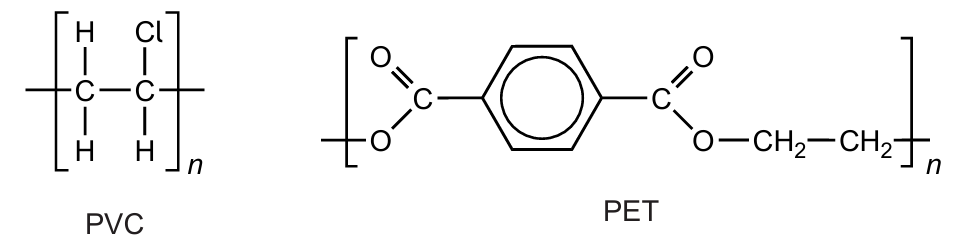
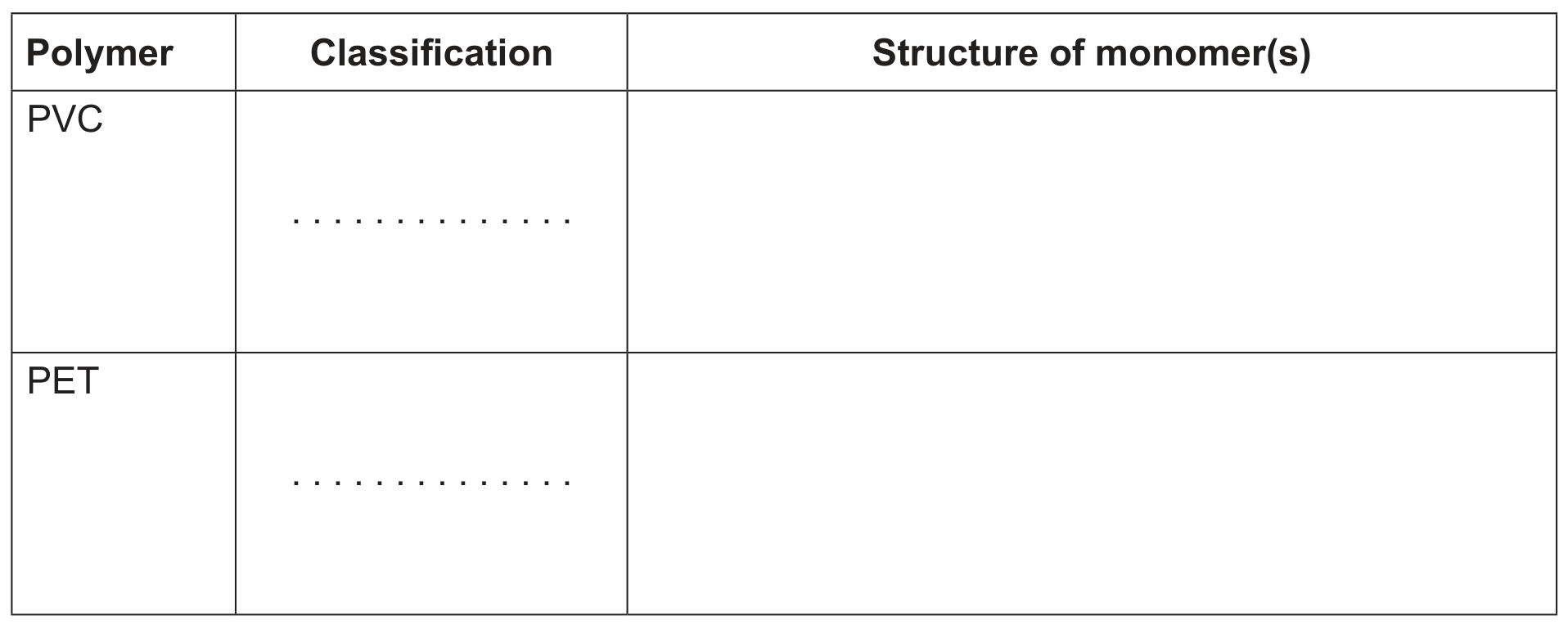
Classify PVC and polyethene terephthalate, PET, as addition or condensation polymers and deduce the structural formulas.

Question image
Table
[ 3 ]
0 selected