EduNinja

IB Chemistry HL2.3 The metallic modelQuestion Bank

Question 1

[Maximum number: 3]

One definition of atomic volume is given by the formula:

 Atomic volume = atomic mass (g mol1) density (g cm3)\text { Atomic volume }=\frac{\text { atomic mass }\left(\mathrm{g} \mathrm{~mol}^{-1}\right)}{\text { density }\left(\mathrm{g} \mathrm{~cm}^{-3}\right)}

The table gives the atomic volumes of the first nineteen elements, in the form in which they occur at STP.
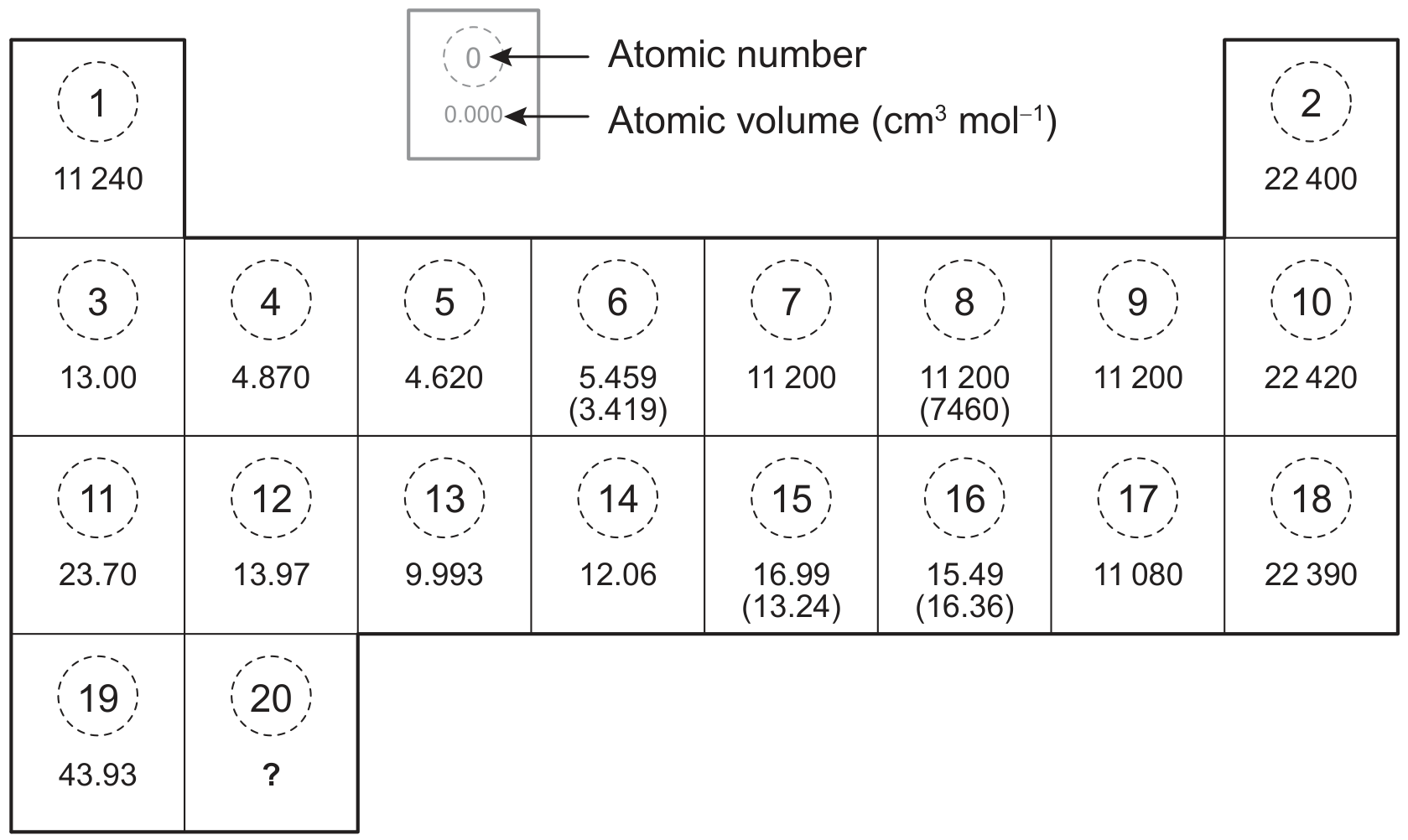
Key:

Key:

Question 1(d)

(a)

Explain why the atomic volumes of elements 11, 12 and 13 show a steady decrease.

[ 2 ]

Question 1(e)

(b)

Estimate the atomic volume, in cm3 mol1\mathrm{cm}^{3} \mathrm{~mol}^{-1}, of element 20.

[ 1 ]

Question 1

[Maximum number: 1]

Iron may be extracted from iron (II) sulfide, FeS.

Question 1(a)

(a)

Outline why metals, like iron, can conduct electricity.

[ 1 ]

Question 1

[Maximum number: 1]

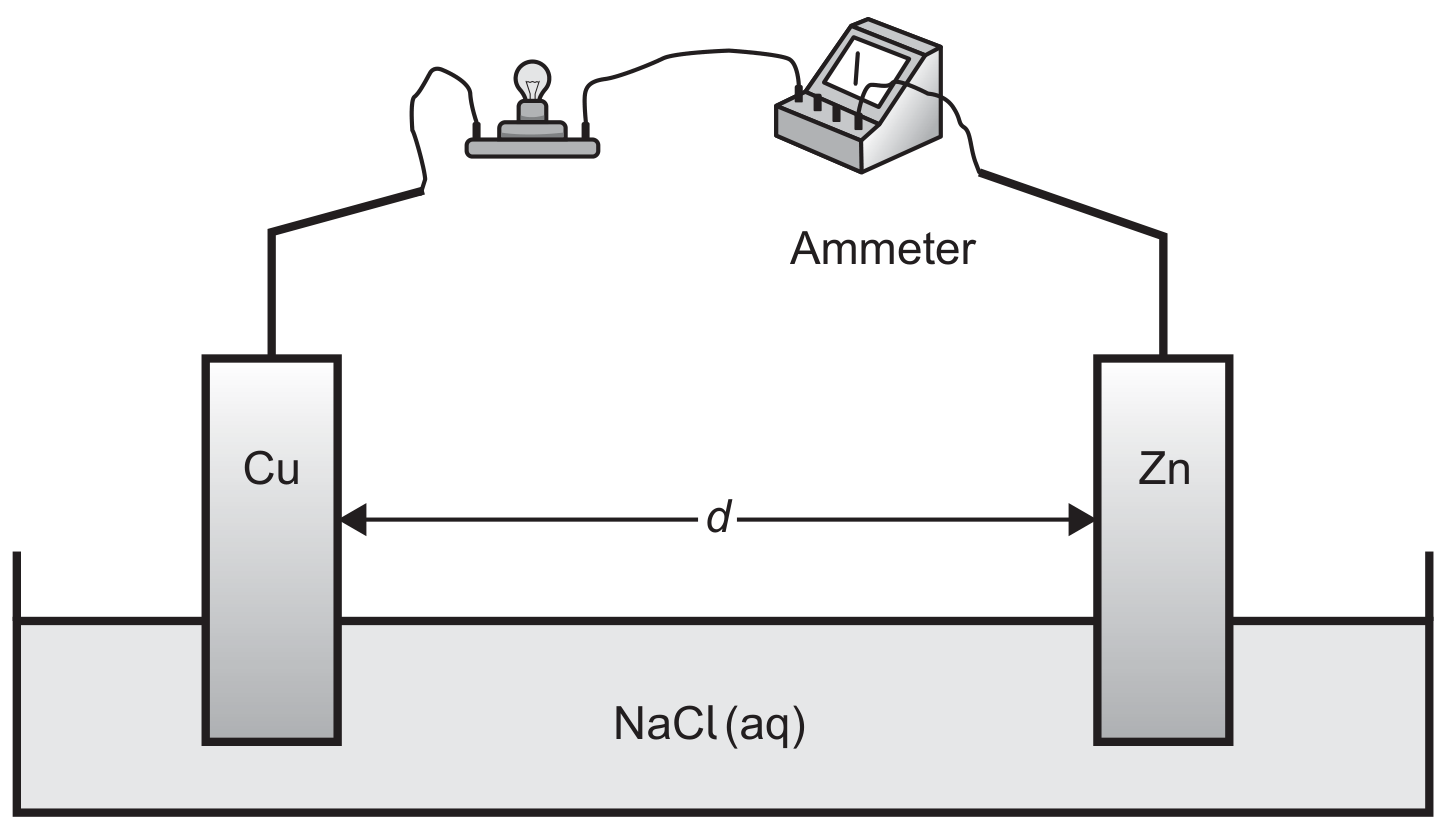
A student set up a simple voltaic cell consisting of a copper electrode and a zinc electrode dipped in sodium chloride solution.

Question image

The student gradually increased the distance, d, between the electrodes to study the effect on the initial current, I, passing through the light bulb.

The student hypothesized that the initial current would be inversely proportional to the distance between the electrodes.

Question 1(b)

(a)

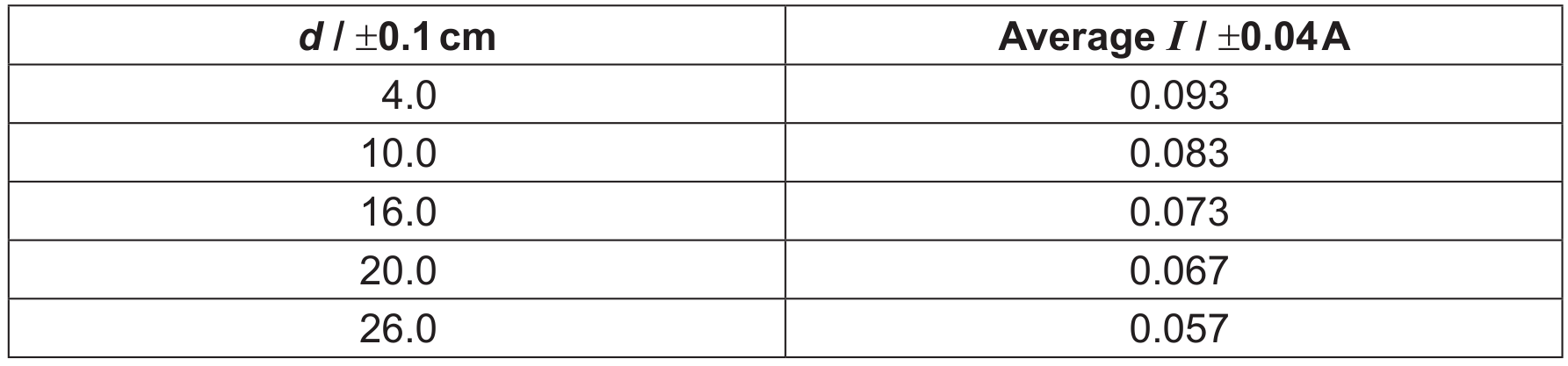
The following data was collected over five trials.

Table

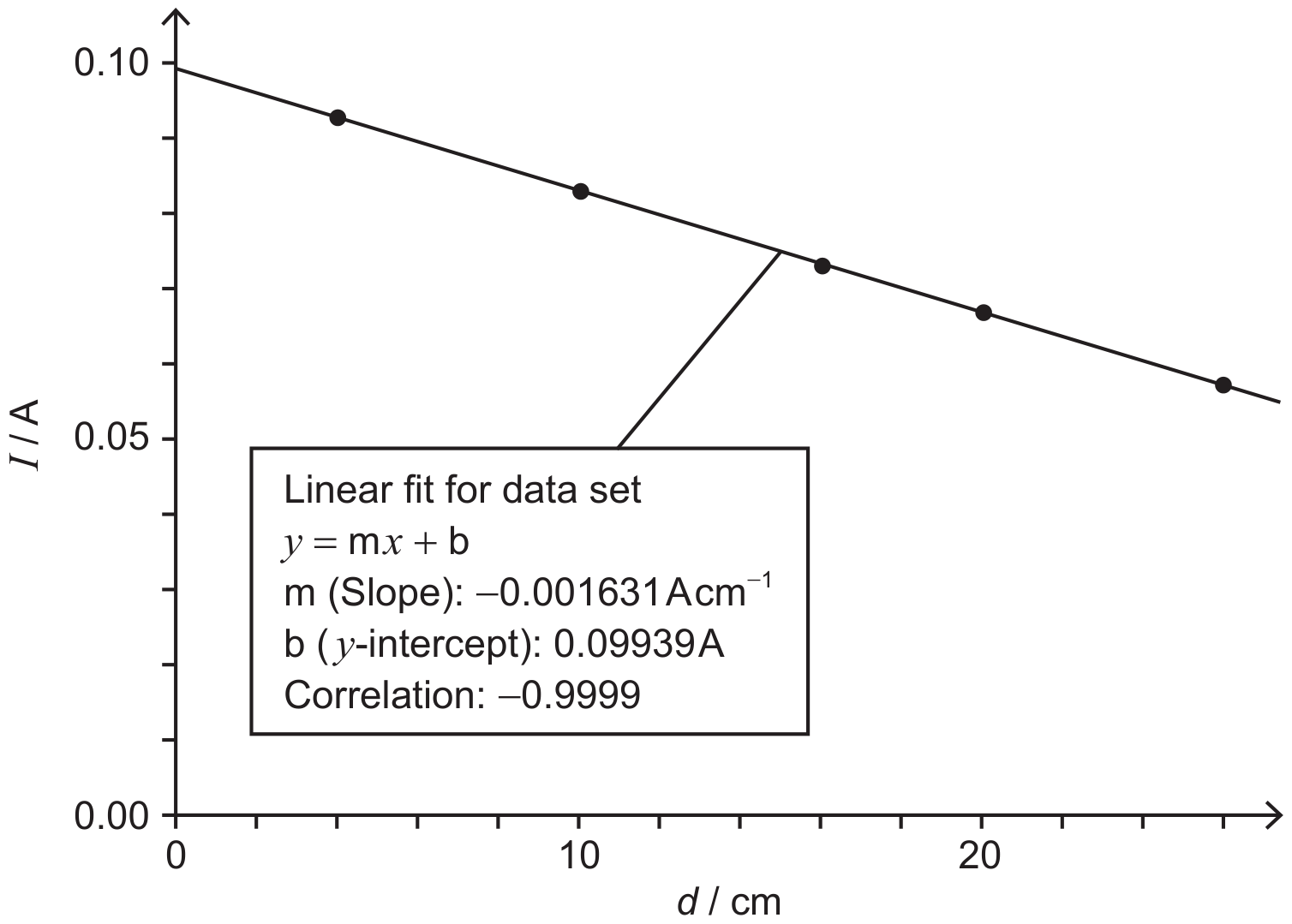
The data did not support the student's hypothesis. He investigated other possible relationships by plotting a graph of the average current against the distance between the electrodes. He obtained the following best-fit line with a correlation coefficient ( r ) of -0.9999 .

Question image
[ 1 ]

Question 1(b)(iii)

(i)

Outline how current flows in the sodium chloride solution.

[ 1 ]

Question 2

[Maximum number: 3]

Titanium and vanadium are consecutive elements in the first transition metal series.

Question 2(a)

(a)

Describe the bonding in metals.

[ 2 ]

Question 2(d)

Question 2(d)(ii)

(b)
(i)

Suggest why the melting point of vanadium is higher than that of titanium.

[ 1 ]

Question 10

[Maximum number: 1]

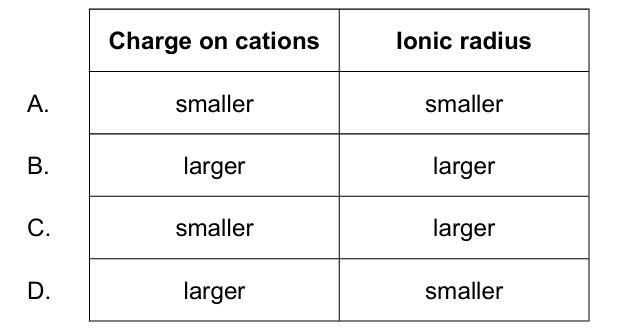
Which combination causes the strength of metallic bonding to increase?

Question image

Question 11

[Maximum number: 1]

Which metal has the strongest metallic bonding?

A

Na

B

Mg

C

Al

D

Ca

Question 2

[Maximum number: 1]

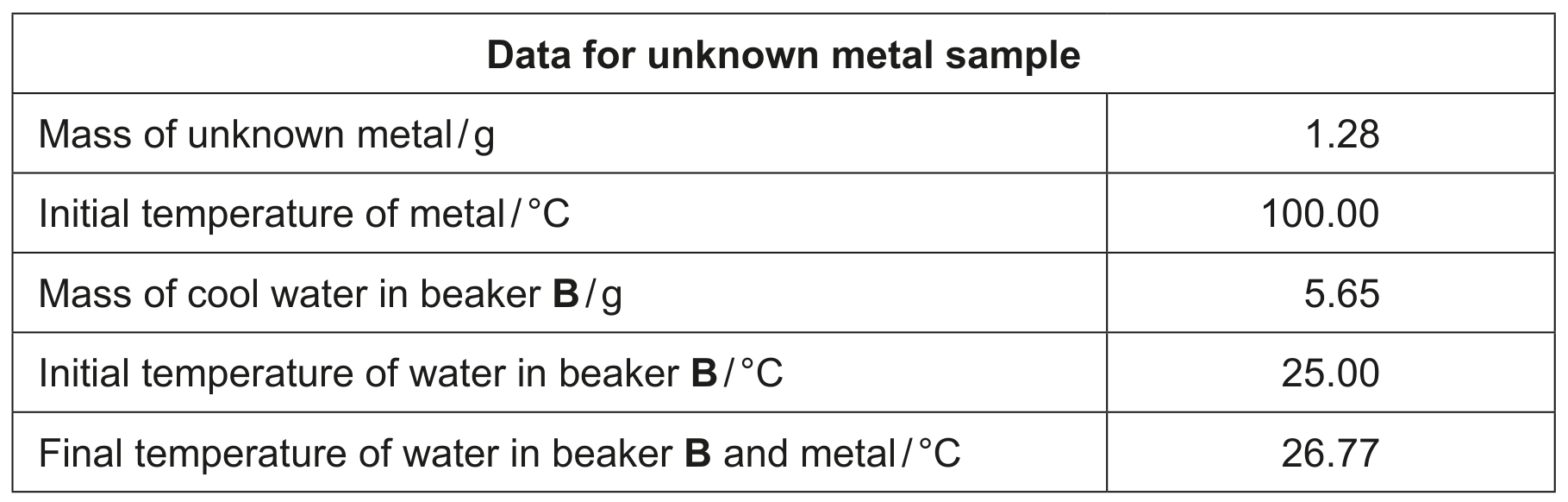
A student was asked to identify an unknown metal with a mass of 1.28 g using calorimetry. The metal was placed in beaker A with boiling water at 100.00C100.00^{\circ} \mathrm{C} until the metal reached the same temperature as the water. The metal was then quickly transferred to beaker B with 5.65 g of water which had an initial temperature of 25.00C25.00^{\circ} \mathrm{C}. The final temperature of the water in beaker B and the metal was 26.77C26.77^{\circ} \mathrm{C}.

Table

Question 2(e)

(a)

State another physical property that could be used to identify the metal without damaging the sample.

[ 1 ]

Question 14

[Maximum number: 1]

Zinc metal contains metallic bonding. Which is the best description of a metallic bond?

A

The electrostatic attraction between a pair of electrons and positively charged nuclei.

B

The electrostatic attraction between oppositely charged ions.

C

The electrostatic attraction between a lattice of positive ions and delocalized electrons.

D

The bond formed when one atom provides both electrons in a shared pair.

Question 3

[Maximum number: 1]

Iron may be extracted from an ore containing Fe2O3\mathrm{Fe}_{2} \mathrm{O}_{3} in a blast furnace by reaction with coke, limestone and air. Aluminium is obtained by electrolysis of an ore containing Al2O3\mathrm{Al}_{2} \mathrm{O}_{3}.

Question 3(d)

Question 3(d)(i)

(a)
(i)

Outline the cause of electrical resistance in metallic conductors.

[ 1 ]

Question 4

[Maximum number: 4]

Metals are extracted from their ores by several methods, including electrolysis and reduction with carbon.

Question 4(c)

(a)

Explain the action of metals as heterogeneous catalysts.

[ 2 ]

Question 4(d)

(b)

Outline how alloys conduct electricity and why they are often harder than pure metals.

Conduct electricity:

Harder than pure metals:

[ 2 ]
0 selected