Question 1
Nitrogen dioxide, , is a brown, toxic and corrosive gas. It can be made in a school laboratory by heating a group II metal nitrate or by the reaction of copper, Cu , with concentrated nitric acid, .
Question 1(b)
The made was sealed in a glass vessel where the following equilibrium reaction occurred:
Suggest two measurements, other than colour change, that could be used to monitor the progress of this reaction over time and the expected results.
Measurement 1:
Expected result:
Measurement 2:
Expected result:
Question 1(c)
A sample of 0.0100 moles of was placed in a sealed container and maintained at a constant temperature of .
Question 1(c)(ii)
The equilibrium concentration of was monitored using colorimetry. A student started the experiment and recorded the absorbance value immediately.
Suggest why this may not give a reliable result.
Question 1(c)(iii)
Suggest how the problem identified in part (c)(ii) could be overcome.
Question 1(d)
The equilibrium was investigated at and it was found that 0.00732 moles of , remained in the container from the original 0.0100 moles.
Determine the value of the equilibrium constant, K for this equilibrium at .
Question 1(e)
The initial amount of was determined by titration. The oxide was first dissolved in water according to the following equation:
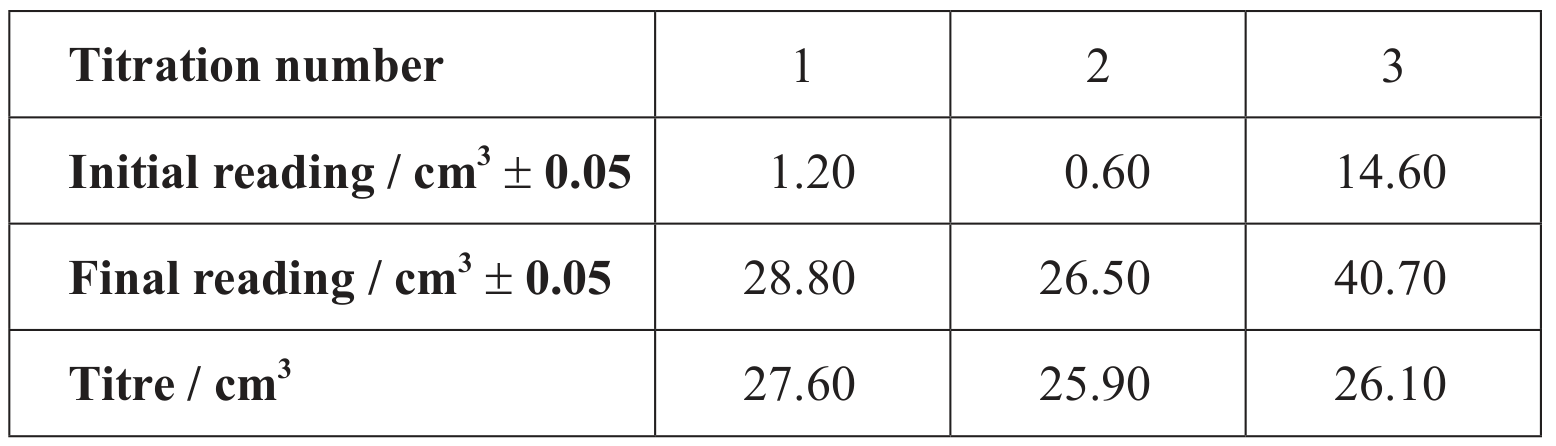
The solution was made up to and portions of this solution were then titrated against a standard solution of sodium hydroxide, NaOH .
Question 1(e)(iii)
The experiment described in part (b) was repeated three more times at different temperatures. The following values for the equilibrium constant, K, were determined:
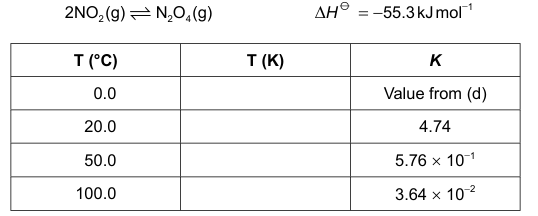
Calculate the values for temperature, T , in degrees kelvin, K , and complete the table.
Question 1(e)(iv)
Deduce if the results in part (e)(iii) are consistent with the enthalpy of reaction data given in part (b).