EduNinja

IB Chemistry HL2.1 Amount of chemical changeQuestion Bank

Question 1

[Maximum number: 4]

Two groups of students (Group A and Group B) carried out a project* on the chemistry of some group 7 elements (the halogens) and their compounds.

Question 1(a)

(a)

In the first part of the project, the two groups had a sample of iodine monochloride (a corrosive brown liquid) prepared for them by their teacher using the following reaction.

I2( s)+Cl2( g)2ICl(l)\mathrm{I}_{2}(\mathrm{~s})+\mathrm{Cl}_{2}(\mathrm{~g}) \rightarrow 2 \mathrm{ICl}(\mathrm{l})

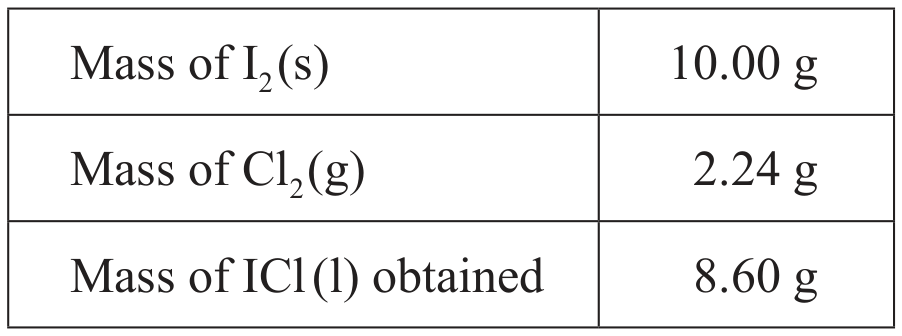
The following data were recorded.

Table
[ 4 ]

Question 1(a)(ii)

(i)

The iodine used in the reaction was in excess. Determine the theoretical yield, in g , of ICl(l).

[ 3 ]

Question 1(a)(iii)

(ii)

Calculate the percentage yield of ICl(l).

[ 1 ]
Question 1

[Maximum number: 1]

Nitrogen monoxide, NO(g), is produced in internal combustion and jet engines.

Question 1(d)

(a)

In an exhaust pipe catalytic converter, NO reacts with carbon monoxide, CO , to form N2\mathrm{N}_{2}.

[ 1 ]

Question 1(d)(ii)

(i)

Deduce the second product and the balanced equation for the reaction.

[ 1 ]

Question 1

[Maximum number: 1]

Nitrogen dioxide, NO2\mathrm{NO}_{2}, is a brown, toxic and corrosive gas. It can be made in a school laboratory by heating a group II metal nitrate or by the reaction of copper, Cu , with concentrated nitric acid, HNO3\mathrm{HNO}_{3}.

Question 1(a)

Question 1(a)(ii)

(a)
(i)

Deduce the coefficients in the equation for the reaction of Cu with concentrated HNO3\mathrm{HNO}_{3}.

Cu( s)+HNO3(aq)Cu(NO3)2(aq)+NO2( g)+H2O(l){ }_{-} \mathrm{Cu}(\mathrm{~s})+{ }_{-} \mathrm{HNO}_{3}(\mathrm{aq}) \rightarrow{ }_{-} \mathrm{Cu}\left(\mathrm{NO}_{3}\right)_{2}(\mathrm{aq})+{ }_{-} \mathrm{NO}_{2}(\mathrm{~g})+{ }_{-} \mathrm{H}_{2} \mathrm{O}(\mathrm{l})
[ 1 ]

Question 1

[Maximum number: 3]

A powder has the following percentage composition by mass:
30.0 % sucrose, C12H22O11\mathrm{C}_{12} \mathrm{H}_{22} \mathrm{O}_{11}
45.0 % citric acid, C6H8O7\mathrm{C}_{6} \mathrm{H}_{8} \mathrm{O}_{7}
25.0 \% sodium hydrogencarbonate, NaHCO3\mathrm{NaHCO}_{3}

In the presence of water, the powder effervesces as the citric acid reacts with the sodium hydrogencarbonate:

3NaHCO3( s)+C6H8O7(aq)Na3(C6H5O7)(aq)+3CO2( g)+3H2O(l)3 \mathrm{NaHCO}_{3}(\mathrm{~s})+\mathrm{C}_{6} \mathrm{H}_{8} \mathrm{O}_{7}(\mathrm{aq}) \rightarrow \mathrm{Na}_{3}\left(\mathrm{C}_{6} \mathrm{H}_{5} \mathrm{O}_{7}\right)(\mathrm{aq})+3 \mathrm{CO}_{2}(\mathrm{~g})+3 \mathrm{H}_{2} \mathrm{O}(\mathrm{l})

Question 1(a)

Question 1(a)(i)

(a)
(i)

Determine the limiting reactant when 1.00 g of this powder reacts.

[ 3 ]

Question 1

[Maximum number: 1]

A student determined the percentage of the active ingredient magnesium hydroxide, Mg(OH)2\mathrm{Mg}(\mathrm{OH})_{2}, in a 1.24 g antacid tablet.

The antacid tablet was added to 50.00 cm350.00 \mathrm{~cm}^{3} of 0.100 moldm30.100 \mathrm{~mol} \mathrm{dm}^{-3} sulfuric acid, which was in excess.

Question 1(d)

(a)

Calculate the amount of H2SO4\mathrm{H}_{2} \mathrm{SO}_{4} that reacted with Mg(OH)2\mathrm{Mg}(\mathrm{OH})_{2}.

[ 1 ]

Question 1

[Maximum number: 1]

4.0 g of solid sodium hydroxide is added to 0.10dm30.10 \mathrm{dm}^{3} of 1.0moldm31.0 \mathrm{moldm}^{-3} aqueous sulfuric acid.

2NaOH( s)+H2SO4(aq)Na2SO4(aq)+2H2O(l)2 \mathrm{NaOH}(\mathrm{~s})+\mathrm{H}_{2} \mathrm{SO}_{4}(\mathrm{aq}) \rightarrow \mathrm{Na}_{2} \mathrm{SO}_{4}(\mathrm{aq})+2 \mathrm{H}_{2} \mathrm{O}(\mathrm{l})

Which statement is correct?

A

Neither reactant is in excess.

B

0.10 molNa2SO40.10 \mathrm{~mol} \mathrm{Na}_{2} \mathrm{SO}_{4} is formed.

C

Excess H2SO4\mathrm{H}_{2} \mathrm{SO}_{4} remains in solution.

D

Excess NaOH remains in solution.

Question 1

[Maximum number: 4]

3.26 g of iron powder are added to 80.0 cm380.0 \mathrm{~cm}^{3} of 0.200 moldm30.200 \mathrm{~mol} \mathrm{dm}^{-3} copper(II) sulfate solution. The following reaction occurs:

Fe( s)+CuSO4(aq)FeSO4(aq)+Cu( s)\mathrm{Fe}(\mathrm{~s})+\mathrm{CuSO}_{4}(\mathrm{aq}) \rightarrow \mathrm{FeSO}_{4}(\mathrm{aq})+\mathrm{Cu}(\mathrm{~s})

Question 1(a)

Question 1(a)(i)

(a)
(i)

Determine the limiting reactant showing your working.

[ 2 ]

Question 1(a)(ii)

(ii)

The mass of copper obtained experimentally was 0.872 g . Calculate the percentage yield of copper.

[ 2 ]

Question 1

[Maximum number: 3]

Chlorine undergoes many reactions.

Question 1(b)

(a)

2.67 g of manganese(IV) oxide was added to 200.0 cm3200.0 \mathrm{~cm}^{3} of 2.00 moldm3HCl2.00 \mathrm{~mol} \mathrm{dm}^{-3} \mathrm{HCl}.

MnO2( s)+4HCl(aq)Cl2( g)+2H2O(l)+MnCl2(aq)\mathrm{MnO}_{2}(\mathrm{~s})+4 \mathrm{HCl}(\mathrm{aq}) \rightarrow \mathrm{Cl}_{2}(\mathrm{~g})+2 \mathrm{H}_{2} \mathrm{O}(\mathrm{l})+\mathrm{MnCl}_{2}(\mathrm{aq})
[ 3 ]

Question 1(b)(ii)

(i)

Determine the limiting reactant, showing your calculations.

[ 2 ]

Question 1(b)(iii)

(ii)

Determine the excess amount, in mol , of the other reactant.

[ 1 ]

Question 1

[Maximum number: 1]

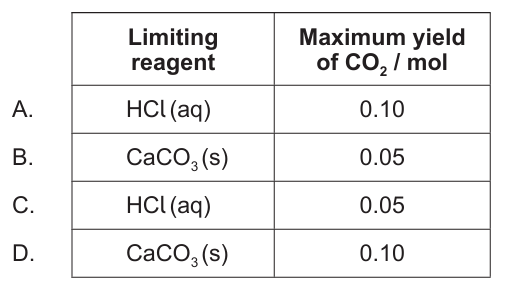
0.10 mol of hydrochloric acid is mixed with 0.10 mol of calcium carbonate.

Question image

Question 1

[Maximum number: 1]

Ammonium nitrate, NH4NO3\mathrm{NH}_{4} \mathrm{NO}_{3}, is used as a high nitrogen fertilizer.

Question 1(f)

(a)

Solid ammonium nitrate can decompose to gaseous dinitrogen monoxide and liquid water.

[ 1 ]

Question 1(f)(i)

(i)

Write the chemical equation for this decomposition.

[ 1 ]
0 selected