EduNinja

IB Chemistry HL1.3 Energy from fuelsQuestion Bank

Question 1

[Maximum number: 7]

Ammonium nitrate, NH4NO3\mathrm{NH}_{4} \mathrm{NO}_{3}, is used as a high nitrogen fertilizer.

Question 1(d)

(a)

Cold packs contain ammonium nitrate and water separated by a membrane.

[ 5 ]

Question 1(d)(v)

(i)

Calculate the standard entropy change, ΔS\Delta S^{\ominus}, for the dissolution of ammonium nitrate.

SNH4NO3( s)=151.1 J mol1 K1 SNH4NO3(aq)=259.8 J mol1 K1\begin{aligned} \mathrm{S}^{\ominus} \mathrm{NH}_{4} \mathrm{NO}_{3}(\mathrm{~s}) & =151.1 \mathrm{~J} \mathrm{~mol}^{-1} \mathrm{~K}^{-1} \\ \mathrm{~S}^{\ominus} \mathrm{NH}_{4} \mathrm{NO}_{3}(\mathrm{aq}) & =259.8 \mathrm{~J} \mathrm{~mol}^{-1} \mathrm{~K}^{-1} \end{aligned}
[ 1 ]

Question 1(d)(vi)

(ii)

Calculate the standard Gibbs free energy change, ΔG\Delta G^{\ominus}, in kJmol1\mathrm{kJ} \mathrm{mol}^{-1}, for the dissolution of ammonium nitrate at 298 K . Use sections 1 and 19 of the data booklet as well as your answer for question part (d)(v).

If you did not obtain an answer in (d)(v), use 102.3 J mol1 K1102.3 \mathrm{~J} \mathrm{~mol}^{-1} \mathrm{~K}^{-1}, although this is not the correct answer.

[ 1 ]

Question 1(d)(vii)

(iii)

Calculate the value of the equilibrium constant for the dissolution of ammonium nitrate at 298 K using the answer to question part (d)(vi) and section 1 of the data booklet.

NH4NO3( s)NH4NO3(aq)\mathrm{NH}_{4} \mathrm{NO}_{3}(\mathrm{~s}) \rightleftharpoons \mathrm{NH}_{4} \mathrm{NO}_{3}(\mathrm{aq})

If you did not obtain an answer in (d)(vi), use 7.84 kJ/mol-7.84 \mathrm{~kJ} / \mathrm{mol}, although this is not the correct answer.

[ 2 ]

Question 1(d)(viii)

(iv)

Deduce, with a reason, the position of the equilibrium.

[ 1 ]

Question 1(f)

(b)

Solid ammonium nitrate can decompose to gaseous dinitrogen monoxide and liquid water.

[ 2 ]

Question 1(f)(iv)

(i)

Predict, with a reason, the signs for the entropy change, ΔS\Delta S^{\ominus}, and Gibbs free energy change, ΔG\Delta G^{\ominus}, of the reaction.

Entropy change:
Gibbs free energy change:
[ 2 ]

Question 1

[Maximum number: 4]

Urea, (H2 N)2CO\left(\mathrm{H}_{2} \mathrm{~N}\right)_{2} \mathrm{CO}, is excreted by mammals and can be used as a fertilizer.

Question 1(d)

(a)

Urea can also be made by the direct combination of ammonia and carbon dioxide gases.

2NH3( g)+CO2( g)(H2 N)2CO( g)+H2O( g)ΔH<02 \mathrm{NH}_{3}(\mathrm{~g})+\mathrm{CO}_{2}(\mathrm{~g}) \rightleftharpoons\left(\mathrm{H}_{2} \mathrm{~N}\right)_{2} \mathrm{CO}(\mathrm{~g})+\mathrm{H}_{2} \mathrm{O}(\mathrm{~g}) \quad \Delta H<0
[ 2 ]

Question 1(d)(iii)

(i)

Determine an approximate order of magnitude for KcK_{\mathrm{c}}, using sections 1 and 2 of the data booklet. Assume ΔG\Delta G^{\ominus} for the forward reaction is approximately +50 kJ at 298 K .

[ 2 ]

Question 1(f)

(b)

The combustion of urea produces water, carbon dioxide and nitrogen.

Formulate a balanced equation for the reaction.

[ 2 ]

Question 1

[Maximum number: 4]

Ethane-1,2-diol, HOCH2CH2OH\mathrm{HOCH}_{2} \mathrm{CH}_{2} \mathrm{OH}, has a wide variety of uses including the removal of ice from aircraft and heat transfer in a solar cell.

Question 1(b)

Question 1(b)(iii)

(a)
(i)

ΔS\Delta S^{\ominus} for the reaction in (b)(i) is 620.1JK1-620.1 \mathrm{JK}^{-1}. Comment on the decrease in entropy.

[ 1 ]

Question 1(b)(iv)

(ii)

Calculate the value of ΔG\Delta G^{\ominus}, in kJ , for this reaction at 298 K using your answer to (b)(i). (If you did not obtain an answer to (b)(i), use -244.0 kJ , but this is not the correct value.)

[ 2 ]

Question 1(b)(v)

(iii)

Comment on the statement that the reaction becomes less spontaneous as temperature is increased.

[ 1 ]

Question 1

[Maximum number: 1]

Ethyne, C2H2\mathrm{C}_{2} \mathrm{H}_{2}, reacts with oxygen in welding torches.

Question 1(a)

(a)

Write an equation for the complete combustion of ethyne.

[ 1 ]

Question 2

[Maximum number: 1]

Which expression gives the sum of all the coefficients for the general equation for the complete combustion of hydrocarbons?

CxHy( g)+O2( g)CO2( g)+H2O(l){ }_{-} \mathrm{C}_{x} \mathrm{H}_{y}(\mathrm{~g})+\ldots \mathrm{O}_{2}(\mathrm{~g}) \rightarrow \ldots \mathrm{CO}_{2}(\mathrm{~g})+\ldots \mathrm{H}_{2} \mathrm{O}(\mathrm{l})
A

1+x+y41+x+\frac{y}{4}

B

1+x+y21+x+\frac{y}{2}

C

1+2x+3y41+2 x+\frac{3 y}{4}

D

1+2x+3y21+2 x+\frac{3 y}{2}

Question 2

[Maximum number: 1]

The reaction between ethene and steam is used in the industrial production of ethanol.

C2H4( g)+H2O( g)C2H5OH( g)\mathrm{C}_{2} \mathrm{H}_{4}(\mathrm{~g})+\mathrm{H}_{2} \mathrm{O}(\mathrm{~g}) \rightarrow \mathrm{C}_{2} \mathrm{H}_{5} \mathrm{OH}(\mathrm{~g})

The enthalpy change of the reaction can be calculated either by using average bond enthalpies or by using standard enthalpies of formation.

Question 2(d)

(a)

Predict the sign of the entropy change of the reaction, ΔS\Delta S, giving a reason.

[ 1 ]

Question 2

[Maximum number: 2]

Nitrogen (IV) oxide, NO2\mathrm{NO}_{2}, is a brown gas found in photochemical smog and has a pollutant causing acid deposition.

Question 2(a)

(a)

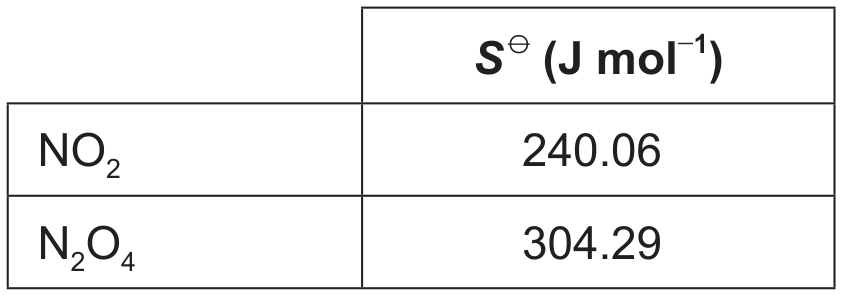
Nitrogen (IV) oxide exists in equilibrium with dinitrogen tetroxide, N2O4( g)\mathrm{N}_{2} \mathrm{O}_{4}(\mathrm{~g}), which is colourless.

2NO2( g)N2O4( g)2 \mathrm{NO}_{2}(\mathrm{~g}) \rightleftharpoons \mathrm{N}_{2} \mathrm{O}_{4}(\mathrm{~g})
[ 2 ]

Question 2(a)(ii)

(i)

Calculate the Gibbs free energy change, ΔG\Delta G^{\ominus}, for this equilibrium at 100C100^{\circ} \mathrm{C}. Use sections 1 and 2 of the data booklet.

[ 1 ]

Question 2(a)(v)

(ii)

Calculate the standard entropy change, in Jmol1\mathrm{J} \mathrm{mol}^{-1}, for the reaction:

Table
[ 1 ]

Question 2

[Maximum number: 4]

In 1921 Thomas Midgley discovered that the addition of a lead compound could improve the combustion of hydrocarbons in automobile (car) engines. This was the beginning of the use of leaded gasoline (petrol).

The percentage composition, by mass, of the lead compound used by Midgley is shown below.

Table

Question 2(a)

Question 2(a)(iii)

(a)
(i)

Determine the equation for the complete combustion of Midgley's compound.

[ 2 ]

Question 2(b)

(b)

The combustion of unleaded gasoline still produces pollution with both local and global consequences. Identify one exhaust gas which causes local pollution and one exhaust gas which causes global pollution.

Local pollutant:

Global pollutant:

[ 2 ]

Question 2

Question 2(b)

Question 2(b)(ii)

(a)
(i)

Calculate the Gibbs free energy, ΔG\Delta G^{\ominus}, in kJ , which is released by the corrosion of 1 mole of iron. Use section 1 of the data booklet.

[ 2 ]

Question 3

[Maximum number: 3]

White phosphorus is an allotrope of phosphorus and exists as P4\mathrm{P}_{4}.

Question 3(c)

(a)

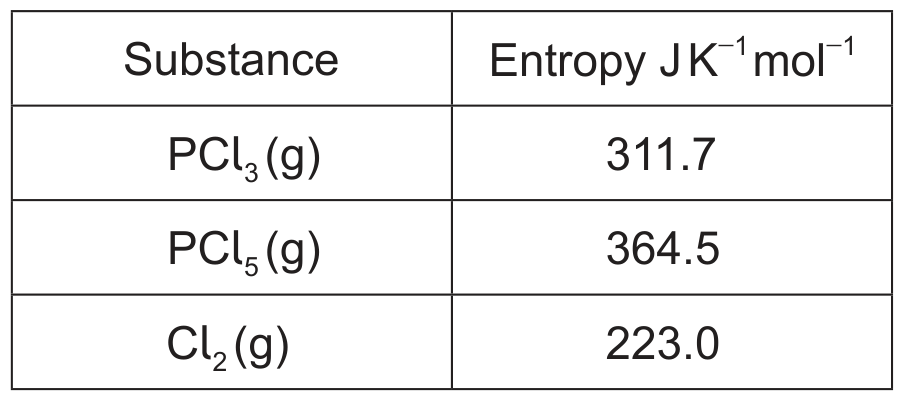
An equilibrium exists between PCl3\mathrm{PCl}_{3} and PCl5\mathrm{PCl}_{5}.

PCl3( g)+Cl2( g)PCl5( g)\mathrm{PCl}_{3}(\mathrm{~g})+\mathrm{Cl}_{2}(\mathrm{~g}) \rightleftharpoons \mathrm{PCl}_{5}(\mathrm{~g})
[ 3 ]

Question 3(c)(ii)

(i)

Calculate the entropy change, ΔS\Delta S, in JK1 mol1\mathrm{JK}^{-1} \mathrm{~mol}^{-1}, for this reaction.

Table
[ 1 ]

Question 3(c)(iii)

(ii)

Calculate the Gibbs free energy change (ΔG)(\Delta G), in kJmol1\mathrm{kJ} \mathrm{mol}^{-1}, for this reaction at 25C25^{\circ} \mathrm{C}. Use section 1 of the data booklet.

If you did not obtain an answer in c(i) or c(ii) use 87.6 kJ mol1-87.6 \mathrm{~kJ} \mathrm{~mol}^{-1} and 150.5 J mol1 K1-150.5 \mathrm{~J} \mathrm{~mol}^{-1} \mathrm{~K}^{-1} respectively, but these are not the correct answers.

[ 2 ]
0 selected