EduNinja

IB Chemistry HL1.2 Energy cyclesQuestion Bank

Question 1

[Maximum number: 4]

Ethane-1,2-diol, HOCH2CH2OH\mathrm{HOCH}_{2} \mathrm{CH}_{2} \mathrm{OH}, has a wide variety of uses including the removal of ice from aircraft and heat transfer in a solar cell.

Question 1(a)

(a)

Ethane-1,2-diol can be formed according to the following reaction.

2CO( g)+3H2( g)HOCH2CH2OH( g)2 \mathrm{CO}(\mathrm{~g})+3 \mathrm{H}_{2}(\mathrm{~g}) \rightleftharpoons \mathrm{HOCH}_{2} \mathrm{CH}_{2} \mathrm{OH}(\mathrm{~g})
[ 3 ]

Question 1(a)(iii)

(i)

Calculate the enthalpy change, ΔH\Delta H^{\ominus}, in kJ , for this reaction using section 11 of the data booklet. The bond enthalpy of the carbon-oxygen bond in CO(g) is 1077 kJ mol11077 \mathrm{~kJ} \mathrm{~mol}^{-1}.

[ 3 ]

Question 1(b)

Question 1(b)(i)

(b)
(i)

Calculate ΔH\Delta H^{\ominus}, in kJ , for this similar reaction below using ΔHf\Delta H_{\mathrm{f}}^{\ominus} data from section 12 of the data booklet. ΔHf\Delta H_{\mathrm{f}}^{\ominus} of HOCH2CH2OH(l)\mathrm{HOCH}_{2} \mathrm{CH}_{2} \mathrm{OH}(\mathrm{l}) is 454.8 kJ mol1-454.8 \mathrm{~kJ} \mathrm{~mol}^{-1}.

2CO( g)+3H2( g)HOCH2CH2OH(l)2 \mathrm{CO}(\mathrm{~g})+3 \mathrm{H}_{2}(\mathrm{~g}) \rightleftharpoons \mathrm{HOCH}_{2} \mathrm{CH}_{2} \mathrm{OH}(\mathrm{l})
[ 1 ]

Question 1

[Maximum number: 2]

Ammonium nitrate, NH4NO3\mathrm{NH}_{4} \mathrm{NO}_{3}, is used as a high nitrogen fertilizer.

Question 1(f)

(a)

Solid ammonium nitrate can decompose to gaseous dinitrogen monoxide and liquid water.

[ 2 ]

Question 1(f)(iii)

(i)

Calculate the standard enthalpy change, ΔH\Delta H^{\ominus}, of the reaction. Use section 12 of the data booklet.

ΔHf ammonium nitrate =366 kJ mol1ΔHf dinitrogen monoxide =82 kJ mol1\begin{aligned} & \Delta H_{\mathrm{f}}^{\ominus} \text { ammonium nitrate }=-366 \mathrm{~kJ} \mathrm{~mol}^{-1} \\ & \Delta H_{\mathrm{f}}^{\ominus} \text { dinitrogen monoxide }=82 \mathrm{~kJ} \mathrm{~mol}^{-1} \end{aligned}
[ 2 ]

Question 1

[Maximum number: 3]

Ethyne, C2H2\mathrm{C}_{2} \mathrm{H}_{2}, reacts with oxygen in welding torches.

Question 1(c)

(a)

Ethyne reacts with steam.

C2H2( g)+H2O( g)C2H4O( g)\mathrm{C}_{2} \mathrm{H}_{2}(\mathrm{~g})+\mathrm{H}_{2} \mathrm{O}(\mathrm{~g}) \rightarrow \mathrm{C}_{2} \mathrm{H}_{4} \mathrm{O}(\mathrm{~g})

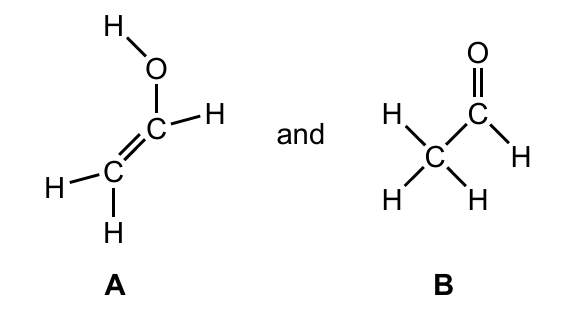
Two possible products are:

Question image
[ 3 ]

Question 1(c)(ii)

(i)

Determine the enthalpy change for the reaction, in kJ , to produce A using section 11 of the data booklet.

[ 3 ]

Question 1

Question 1(b)

(a)

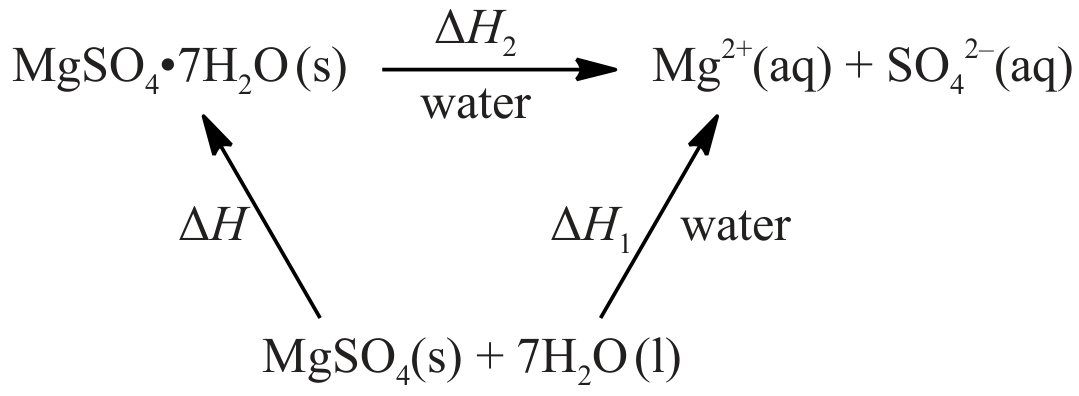
The students repeated the experiment using 6.16 g of solid hydrated magnesium sulfate, MgSO47H2O(s)\mathrm{MgSO}_{4} \cdot 7 \mathrm{H}_{2} \mathrm{O}(\mathrm{s}), and 50.0 cm350.0 \mathrm{~cm}^{3} of water. They found the enthalpy change, ΔH2\Delta H_{2}, to be +18 kJ mol1+18 \mathrm{~kJ} \mathrm{~mol}^{-1}.

The enthalpy of hydration of solid anhydrous magnesium sulfate is difficult to determine experimentally, but can be determined using the diagram below.

Question image
[ 1 ]

Question 1(b)(i)

(i)

Determine the enthalpy change, ΔH\Delta H, in kJmol1\mathrm{kJ} \mathrm{mol}^{-1}, for the hydration of solid anhydrous magnesium sulfate, MgSO4\mathrm{MgSO}_{4}.

[ 1 ]

Question 2

[Maximum number: 8]

The reaction between ethene and steam is used in the industrial production of ethanol.

C2H4( g)+H2O( g)C2H5OH( g)\mathrm{C}_{2} \mathrm{H}_{4}(\mathrm{~g})+\mathrm{H}_{2} \mathrm{O}(\mathrm{~g}) \rightarrow \mathrm{C}_{2} \mathrm{H}_{5} \mathrm{OH}(\mathrm{~g})

The enthalpy change of the reaction can be calculated either by using average bond enthalpies or by using standard enthalpies of formation.

Question 2(a)

(a)

Determine the enthalpy change of the reaction, in kJmol1\mathrm{kJ} \mathrm{mol}^{-1}, using the average bond enthalpies in Table 10 of the Data Booklet.

[ 3 ]

Question 2(b)

Question 2(b)(i)

(b)
(i)

Define the term standard enthalpy change of formation.

[ 2 ]

Question 2(b)(ii)

(ii)

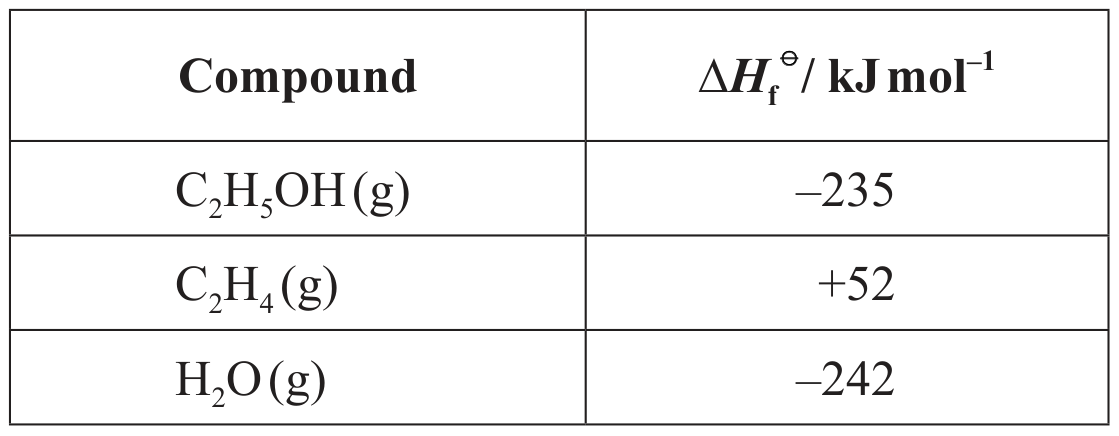
Determine the enthalpy change of the reaction, in kJmol1\mathrm{kJ} \mathrm{mol}^{-1}, between ethene and steam using the enthalpy change of formation values given below.

Table
[ 2 ]

Question 2(c)

(c)

Comment on which of the values obtained in (a) and (b)(ii) is more accurate, giving a reason.

[ 1 ]

Question 2

[Maximum number: 1]

Nitrogen (IV) oxide, NO2\mathrm{NO}_{2}, is a brown gas found in photochemical smog and has a pollutant causing acid deposition.

Question 2(a)

(a)

Nitrogen (IV) oxide exists in equilibrium with dinitrogen tetroxide, N2O4( g)\mathrm{N}_{2} \mathrm{O}_{4}(\mathrm{~g}), which is colourless.

2NO2( g)N2O4( g)2 \mathrm{NO}_{2}(\mathrm{~g}) \rightleftharpoons \mathrm{N}_{2} \mathrm{O}_{4}(\mathrm{~g})
[ 1 ]

Question 2(a)(iv)

(i)

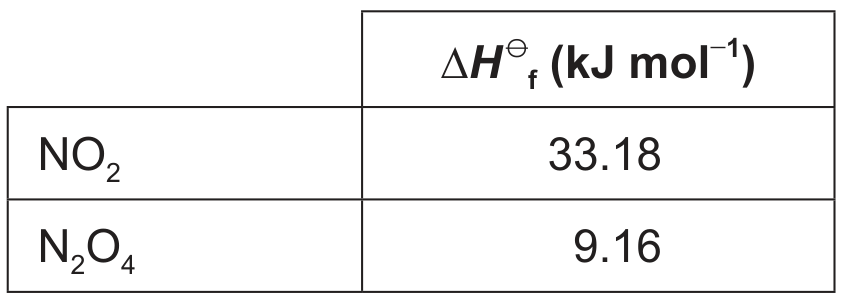
Calculate the standard enthalpy change, in kJmol1\mathrm{kJ} \mathrm{mol}^{-1}, for the reaction:

N2O4( g)2NO2( g)\mathrm{N}_{2} \mathrm{O}_{4}(\mathrm{~g}) \rightarrow 2 \mathrm{NO}_{2}(\mathrm{~g})
Table
[ 1 ]

Question 3

White phosphorus is an allotrope of phosphorus and exists as P4\mathrm{P}_{4}.

Question 3(c)

(a)

An equilibrium exists between PCl3\mathrm{PCl}_{3} and PCl5\mathrm{PCl}_{5}.

PCl3( g)+Cl2( g)PCl5( g)\mathrm{PCl}_{3}(\mathrm{~g})+\mathrm{Cl}_{2}(\mathrm{~g}) \rightleftharpoons \mathrm{PCl}_{5}(\mathrm{~g})

Question 3(c)(i)

(i)

Calculate the standard enthalpy change (ΔH)\left(\Delta H^{\ominus}\right) for the forward reaction in kJmol1\mathrm{kJ} \mathrm{mol}^{-1}.

ΔHfPCl3( g)=306.4 kJ mol1ΔHfPCl5( g)=398.9 kJ mol1\begin{aligned} \Delta H^{\ominus}{ }_{\mathrm{f}} \mathrm{PCl}_{3}(\mathrm{~g}) & =-306.4 \mathrm{~kJ} \mathrm{~mol}^{-1} \\ \Delta H^{\ominus}{ }_{\mathrm{f}} \mathrm{PCl}_{5}(\mathrm{~g}) & =-398.9 \mathrm{~kJ} \mathrm{~mol}^{-1} \end{aligned}

Question 2

[Maximum number: 4]

Methanoic acid can be produced by the hydrogenation of carbon dioxide according to the equilibrium

CO2( g)+H2( g)HCOOH( g)\mathrm{CO}_{2}(\mathrm{~g})+\mathrm{H}_{2}(\mathrm{~g}) \rightleftharpoons \mathrm{HCOOH}(\mathrm{~g})

Question 2(c)

(a)

Bond enthalpies are a useful way of finding approximate enthalpy changes for reactions.

[ 4 ]

Question 2(c)(i)

(i)

Determine the enthalpy change, ΔH\Delta H^{\ominus}, of this reaction, using section 11 of the data booklet.

[ 3 ]

Question 2(c)(iii)

(ii)

Bond enthalpies are usually only approximate values. Identify which of the bond enthalpies you have just used is actually an exact value, and give a reason for your choice.

[ 1 ]

Question 2

[Maximum number: 4]

Methanoic acid can be produced by the hydrogenation of carbon dioxide according to the equilibrium

CO2( g)+H2( g)HCOOH( g)\mathrm{CO}_{2}(\mathrm{~g})+\mathrm{H}_{2}(\mathrm{~g}) \rightleftharpoons \mathrm{HCOOH}(\mathrm{~g})

Question 2(c)

(a)

Bond enthalpies are a useful way of finding approximate enthalpy changes for reactions.

[ 4 ]

Question 2(c)(i)

(i)

Determine the enthalpy change, ΔH\Delta H^{\ominus}, of this reaction, using section 11 of the data booklet.

[ 3 ]

Question 2(c)(iii)

(ii)

Bond enthalpies are usually only approximate values. Identify which of the bond enthalpies you have just used is actually an exact value, and give a reason for your choice.

[ 1 ]

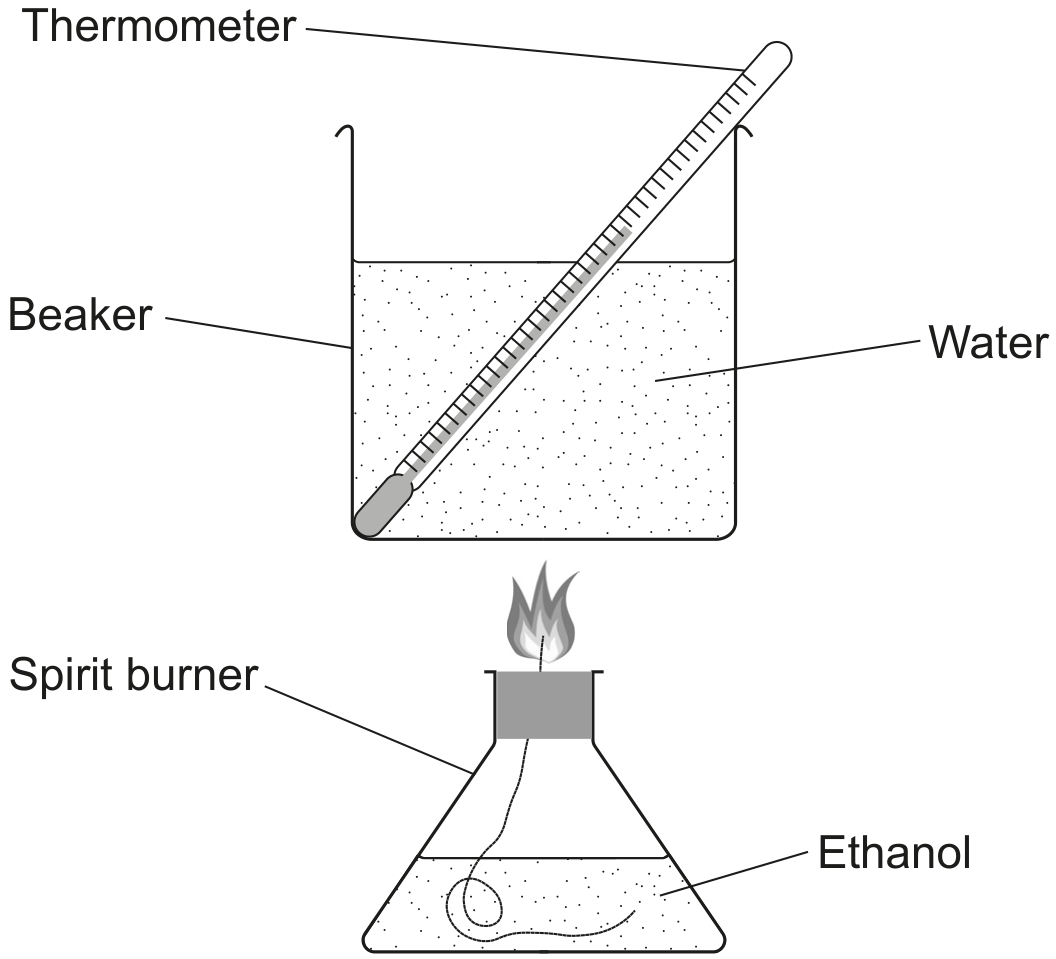
Question 14

[Maximum number: 1]

What is the enthalpy of combustion, ΔHc\Delta H_{\mathrm{c}}, of ethanol in kJmol1\mathrm{kJ} \mathrm{mol}^{-1} ?

Maximum temperature of water: 30.0C30.0^{\circ} \mathrm{C}
Initial temperature of water: 20.0C20.0^{\circ} \mathrm{C}
Mass of water in beaker: 100.0 g
Loss in mass of ethanol: 0.230 g
MrM_{\mathrm{r}} (ethanol): 46.08
Specific heat capacity of water: 4.18 J g1 K14.18 \mathrm{~J} \mathrm{~g}^{-1} \mathrm{~K}^{-1}q=mcΔTq=m c \Delta T

Question image
A

100.0×4.18×(10.0+273)0.23046.08×1000-\frac{100.0 \times 4.18 \times(10.0+273)}{\frac{0.230}{46.08} \times 1000}

B

0.230×4.18×10.0100.046.08×1000-\frac{0.230 \times 4.18 \times 10.0}{\frac{100.0}{46.08} \times 1000}

C

100.0×4.18×10.00.23046.08×1000-\frac{100.0 \times 4.18 \times 10.0}{\frac{0.230}{46.08} \times 1000}

D

100.0×4.18×10.00.23046.08-\frac{100.0 \times 4.18 \times 10.0}{\frac{0.230}{46.08}}

0 selected