EduNinja

IB Chemistry HL1.1 Measuring enthalpy changesQuestion Bank

Question 1

[Maximum number: 3]

Ammonium nitrate, NH4NO3\mathrm{NH}_{4} \mathrm{NO}_{3}, is used as a high nitrogen fertilizer.

Question 1(d)

(a)

Cold packs contain ammonium nitrate and water separated by a membrane.

[ 3 ]

Question 1(d)(i)

(i)

The mass of the contents of the cold pack is 25.32 g and its initial temperature is 25.2C25.2^{\circ} \mathrm{C}. Once the contents are mixed, the temperature drops to 0.8C0.8^{\circ} \mathrm{C}.

Calculate the energy, in J , absorbed by the dissolution of ammonium nitrate in water within the cold pack. Assume the specific heat capacity of the solution is 4.18 J g1 K14.18 \mathrm{~J} \mathrm{~g}^{-1} \mathrm{~K}^{-1}. Use section 1 of the data booklet.

[ 1 ]

Question 1(d)(ii)

(ii)

Determine the mass of ammonium nitrate in the cold pack using your answer obtained in (d)(i) and sections 6 and 19 of the data booklet.

If you did not obtain an answer in (d)(i), use 3.11×10³ J3.11 \times 10^{3} \mathrm{~J}, although this is not the correct answer.

[ 2 ]
Question 1

[Maximum number: 3]

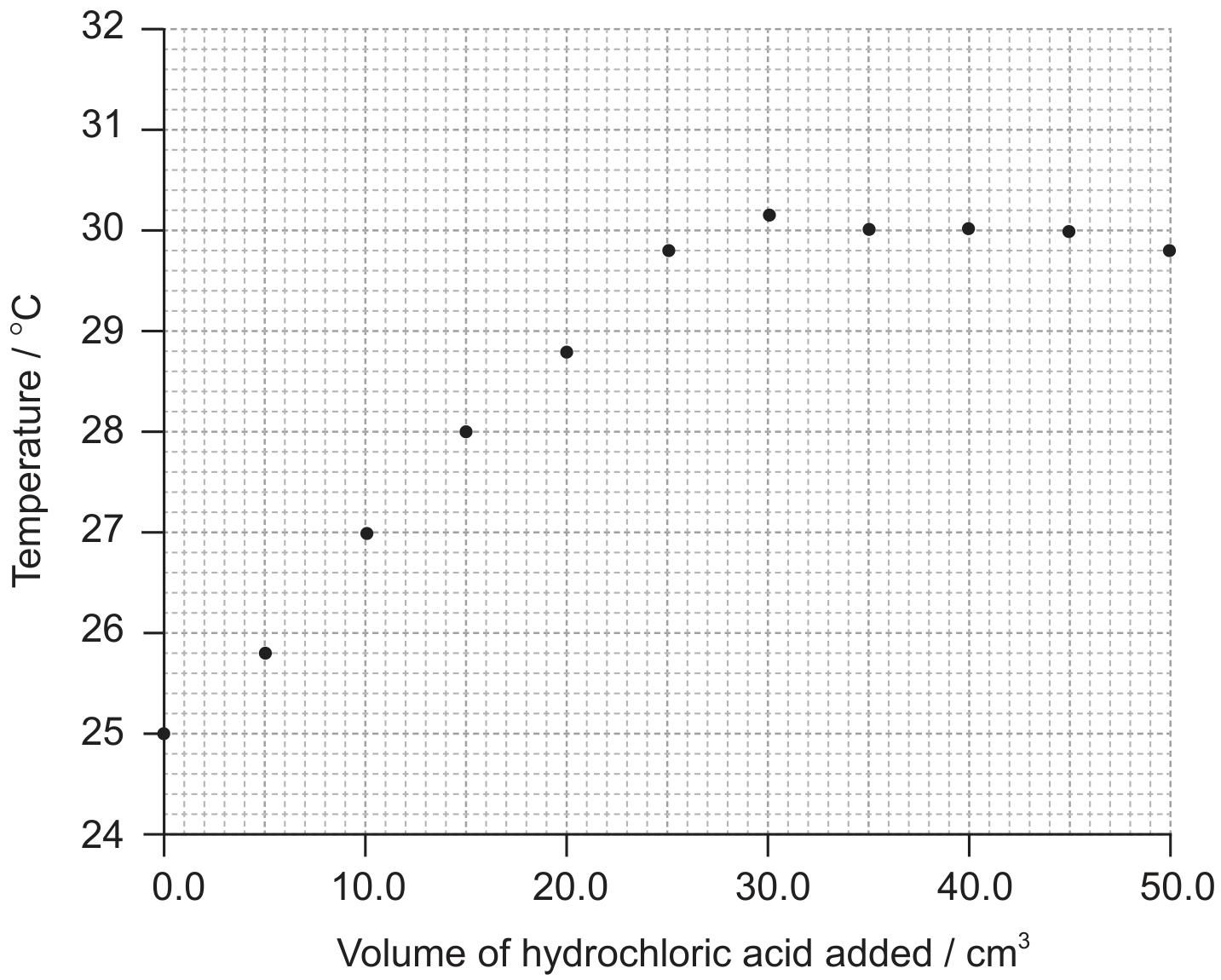
A student carried out an experiment to determine the concentration of a hydrochloric acid solution and the enthalpy change of the reaction between aqueous sodium hydroxide and this acid by thermometric titration.

She added 5.0 cm35.0 \mathrm{~cm}^{3} portions of hydrochloric acid to 25.0 cm325.0 \mathrm{~cm}^{3} of 1.00moldm31.00 \mathrm{moldm}^{-3} sodium hydroxide solution in a glass beaker until the total volume of acid added was 50.0 cm350.0 \mathrm{~cm}^{3}, measuring the temperature of the mixture each time. Her results are plotted in the graph below.

Question image

The initial temperature of both solutions was the same.

Question 1(b)

Question 1(b)(ii)

(a)
(i)

Calculate the enthalpy change, in kJmol1\mathrm{kJ} \mathrm{mol}^{-1}, for the reaction of hydrochloric acid and sodium hydroxide solution.

[ 3 ]

Question 1

[Maximum number: 1]

Two groups of students (Group A and Group B) carried out a project* on the chemistry of some group 7 elements (the halogens) and their compounds.

Question 1(a)

(a)

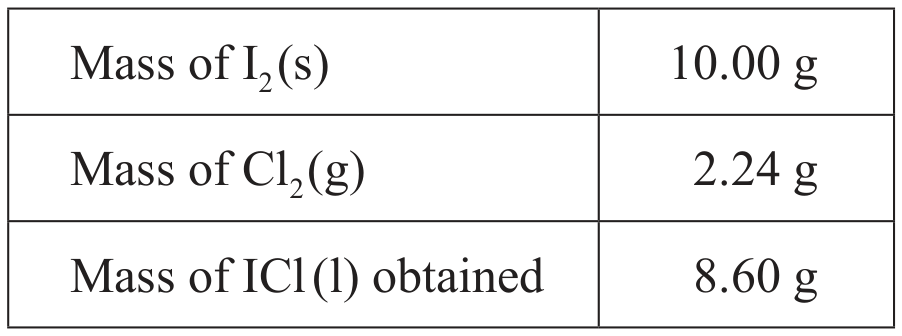
In the first part of the project, the two groups had a sample of iodine monochloride (a corrosive brown liquid) prepared for them by their teacher using the following reaction.

I2( s)+Cl2( g)2ICl(l)\mathrm{I}_{2}(\mathrm{~s})+\mathrm{Cl}_{2}(\mathrm{~g}) \rightarrow 2 \mathrm{ICl}(\mathrm{l})

The following data were recorded.

Table
[ 1 ]

Question 1(a)(iv)

(i)

Using a digital thermometer, the students discovered that the reaction was exothermic. State the sign of the enthalpy change of the reaction, ΔH\Delta H.

[ 1 ]

Question 1

Question 1(a)

(a)

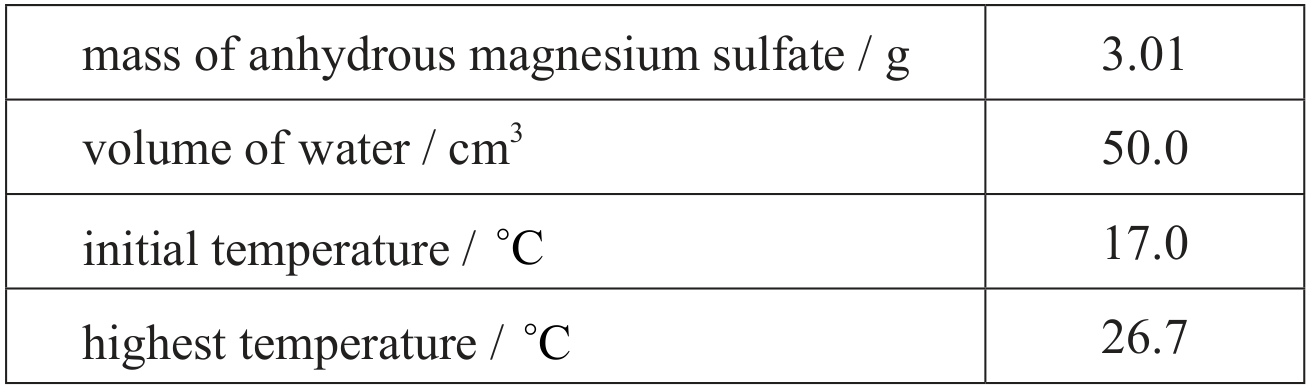
Two chemistry students wished to determine the enthalpy of hydration of anhydrous magnesium sulfate. They measured the initial and the highest temperature reached when anhydrous magnesium sulfate, MgSO4( s)\mathrm{MgSO}_{4}(\mathrm{~s}), was dissolved in water. They presented their results in the table below.

Table
[ 2 ]

Question 1(a)(ii)

(i)

Calculate the enthalpy change, ΔH1\Delta H_{1}, for anhydrous magnesium sulfate dissolving in water, in kJmol1\mathrm{kJ} \mathrm{mol}^{-1}. State your answer to the correct number of significant figures.

[ 2 ]

Question 1

[Maximum number: 1]

Ethane-1,2-diol, HOCH2CH2OH\mathrm{HOCH}_{2} \mathrm{CH}_{2} \mathrm{OH}, has a wide variety of uses including the removal of ice from aircraft and heat transfer in a solar cell.

Question 1(b)

Question 1(b)(ii)

(a)
(i)

Deduce why the answers to (a)(iii) and (b)(i) differ.

[ 1 ]

Question 1

[Maximum number: 1]

Ethyne, C2H2\mathrm{C}_{2} \mathrm{H}_{2}, reacts with oxygen in welding torches.

Question 1(c)

(a)

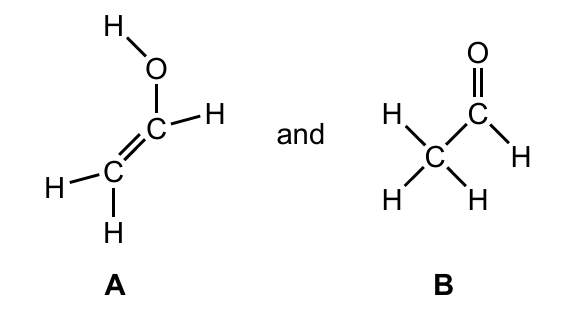
Ethyne reacts with steam.

C2H2( g)+H2O( g)C2H4O( g)\mathrm{C}_{2} \mathrm{H}_{2}(\mathrm{~g})+\mathrm{H}_{2} \mathrm{O}(\mathrm{~g}) \rightarrow \mathrm{C}_{2} \mathrm{H}_{4} \mathrm{O}(\mathrm{~g})

Two possible products are:

Question image
[ 1 ]

Question 1(c)(iii)

(i)

The enthalpy change for the reaction to produce B is -213 kJ .

Predict, giving a reason, which product is the most stable.

[ 1 ]

Question 1

[Maximum number: 4]

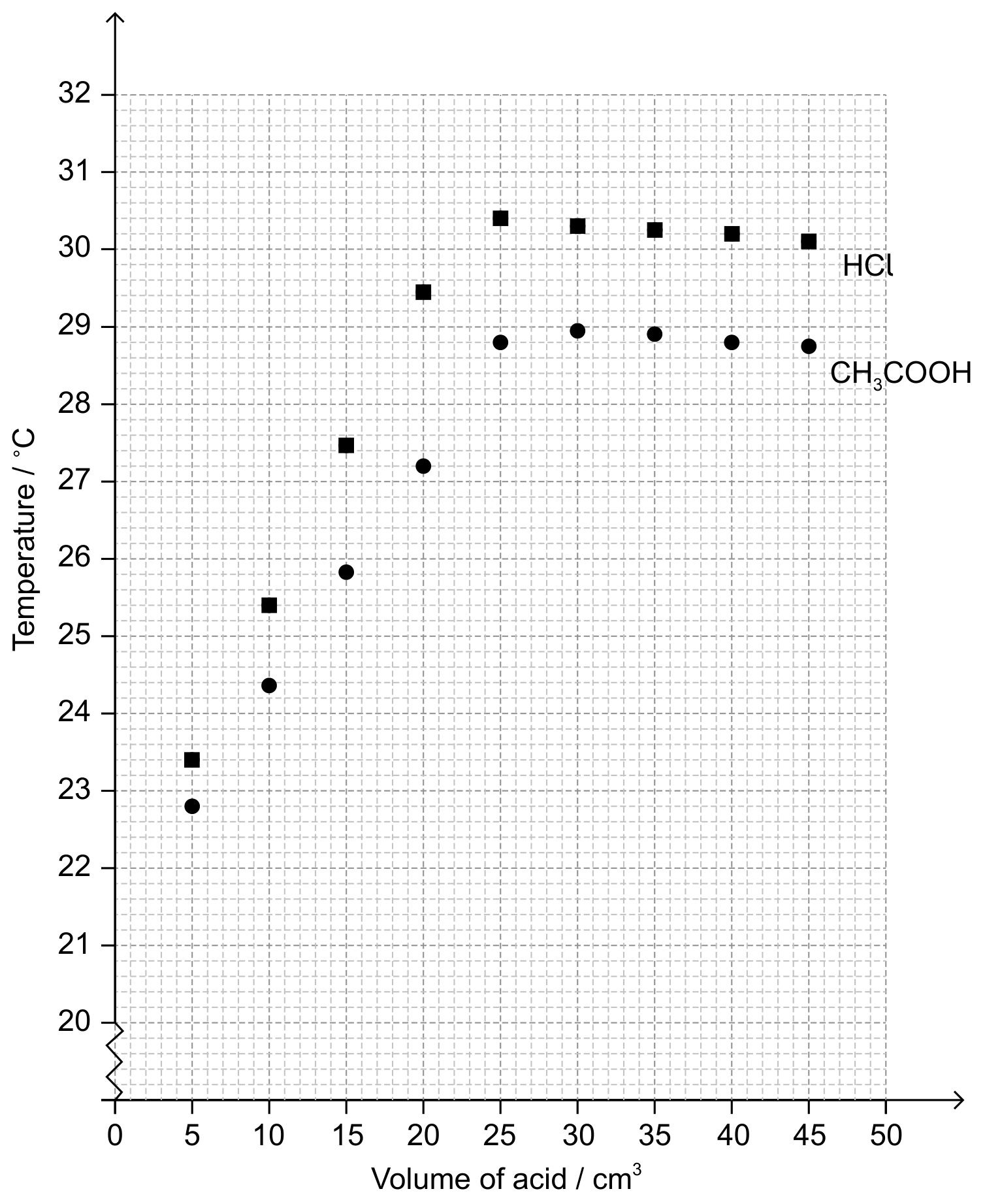
A student titrated two acids, hydrochloric acid, HCl(aq) and ethanoic acid, CH3COOH(aq)\mathrm{CH}_{3} \mathrm{COOH}(\mathrm{aq}), against 50.0 cm350.0 \mathrm{~cm}^{3} of 0.995 moldm30.995 \mathrm{~mol} \mathrm{dm}^{-3} sodium hydroxide, NaOH(aq), to determine their concentration. The temperature of the reaction mixture was measured after each acid addition and plotted against the volume of each acid.

Question image

Question 1(d)

Question 1(d)(i)

(a)
(i)

Determine the heat change, q, in kJ , for the neutralization reaction between ethanoic acid and sodium hydroxide.
Assume the specific heat capacities of the solutions and their densities are those of water.

[ 2 ]

Question 1(d)(ii)

(ii)

Calculate the enthalpy change, ΔH\Delta H, in kJmol1\mathrm{kJ} \mathrm{mol}^{-1}, for the reaction between ethanoic acid and sodium hydroxide.

[ 2 ]

Question 1

[Maximum number: 2]

3.26 g of iron powder are added to 80.0 cm380.0 \mathrm{~cm}^{3} of 0.200 moldm30.200 \mathrm{~mol} \mathrm{dm}^{-3} copper(II) sulfate solution. The following reaction occurs:

Fe( s)+CuSO4(aq)FeSO4(aq)+Cu( s)\mathrm{Fe}(\mathrm{~s})+\mathrm{CuSO}_{4}(\mathrm{aq}) \rightarrow \mathrm{FeSO}_{4}(\mathrm{aq})+\mathrm{Cu}(\mathrm{~s})

Question 1(b)

Question 1(b)(i)

(a)
(i)

The reaction was carried out in a calorimeter. The maximum temperature rise of the solution was 7.5C7.5^{\circ} \mathrm{C}.

Calculate the enthalpy change, ΔH\Delta H, of the reaction, in kJ , assuming that all the heat released was absorbed by the solution. Use sections 1 and 2 of the data booklet.

[ 2 ]

Question 1

[Maximum number: 2]

Hydrogen cyanide, HCN , is a very toxic compound.

Question 1(b)

(a)

HCN acts as a weak acid in aqueous solution.

[ 2 ]

Question 1(b)(vi)

(i)

Calculate the temperature rise of the solution when 30.0 cm330.0 \mathrm{~cm}^{3} of 0.200 moldm3KOH0.200 \mathrm{~mol} \mathrm{dm}^{-3} \mathrm{KOH} is mixed with 20.0 cm320.0 \mathrm{~cm}^{3} of 0.100 moldm3HCN0.100 \mathrm{~mol} \mathrm{dm}^{-3} \mathrm{HCN}. Use enthalpy of neutralization of HCN=13.3 kJ mol1\mathrm{HCN}=-13.3 \mathrm{~kJ} \mathrm{~mol}^{-1} and sections 1 and 2 of the data booklet.

[ 2 ]

Question 2

[Maximum number: 4]

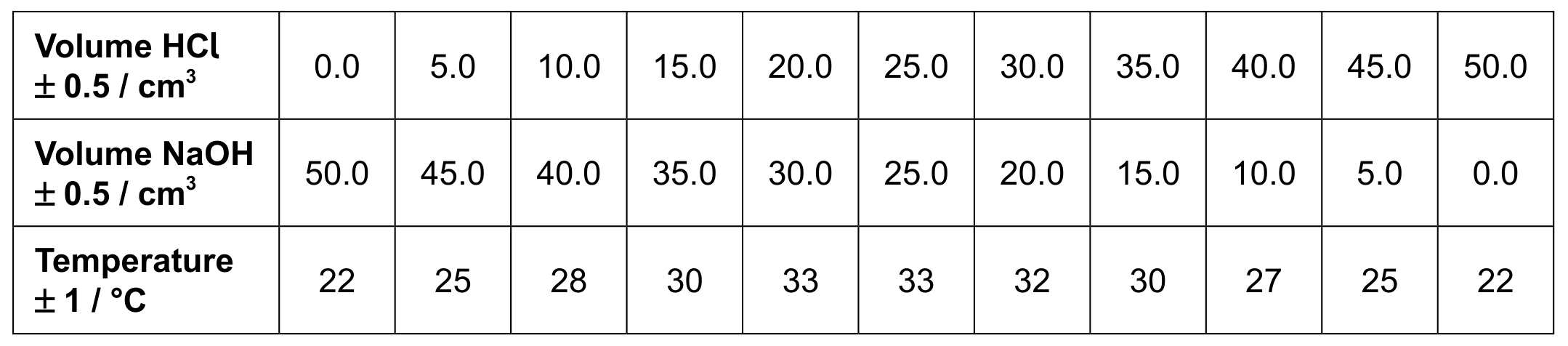
A teacher gave the class an experimental assignment to determine the concentration of aqueous sodium hydroxide, NaOH , using 2.00moldm32.00 \mathrm{moldm}^{-3} hydrochloric acid, HCl , a thermometer and laboratory glassware.

Question 2(a)

(a)

Student A used a 50 cm350 \mathrm{~cm}^{3} measuring cylinder to make the following mixtures of the two solutions in a 125 cm3125 \mathrm{~cm}^{3} conical flask and measured the highest temperature for each mixture.

Table
[ 2 ]

Question 2(a)(iv)

(i)

State two assumptions that are made when using the formula in part (a)(iii) to calculate the enthalpy of neutralization.

[ 2 ]

Question 2(b)

(b)

Student B used a slightly different technique, transferring 25.00 cm325.00 \mathrm{~cm}^{3} of NaOH to a 125 cm3125 \mathrm{~cm}^{3} conical flask, using a pipette, and then adding the HCl,5.00 cm3\mathrm{HCl}, 5.00 \mathrm{~cm}^{3} at a time from a burette, measuring the steady temperature at each step.

Table
[ 2 ]

Question 2(b)(vi)

(i)

Deduce, giving the reason, for which volume reading the temperature would be most affected by heat lost to the surroundings.

Student:
Volume reading:
Reason:

[ 2 ]
0 selected