Question 1
[Maximum number: 2]
Iron(II) sulfide can be produced by heating powdered iron and sulfur together.
Question 1(a)
(a)
Describe the difference between an element and a compound.
[ 2 ]
 EduNinja
Iron(II) sulfide can be produced by heating powdered iron and sulfur together.
Describe the difference between an element and a compound.
Which of the following are homogeneous mixtures?
I. An aqueous solution of sodium chloride
II. A mixture of pentane and hexane
III. A mixture of ethanol and water
I and II only
I and III only
II and III only
I, II and III
Which equation represents sublimation?
What happens as ice melts at ?
I. Molecules gain kinetic energy and temperature increases.
II. Added energy overcomes hydrogen bonds between molecules.
III. Molecules gain sufficient energy to move from fixed positions.
I and II only
I and III only
II and III only
I, II and III
Alkanes are commonly occurring organic compounds.
The first four straight chain alkanes are gases at room temperature.
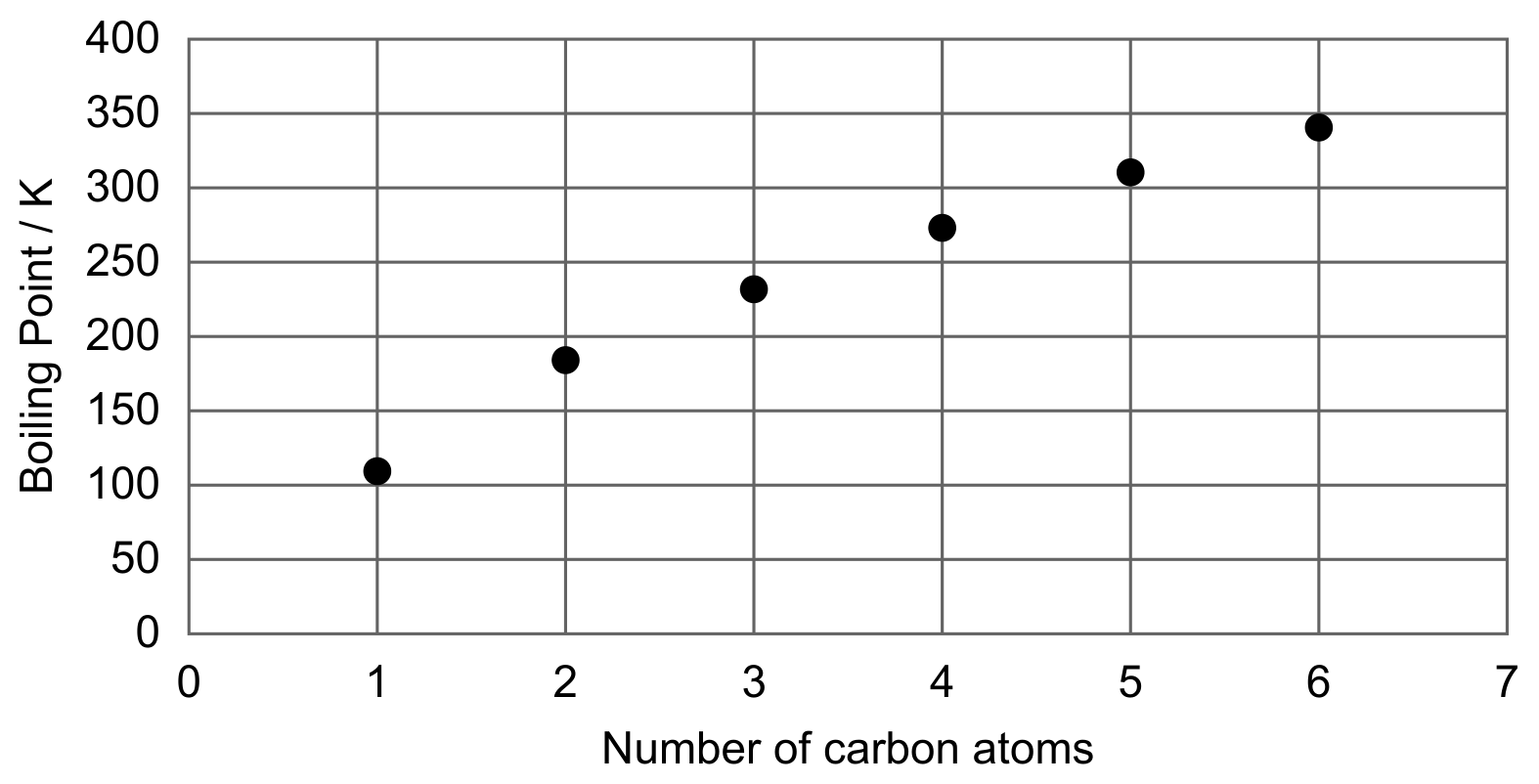
Boiling points of straight chain alkanes
Explain why the volume occupied by a sample of propane increases sharply when the sample is heated up from 200 to 250 K at constant pressure.
Physical properties of elements vary according to atomic number. Sections 6 to 9 of the data booklet list some of these properties.
Melting points and boiling points of elements 1 to 95
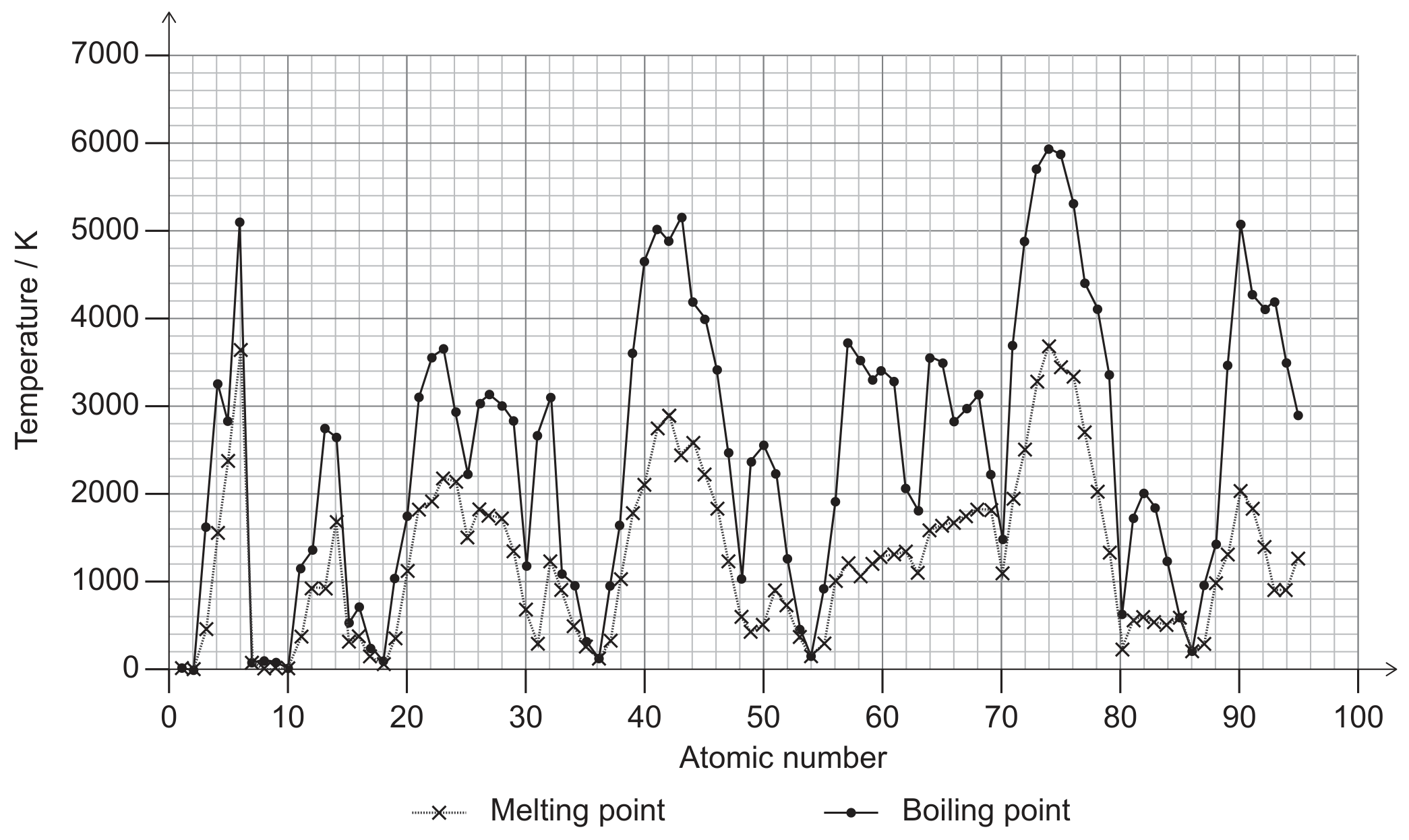
Deduce, giving a reason, the group of elements in the periodic table most likely to undergo sublimation.
Which one of the following observations provides evidence that matter is composed of atoms?
The line emission spectra of hydrogen produce four visible lines.
Sodium chloride is soluble in water and conducts electricity in the aqueous state.
Water is a liquid at room temperature, but hydrogen sulfide and hydrogen selenide are gases.
12.0 g of carbon combines with either 16.0 g or 32.0 g of oxygen but never any other ratio.
Students were asked to investigate how a change in concentration of hydrochloric acid, HCl , affects the initial rate of its reaction with marble chips, .
They decided to measure how long the reaction took to complete when similar chips were added to of acid and of acid.
Two methods were proposed:
(1) using small chips, keeping the acid in excess, and recording the time taken for the solid to disappear
(2) using large chips, keeping the marble in excess, and recording the time taken for bubbles to stop forming.
Annotate the balanced equation below with state symbols.
A student was given a mixture to separate and collect the individual components. The mixture contained sand, , sodium chloride, NaCl(s), and iron filings, Fe(s). The student observed the original mixture and made the following hypothesis.
The iron would have the lowest percent by mass because it appeared to be present in the smallest quantity.
In a different experiment, the students needed to separate a mixture of methanol and butan-1-ol. State the best method to separate this mixture and the physical property used for the separation.
Separation method:
Physical property:
Sodium thiosulfate solution reacts with dilute hydrochloric acid to form a precipitate of sulfur at room temperature.
Identify the formula and state symbol of X .
Suggest why the experiment should be carried out in a fume hood or in a well-ventilated laboratory.