EduNinja

IB Business Management SL3.8 Investment appraisalQuestion Bank

3.8 Investment appraisal

Question 2

[Maximum number: 11]

2. Bangkok Shrimp (BS)
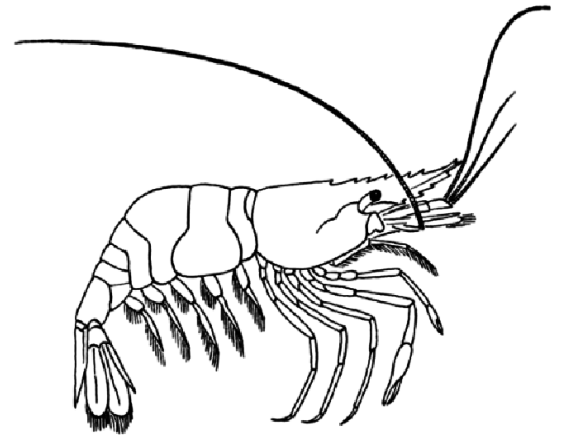
In 2011, an environmental catastrophe contaminated the waters off the coast of South America, one of the main fishing areas of the world. As a result of the catastrophe (and the resulting lower supply of shrimp), the price of shrimp worldwide increased by 30 %. Aroon Bhuvanadh, owner of Bangkok Shrimp (BS) located in Thailand, saw this as an excellent opportunity to expand his business. He decided to increase the number of his shrimp boats from two to three in order to benefit
Question image

from the higher prices and profits.
[image: http://commons.wikimedia.org/wiki/ File:Prawn_\%28PSF\%29.png; Pearson Scott Foresman]

The price of the new shrimp boat is $ 175000. If the selling price of shrimp remains at the current high levels, anticipated profits per boat after all expenses would be $ 35000 per year. If prices fall to pre-2011 levels, the profit would decrease to $ 10000. Aroon's bank will provide finance for the new boat. If the new boat is properly maintained, it will last longer than the proposed seven-year term of the bank loan.

Aroon captains one of the existing boats. He currently employs an experienced captain for the second boat, and he will have to recruit an additional experienced captain for the third boat.

Aroon's wife Kanya is worried that the price of shrimp may return to pre-2011 levels before the bank loan is repaid. For this reason, she wants to change the legal structure of the business from a sole trader to a private limited company.

Aroon has a vision: by taking advantage of the opportunity of the current high shrimp prices, he will own three shrimp boats and, later, can leave one boat to each of his three sons when he and Kanya retire in 2017.

Question 2(b)

(a)

Assuming shrimp prices remain at current high levels, calculate for the new shrimp boat (show all your working):

[ 4 ]

Question 2(b)(i)

(i)

the payback period (without depreciation).

[ 2 ]

Question 2(b)(ii)

(ii)

the average rate of return (ARR) over a seven-year period.

[ 2 ]

Question 2(c)

(b)

Assuming shrimp prices return to their pre-2011 levels two years after B S acquires the new shrimp boat, calculate (show all your working):

[ 4 ]

Question 2(c)(i)

(i)

the payback period (without depreciation).

[ 2 ]

Question 2(c)(ii)

(ii)

the average rate of return (ARR) over a seven-year period.

[ 2 ]

Question 2(d)

(c)

Comment on the results of your investment appraisal calculations in parts (b) and (c).
[ 3 ]

Question 2

[Maximum number: 8]

2. Windmills OPQ (WO)
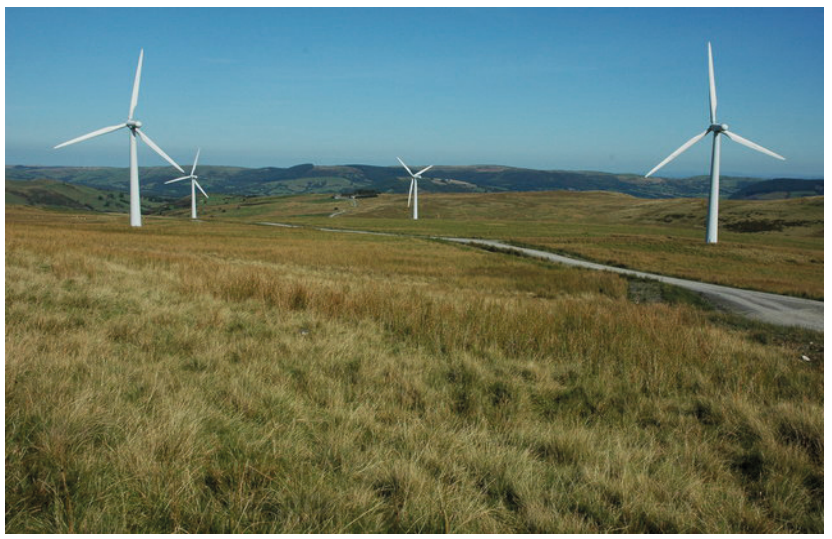
Windmills OPQ (WO) develops and produces electrical and mechanical components for windmills. WO has developed a unique selling point/proposition (USP) because of its customization and modification services.
In 2023, WO identified two six-year investment project options that could be beneficial.
- Option 1: Research and development (R\&D).
- Option 2: Open a wind farm with five windmills.

Question image

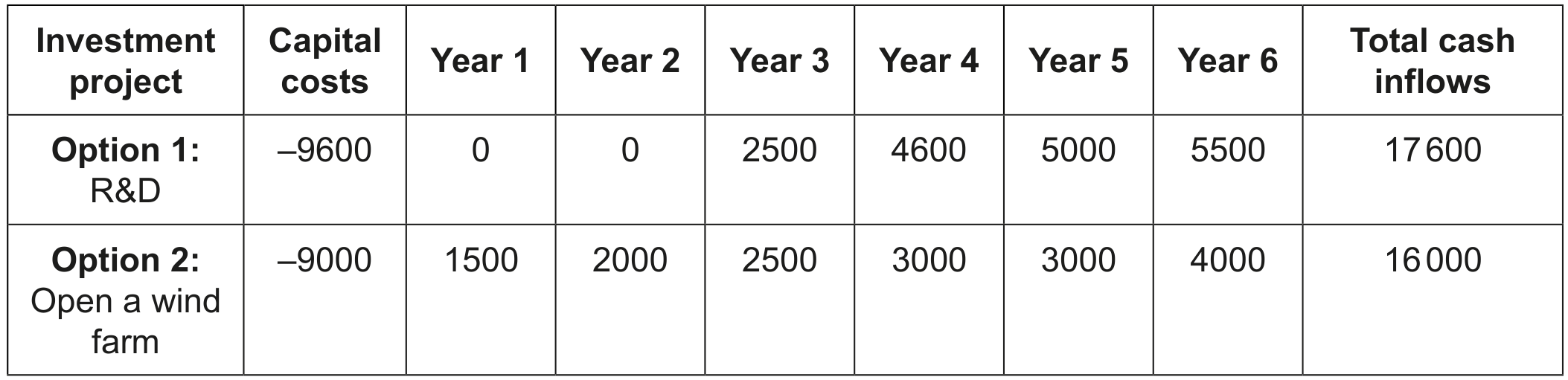
The capital costs and forecasted cash flows for both investment projects are shown in Table 2.

Table 2: Capital costs and expected cash flows for both investment projects (all figures in \$000s)

Table 2: Capital costs and expected cash flows for both investment projects (all figures in \$000s)

WO's board of directors think that the forecasted cash flow for Option 2 is too low. They believe that the demand for electricity generated by windmills is likely to rise more than the current forecast assumes. Electricity prices are also increasing.

Question 2(b)

(a)

Using relevant information from Table 2, calculate:

[ 6 ]

Question 2(b)(i)

(i)

the average rate of return (ARR) for Option 1 (show all your working);

[ 2 ]

Question 2(b)(ii)

(ii)

the average rate of return (ARR) for Option 2 (show all your working);

[ 2 ]

Question 2(b)(iii)

(iii)

the payback period for Option 1 (show all your working).

[ 2 ]

Question 2(c)

(b)

Comment on whether WO should choose Option 1 or Option 2.

Answer one question from this section.

[ 2 ]

Question 2

[Maximum number: 4]

Fru-Yo (FY)

Question image

Fru-Yo (FY) produces premium-priced yoghurts. FY has strong brand loyalty and relies only on word-of mouth promotion. FYs target market is consumers who may have health problems.

FY created two new zero-sugar fruit yoghurts. FY did no market research into the new yoghurts but is confident that FYs brand loyalty will ensure success. The market constantly changes because competitors regularly introduce new healthy yoghurts.

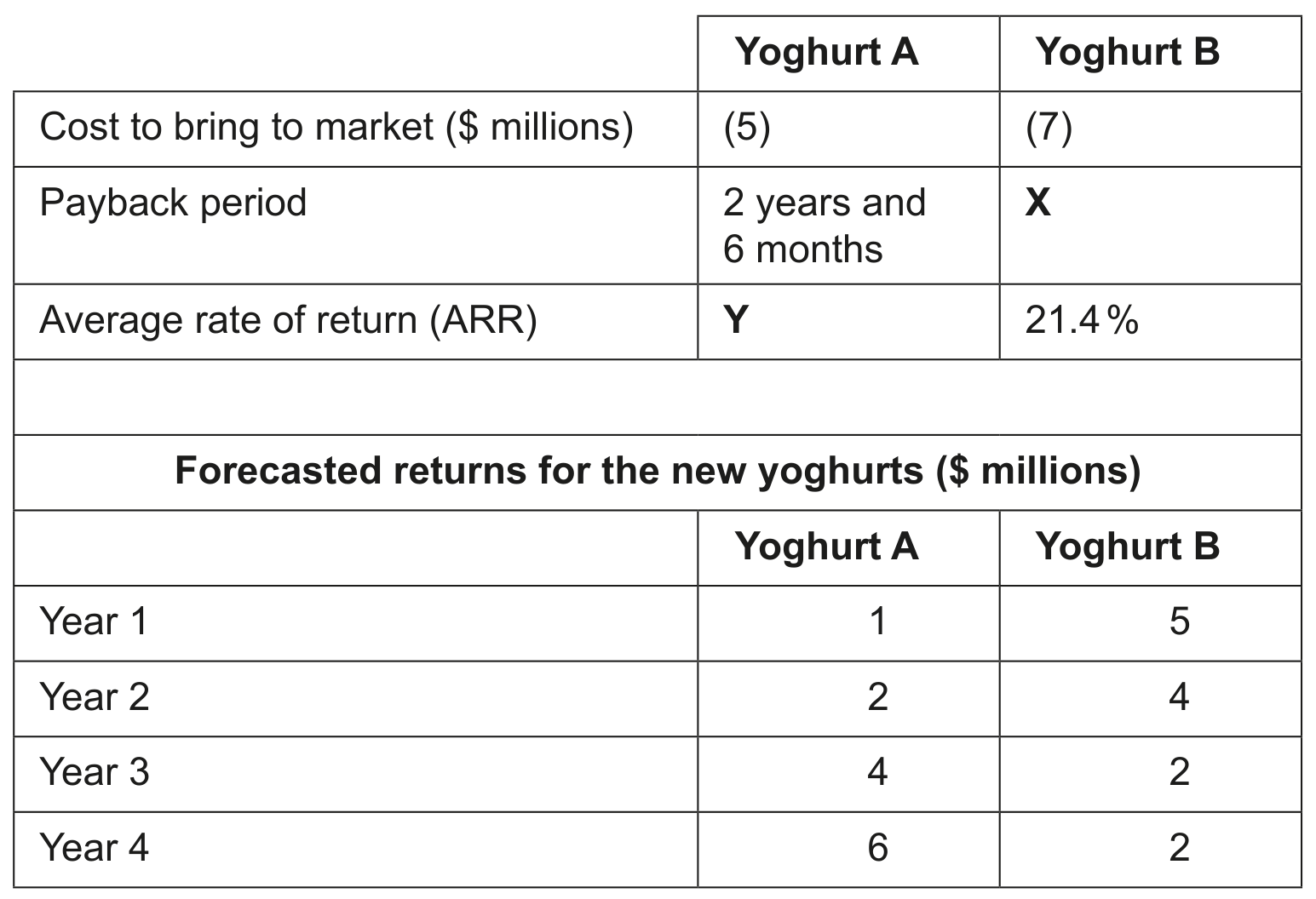
Table 2 shows forecasted financial information for the two new zero-sugar fruit yoghurts, Yoghurt A and Yoghurt B.

Table 2: Forecasted financial information for FY's new zero-sugar fruit yoghurts

Table 2: Forecasted financial information for FY's new zero-sugar fruit yoghurts

Question 2(b)

(a)

Using Table 2:

[ 4 ]

Question 2(b)(i)

(i)

calculate the forecasted payback period for the cost of bringing Yoghurt B to market, X (show all your working);

[ 2 ]

Question 2(b)(ii)

(ii)

calculate the forecasted average rate of return (ARR) for Yoghurt A, Y (show all your working);

[ 2 ]

Question 2

[Maximum number: 8]

2. Daytona Go-Carts
In 2020, Ron James aims to open Daytona Go-Carts, a race track where individuals as young as twelve can rent go-carts and participate in races. Through primary market research, Ron has discovered that many teenagers would enjoy participating in go-cart races.
Ron has two options for locations for the go-cart race track:
- Option 1: The cost of the site would be $ 1.2 million
- Option 2: The cost of the site would be $ 1.8 million.

Question image

Forecasted profits for Option 1 are:

Table

Forecasted profits for Option 2 are $ 300000 in the first year, with profits growing by 20 % per year for the next four years.

Question 2(b)

(a)

Calculate, for Option 1:

[ 4 ]

Question 2(b)(i)

(i)

the average rate of return (ARR) (show all your working);

[ 2 ]

Question 2(b)(ii)

(ii)

the payback period (show all your working).

[ 2 ]

Question 2(c)

(b)

Calculate, for Option 2, the average rate of return (ARR) (show all your working).

[ 2 ]

Question 2(d)

(c)

Explain one reason why Option 1 may be a less risky investment than Option 2.

Answer one question from this section.

[ 2 ]

Question 3

Question 3(b)

(a)

Using the additional information below, calculate:

[ 4 ]

Question 3(b)(i)

(i)

the average rate of return (ARR), for setting up Mr Carroccio's shoe repair business (show all your working);

[ 2 ]

Question 3(b)(ii)

(ii)

the payback period, for setting up Mr Carroccio's shoe repair business (show all your working).

[ 2 ]

Question 4

[Maximum number: 2]

M M is reviewing its hotel and mining operations.
To understand customer opinions about its hotels, M M will distribute questionnaires at two of its hotels and use a convenience sampling method. M M is also considering introducing flexitime for hotel employees.
For its gold mining operations, M M wants to increase its market share worldwide to 1 % by 2030. In 2020, MM produced 17 tonnes of the global production of 3200 tonnes.
In another development, M M wants to enter the rapidly growing lithium market. M M has rejected the idea of buying an existing lithium producer and is considering two options: opening its own lithium mine in Australia or entering a joint venture with a lithium mining company.
Option 1: Open a lithium mine in Australia
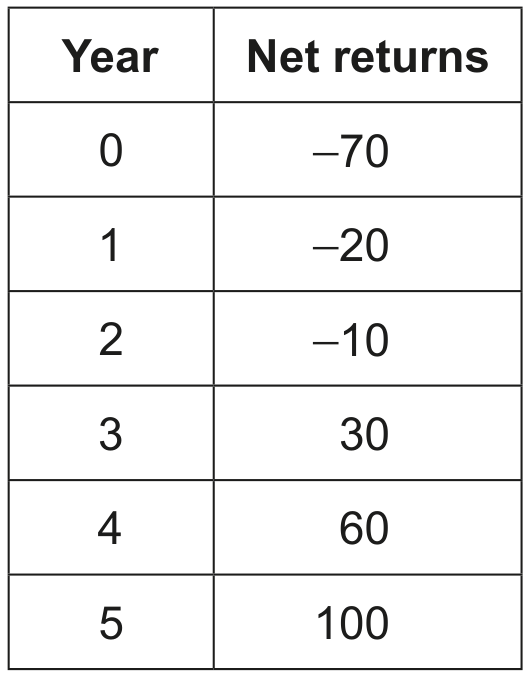
M M has identified a site in Australia, and the Australian government, which is keen to develop its country's lithium mining industry, will approve a mining license for it. Development of the mine would take three years and cost $ 100 million. Table 2 shows the forecasted net returns for the first six years.

Table 2: Forecasted net returns for the lithium mine (in millions of \$)

Table 2: Forecasted net returns for the lithium mine (in millions of \$)

M M will sell the lithium to battery manufacturers in China, a market familiar to the Australian mining industry. Transport costs would be high. Environmental pressure groups oppose the mine because of the water and air pollution they think it would create.
Option 2: A joint venture with CanLith (CL)
C L, a lithium mining company, is seeking expansion with a new mine and needs finance. A joint venture with M M would bring M M 's expertise and corporate values to the expansion. M M and C L would have equal ownership of the new mine and jointly manage it. C L would appoint a board of directors. However, C L has attracted bad publicity because of its poor environmental record, and local people oppose the new mine. Information on the joint venture is shown in Table 3.

Table 3: Information on setting up the joint venture

Table 3: Information on setting up the joint venture

Question 4(b)

(a)

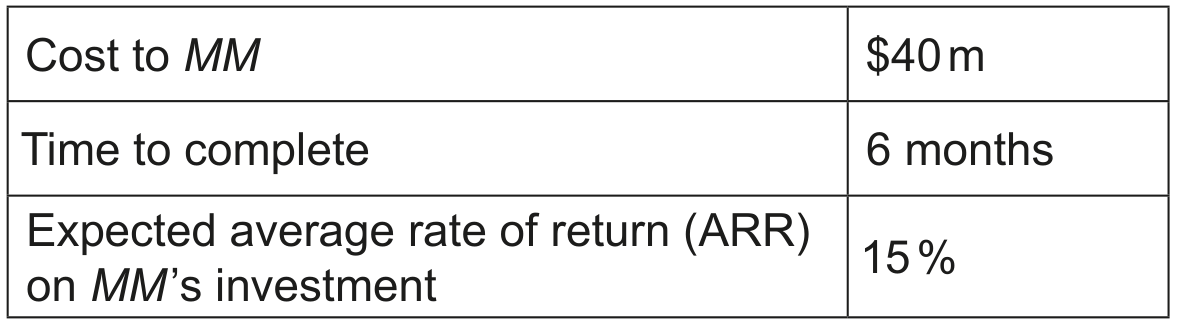
Calculate for M M :

[ 2 ]

Question 4(b)(ii)

(i)

the average rate of return (ARR) for the lithium mine (show all your working).

[ 2 ]

Question 4

[Maximum number: 14]

While identifying a location for the new factory, Zylstra Industries (ZI), a large manufacturing company located not far from Location A, presented RDM with another possibility: a strategic alliance. Thus, RDM have two options to consider.

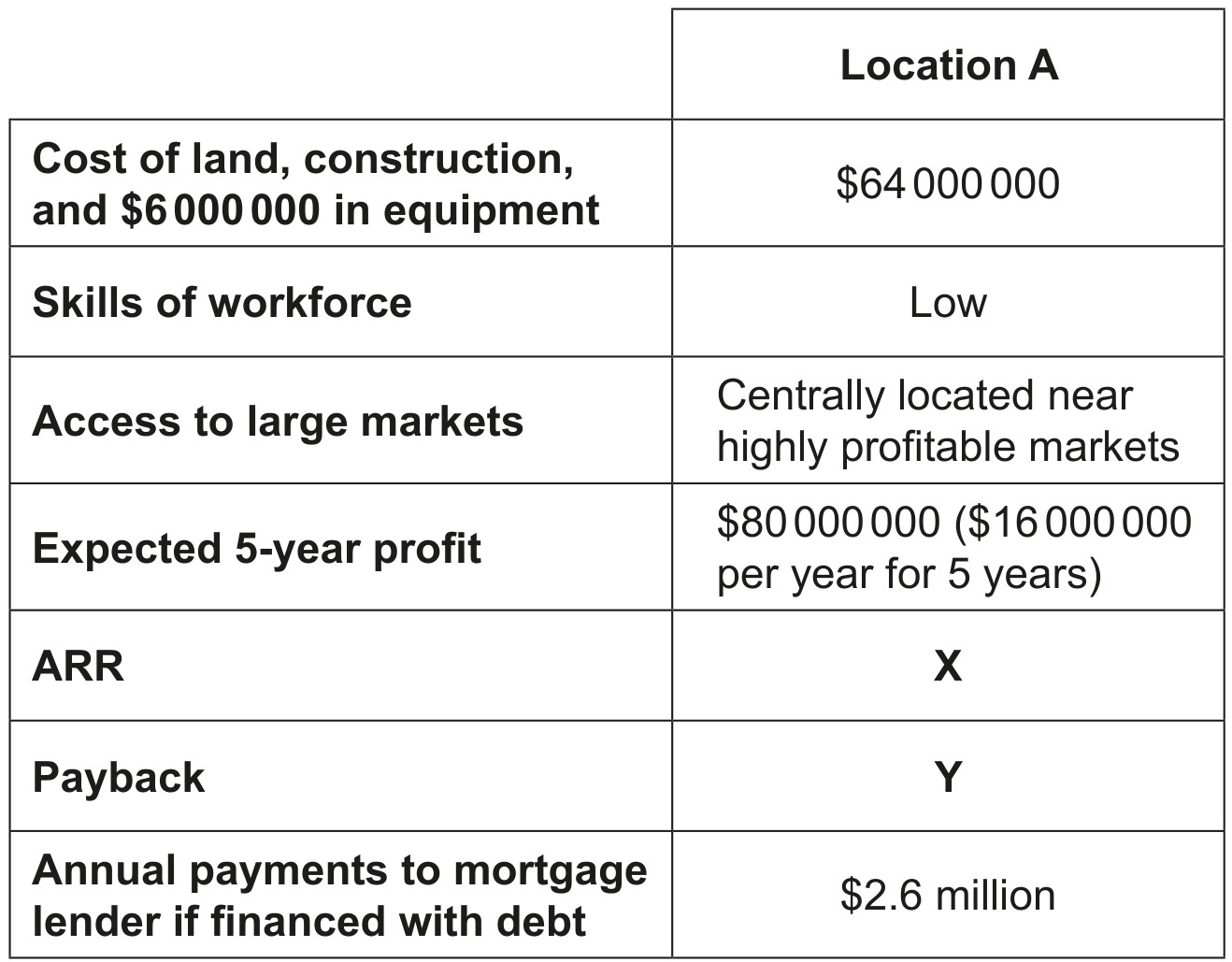
Option 1: Purchase land and build a new automated factory. The potential location is summarized in Table 1.

Table 1: Information on Location A

Table 1: Information on Location A

Location A is in an economically depressed area of northwestern Europe, where land values nevertheless remain high. Location A has an old industrial tradition with a long tradition of poor industrial/employee relations.

Option 2: A ten-year strategic alliance with Z I. Z I has proposed that RDM uses some of its vacant manufacturing space in exchange for assistance in transforming Zl's manufacturing process into a highly automated one using robots. Twenty RDM engineers and computer scientists would:
- transform ZI's current factory into an automated one
- train ZI engineers
- monitor the factory for the duration of the strategic alliance.

ZI would pay all capital expenditures and RDM would employ the twenty engineers and computer scientists. Average salary and other financial rewards of one highly skilled employee would be $ 150000 per year. In exchange, RDM would get free usage of factory floor space. RDM would buy its own equipment at a cost of $ 6000000.

RDM estimates that leasing space similar to what Z I is offering would cost $ 3000000 a year.

Question 4(b)

(a)

Using the information in Table 1, calculate for Location A:

[ 4 ]

Question 4(b)(i)

(i)

the payback period (show all your working);

[ 2 ]

Question 4(b)(ii)

(ii)

the average rate of return (ARR) (show all your working).

[ 2 ]

Question 4(d)

(b)

Recommend whether RDM should choose Option 1 or Option 2.

[ 10 ]

Question 4

[Maximum number: 4]

DA's board must make two major decisions.

Decision 1: DA needs to reduce employment costs. A new system of pay and benefits is under consideration. This includes:
- changing from an annual salary to low basic wages with profit-related bonuses
- reducing social benefits for employees, such as paying market rents for the housing in Ville d'Ablet and having to pay for the use of the leisure facilities
- offering generous compensation payments to employees who are prepared to leave the business.

Decision 2: The three options from DA directors (lines 105-143) must be considered.
Immediately prior to the board meeting, Mia withdrew her proposal (Option C).
There is now additional information available on the remaining options.

Louise plans to target the mass market and proposes using the brand name DuLow for the redesigned products. She is planning for DA to outsource production to Star Electrics (SE). SE uses mass production together with some customization of products. SE keeps costs low by importing cheap raw materials and paying low wages.

Ben, the human resource management director, is concerned about the impact this change would have on DA's employees.

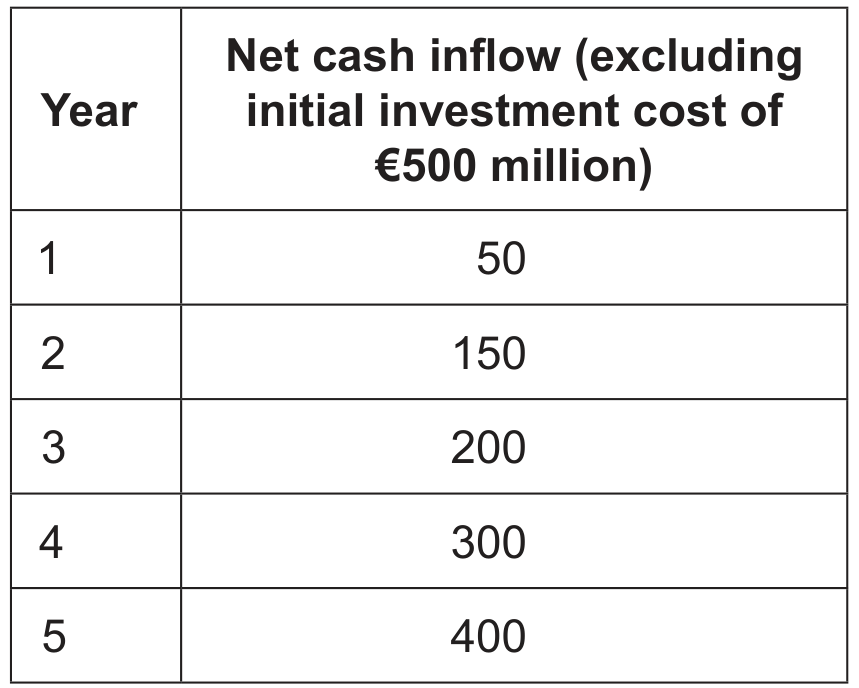
Salah's plan requires new production lines, one for each product. Salah proposes using cellular manufacturing. The investment cost is estimated to be € 500 million. Salah estimates the following net cash inflows (excluding the initial investment cost).

Table 1: Forecast financial information for Option B (figures in € millions)

Table 1: Forecast financial information for Option B (figures in € millions)

Louise thinks the option is expensive. Dodi, the finance director, thinks that the investment is too large and he believes that some shareholders are also concerned about the size of future dividends. Salah believes that shareholders will be pleased about the revenues that this investment will generate. Mia is worried that the products would be expensive to produce and that demand might fall in five to seven years.

Question 4(b)

(a)

Using Table 1, calculate for Option B:

[ 4 ]

Question 4(b)(i)

(i)

the average rate of return (ARR) (show all your working).

[ 3 ]

Question 4(b)(ii)

(ii)

the payback period (no working required).

[ 1 ]

Question 4

[Maximum number: 4]

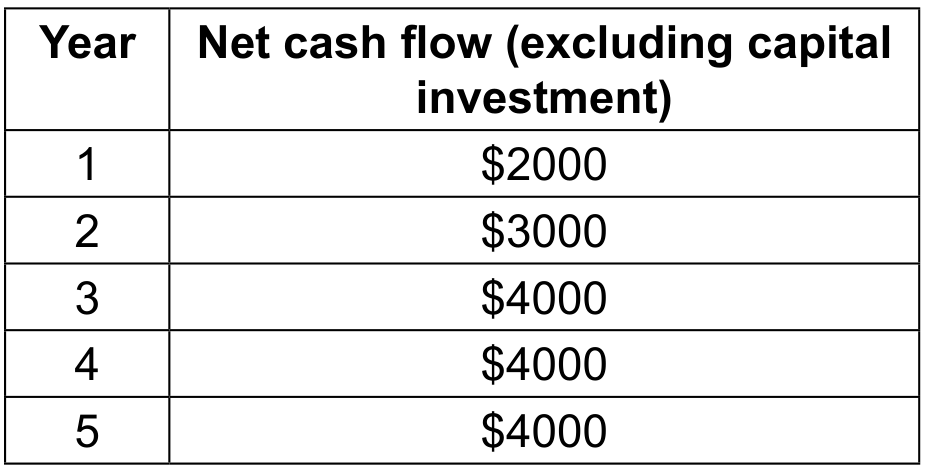
Paul's idea for 3D printing takes Utopia into a secondary sector activity that contrasts with its usual tertiary sector activities. In order to produce a sufficient number of souvenirs, Utopia would need to buy ten 3D printers at $ 1000 each. There would be material costs and significant operating costs, as well as time and additional labour. Paul has produced a net cash flow forecast for the project (Table 1) assuming a five year life for the printers. He likes the idea that each souvenir produced could be of a unique design and personalized. Some of the materials would be from recycled plastics obtained from waste at the resort. Recycling would reduce variable costs and it would be good for the resort's environment and for Utopia's caring image.

Liza does not like the idea of 3D printing. She is concerned that the souvenirs may damage Utopia's exclusive brand. She can see difficulties with recruiting someone with both the necessary IT skills and the ability to make decisions about which types of souvenirs to produce. She is particularly concerned about the impact on Utopia's current suppliers of souvenirs. She thinks that 3D printing is more suited to larger organizations.

John believes that the 3D printing technology will bring other benefits to his businesses. He can imagine decorations and other useful items being produced for the resort and its offices.

Table 1: Net cash flow for the 3D printing project

Table 1: Net cash flow for the 3D printing project

Question 4(c)

(a)

Using the information above, calculate the payback period and the average rate of return (ARR) for the 3D printing project (show all your working).

[ 4 ]

Question 4(d)

(b)

Using information from the case study, additional information above and your results

Question 4

[Maximum number: 10]

BRD manufactures Matchfix plastic model kits in its Liverpool factory. The Matchfix product range was profitable until 2020 . The market is competitive, and prices are increasingly important to customers. BRD uses a cost-plus (mark-up) pricing strategy and reviews its kit prices regularly. In 2021, the cost of plastic increased by 20 %, with a further increase in 2022 of 25 %. Matchfix plastic model kit sales fell in 2021 and again in 2022.

By 2022, 50 % of the Liverpool factory space was unused. The marketing director, Simpson Smith, wants to attract a new market segment. He has suggested two options for this unused space: a science and imagination centre and a railway museum.
- Option 1: A science and imagination centre. This would include interactive exhibits, allowing families to experiment with wind, magnets, electricity, and light. Highly trained employees would be needed to assist with experiments.
- Option 2: A railway museum. This would display full-size railway engines and rail cars used in the 20th century. A small number of employees would be needed as guides.

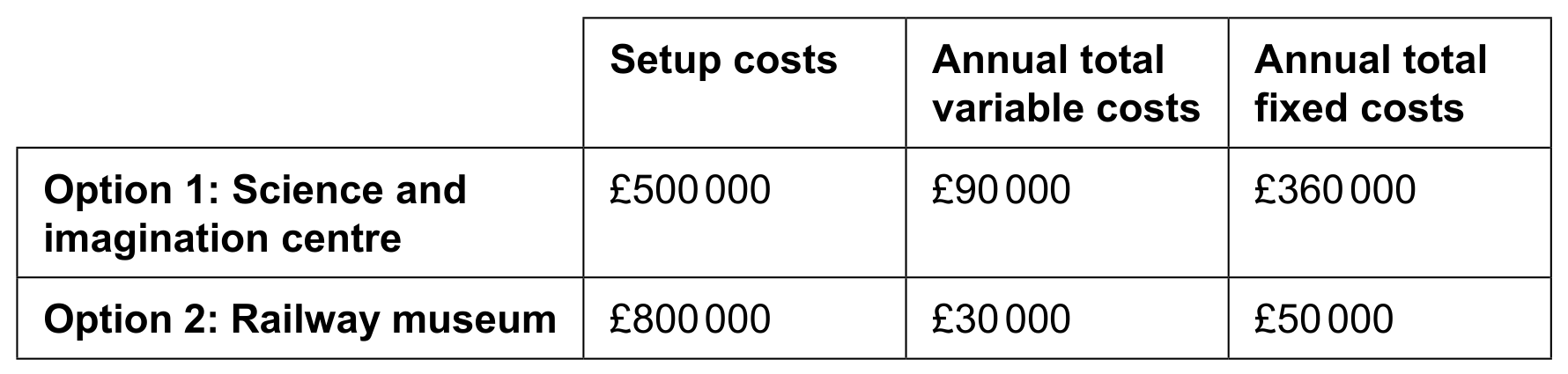
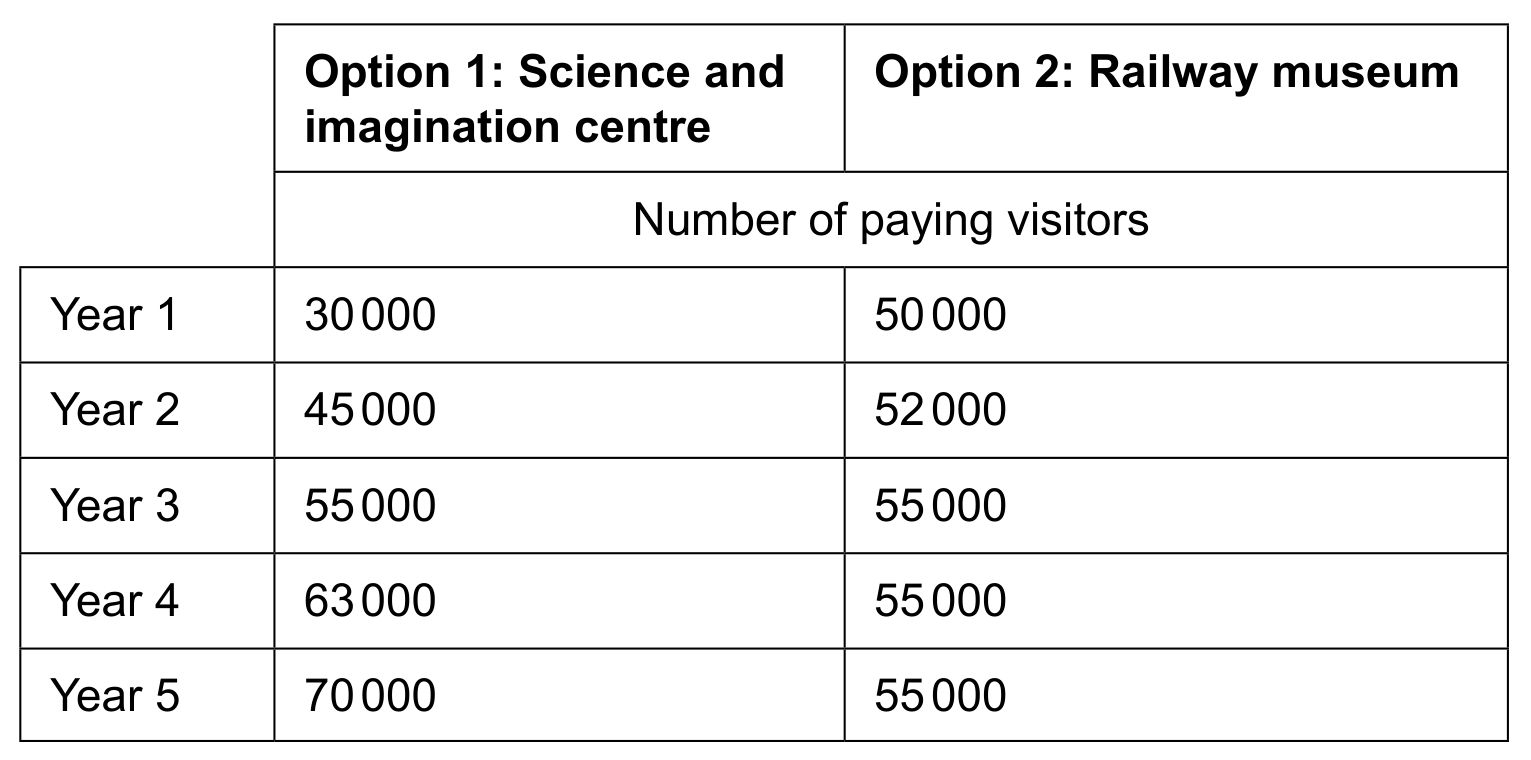
For each option, the entrance fee would be £ 15 per adult, with accompanied children entering for free. BRD would also open a café. Fixed costs for the café are forecasted at £ 25000 per annum and variable costs at £ 10 per customer. Simpson has predicted that 80 % of visitors will visit the café, with an average spend per adult of £ 15. Forecasted costs and visitor numbers for both options are shown in Table 1 and Table 2.

Table 1: Forecasted costs for Option 1 and Option 2

Table 1: Forecasted costs for Option 1 and Option 2

Table 2: Forecasted number of paying visitors for Option 1 and Option 2

Table 2: Forecasted number of paying visitors for Option 1 and Option 2

Question 4(d)

(a)

Recommend whether BRD should choose Option 1 (the science and imagination centre) or Option 2 (the railway museum).

[ 10 ]
0 selected