EduNinja

IB Business Management SL3.3 Costs and revenuesQuestion Bank

Question 1

[Maximum number: 2]

1. Fishers
Fishers manufactures baseball caps. In 2017, it sold 75000 caps. The variable cost per cap was $ 6.70 % of Fishers's annual sales occur from April to September. Starting in March, Fishers experiences a significant increase in current assets and current liabilities, which start to decrease in October.

Table 1: Selected data for Fishers for 2017 (figures in \$000s)

Table 1: Selected data for Fishers for 2017 (figures in \$000s)

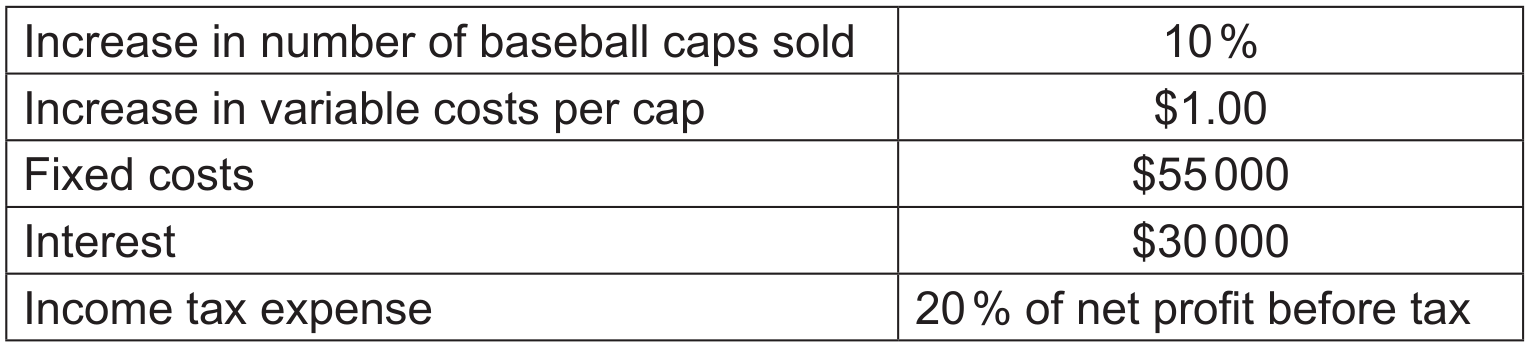
Table 2: Selected forecasted financial information for Fishers for 2018

Table 2: Selected forecasted financial information for Fishers for 2018

Sales price per cap will remain the same as in 2017.

Question 1(c)

(a)

Using Table 2, calculate the following forecasted figures for 2018:

[ 2 ]

Question 1(c)(i)

(i)

sales revenue;

[ 1 ]

Question 1(c)(ii)

(ii)

total variable costs;

[ 1 ]

Question 1

[Maximum number: 2]

1. Calorie Count (CC)
Evana Dox has recently set up her own business, called Calorie Count (CC). She has identified a precise market segment: local middle-aged people struggling to have a healthy lifestyle because of long working hours. Customers will order meals in the morning, and in the evening Evana will deliver the meals.
Evana is converting the ground floor of her house into a professional kitchen complying with all hygiene standards and food safety regulations. She will employ her niece Athena, a graduate from a catering college. 60 % of the initial investment and start-up costs will come from Evana's personal savings; the other 40 % will be financed by external sources.
Evana has carried out secondary market research and found that the net profit margin in catering businesses of the same size is 35 %. However, for her new business Evana knows that her net profit margin will be much lower.
For her first year of operations, she aims for a net profit margin of 15 %. In the first year, she hopes to sell an average of 50 meals per day, 5 days per week. She estimates that each meal would be sold at an average price of $ 17. This price, Evana believes, will be competitive and will generate an adequate contribution per meal for her business to be successful.
CC uses a cost-based pricing strategy, with the following estimated costs:
- variable cost per meal: 70 % of selling price
- fixed cost per annum: $ 42000.

Question 1(a)

(a)

Identify two variable costs for CC.

[ 2 ]

Question 1

[Maximum number: 2]

1. Suparman Fish ( SF )
Gepa Suparman owns and operates four fishing boats in Indonesia. There is a growing demand for canned (tinned) food, including cans of fish. Gepa wants to enter the secondary sector by opening a small factory producing cans of fish.
Gepa's business will be called Suparman Fish ( S F ) and will be a private limited company. Gepa will own all of the shares. The factory will be located in a village three miles from the harbour. Because unemployment is high in the village, Gepa should easily find workers for the new factory. In addition to the manager's salary, workers' wages, and the cost of fish, supplies, and cans, S F will have the semi-variable cost of electricity.
Gepa has prepared a four-month cash-flow forecast based on the following information:
- opening balance month 1: $ 15000.
- month 1 : sales revenue of $ 1000, increasing by 20 % per month.
- manager's salary: $ 300 per month.
- workers' wages: $ 175 per worker per month.

Table

- variable costs (fish, supplies, and cans) are equal to 40 % of sales revenue.
- semi-variable cost of electricity: fixed cost of $ 100 per month, plus a variable cost of $ 0.10 per kilowatt hour (kwh). Month 1 usage: 100 kwh , increasing by 10 % each month.

Although S F would create several jobs in the village, many residents are not happy about the new factory. The new factory would use chemicals, which cause pollution. Residents are concerned about the unpleasant smells from the factory. A representative from the local employment office is concerned whether Gepa's factory will provide a safe working environment.

Question 1(b)

(a)

Explain why electricity is a semi-variable cost for S F.

[ 2 ]

Question 2

Question 2(b)

(a)

Explain how Kos Palouk's fixed and variable costs would be affected by pursuing Option 2 (lines 150-152).

[ 4 ]

Question 2

[Maximum number: 2]

Parder

Image removed for copyright reasons

Parder manufactures ride-on (riding) lawnmowers.
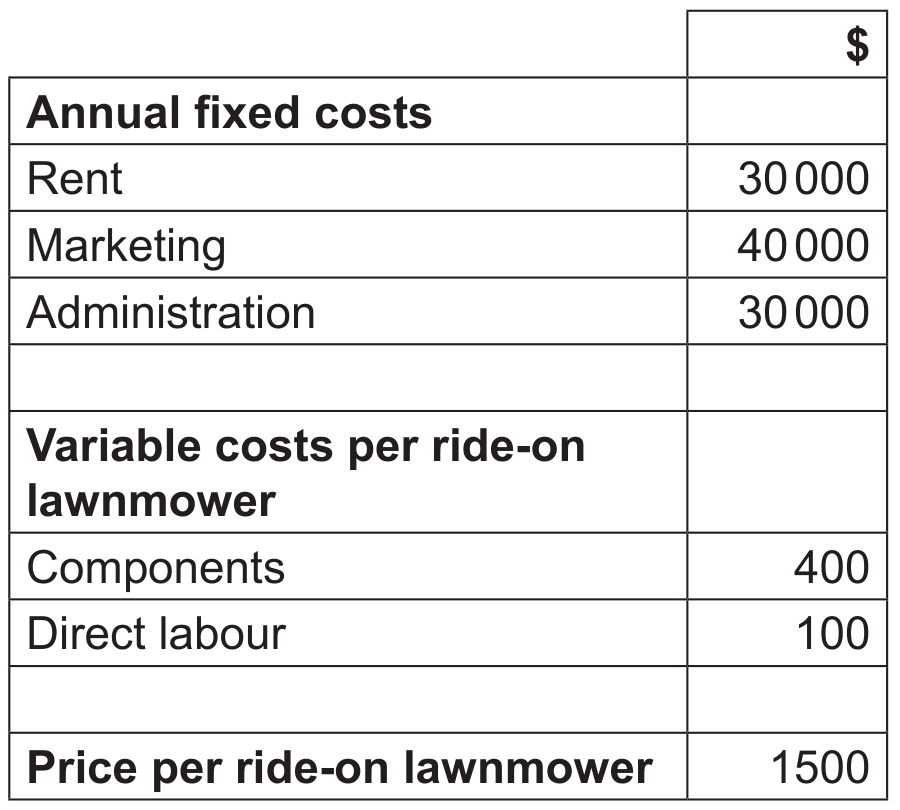
Selected forecast financial data for the ride-on lawnmowers, for 2016:

Table

Question 2(a)

(a)

Define the term variable costs.

[ 2 ]

Question 2

[Maximum number: 2]

2. Ritev Enterprises (RE)
Ritev Enterprises (RE) is a public limited company that owns a chain of 20 gas (petrol) stations. Next year, R E plans to modernize its gas stations by installing self-service pumps.
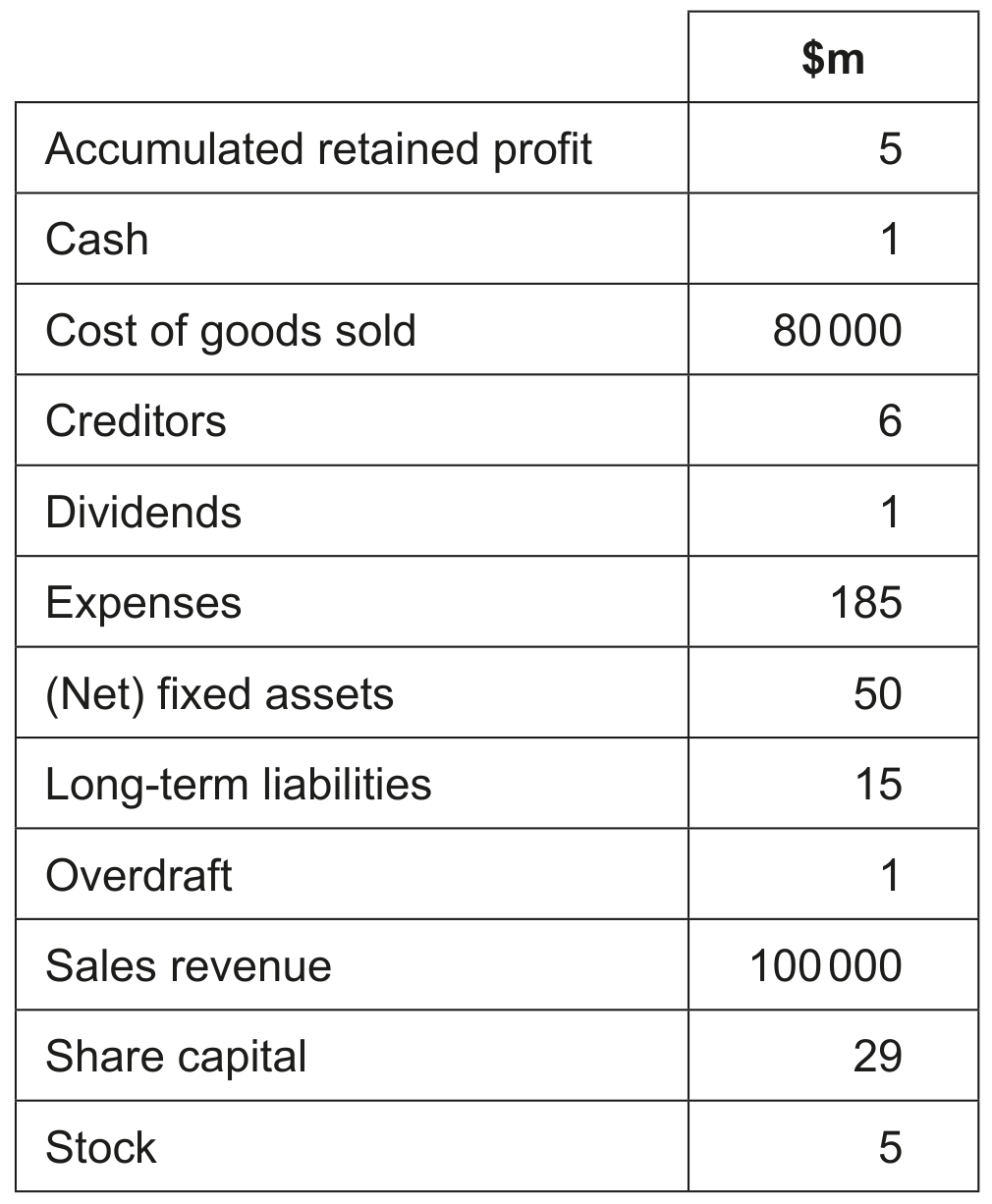
Table 2 provides selected financial data for R E from:
- the profit and loss account for year ending 31 May 2021
- the balance sheet as of 31 December 2021.

Table 2: Selected financial data for R E

Table 2: Selected financial data for R E

The finance director is concerned about the trend in consumer preference for electric cars and the potential impact of increased numbers of electric cars on R E.

Question 2(c)

(a)

Explain the potential impact of the increasing popularity of electric cars on R E 's costs and revenues.

Answer one question from this section.

[ 2 ]

Question 4

[Maximum number: 2]

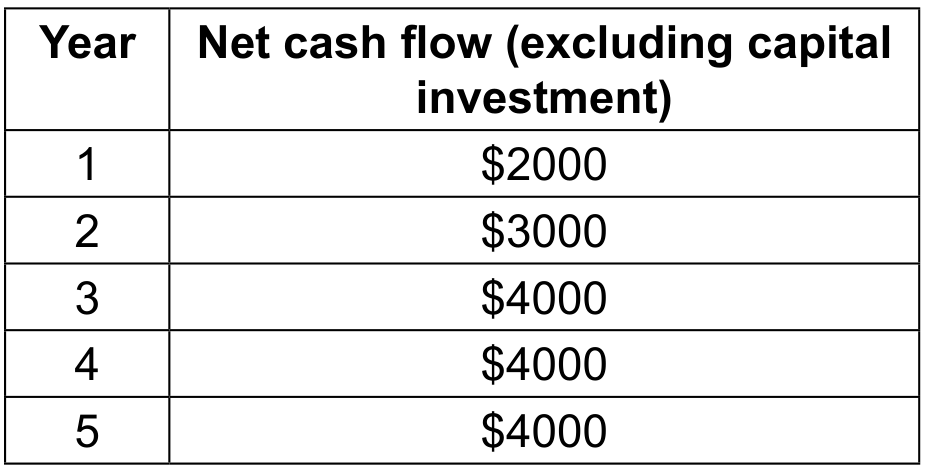
Paul's idea for 3D printing takes Utopia into a secondary sector activity that contrasts with its usual tertiary sector activities. In order to produce a sufficient number of souvenirs, Utopia would need to buy ten 3D printers at $ 1000 each. There would be material costs and significant operating costs, as well as time and additional labour. Paul has produced a net cash flow forecast for the project (Table 1) assuming a five year life for the printers. He likes the idea that each souvenir produced could be of a unique design and personalized. Some of the materials would be from recycled plastics obtained from waste at the resort. Recycling would reduce variable costs and it would be good for the resort's environment and for Utopia's caring image.

Liza does not like the idea of 3D printing. She is concerned that the souvenirs may damage Utopia's exclusive brand. She can see difficulties with recruiting someone with both the necessary IT skills and the ability to make decisions about which types of souvenirs to produce. She is particularly concerned about the impact on Utopia's current suppliers of souvenirs. She thinks that 3D printing is more suited to larger organizations.

John believes that the 3D printing technology will bring other benefits to his businesses. He can imagine decorations and other useful items being produced for the resort and its offices.

Table 1: Net cash flow for the 3D printing project

Table 1: Net cash flow for the 3D printing project

Question 4(a)

(a)

Define the term variable cost.

[ 2 ]

Question 4

[Maximum number: 2]

In 2022, the global home water filter market was $14 billion.

SVT's product penetration in Europe and the United States of America (USA) is high and growing but low in the rest of the world. In 2022:
- SVTs total sales revenue from home water filters was $ 4.9 billion
- the average revenue earned per water filter was $ 20
- 90 % of SVTs home water filter sales were to Europe and the USA.

In 2022, SVT announced the closure of its European and USA water filter manufacturing factories. Water filter profit margins had fallen for three years, partly because of increasing costs of energy, rent and labour. SVT has since built a huge new factory in Asia to manufacture home water filters.

SVT's market research, using quota sampling, found that 80 % of households that purchased an SVT water filter:
- had an above-average income
- owned two or more cars.

In January 2023, SVT:
- launched an advertising campaign in Europe and the USA highlighting the lack of potable water for millions of people in less economically developed countries (LEDCs)
- announced a 5 % worldwide increase in the price of its home water filters.

SVT committed to use the revenue from the 5 % price increase to provide two million free WF15 water purifiers annually to charities in LEDCs. It costs SVT $10 to make a water purifier.

Some disagreement occurred among the board of directors regarding this price increase. Some directors felt it would highlight SVTs vision and commitment to helping people in LEDCs, but others believed sales might fall, impacting profits in SVTs Consumer Products Division.

Question 4(b)

Question 4(b)(ii)

(a)
(i)

Calculate the number of home water filters SVT sold in 2022 to the rest of the world (excluding Europe and the USA) (show all your working).

[ 2 ]

Question 4

Question 4(a)

Question 4(a)(ii)

(a)
(i)

Identify two fixed costs for The Imperial (line 146).

[ 2 ]

Question 4

[Maximum number: 2]

4. Willow Enterprises (WE)
Willow Enterprises (WE) was founded in 1989 originally as a small manufacturer of carpeting for high-end commercial and institutional office space. In 1997 the management made several strategic decisions:
- change from the use of cheap man-made materials to more expensive natural fibres in its carpets
- change legal status from a private to a public limited company
- use profits to increase production capacity and expand the sales force
- diversify by taking over other regional businesses, including a retail chain, and transform them into environmentally friendly businesses.
Because of its appeal to environmentally conscious customers, WE became the regional market leader and, by 2008, was an important carpet manufacturer at a national level.
At this time, Chief Executive Officer Simon Dee decided that WE would adopt a far-reaching programme of corporate social responsibility (CSR). Every year, WE committed more resources to various forms of corporate social responsibility (CSR), such as charitable contributions and fair payments to employees and suppliers. By 2018, WE had diverse revenue streams and a brand identity strongly associated with corporate social responsibility (CSR).
For the last few years, WE's gross and net profit margins have been falling slightly but steadily. Simon has attributed the declining profitability to diseconomies of scale and one-off (one-time) expenses associated with each takeover. The Chief Financial Officer, Ruth Croft, disagreed. She gave Simon a copy of a 1970 article by the economist Milton Friedman entitled "The Social Responsibility of Business is to increase its Profits".

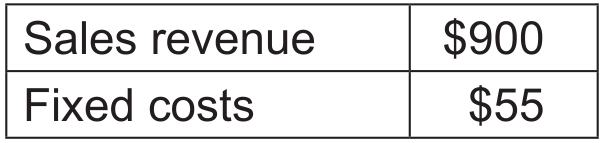
Question 4(a)

(a)

Define the term revenue streams.

[ 2 ]
0 selected