Question 7
[Maximum number: 1]
A mutation in which type of cell could be inherited?
A
Beta cell in the pancreas
B
T-cell in the lymph
C
Sperm cell in the testis
D
Skeletal muscle cell in the diaphragm
 EduNinja
A mutation in which type of cell could be inherited?
Beta cell in the pancreas
T-cell in the lymph
Sperm cell in the testis
Skeletal muscle cell in the diaphragm
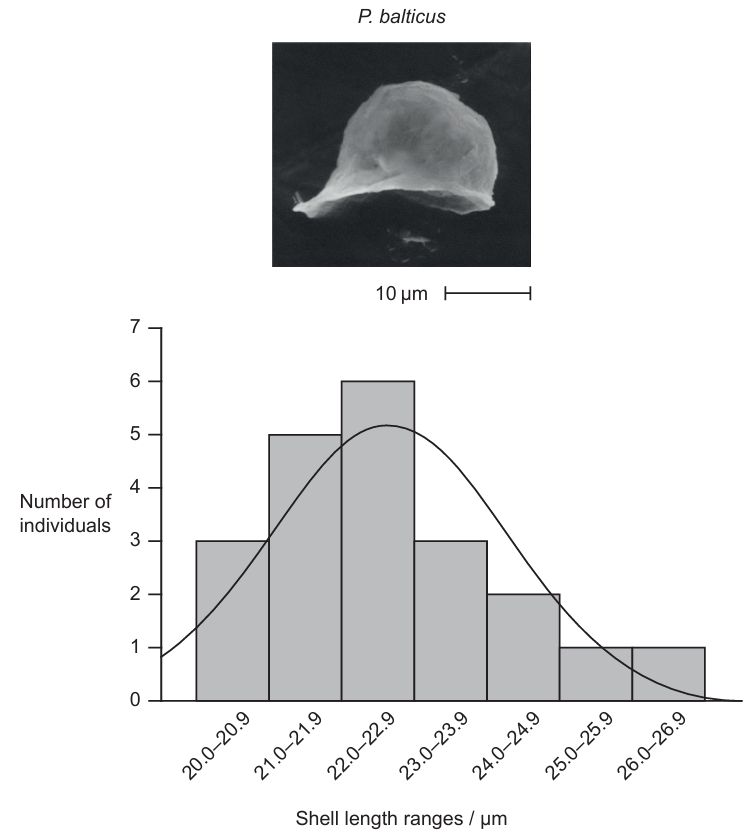
Psammonobiotus balticus belongs to a group of protists (unicellular eukaryotic organisms) that have a shell surrounding most of the cell, which provides shelter from predators. The graph shows the frequency of varying shell lengths in a population of P. balticus.
Mutations may increase variation within a species. Compare and contrast substitution and insertion mutations.
What is a feature of mutations?
They occur randomly.
They only occur in germ cells.
The frequency cannot be increased by external factors.
They only occur in certain base sequences of the genome.
What is a gene mutation?
Failure of chromosome pairs to separate properly during cell division
Changes to genes caused by natural selection
Changes to the nucleotide sequence of the genetic material
Changes in karyotypes
How is a new allele produced?
Cloning
Mutation
Differentiation
Natural selection
What occurs during gene mutation?
Allele change
Crossing over
Non-disjunction
Evolution
One type of gene mutation involves a base substitution.
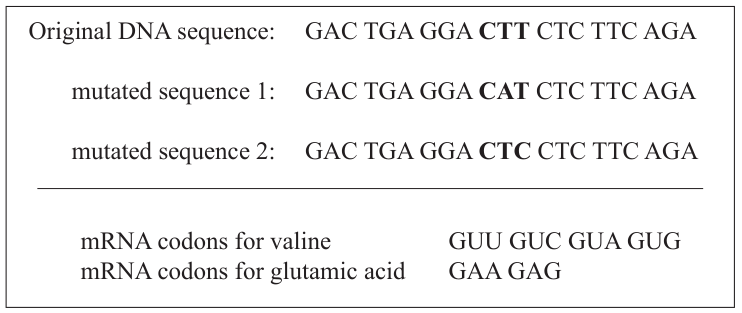
What are the consequences of the base substitutions in the two new sequences of DNA?
Both are mutations that would result in different polypeptides.
Sequence 2 would result in a changed polypeptide but sequence 1 would not.
All three DNA sequences would translate into the same polypeptide.
Only the original DNA and sequence 2 would translate into the same polypeptide.
Which of the following is the cause of sickle-cell anemia?
Tryptophan is replaced by leucine.
Leucine is replaced by valine.
Glutamic acid is replaced by valine.
Lysine is replaced by glutamic acid.
In some people, hemoglobin always contains the amino acid valine in place of a glutamic acid at one position in the protein. What is the cause of this?
An error in transcription of the hemoglobin gene
An error in translation of the mRNA
Lack of glutamic acid in the diet
A base substitution in the hemoglobin gene
The Cancer Council of New South Wales has stated that one in five cancer deaths are caused by smoking. How can smoking cause cancer?
20 % of smokers get cancer.
Cigarette smoke contains mutagenic chemicals.
Smoking reduces the rate of mitosis in cells.
Smoking is addictive.