Question 1
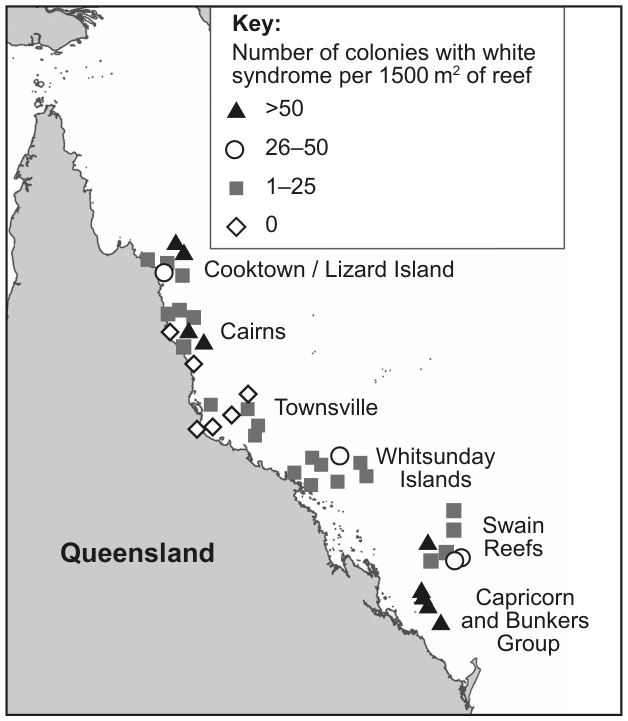
The incidence of white syndrome, an infectious disease of coral, was investigated in a six-year study on Australia's Great Barrier Reef. The map shows disease conditions on coral reefs at six study sites.
Question 1(b)
Satellites were used to record sea surface temperatures. The temperatures each week above a reef were compared with mean temperatures for that week between 1985 and 2004. If the sea surface temperature was or more above the mean, this was recorded as a weekly sea surface temperature anomaly (WSSTA). The number of WSSTAs was calculated for the twelve months preceding the date on which a reef was surveyed for white syndrome.
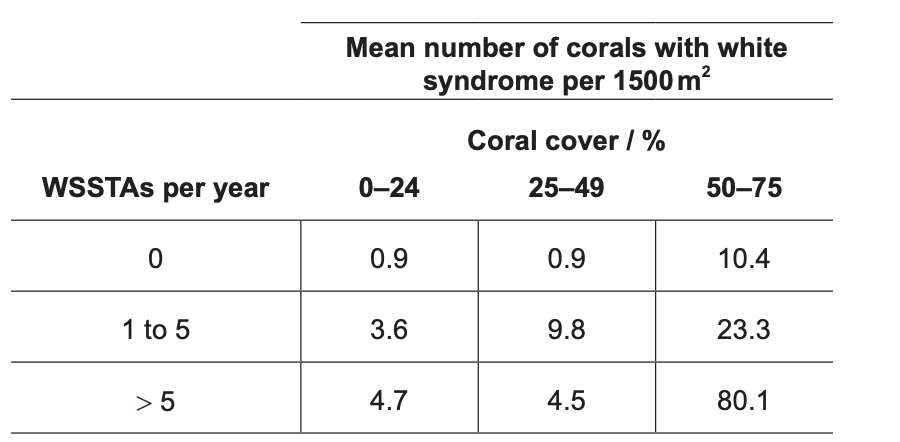
On each reef, the number of cases of white syndrome in a sample area was surveyed once per year. The table shows these cases in relation to numbers of WSSTAs and coral cover on the reef. Low coral cover was 0-24 % and high coral cover was 50-75 %.
Question 1(b)(i)
Describe the evidence that is provided by the data in the table for the harmful effects of rising sea temperatures on corals.
Question 1(c)
The graphs show the relationship between the weekly sea surface temperature anomalies (WSSTA) and coral cover during two twelve-month periods (1998-99 and 2002-03), which were the warmest in the six-year study. Each dot represents one studied reef.
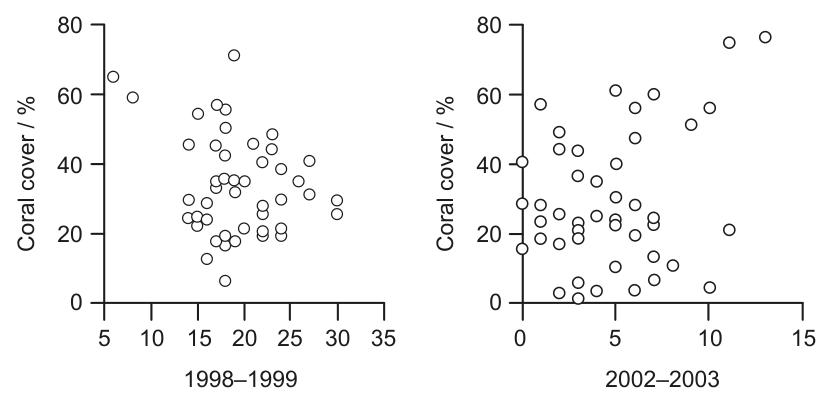
Question (ii)
Suggest a reason for the correlation between coral cover and WSSTA in 1998-1999.
Question 1(d)
Some scientists predict that, if humans continue to produce carbon dioxide at the current rate, the pH of the oceans will become more acidic. Suggest possible effects on the coral reefs.