Question 2
[Maximum number: 1]
The image shows a DNA nucleotide.
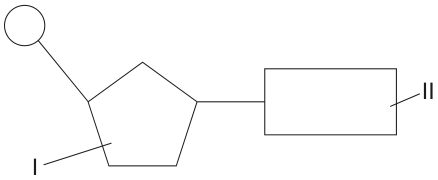
Which correctly identifies the parts labelled I and II?
I
II
base
phosphate
ribose
uracil
deoxyribose
base
ribose
adenine
 EduNinja
The image shows a DNA nucleotide.
Which correctly identifies the parts labelled I and II?
I
II
base
phosphate
ribose
uracil
deoxyribose
base
ribose
adenine
What allows DNA to store very large amounts of data?
Two strands of DNA
Base sequence
Complementary base pairing
Sugar-phosphate backbone
Research has shown that the genetic code is not entirely universal. Which research finding has shown this?
Some amino acids are coded for by more than one codon.
There are differences between the base sequences of genes in different species.
In some organisms the genetic code for mitochondria differs from the genetic code for the nucleus.
Some codons code for the addition of an amino acid and some code for the termination of translation.
What is the arrangement of subunits in a DNA nucleotide?
sugar - base - phosphate
sugar - phosphate - base
phosphate - sugar - base
sugar - phosphate - base - base - phosphate - sugar
Which parts of this nucleotide would bond covalently with other nucleotides in a DNA double helix?
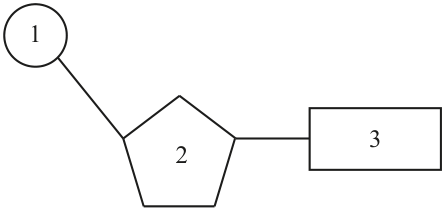
1 and 2 only
1 and 3 only
2 and 3 only
1, 2 and 3
State two structural features that differ between RNA and DNA.
Which molecules form the nucleotide marked in the diagram?
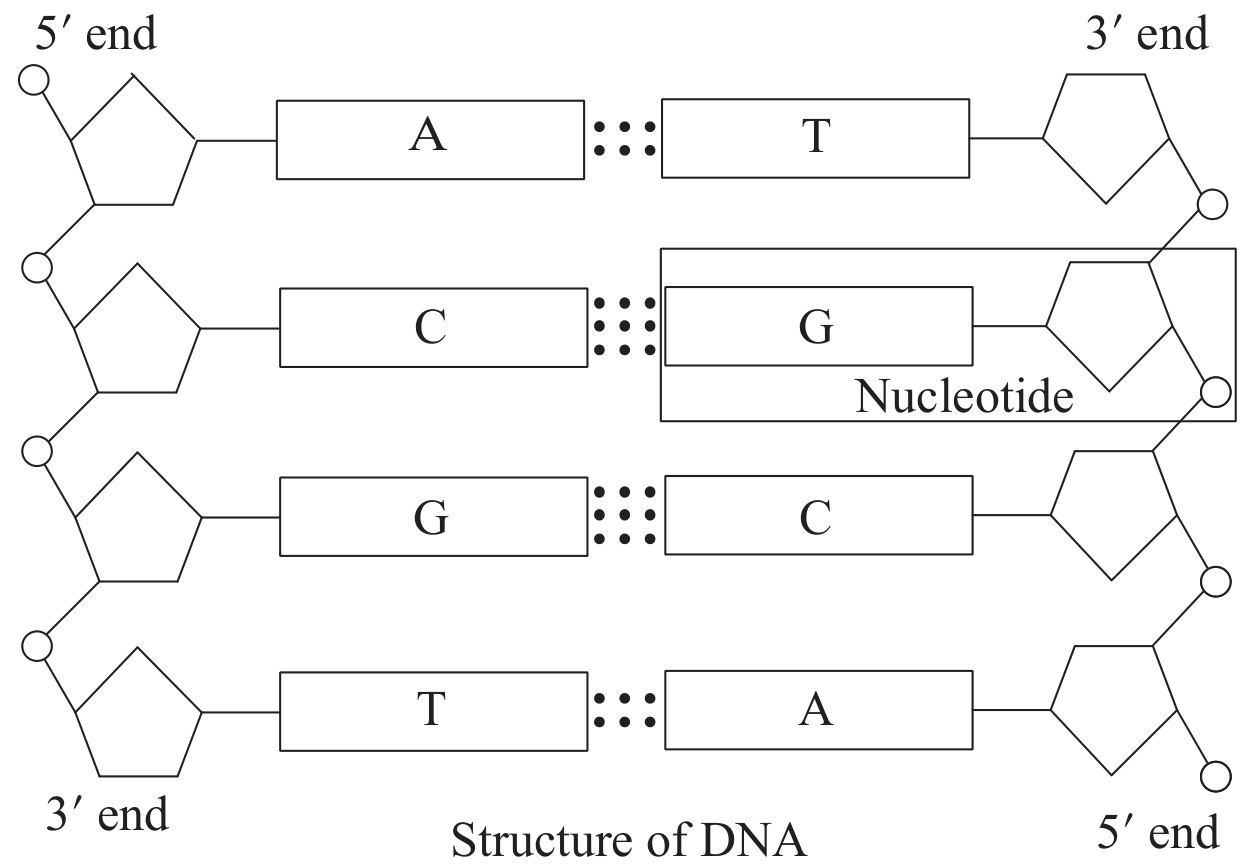
phosphate, deoxyribose and nitrogenous base
phosphorus, ribose and nitrogenous base
phosphorus, deoxyribose and guanosine
phosphate, ribose and guanine
The diagram shows a dinucleotide.
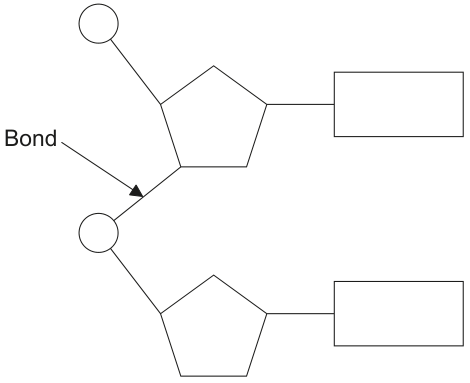
Which type of bond is identified by the arrow?
Phosphate
Hydrogen
Covalent
Peptide
The diagram shows part of a DNA molecule.
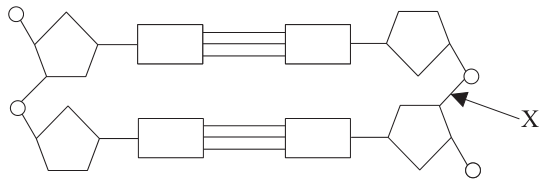
What type of bond does X represent?
Covalent bond
Hydrogen bond
Peptide bond
Semi-conservative bond
Watson and Crick worked out the three-dimensional structure of DNA. What did the model they built show for the first time?
DNA is a polynucleotide.
DNA contains equal quantities of adenine and thymine.
DNA molecules have a helical shape.
DNA is a double helix with antiparallel sugar-phosphate backbones.