
Explain the Selection Chain
Natural selection is the mechanism that drives evolutionary change. It acts on heritable variation: individuals with variants better suited to a selection pressure survive and reproduce more, so the alleles linked to those traits become more common. Over many generations, this can produce adaptation, speciation, and biodiversity.
Order the natural selection chain.
OrderMake Variation First
Selection cannot choose between identical individuals. Mutation creates new alleles, especially when germ-line mutations are inherited. Meiosis and random fertilization create new combinations of existing alleles, giving selection different phenotypes to act on.
Sort the source of variation.
SortLink Overproduction to Selection
Overproduction matters because environments have limited resources. More offspring are produced than can survive, causing high mortality and competition for food, space, mates, and other resources. That competition creates selection because individuals differ in survival and reproduction.
Match each idea to its role in selection.
MatchSpot Abiotic Selection Pressures
Selection pressure does not have to be another organism. Abiotic factors such as temperature, drought, light, salinity, and pH can favour variants that tolerate those conditions. These pressures can be density-independent because they affect survival regardless of population density.
Sort each selection pressure.
SortDefine Fitness Correctly
Fitness does not mean strength or health in a general sense. In evolution, fitness means passing alleles to offspring in a particular environment. An individual with higher fitness survives and reproduces more successfully, so its alleles are better represented in the next generation.
Spot the error: the fittest organism is always the strongest individual.
Spot ErrorsReject Acquired Inheritance
Natural selection causes evolution only if the selected trait is heritable. Acquired characteristics developed during an individual’s life are not inherited through DNA base sequences. Selection changes populations when inherited alleles affect survival or reproduction.
Spot the error: an animal stretches its neck during life, so its offspring inherit a longer neck.
Spot ErrorsBalance Mates and Predators
Sexual selection favours traits that increase mating success, even if they carry survival costs. Displays, ornaments, colours, and behaviours can be selected when they improve mate choice or competition for mates. The key exam move is to weigh mating advantage against possible predation or energy cost.
A bright male display attracts mates but also predators. What decides whether it spreads?
DecisionRead Endler's Guppy Data
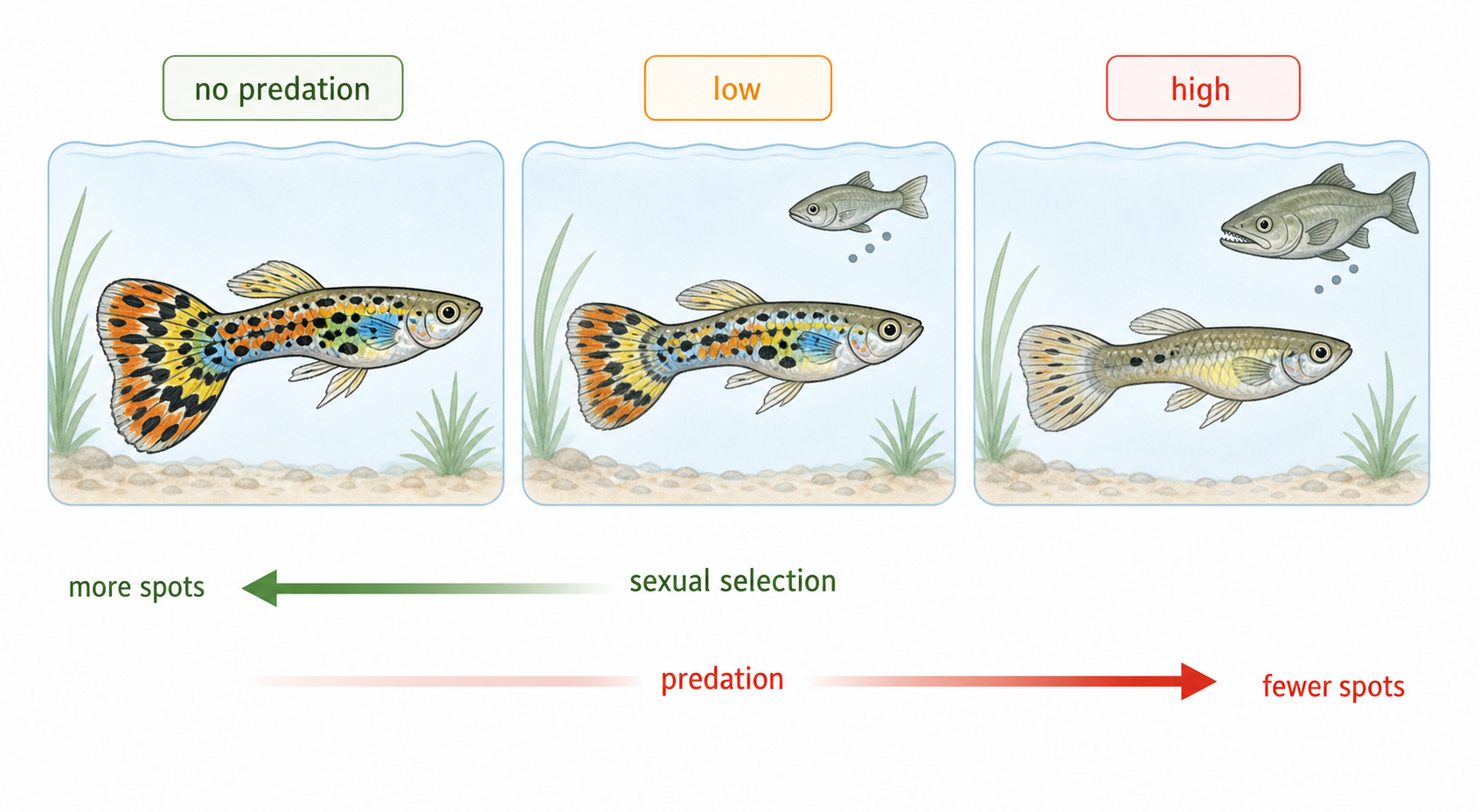
Endler’s guppy experiments modelled selection by controlling selection pressures. Predation pressure selected against conspicuous colour patterns, while mate choice could favour them. The evidence is powerful because changing the predation environment changed colour patterns over generations.
Endler's model shows a trade-off: bright colour can attract mates but also predators.
Match the guppy evidence to the selection idea.
MatchMatch the guppy evidence to the selection idea.
ChooseRetrieve the Core Natural Selection Route
ReviewCore D4.1 examples follow the same causal route: heritable variation exists, a selection pressure acts, individuals differ in fitness, and alleles linked to higher reproduction become more common. Endler’s guppies and sexual selection are evidence versions of the same chain.
Match each retrieval cue to its exam-use meaning.
MatchTransfer: Explain Core Natural Selection
Exam PracticeCore natural-selection exam answers should never stop at “the best adapted survive.” They need the chain: heritable variation exists, a named pressure acts, some individuals have higher fitness, and their alleles become more common over generations. Use this for abiotic pressure, overproduction, sexual selection, and Endler-style data.
Explain how a selection pressure can cause evolutionary change in a population.
Explain how a selection pressure can cause evolutionary change in a population.
ChooseMatch each exam move to the mark it earns.
Match