EduNinja
IB Biology SL/Notes/D1.1 DNA replication

IB Biology SLD1.1 DNA replicationNotes

Why DNA Must Replicate
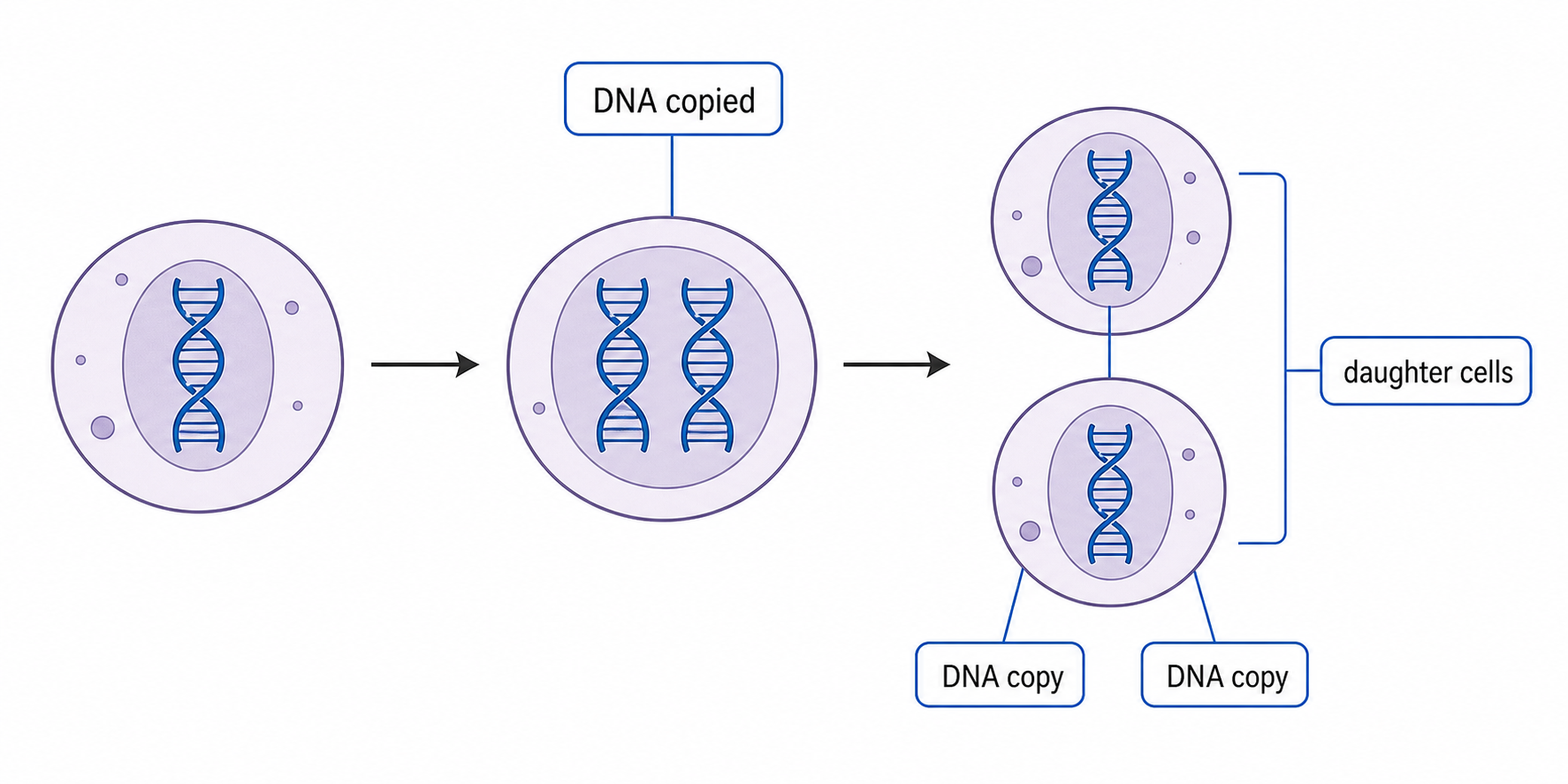
DNA replication happens before cell division so each new cell can receive a complete copy of the genetic information. This is why replication matters for reproduction, growth, and tissue replacement: it maintains genetic continuity rather than making each division genetically random.

DNA replication produces exact DNA copies before cell division.
It maintains genetic continuity for reproduction, growth, and tissue replacement.
The exam answer should connect copying to inheritance, not just say DNA doubles.

Replication prepares genetic continuity before division.

Put the purpose of replication in order.

Order
1
cell prepares to divide
2
DNA is copied accurately
3
each daughter cell receives genetic information
4
genetic continuity is maintained for growth, repair, or reproduction

Put the purpose of replication in order.

Choose
cell prepares to divide
DNA is copied accurately
each daughter cell receives genetic information
genetic continuity is maintained for growth, repair, or reproduction

Build the Semi-Conservative Model

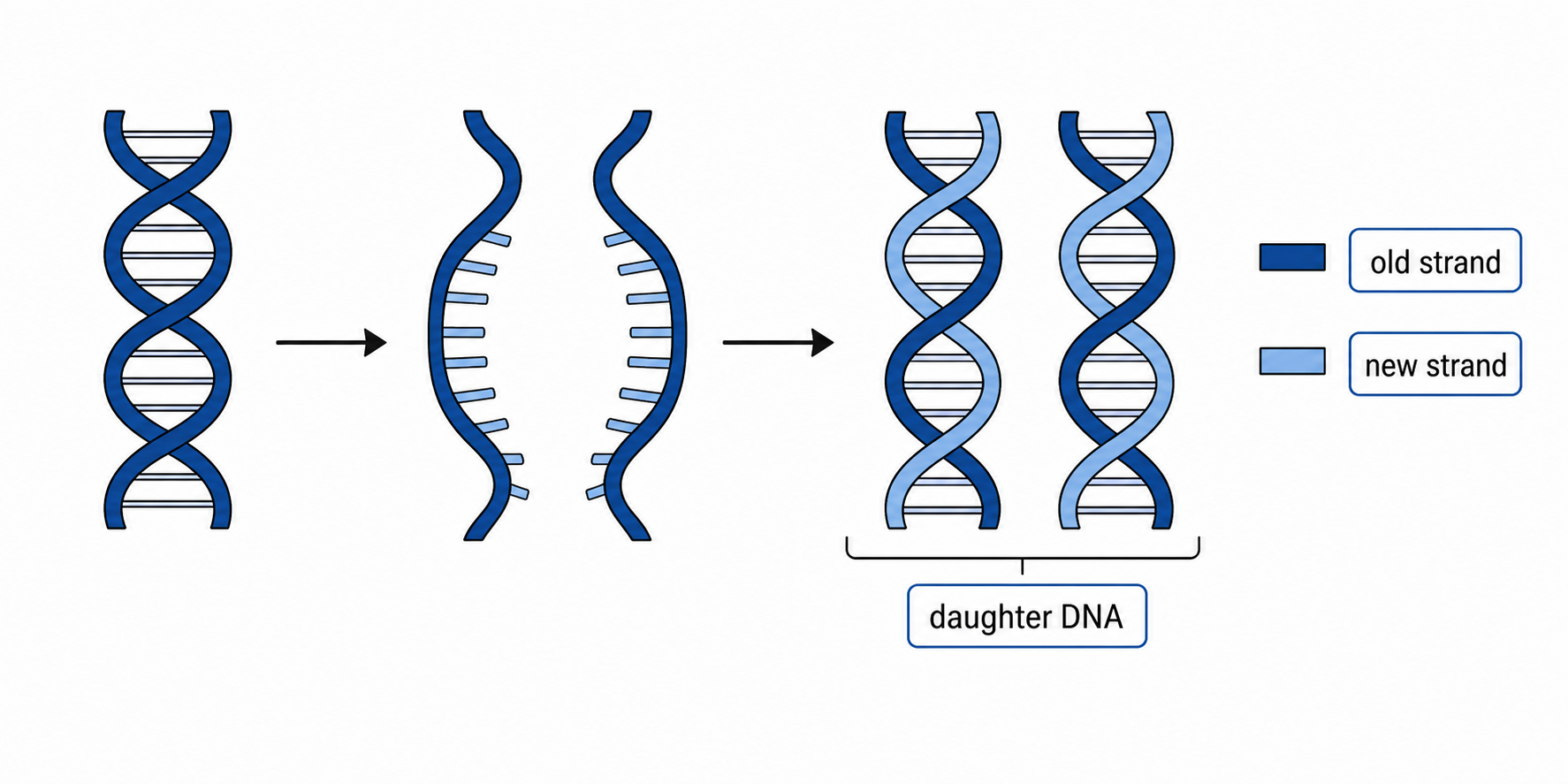
Semi-conservative replication means each daughter DNA molecule contains one original strand and one newly synthesized strand. Complementary base pairing explains the copying accuracy, and Meselson-Stahl isotope evidence supports this model by showing hybrid DNA after one generation and hybrid plus light DNA after two generations.

Each new DNA molecule has one original strand and one new strand.
Complementary base pairing gives accurate copying.
Meselson-Stahl isotope evidence supports the semi-conservative model.

Each daughter DNA conserves one parental strand.

Which diagram would support semi-conservative replication after one round?

Choose

Which diagram would support semi-conservative replication after one round?

Choose

Assign Helicase and DNA Polymerase

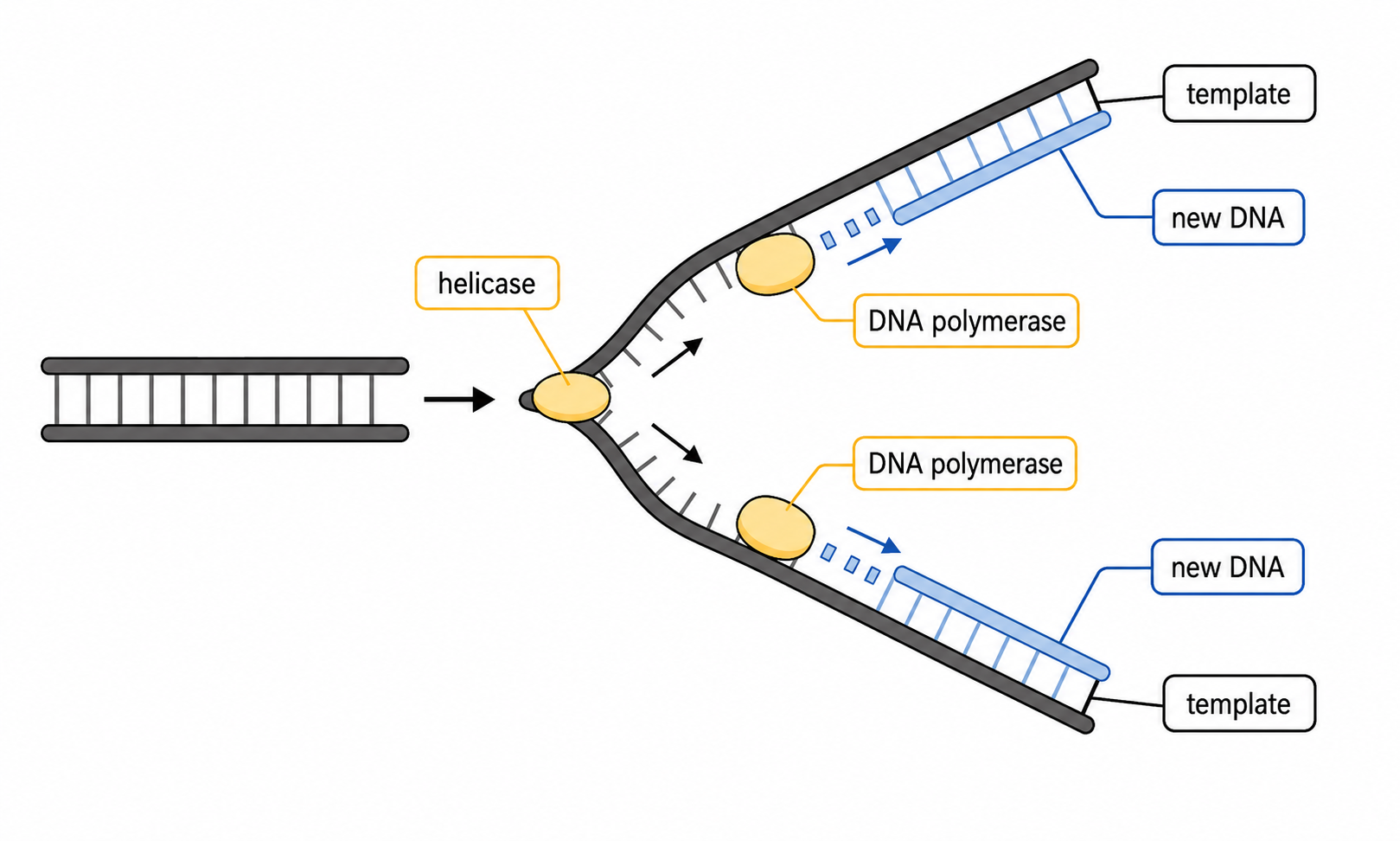
At the replication fork, helicase unwinds DNA by breaking hydrogen bonds between the two strands. DNA polymerase then joins complementary nucleotides to build new strands, using base pairing to copy the original templates accurately.

Helicase unwinds DNA and breaks hydrogen bonds between strands.
DNA polymerase joins complementary nucleotides to build new strands.
Base pairing links the enzyme action to accuracy.

Open the template first, then build the complementary strand.

Label the enzyme jobs at the replication fork.

Label
Labels
4

Label the enzyme jobs at the replication fork.

Choose

Amplify Then Separate DNA

Practice

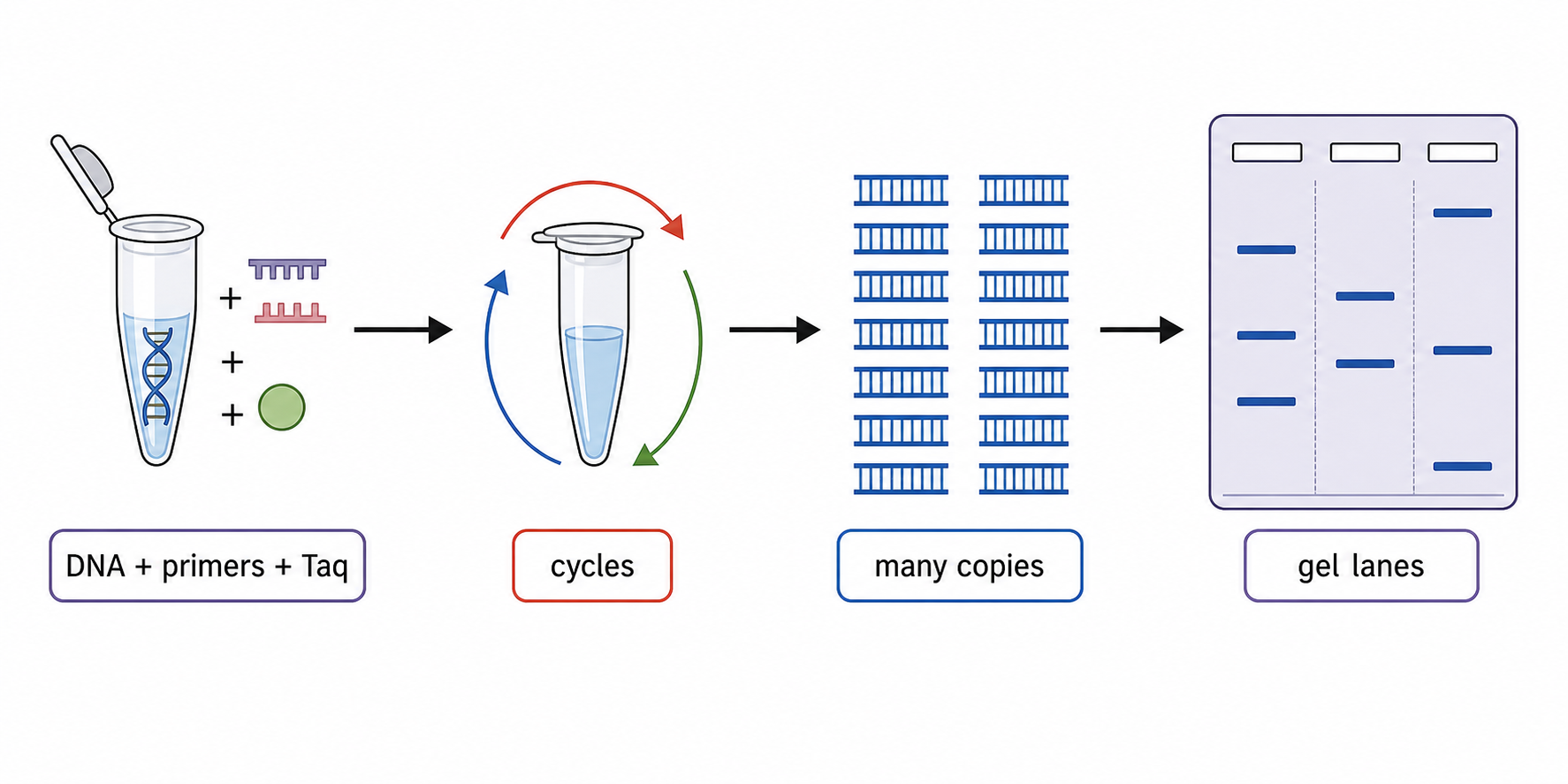
PCR and gel electrophoresis are a workflow, not the same technique. PCR amplifies a selected DNA sequence using primers, temperature cycles, and Taq polymerase; gel electrophoresis then separates DNA fragments by size and charge, with smaller fragments moving further through the gel.

PCR amplifies selected DNA using primers, temperature cycles, and Taq polymerase.
Gel electrophoresis separates DNA fragments by size and charge.
PCR answers how to make enough DNA; gel electrophoresis answers how to compare fragment patterns.

Amplify first, then separate and compare.

Put the DNA analysis workflow in order.

Order
1
compare band patterns
2
choose target DNA sequence
3
load DNA fragments into gel
4
add primers and Taq polymerase
5
cycle temperatures to amplify DNA
6
separate fragments by size and charge

Put the DNA analysis workflow in order.

Choose
choose target DNA sequence
add primers and Taq polymerase
cycle temperatures to amplify DNA
load DNA fragments into gel
separate fragments by size and charge
compare band patterns

Use DNA Profiles in Real Cases

Practice

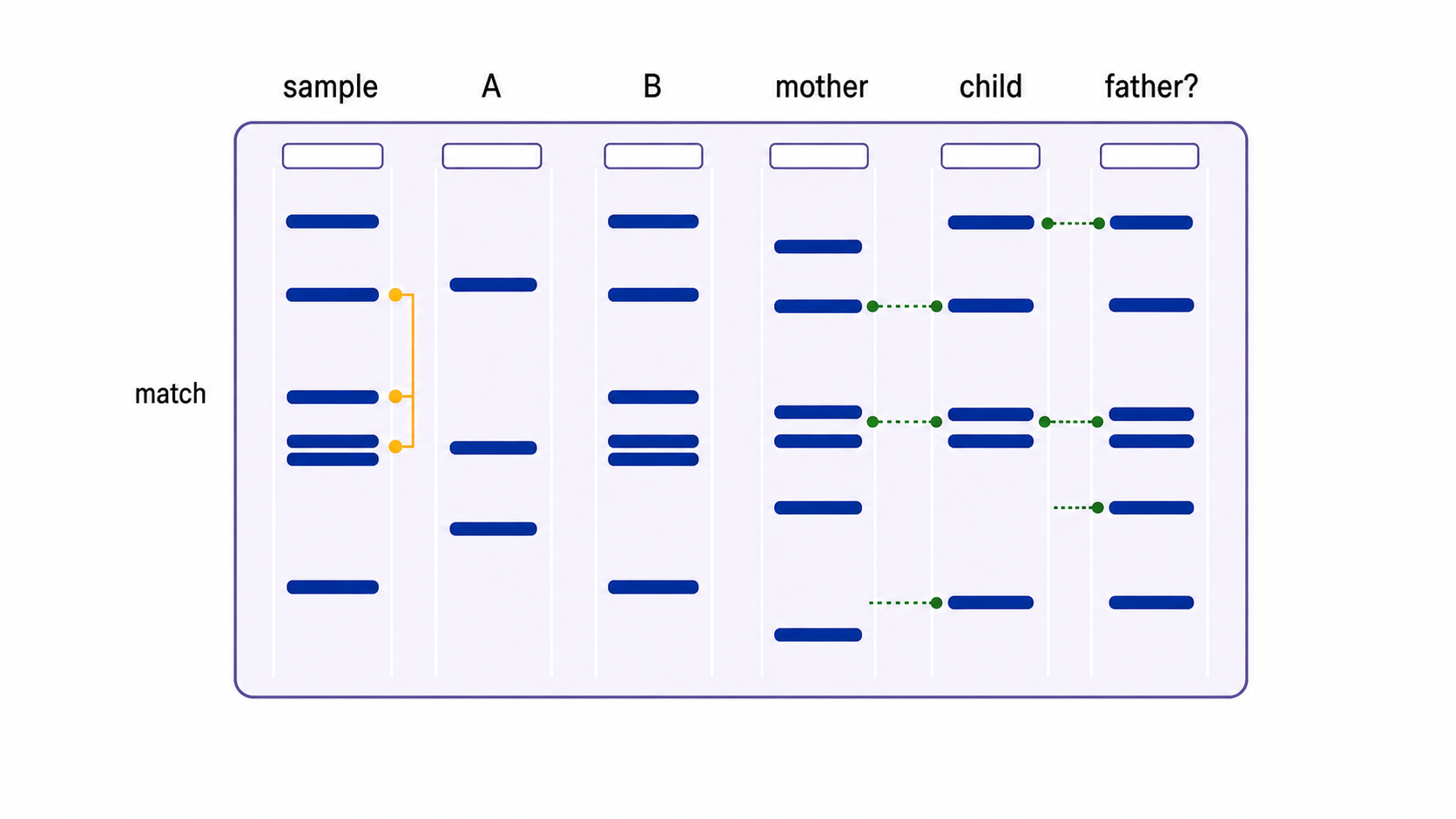
DNA profiling uses PCR and gel electrophoresis to compare DNA fragment patterns. In forensic identification, a sample profile can be compared with suspect profiles; in paternity testing, a child's bands should be explainable by inheritance from the biological parents.

PCR and gel electrophoresis support DNA profiling.
Applications include forensic identification and paternity testing.
Band patterns are evidence that must be compared carefully.

DNA profiles use band-pattern evidence.

Compare the band patterns in two DNA profiles.

Compare
A
Suspect A shares all sample bands.
B
Suspect B is missing two sample bands.
Which profile is stronger evidence for a match, and what caution should be remembered?

Compare the band patterns in two DNA profiles.

Choose
Models
Suspect A shares all sample bands.Suspect B is missing two sample bands.

Transfer: Explain Core DNA Replication

Exam Practice

DNA replication produces exact DNA copies before cell division and maintains genetic continuity for reproduction, growth, and tissue replacement. Semi-conservative replication gives each new DNA molecule one original strand and one new strand; complementary base pairing and Meselson-Stahl isotope evidence support the model. Helicase unwinds DNA and breaks hydrogen bonds; DNA polymerase joins complementary nucleotides to build new strands. PCR amplifies selected DNA using primers, temperature cycles, and Taq polymerase; gel electrophoresis separates DNA fragments by size and charge. PCR and gel electrophoresis support DNA profiling for forensic identification and paternity testing.

DNA replication produces exact DNA copies before cell division and maintains genetic continuity for reproduction, growth, and tissue replacement.
Semi-conservative replication gives each new DNA molecule one original strand and one new strand; complementary base pairing and Meselson-Stahl isotope evidence support the model.
Helicase unwinds DNA and breaks hydrogen bonds; DNA polymerase joins complementary nucleotides to build new strands.
PCR amplifies selected DNA using primers, temperature cycles, and Taq polymerase; gel electrophoresis separates DNA fragments by size and charge.
PCR and gel electrophoresis support DNA profiling for forensic identification and paternity testing.

Put the answer frame in order.

Order
1
assign helicase and DNA polymerase roles
2
state why DNA must replicate before cell division
3
apply DNA profiles to forensic or paternity evidence
4
separate PCR amplification from gel electrophoresis separation
5
explain semi-conservative replication using old and new strands

Use this for SL/core questions about DNA copying, semi-conservative replication, helicase/polymerase roles, PCR, gel electrophoresis, and DNA profiling.

DNA replication produces exact DNA copies before cell division and maintains genetic continuity for reproduction, growth, and tissue replacement.
Semi-conservative replication gives each new DNA molecule one original strand and one new strand; complementary base pairing and Meselson-Stahl isotope evidence support the model.
Helicase unwinds DNA and breaks hydrogen bonds; DNA polymerase joins complementary nucleotides to build new strands.
PCR amplifies selected DNA using primers, temperature cycles, and Taq polymerase; gel electrophoresis separates DNA fragments by size and charge.
PCR and gel electrophoresis support DNA profiling for forensic identification and paternity testing.

Use this for SL/core questions about DNA copying, semi-conservative replication, helicase/polymerase roles, PCR, gel electrophoresis, and DNA profiling.

Common loss: saying DNA copies itself without explaining semi-conservative copying, enzyme roles, or the difference between PCR and gel electrophoresis.