
Recognize an Enzyme Catalyst
Enzymes are mostly protein biological catalysts, with some RNA examples. They speed up reactions in small amounts and remain unchanged after catalysis, so cells can run reactions quickly without using up the enzyme.
Which statement best describes an enzyme catalyst?
ChooseDefine Metabolism
Metabolism is all enzyme-controlled chemical reactions in cells. Specific enzymes control which metabolic reactions occur and when, so metabolism is not random chemistry; it is coordinated pathway control.
Which is the best definition of metabolism?
ChooseSort Anabolism and Catabolism
PracticeMetabolism includes anabolism and catabolism. Anabolism builds complex molecules from smaller ones, often by condensation, and requires energy. Catabolism breaks molecules down by hydrolysis or oxidation and releases energy.
Sort each reaction clue.
SortInspect an Active Site
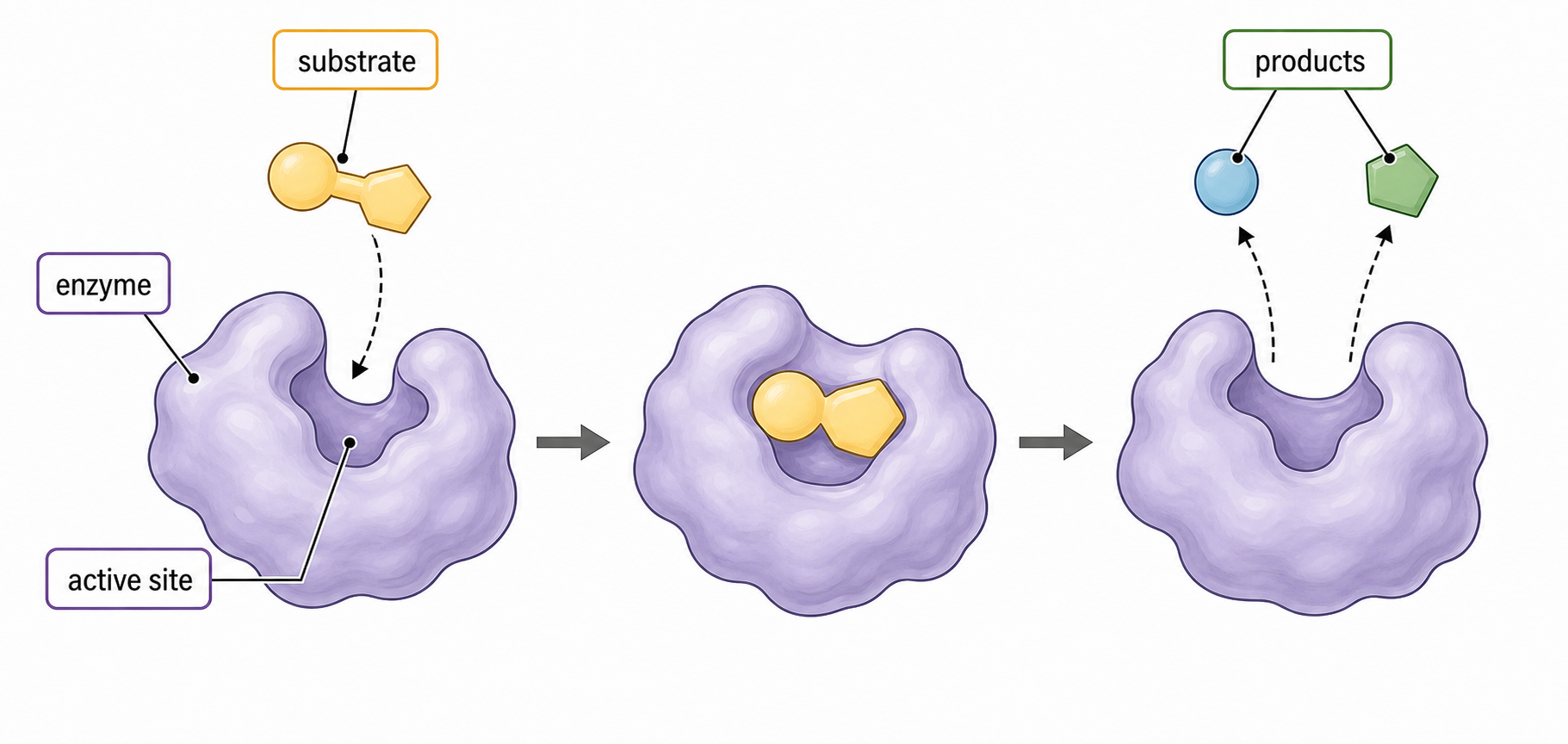
Enzymes are usually globular proteins with a small active-site pocket. The active site binds the substrate, forms an enzyme-substrate complex, and catalyses the reaction. Active-site shape and chemistry are why enzymes are specific.
The folded protein creates the pocket that does the chemistry.
Which statement best links active site to function?
ChooseWhich statement best links active site to function?
ChooseExplain Induced Fit
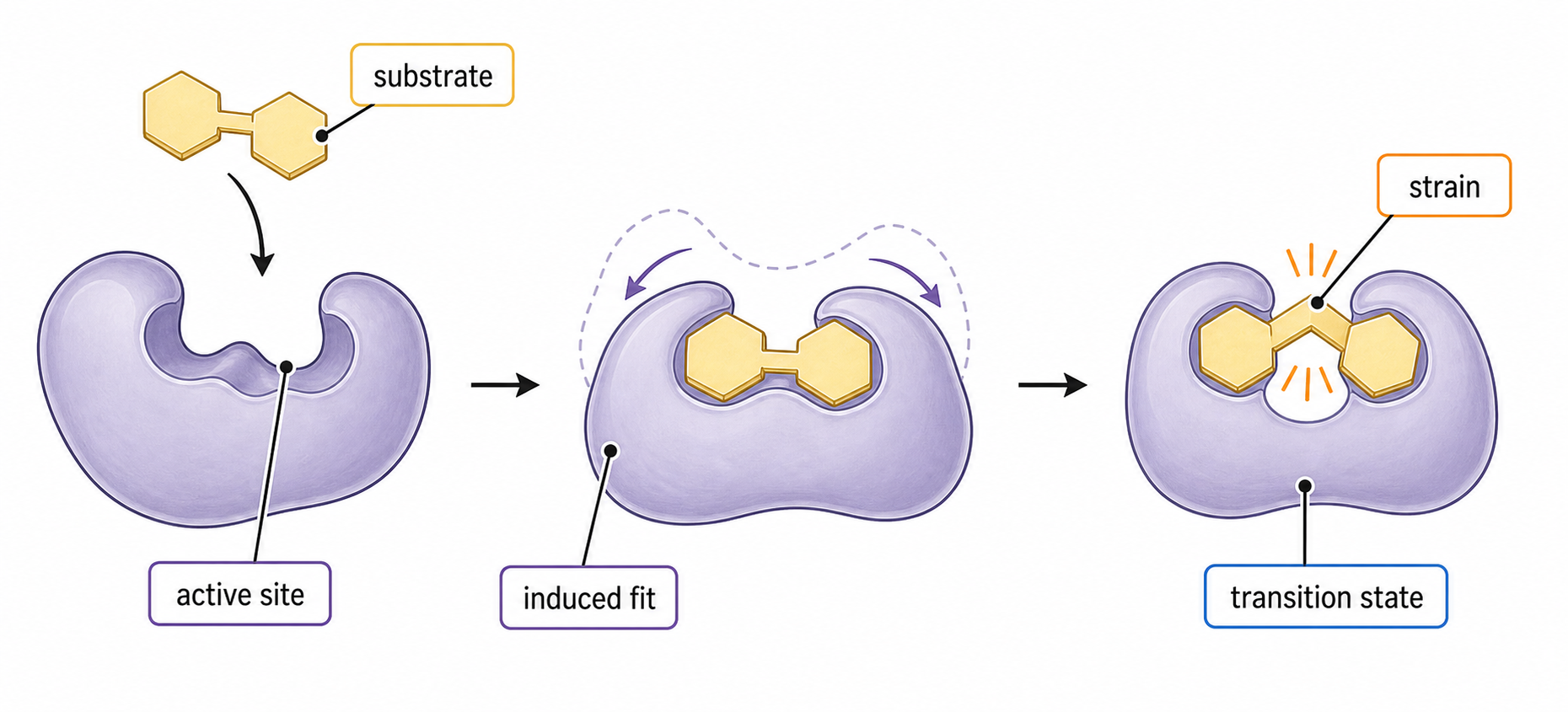
In induced fit, substrate binding causes shape changes in both enzyme and substrate. This aligns catalytic groups and raises the substrate toward the transition state, making reaction more likely.
Binding helps create the best catalytic fit rather than matching a rigid template from the start.
Order induced-fit catalysis.
OrderOrder induced-fit catalysis.
ChoosePredict Collision Rate
PracticeMolecular motion brings substrates and active sites into collision. Higher kinetic energy can increase successful active-site collisions, but only up to the point where enzyme structure remains intact.
Why can a moderate temperature rise increase enzyme reaction rate?
ChooseLink Shape to Specificity
PracticeActive-site amino acid arrangement determines substrate specificity. Denaturation changes tertiary structure and active-site shape, reducing activity; it does not usually break peptide bonds in the primary structure.
What usually happens when an enzyme is denatured?
ChooseRead Enzyme Rate Curves
Practice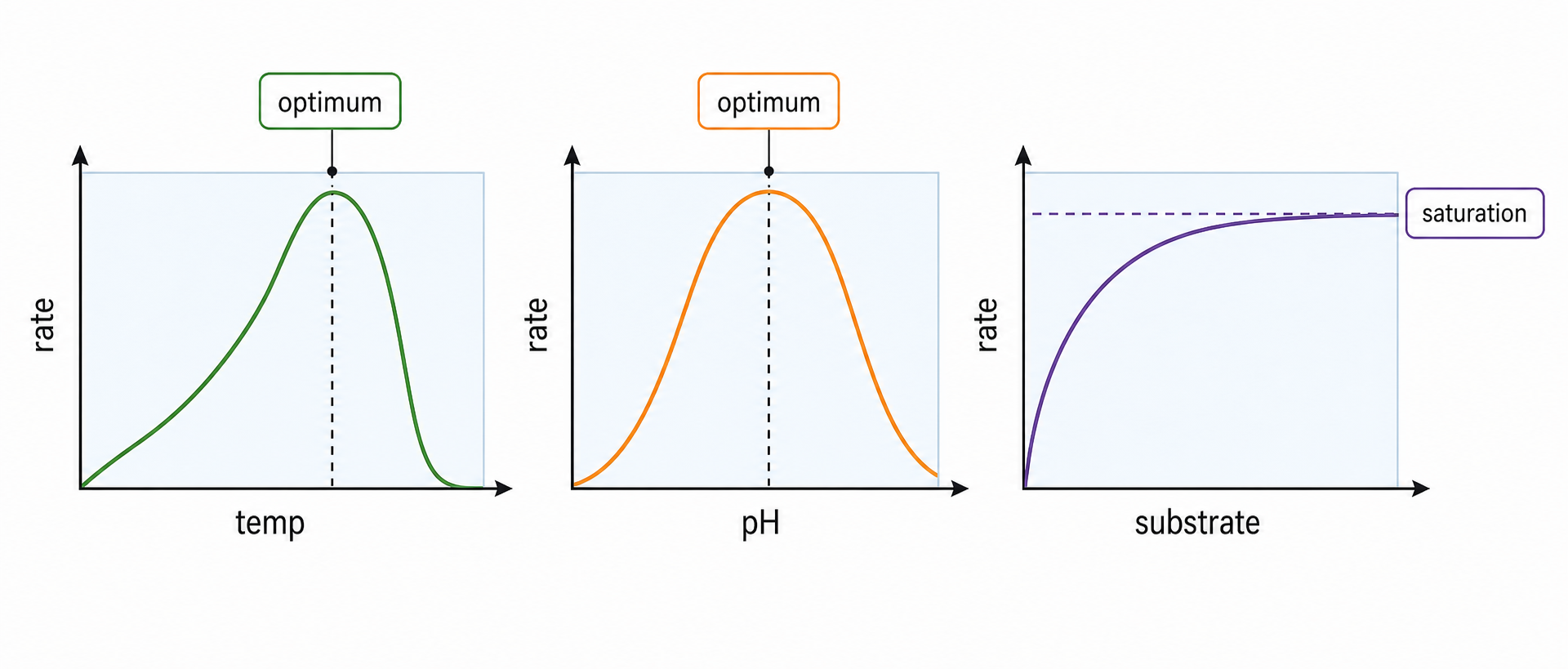
Temperature, pH, and substrate concentration change enzyme activity in different ways. Temperature increases rate to an optimum, then denaturation lowers activity. pH changes bonding in the active site. Substrate concentration increases rate until active sites are saturated and the curve plateaus.
The graph shape tells you the mechanism.
Match each curve pattern to its mechanism.
MatchMatch each curve pattern to its mechanism.
ChoosePlan an Enzyme Assay
PracticeEnzyme reaction rate can be measured by substrate loss or product formation per unit time. Good assays use initial rate, replicates, controls, and graphs. Examples include amylase assays tracking starch loss or catalase assays tracking oxygen production.
Sort each assay feature by purpose.
SortCompare Activation Energy
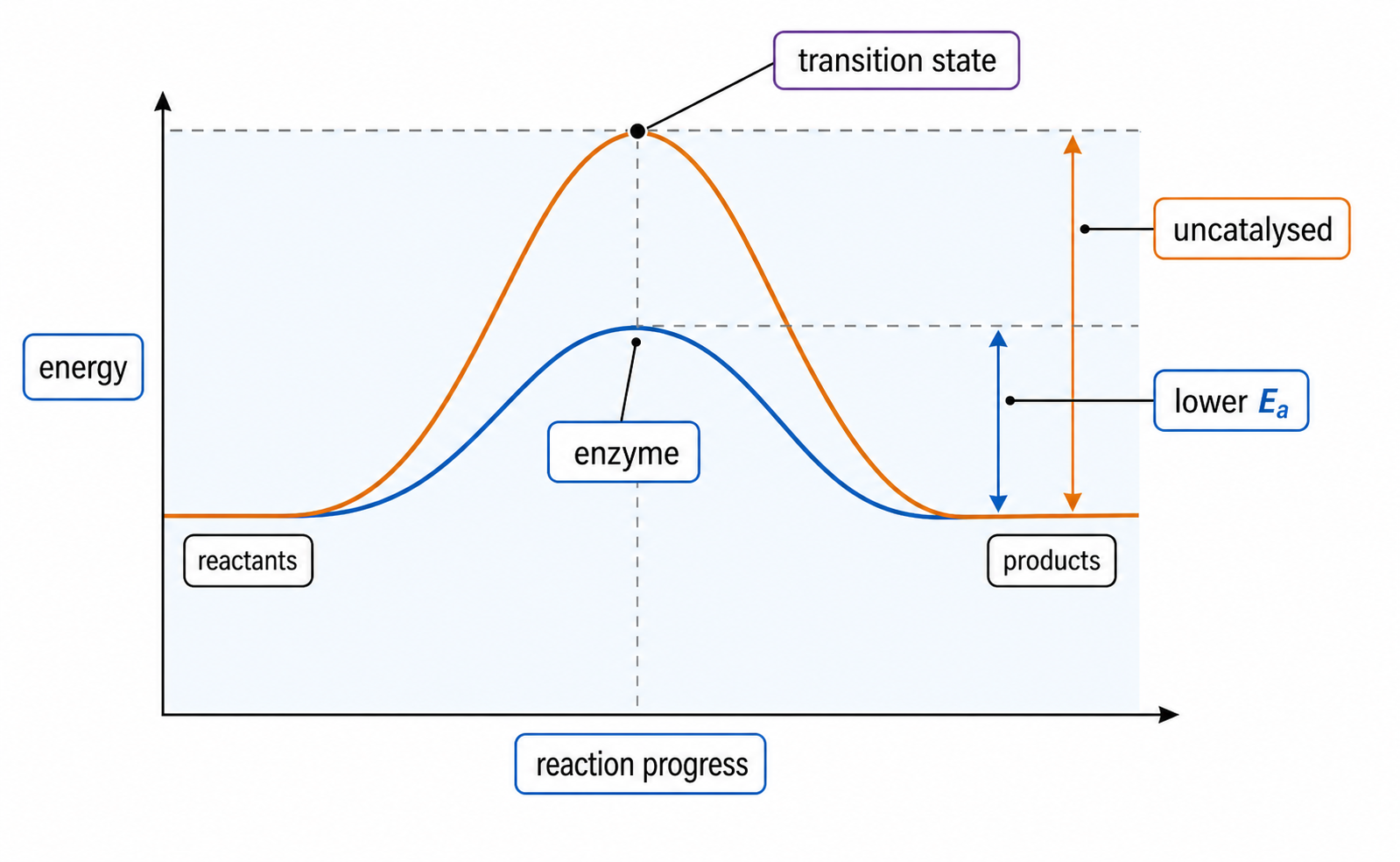
Enzymes lower activation energy by providing an alternative pathway and stabilizing the transition state. They do not remove the energy barrier completely, and they do not change the overall energy difference between reactants and products.
The enzyme changes the route, not the starting and ending energy levels.
What does an enzyme change on an energy profile?
ChooseWhat does an enzyme change on an energy profile?
ChooseSL Transfer: Explain Enzyme Catalysis And Rate
Exam PracticeEnzymes are biological catalysts that lower activation energy and remain unchanged. Their globular protein shape creates active-site specificity; induced fit aligns substrates; molecular motion and collisions affect rate; temperature, pH, and substrate concentration change activity; assays measure substrate loss or product formation over time.
Use this for core questions on enzyme definition, metabolism, active sites, induced fit, rate curves, enzyme assays, and activation energy.
Use this for core questions on enzyme definition, metabolism, active sites, induced fit, rate curves, enzyme assays, and activation energy.
Do not write isolated enzyme terms without explaining active-site shape, activation energy, or rate mechanism.