
Explain Why Gas Exchange Needs Specialized Surfaces
Gas exchange is the exchange of respiratory gases between an organism and its environment. Animals take in oxygen for aerobic respiration and release carbon dioxide. Small organisms can often rely on diffusion across the body surface, but larger or more active organisms need specialized exchange surfaces because surface area-to-volume ratio decreases and demand for oxygen increases.
Sort each statement into ventilation, gas exchange, or cell respiration.
SortInspect Efficient Gas-Exchange Surfaces
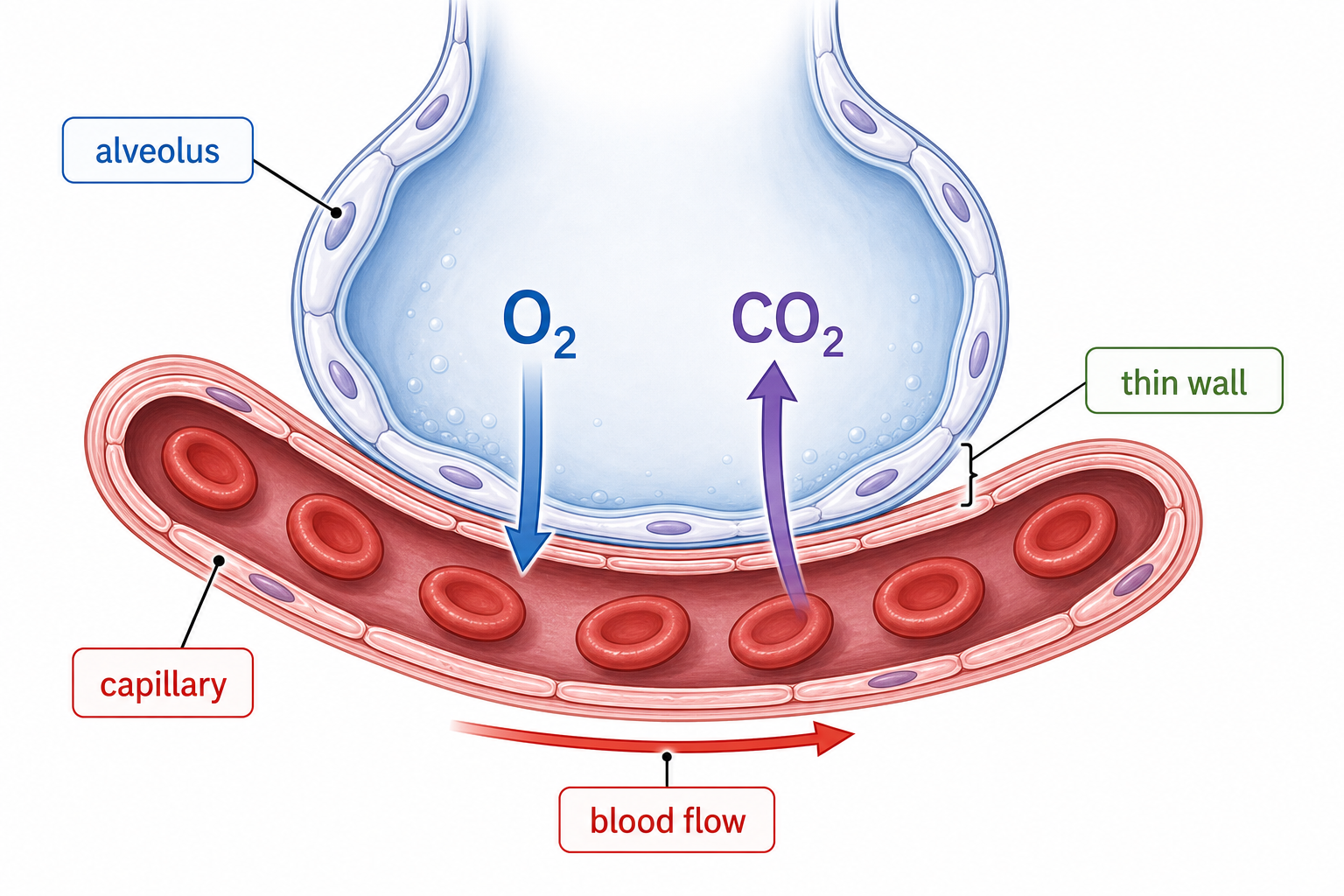
Efficient gas-exchange surfaces all solve the same diffusion problem. They are permeable so gases can cross, thin so the diffusion path is short, moist so gases dissolve, large so more gas can cross at once, and supplied with a steep concentration gradient.
Use the picture to connect each surface feature to a faster diffusion step.
Match each gas-exchange surface feature to the diffusion advantage.
MatchMatch each gas-exchange surface feature to the diffusion advantage.
ChooseMaintain the Diffusion Gradient
Diffusion slows if the gradient disappears, so gas-exchange systems keep gradients steep. Ventilation refreshes air or water at the exchange surface, while continuous blood flow carries oxygen away and brings carbon dioxide toward the surface. Dense capillary networks add exchange area and keep red blood cells close to the surface.
Order the gradient-maintenance story for oxygen in alveoli.
OrderInspect Mammalian Lung Adaptations
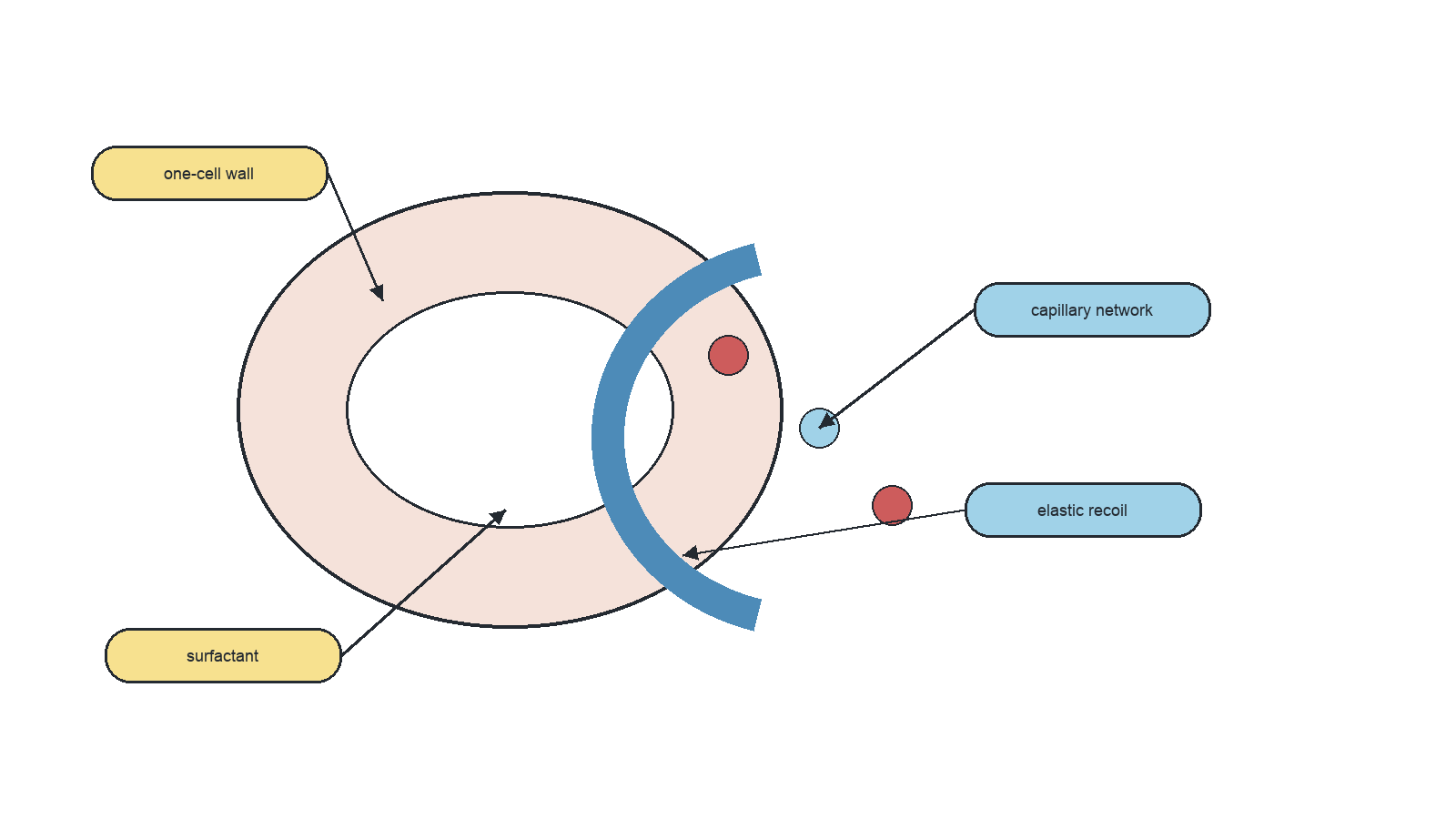
Mammalian lungs are adapted for fast gas exchange. Many small alveoli provide a large surface area; type I pneumocytes and capillary walls are thin for a short diffusion path; dense capillary beds maintain gradients and bring red blood cells close; surfactant reduces surface tension; elastic fibres support ventilation and recoil.
Read the alveolus as a set of linked diffusion and ventilation adaptations, not as a label list.
Match each alveolar feature to its gas-exchange role.
MatchMatch each alveolar feature to its gas-exchange role.
ChooseTrace Inspiration and Expiration
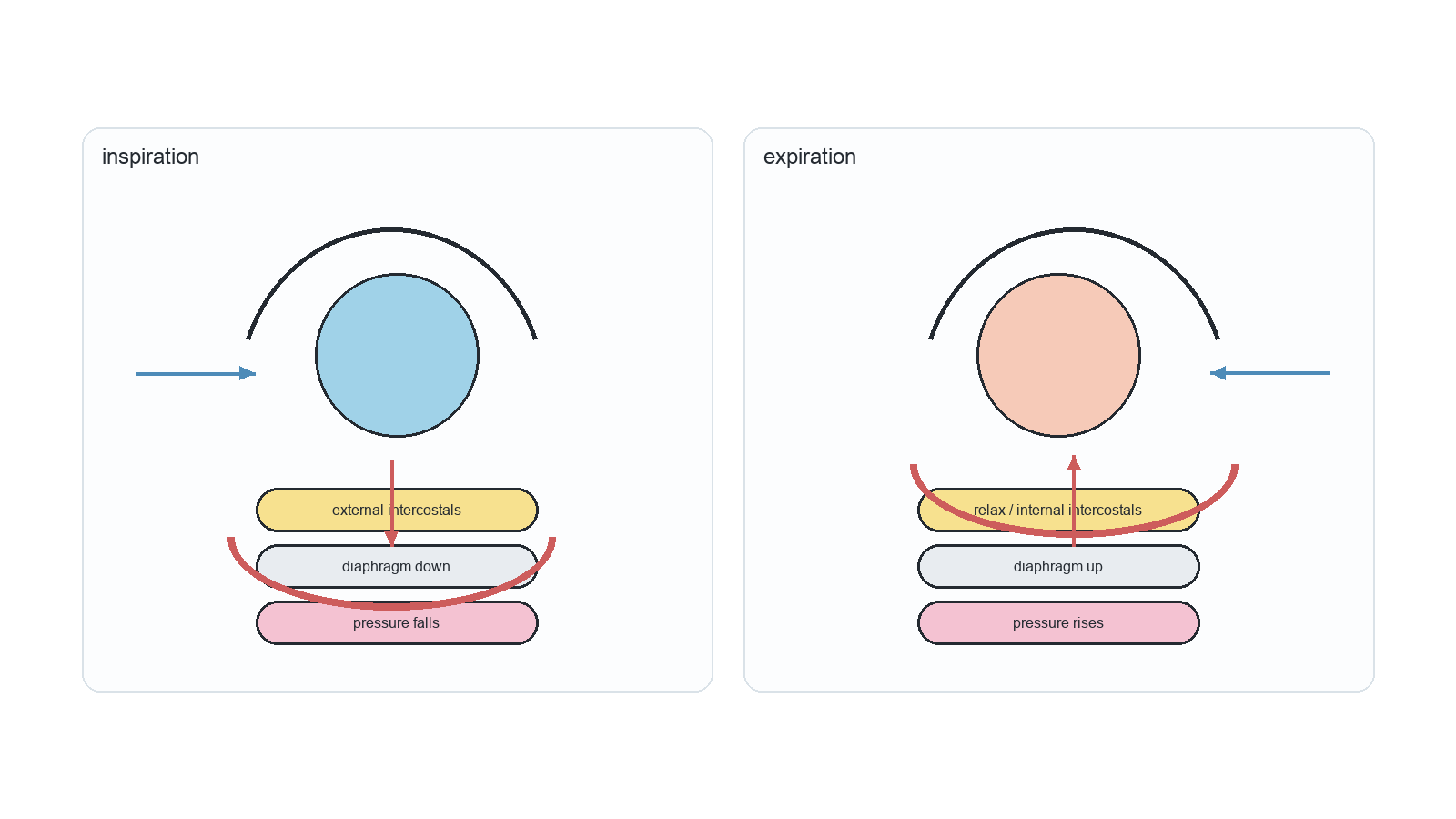
Ventilation changes thoracic volume and pressure. During inspiration, the diaphragm and external intercostal muscles contract, increasing thoracic volume and lowering pressure, so air moves in. During expiration, thoracic volume decreases; relaxed breathing is mostly passive, while internal intercostals and abdominal muscles help forced exhalation.
Track muscle action first, then volume, then pressure, then airflow direction.
Order the events of inspiration.
OrderOrder the events of inspiration.
ChooseRead Spirometry Measures
PracticeSpirometry records breathing patterns, ventilation rate, and lung volumes. Tidal volume is the air moved during normal relaxed breathing. Vital capacity equals tidal volume plus inspiratory reserve volume plus expiratory reserve volume. During exercise, tidal volume and ventilation rate usually increase to meet oxygen demand and remove carbon dioxide.
A student breathes deeper and faster during exercise. Which explanation is best?
ChooseBalance Leaf Gas Exchange and Water Loss
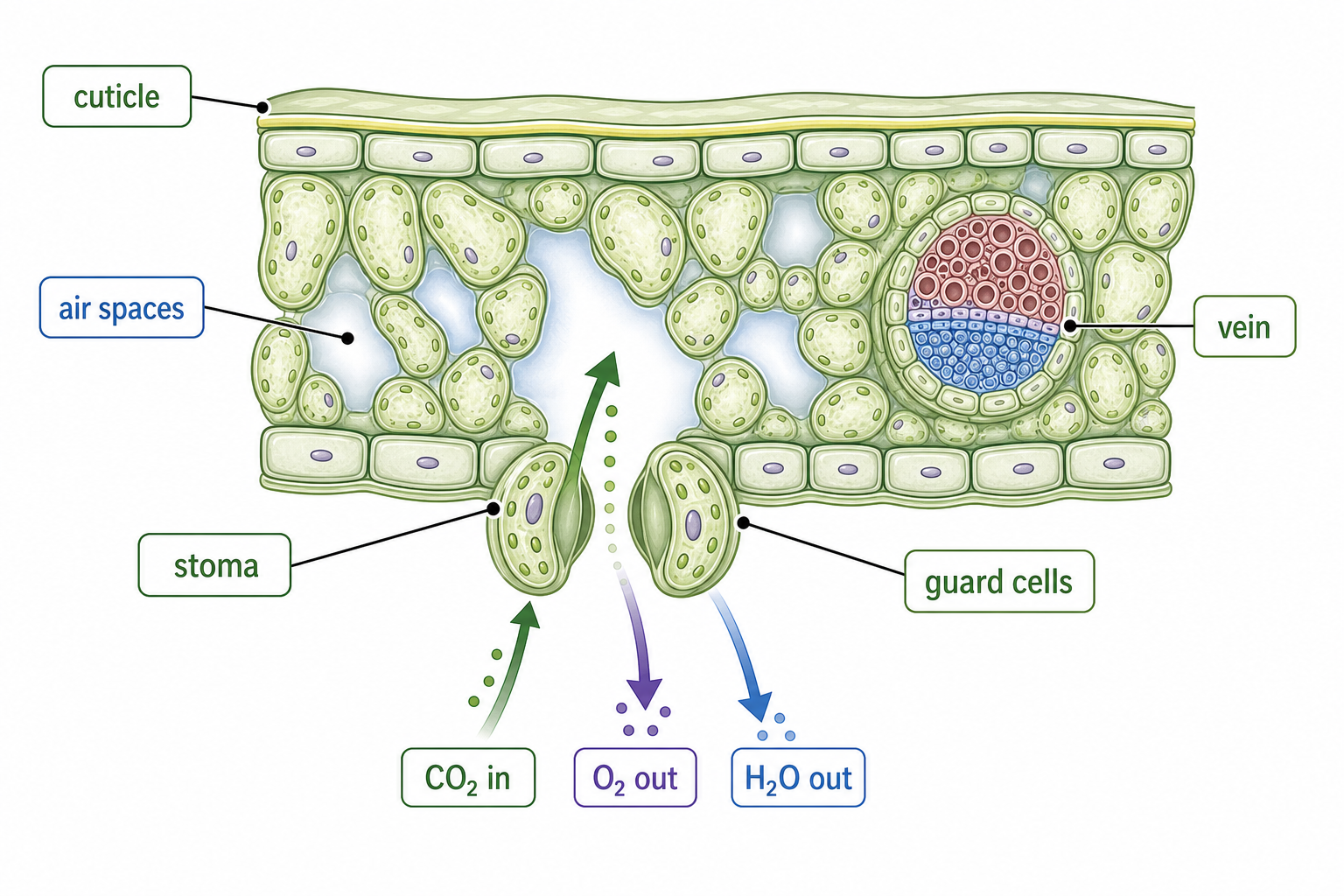
Leaves must exchange gases for photosynthesis and respiration while limiting water loss. Stomata allow carbon dioxide, oxygen, and water vapour to diffuse. Guard cells open and close stomata by changing turgor. Waxy cuticle, lower epidermal stomata, air spaces, mesophyll, and veins help balance gas exchange with transpiration.
A leaf must let carbon dioxide in for photosynthesis while limiting uncontrolled water loss.
Sort each leaf feature by its main role.
SortSort each leaf feature by its main role.
ChooseInspect a Dicot Leaf Cross-Section
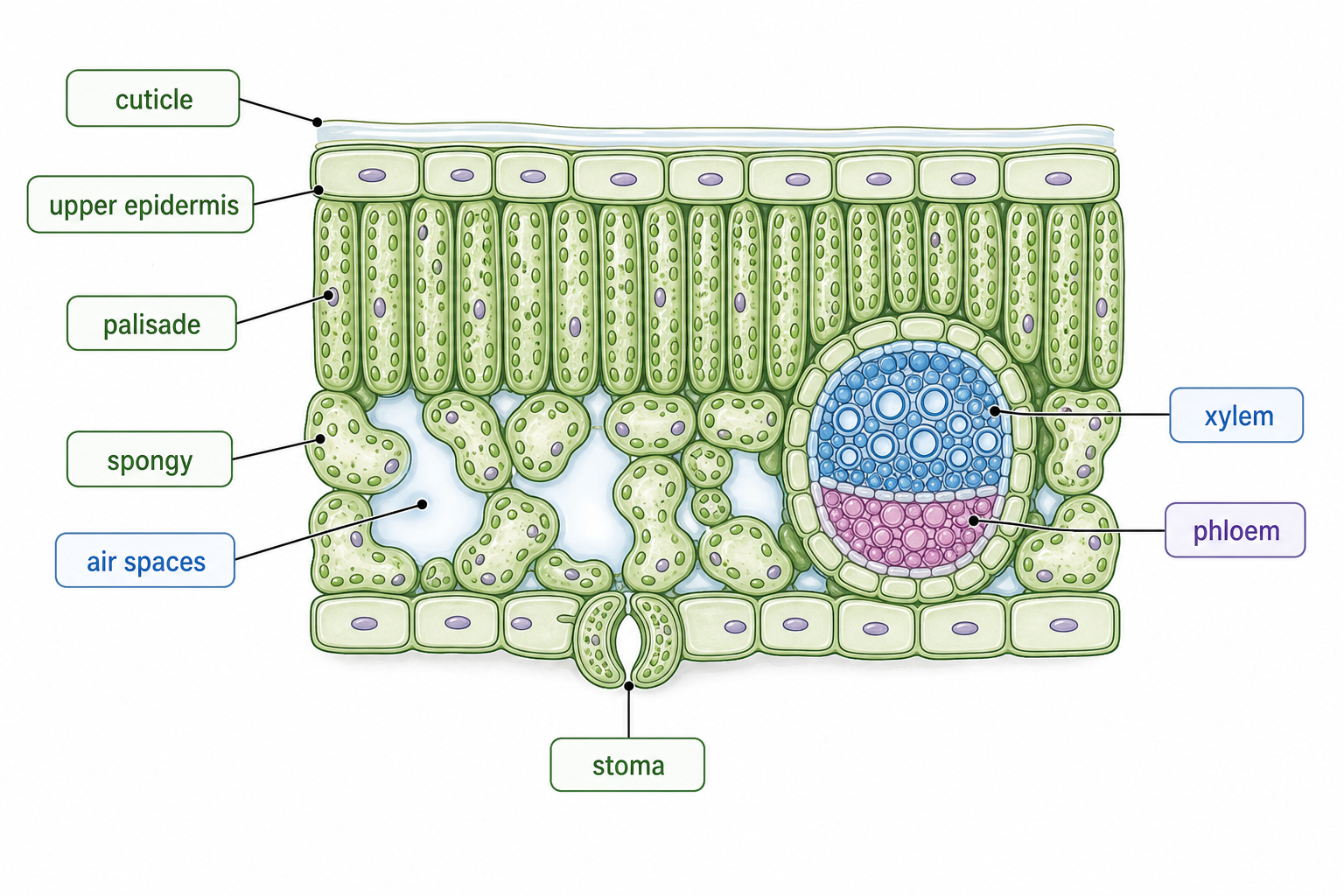
A dicot leaf cross-section has a functional distribution of tissues. Waxy cuticle and epidermis protect the leaf; palisade mesophyll is packed for photosynthesis; spongy mesophyll has air spaces for diffusion; vascular bundles contain xylem for water transport and phloem for assimilate transport; stomata connect internal air spaces with the atmosphere.
Use tissue position to explain both diffusion path and transport support.
Match each dicot leaf tissue to its function.
MatchMatch each dicot leaf tissue to its function.
ChoosePredict Transpiration Changes
PracticeTranspiration is water loss from leaves: water evaporates from mesophyll cell walls, then water vapour diffuses out through stomata. Temperature, humidity, wind, and light change the rate by affecting evaporation, water-vapour gradients, air movement, and stomatal opening. Potometers estimate transpiration indirectly by measuring water uptake.
Under which conditions would transpiration be greatest?
ChooseCompare Stomatal Density Data
PracticeStomatal density is the number of stomata per unit leaf area. Higher stomatal density can increase carbon dioxide uptake but also increases potential water loss. Leaf casts or micrographs allow stomatal counts; reliability improves by sampling multiple areas or leaves and calculating a mean.
Which method gives a more reliable estimate of stomatal density?
ChooseCore Transfer: Explain Gas Exchange Across Animals And Leaves
Exam PracticeCore gas-exchange answers link exchange surfaces to diffusion gradients. For animals, exchange surfaces are explained by diffusion properties, ventilation, and blood flow. For plants, leaves allow carbon dioxide entry and oxygen/water vapour exit while controlling water loss through stomata. Spirometry, transpiration, and stomatal density data provide evidence of gradient and surface-area effects.
Use this for core questions on gas-exchange surfaces, alveoli, ventilation, spirometry, leaves, transpiration, and stomatal density.
Use this for core questions on gas-exchange surfaces, alveoli, ventilation, spirometry, leaves, transpiration, and stomatal density.
Do not list adaptations without explaining diffusion distance, surface area, moisture, gradient maintenance, or water-loss trade-off.