
Build The Bilayer From Amphipathic Lipids
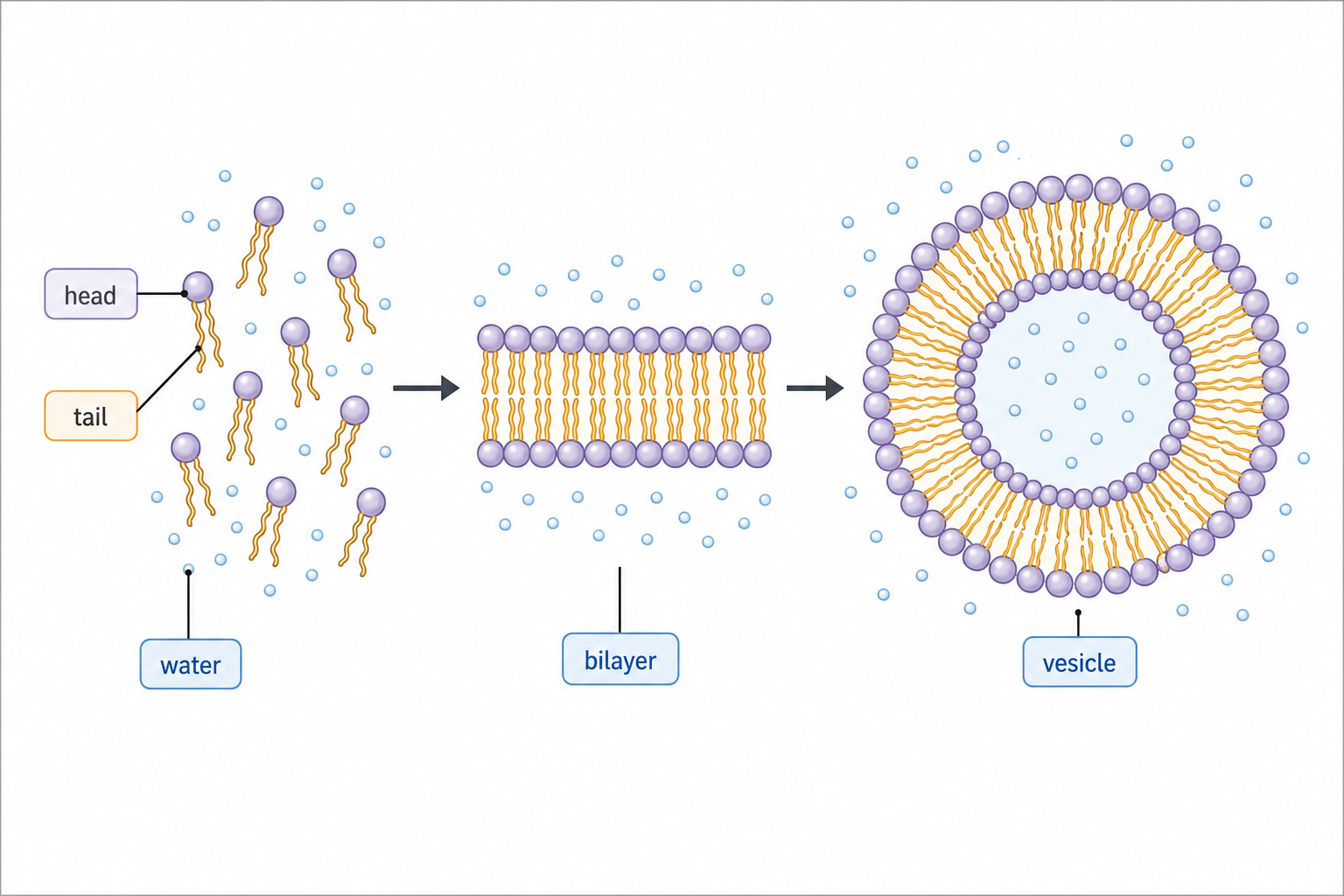
Membranes begin with amphipathic phospholipids: hydrophilic heads interact with water and hydrophobic tails avoid water. In water, this automatically drives phospholipids into continuous closed bilayers, with heads outward and tails inward. That bilayer is the structural basis of plasma membranes and vesicles.
Bilayer structure comes directly from the amphipathic phospholipid design.
Match each phospholipid part to its water relationship.
MatchMatch each phospholipid part to its water relationship.
ChooseExplain Why Bilayers Are Selective Barriers
The hydrophobic fatty acid tails create a stable membrane core. That core has low permeability to ions and to large or hydrophilic molecules, because charged or polar particles cannot easily pass through the non-polar interior. This is why membranes can separate aqueous compartments and control entry and exit.
Sort substances by whether the bilayer core lets them pass easily.
SortTrack Simple Diffusion
Practice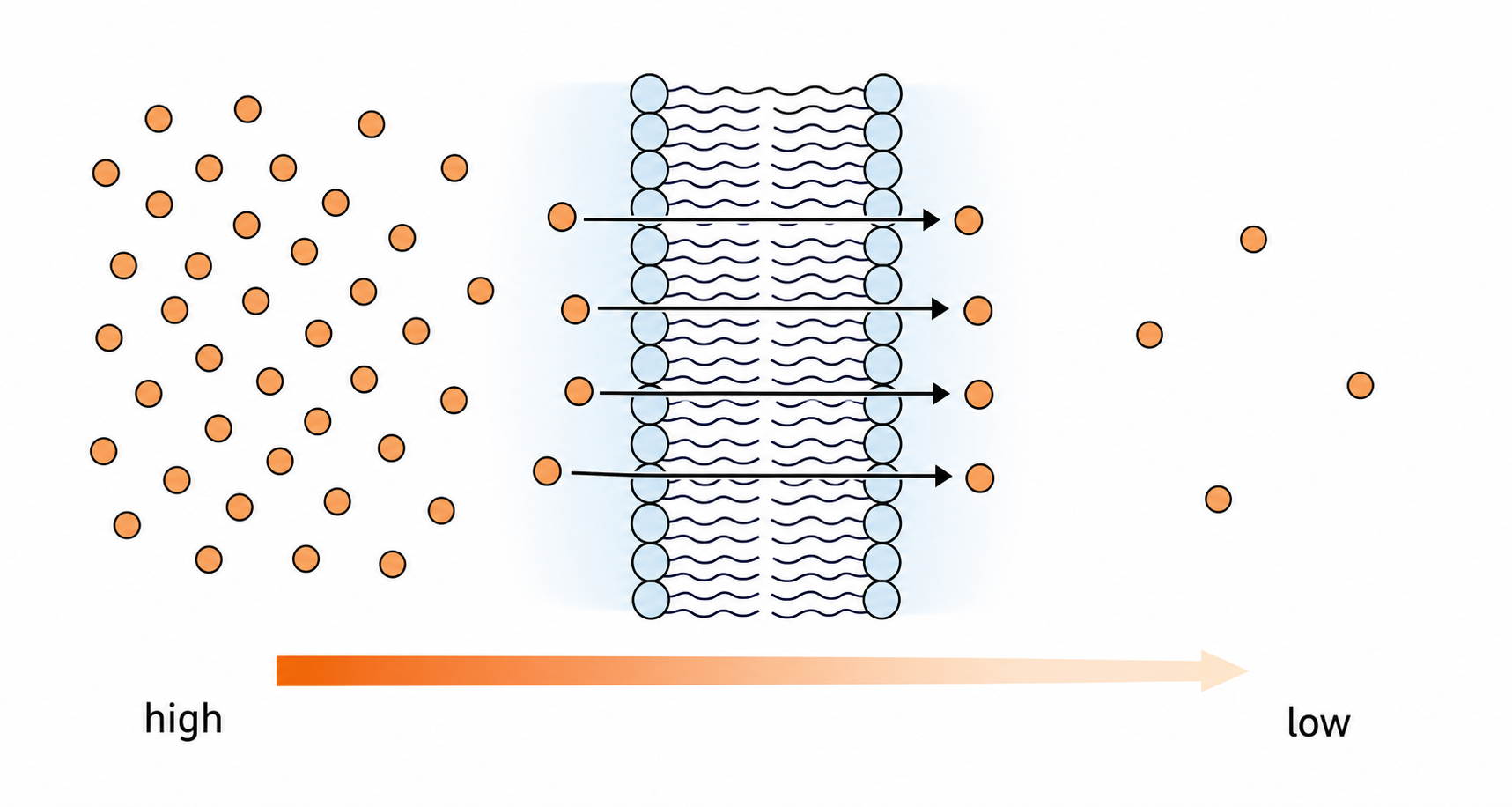
Diffusion is passive movement down a concentration gradient using the particles’ own kinetic energy. Small non-polar molecules such as oxygen and carbon dioxide can diffuse directly through the bilayer. The rate depends on gradient steepness, diffusion distance, surface area, and temperature.
Which condition gives the fastest simple diffusion?
ChoosePlace Integral And Peripheral Proteins
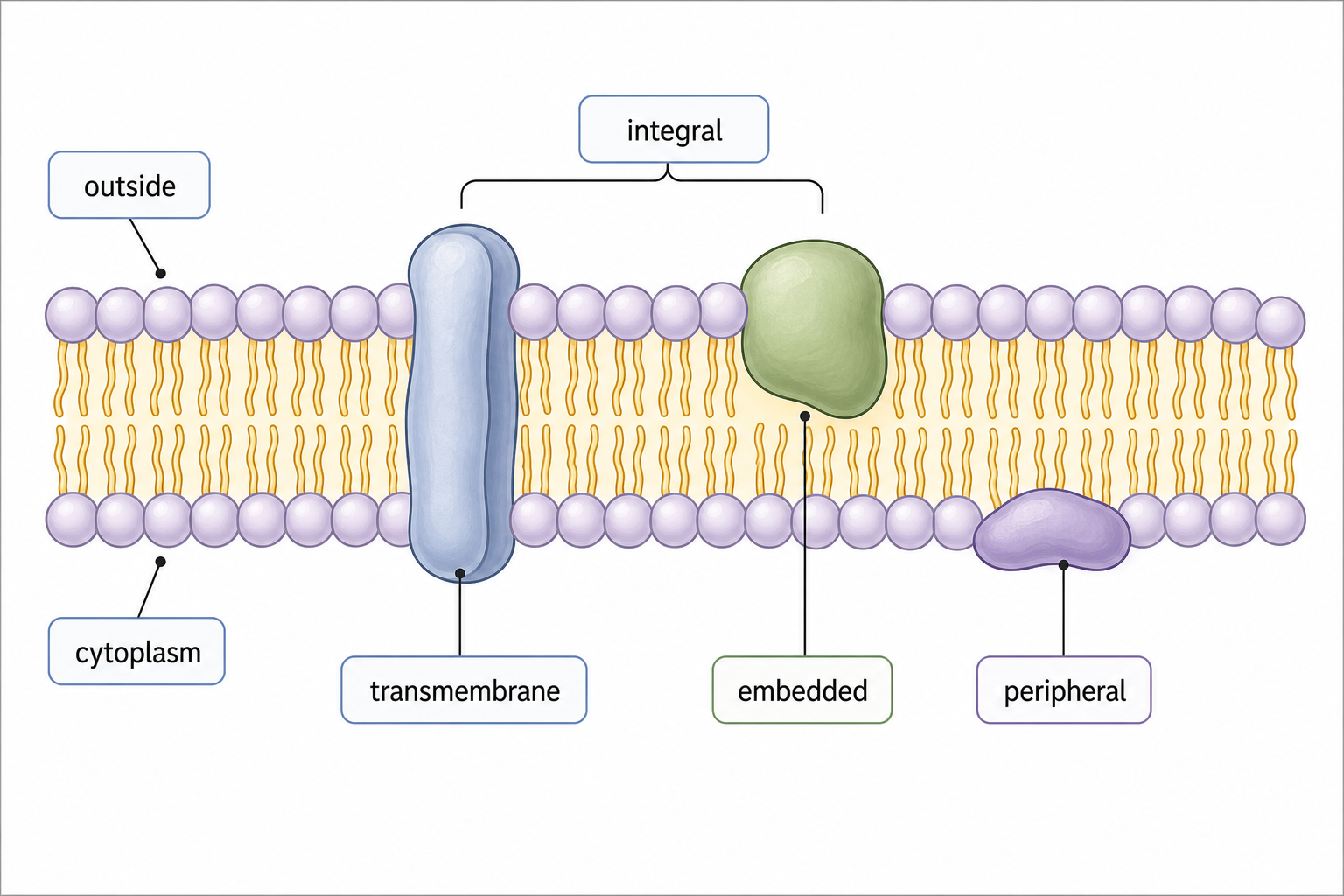
Membrane proteins solve jobs the lipid bilayer cannot do alone. Integral proteins are embedded in one or both lipid layers and may span the membrane; they can act as channels, carriers, pumps, receptors, enzymes, or antigens. Peripheral proteins attach to membrane surfaces and often act as receptors, scaffolds, or support proteins.
Protein position helps predict membrane function.
Sort membrane protein roles by likely protein type.
SortSort membrane protein roles by likely protein type.
ChoosePredict Osmosis And Aquaporins
Practice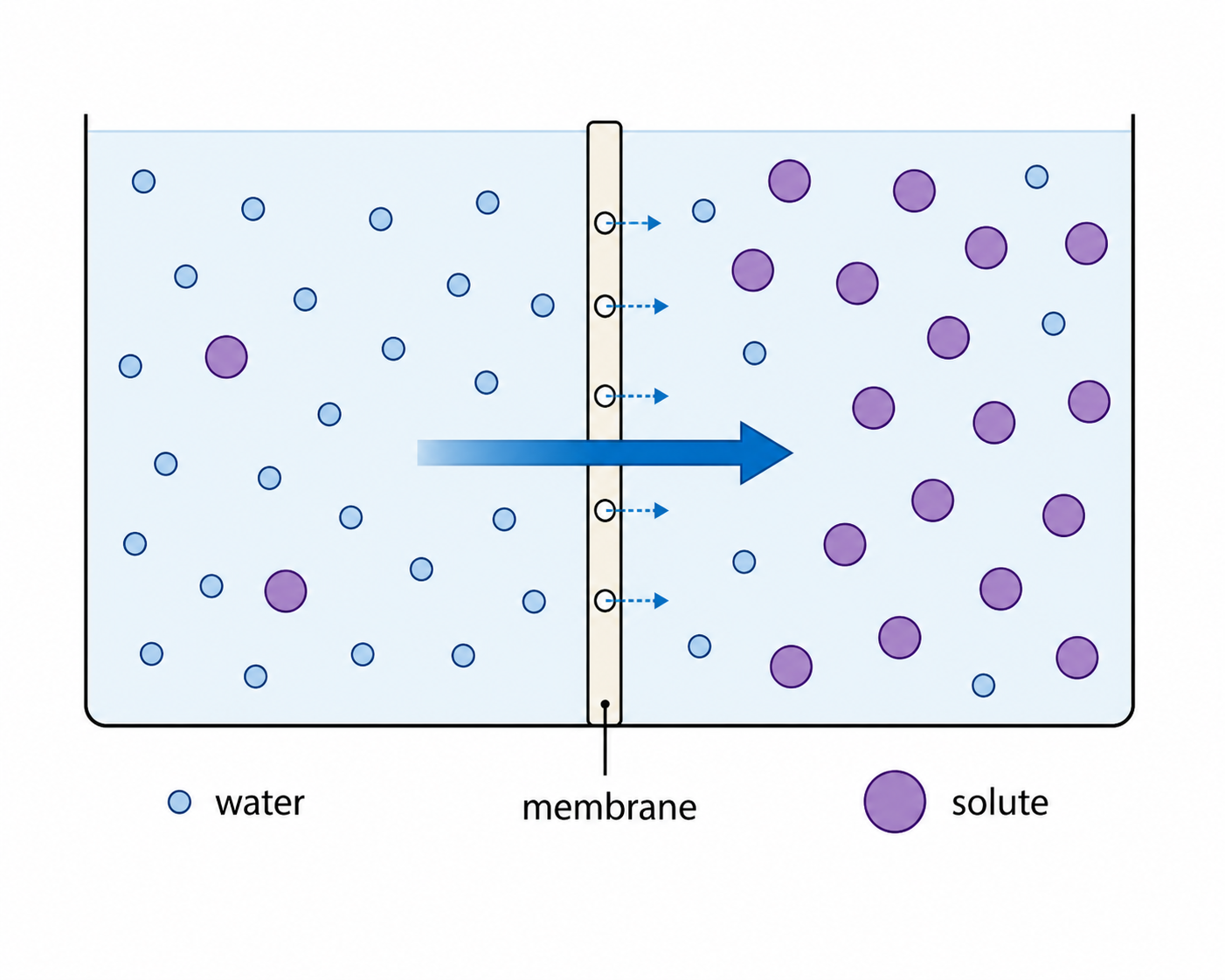
Osmosis is the passive net movement of water across a partially permeable membrane. Water moves from lower solute concentration to higher solute concentration, because the side with more solute has lower water availability. Aquaporins are protein pores that increase water diffusion across membranes.
A cell is placed in a solution with higher solute concentration outside. Predict water movement.
PredictChoose Channels For Facilitated Diffusion
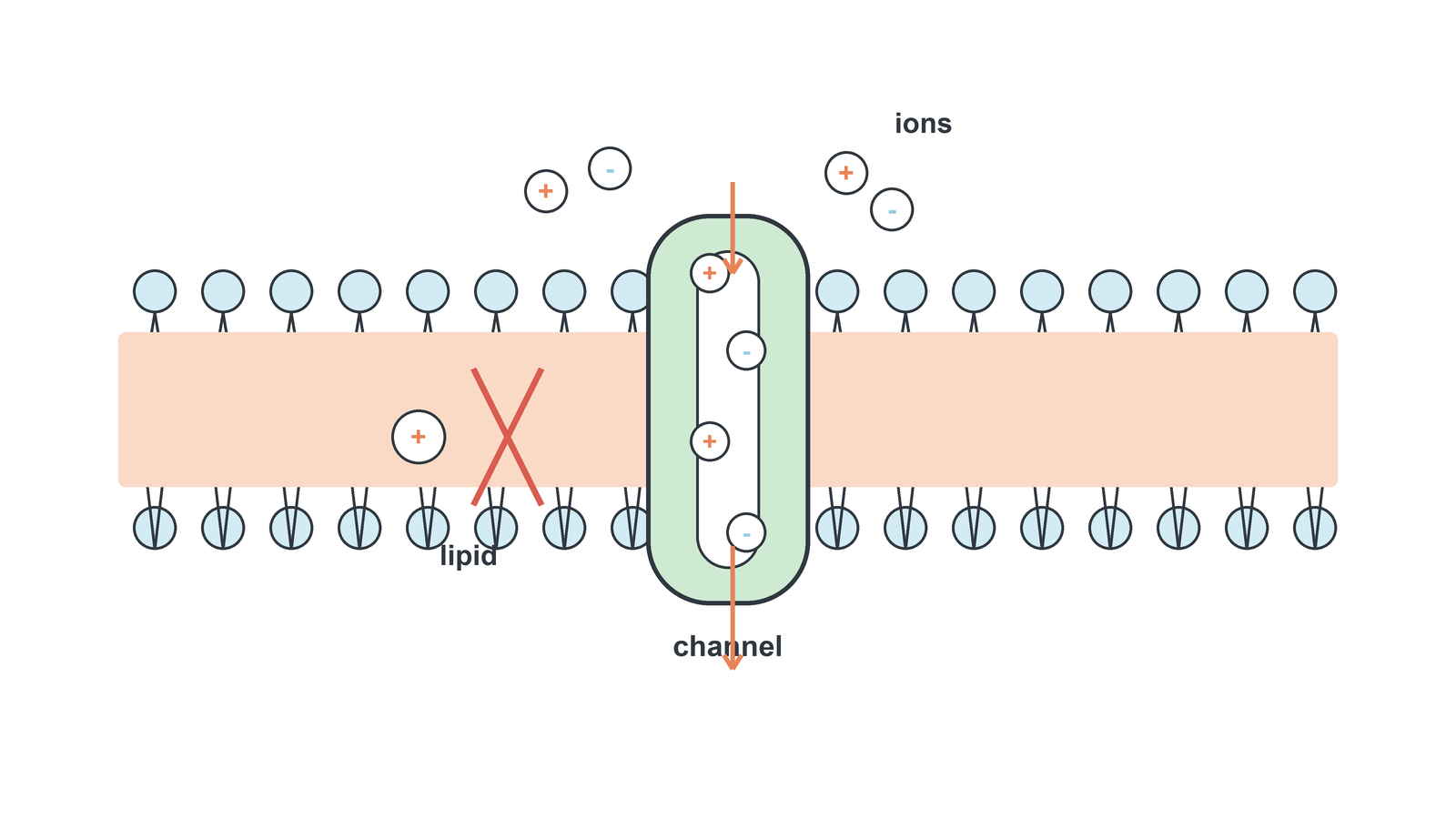
Channel proteins provide hydrophilic pores through the hydrophobic membrane core. They allow specific ions or polar substances to move down their gradients without ATP. Channels and transporters are selective, so ADP, ATP, water, ions, and polar molecules need the right protein path.
Match each transport clue to the correct idea.
MatchExplain How Pumps Spend ATP
Practice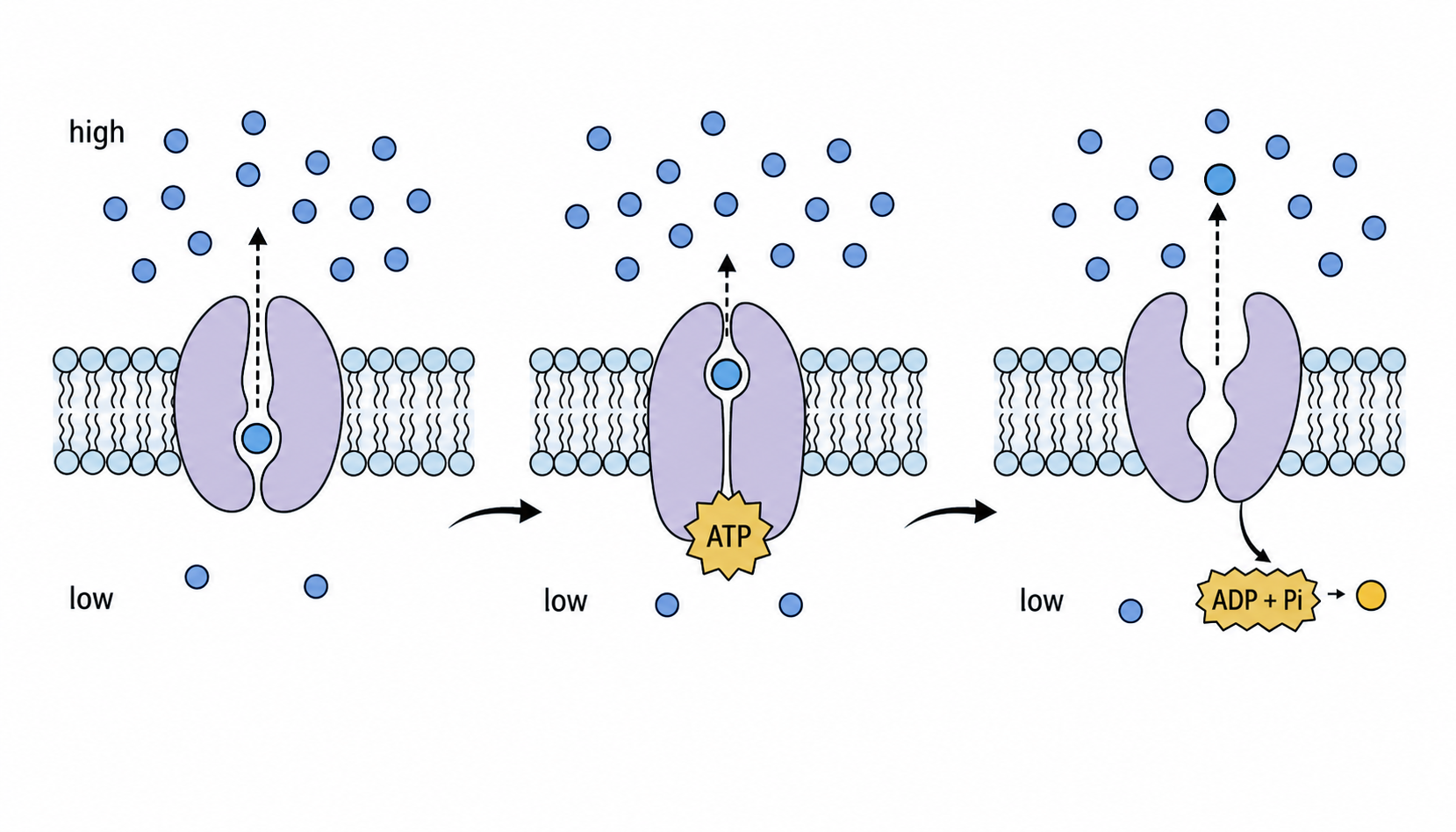
Pump proteins carry out active transport. They use ATP from respiration to move specific molecules or ions against concentration gradients. This movement is selective and uses carrier or pump proteins, not open channels, because the protein must change shape and drive movement uphill.
Put pump transport in order.
OrderRead Selective Permeability As A Decision
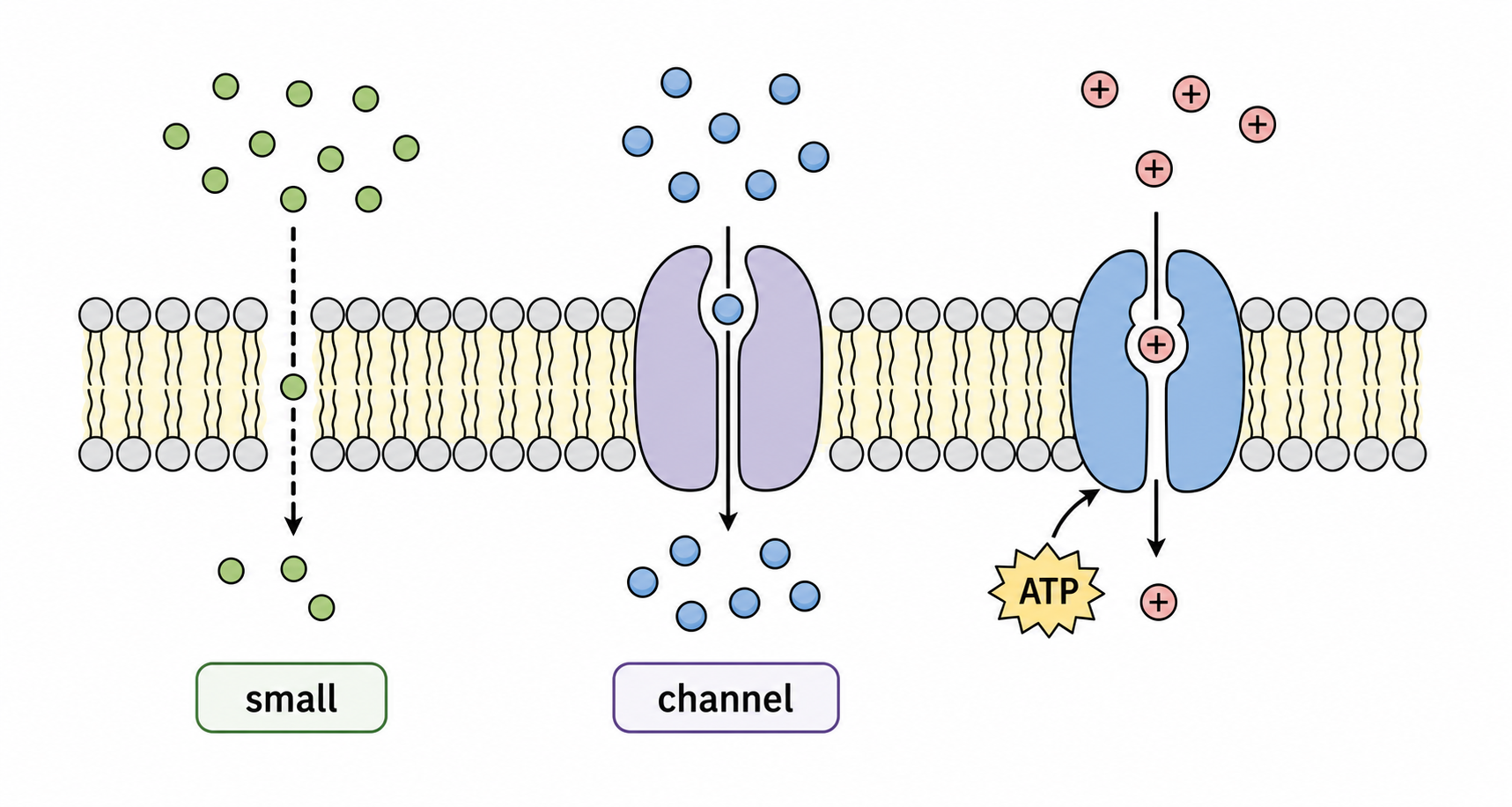
Selective permeability is a decision tree. Small non-polar molecules can cross by simple diffusion. Polar, charged, or large molecules need proteins. If movement is down-gradient, facilitated diffusion can work; if movement is against a gradient, active transport is needed. This selectivity is essential in roots, intestines, kidneys, and neurons.
Match each transport case to the best mechanism.
MatchUse The Glycocalyx For Recognition
Glycoproteins and glycolipids have short carbohydrate chains on the extracellular surface. Together they form the glycocalyx. This carbohydrate-rich layer supports recognition, adhesion, signalling, and interaction with water, so the membrane surface is not just a barrier; it is also an identity and communication surface.
Match each glycocalyx feature to its role.
MatchDefend The Fluid Mosaic Model
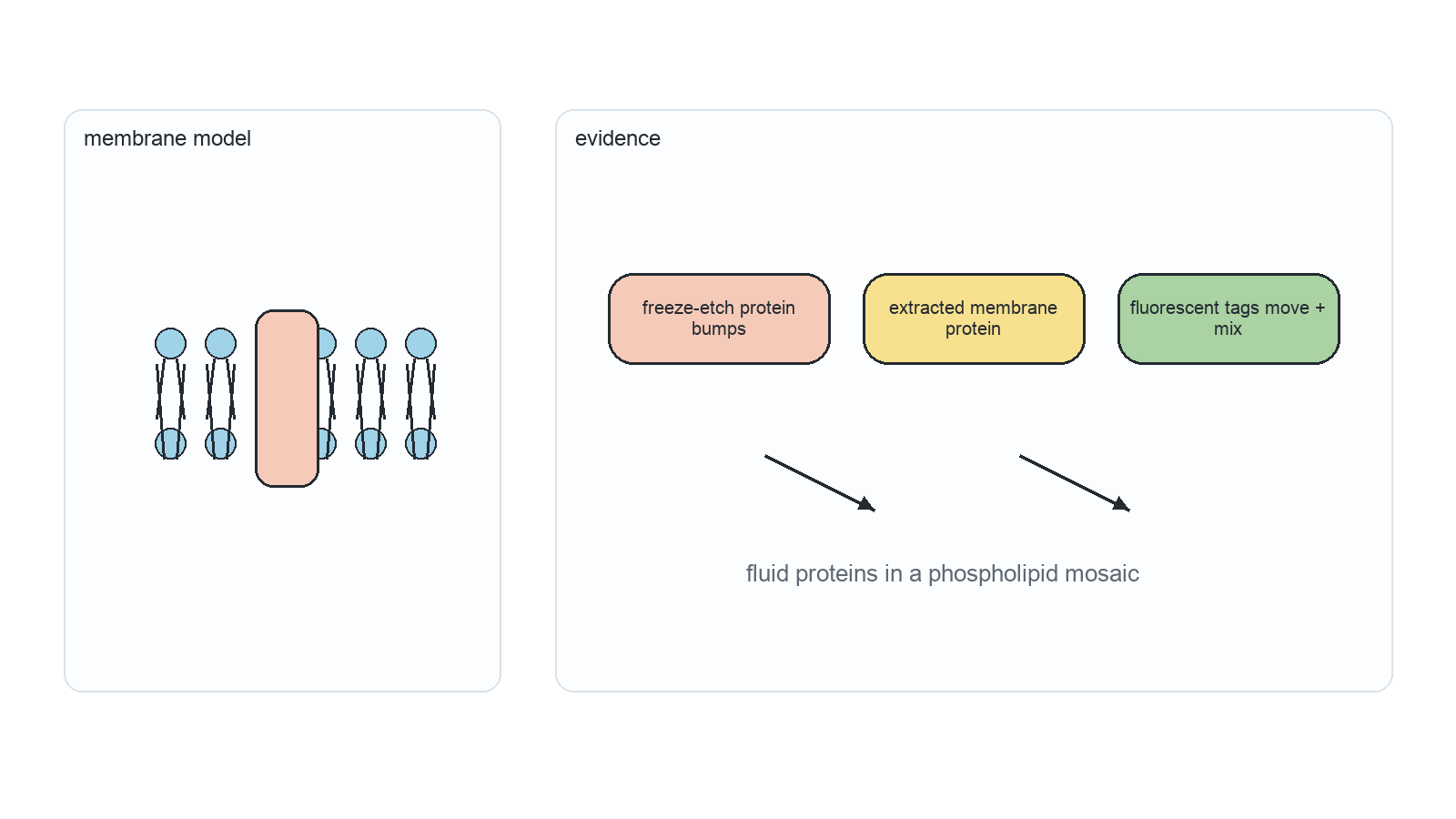
The fluid mosaic model describes a membrane as mobile lipids and proteins in a phospholipid bilayer. “Fluid” means many components can move laterally. “Mosaic” means the membrane contains different components: integral proteins, peripheral proteins, cholesterol, glycoproteins, and glycolipids. Freeze-etching, protein extraction, and fluorescent tagging supported the model.
The model explains both membrane composition and the evidence that supported it.
Match evidence or component to the model idea.
MatchMatch evidence or component to the model idea.
ChooseSL Transfer: Choose The Transport Route
Exam PracticeThe SL membrane model is a decision system. The bilayer forms because phospholipids are amphipathic, and the hydrophobic core creates selective permeability. Small non-polar molecules diffuse directly; water moves by osmosis and often through aquaporins; ions and polar molecules use channels or transporters; pumps use ATP for movement against gradients. Proteins and glycocalyx components add transport, recognition, and model evidence.
Match each membrane question to the best rule.
MatchUse this for combined SL questions on membrane structure and transport.
Use this for combined SL questions on membrane structure and transport.
Phospholipids are amphipathic, so in water they form bilayers with hydrophilic heads facing water and hydrophobic tails inward. The hydrophobic core has low permeability to ions and large or hydrophilic molecules, making membranes selectively permeable. Small non-polar molecules such as oxygen diffuse down gradients through the bilayer; water moves by osmosis and often through aquaporins; ions and polar molecules need channels or transporters for facilitated diffusion; pumps use ATP to move substances against gradients. Integral and peripheral proteins add transport and signalling roles, while glycoproteins and glycolipids form the glycocalyx for recognition.
Writing a list of transport types without applying gradient, molecule type, or ATP use.