
Read The Amino Acid Backbone
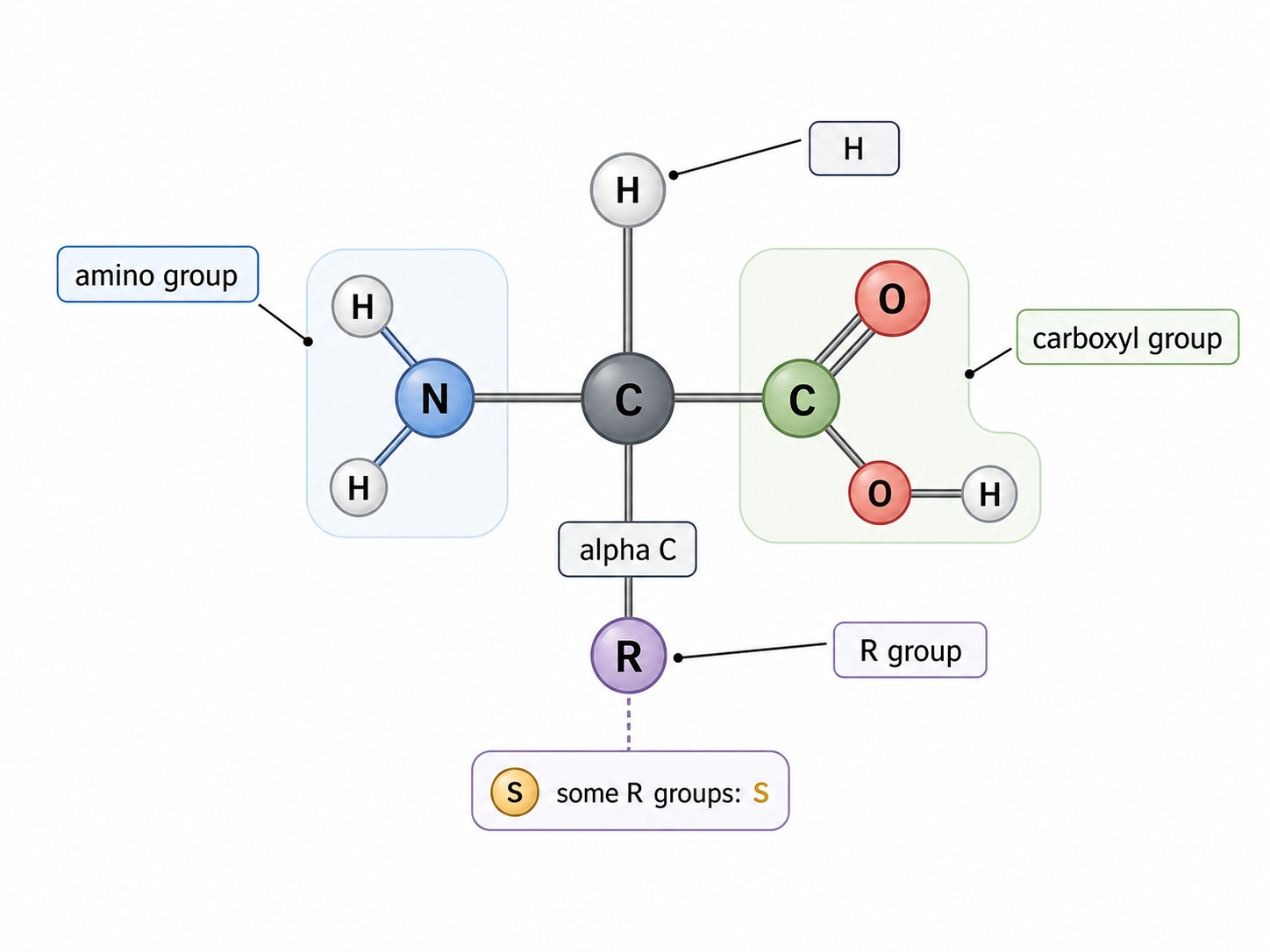
Every amino acid has the same backbone: an alpha carbon bonded to an amine group, a carboxyl group, a hydrogen atom, and an R-group. The R-group is the variable part, so it determines properties such as charge, polarity, hydrophobicity, and later folding behaviour. Proteins contain C, H, O, N, and usually S because some amino acids contain sulfur.
Use the shared backbone to recognize any amino acid, then look to the R-group for its chemistry.
Label the generalized amino acid.
LabelLabel the generalized amino acid.
ChooseBuild A Peptide Bond
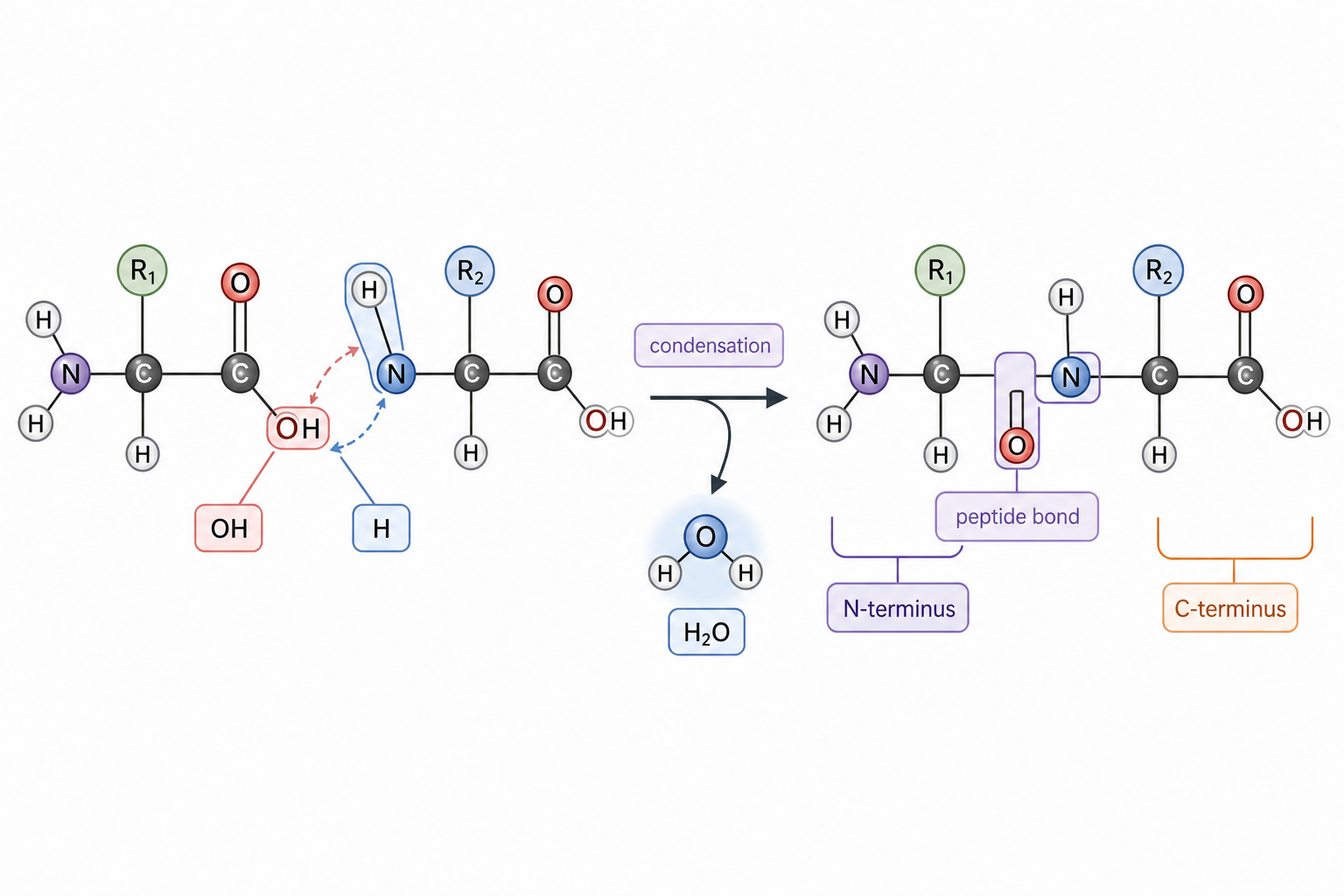
Peptide bonds form by condensation. The carboxyl group of one amino acid reacts with the amine group of another, water is released, and a peptide bond links the residues. The chain has direction: an N-terminus at one end and a C-terminus at the other. Ribosomes assemble polypeptides in this directional order.
Track which atoms leave as water, then identify the new peptide bond and chain direction.
Put peptide-bond formation in order.
OrderPut peptide-bond formation in order.
ChooseDecide Which Amino Acids Must Come From Diet
PracticeEssential amino acids are “essential” because the body cannot synthesize enough of them, so they must come from dietary protein. Non-essential amino acids can be made by transamination, mainly in the liver. If an essential amino acid is missing, protein synthesis is limited because the ribosome cannot complete all needed polypeptides, which can contribute to malnutrition.
Sort each statement into essential, non-essential, or deficiency consequence.
SortExplain Protein Sequence Diversity
Protein diversity comes from sequence possibilities. Twenty coded amino acids can be combined in different types, numbers, and orders, creating vast numbers of polypeptide sequences. Genes encode those sequences, and the proteome is the full set of proteins expressed by a cell, tissue, or organism at a given time.
Match each term to its role in protein diversity.
MatchPredict Denaturation From Shape Change
Practice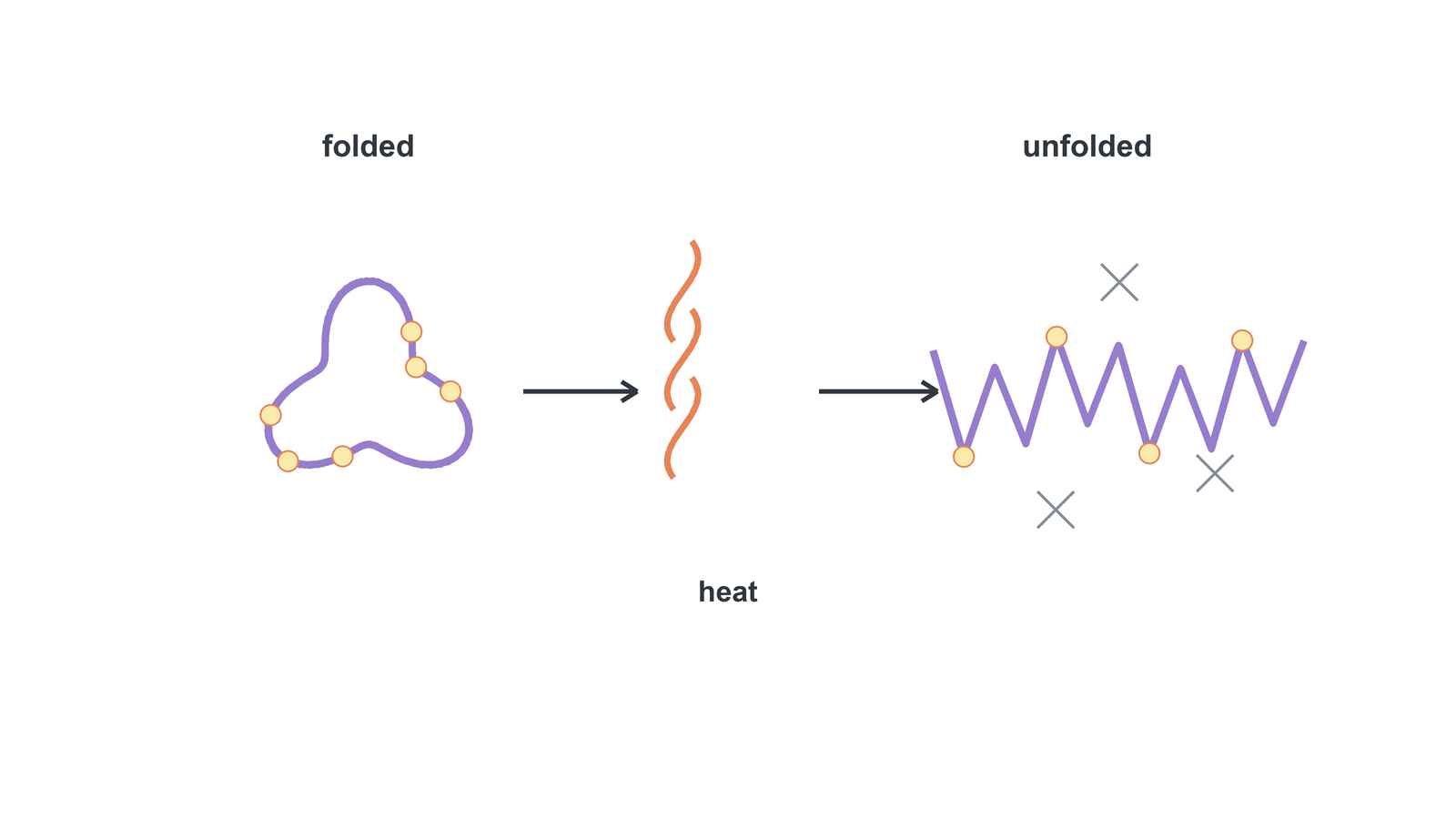
Protein shape determines function, especially for enzyme active sites. High temperature or unsuitable pH can disrupt weak bonds that maintain the folded shape. When the active site changes shape, the substrate no longer fits properly and function falls. Small proteins may sometimes refold, but denaturation is often irreversible.
An enzyme is moved to a very acidic solution. Predict what happens.
PredictCore Transfer: Build And Use Proteins
Exam PracticeThe core protein story is build -> vary -> function. Amino acids share a backbone but differ in R-groups. Peptide bonds form by condensation between carboxyl and amine groups. Some amino acids must come from diet, or protein synthesis is limited. Twenty coded amino acids create many sequences by type, number, and order. Finally, shape determines function, so denaturation changes performance.
Match each core prompt to its answer rule.
MatchUse this for core protein questions on amino acid structure, peptide-bond formation, essential amino acids, sequence diversity, or denaturation.
Use this for core protein questions on amino acid structure, peptide-bond formation, essential amino acids, sequence diversity, or denaturation.
Proteins are built from amino acids with a shared alpha-carbon backbone and variable R-groups that determine chemical properties. Peptide bonds form by condensation between the carboxyl group of one amino acid and the amine group of another, releasing water and creating directional chains. Essential amino acids must be obtained from dietary protein, while non-essential amino acids can be made by transamination. Protein diversity comes from the type, number and order of the 20 coded amino acids. Protein shape determines function, so high temperature or unsuitable pH can disrupt weak bonds, denature the protein and reduce activity.
Listing terms without explaining how structure leads to function.