
Use Carbon To Explain Molecular Variety
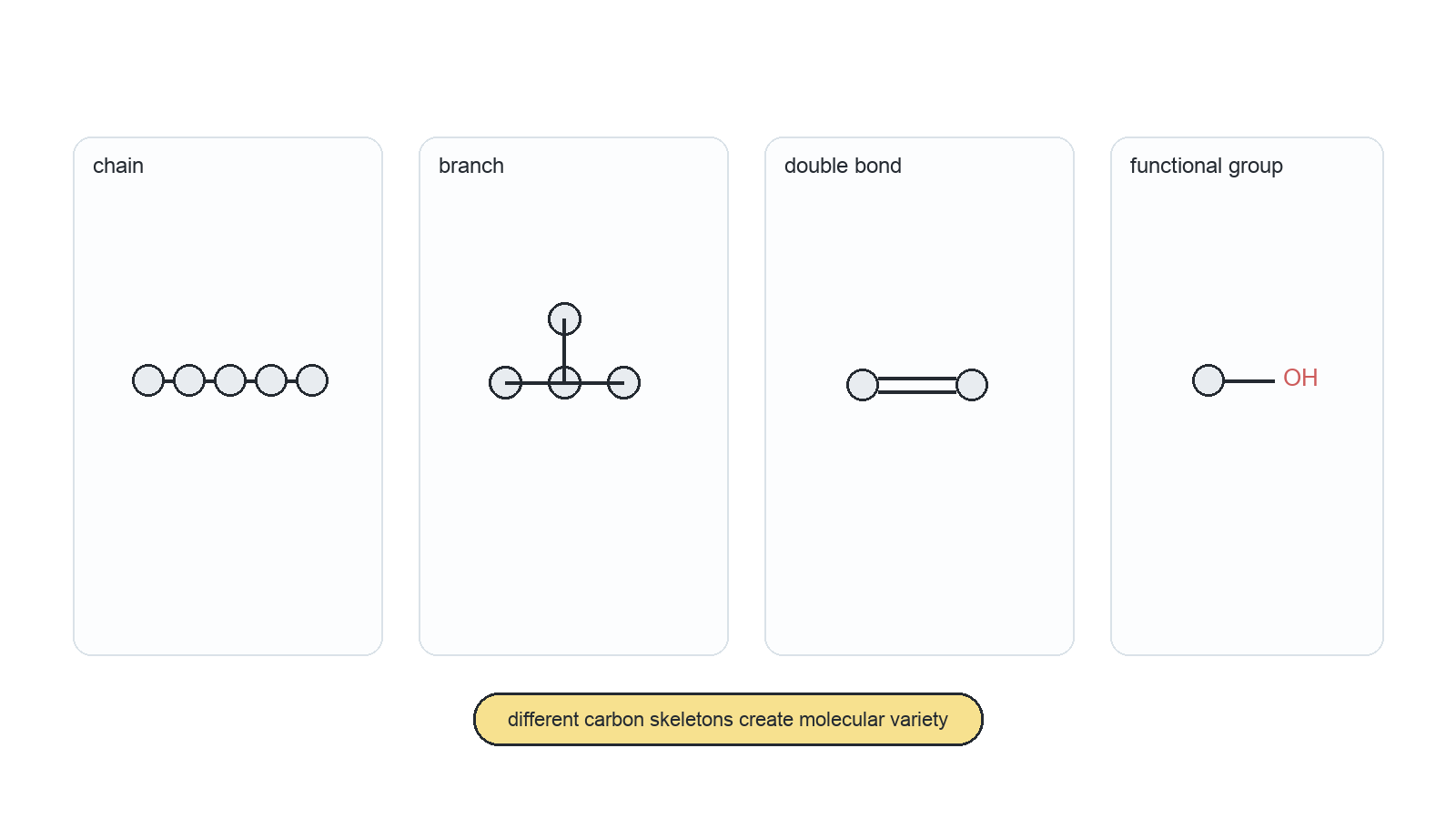
Carbon is useful in biology because it forms four strong covalent bonds with atoms such as C, H, O, N, S, and P. Four bonds let carbon skeletons form chains, branches, rings, single bonds, and double bonds. Functional groups then give each carbon compound its chemical behaviour, so structure explains function rather than just naming molecules.
Carbon diversity comes from both skeleton shape and attached functional groups.
Build Molecules By Condensation
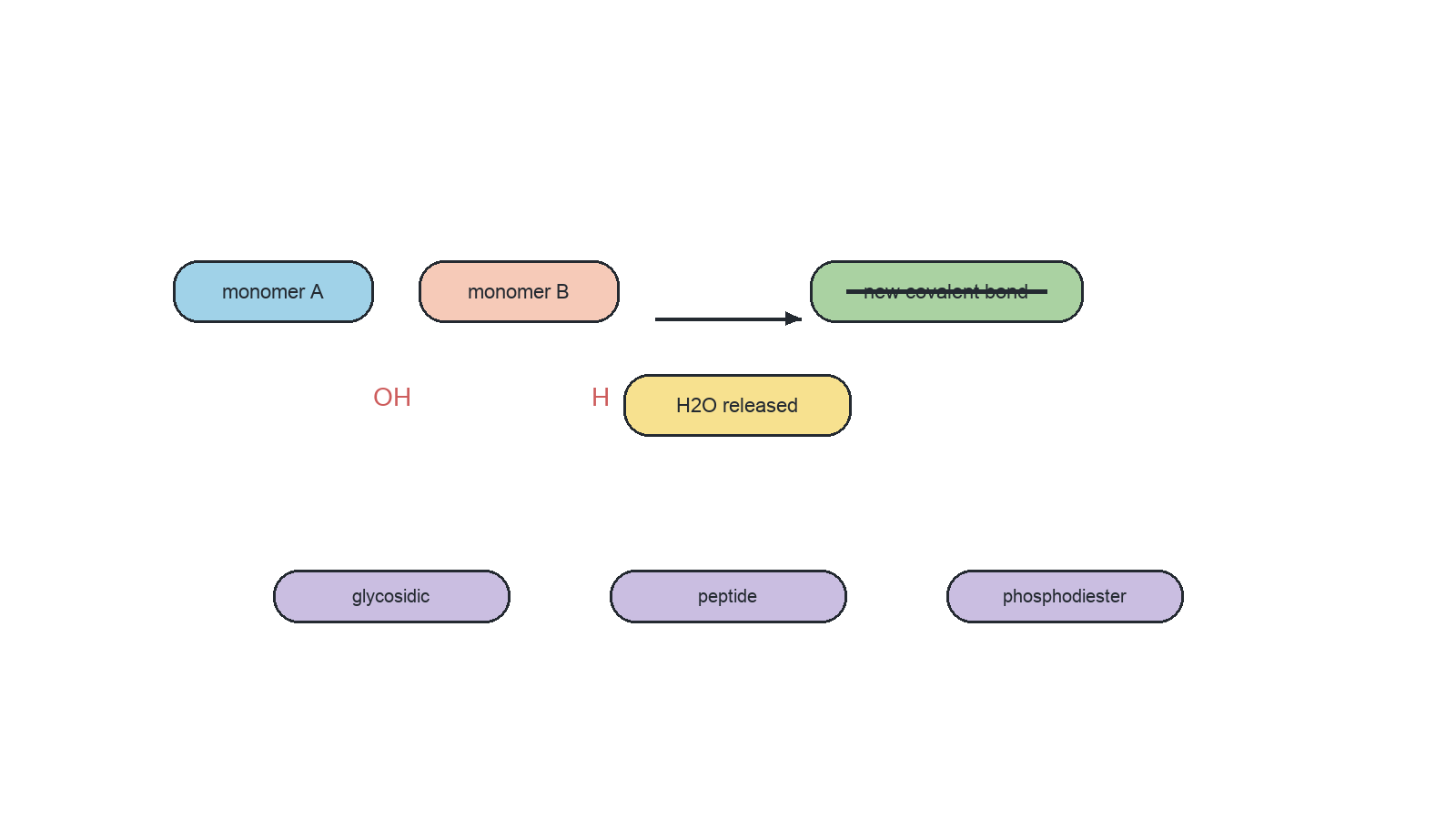
Condensation builds larger molecules. Two smaller molecules join by forming a covalent bond, and water is released from -H and -OH groups. Repeated condensation builds polymers such as polysaccharides, polypeptides, and nucleic acids. The bond name depends on the molecule: glycosidic in carbohydrates, peptide in proteins, and phosphodiester in nucleic acids.
Condensation builds larger molecules by forming a bond and releasing water.
Put condensation polymer formation in the correct order.
OrderPut condensation polymer formation in the correct order.
ChooseBreak Molecules By Hydrolysis
Hydrolysis is the reverse logic of condensation. Water is used to break covalent bonds in polymers, supplying -H and -OH to the separated monomers. This matters in digestion: amylases, proteases, and nucleases catalyse hydrolysis so large biomolecules become small enough to use or absorb.
Match each enzyme to the molecule type it hydrolyses.
MatchUse Monosaccharide Structure For Function
PracticeMonosaccharides are single sugar units. Pentoses such as ribose have five carbons; hexoses such as glucose have six. Glucose is useful because it is soluble, transportable, chemically stable, and a direct substrate for respiration. A small structural difference at carbon 1 separates alpha-glucose from beta-glucose, and that difference leads to different polysaccharides.
Sort each sugar example by role.
SortCompare Starch And Glycogen Stores
PracticeStarch and glycogen are alpha-glucose energy stores. Plants store starch as amylose and branched amylopectin. Animals and fungi store glycogen, which is more highly branched. Their large insoluble molecules do not strongly affect osmosis, they are compact, and hydrolysis can release glucose when needed. More branching gives more enzyme-accessible ends.
Match each storage feature to its benefit.
MatchExplain Cellulose Strength
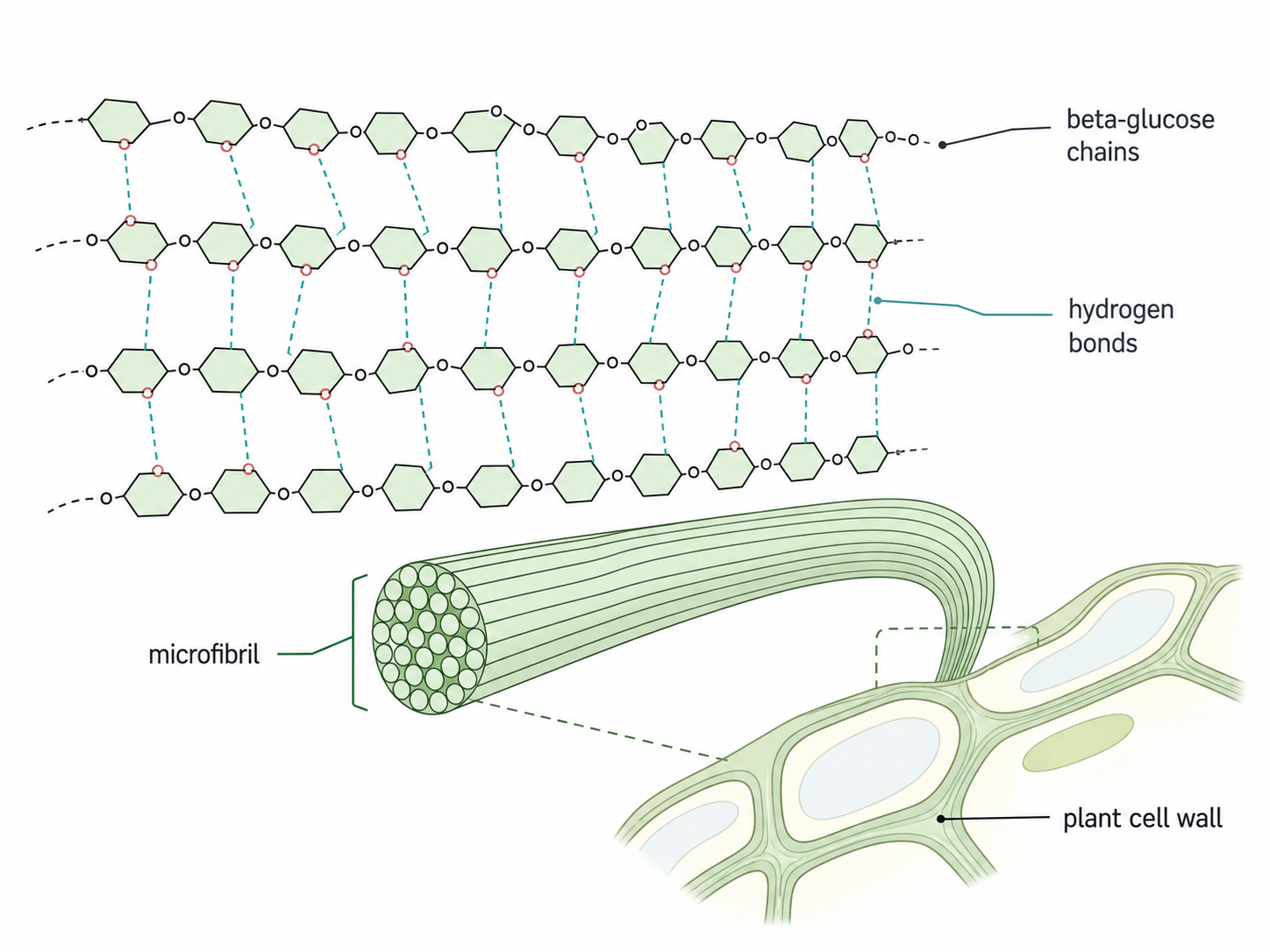
Cellulose shows how one sugar isomer changes function. It is made of beta-glucose joined by 1,4 glycosidic bonds. Alternating beta-glucose orientation makes straight, unbranched chains. Many hydrogen bonds between parallel chains form fibrils and fibres, giving plant cell walls high tensile strength.
Cellulose strength comes from straight beta-glucose chains cross-linked by many hydrogen bonds.
Put the cellulose structure-function chain in order.
OrderPut the cellulose structure-function chain in order.
ChooseUse Surface Carbohydrates For Recognition
PracticeCarbohydrates are also information tags. Glycoproteins and glycolipids on the outer membrane surface form the glycocalyx. Their carbohydrate chains help cells recognize self and non-self, adhere, and signal. ABO blood group antigens are a strong example: different surface sugars affect immune compatibility during transfusion.
Match each surface carbohydrate feature to its role.
MatchExplain Lipid Hydrophobicity
Lipids are grouped by hydrophobic behaviour rather than by one repeated monomer pattern. They are sparingly soluble in water and soluble in non-polar solvents because much of their structure is non-polar hydrocarbon chain or ring material. Fats, oils, waxes, phospholipids, and steroids are lipid examples, but lipids are not true polymers because they are not built from repeating identical monomers.
Sort each statement as lipid property or common mistake.
SortBuild Triglycerides And Phospholipids
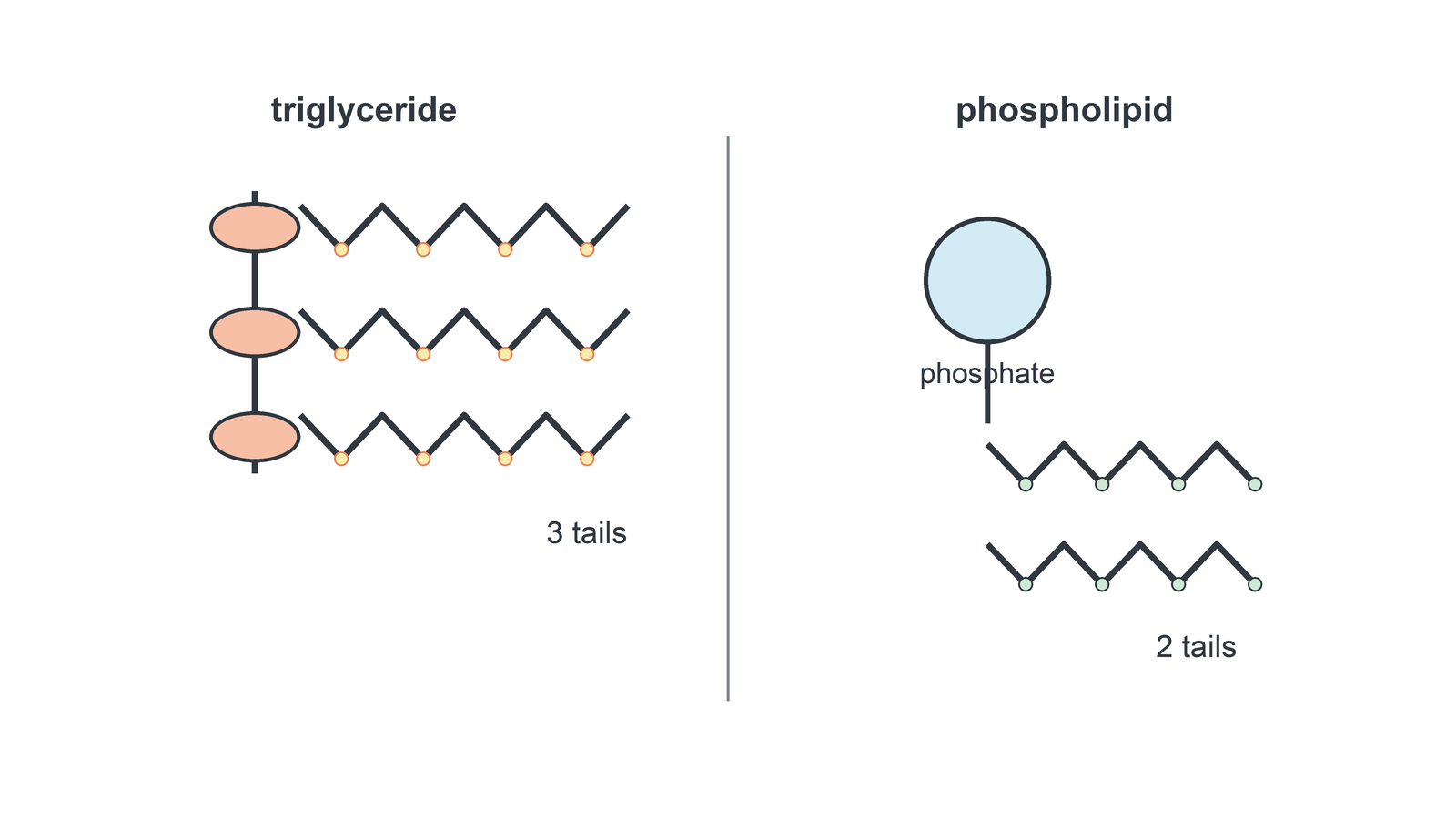
Condensation forms ester bonds between glycerol and fatty acids. A triglyceride has glycerol plus three fatty acids, making it suited to energy storage. A phospholipid has glycerol, two fatty acids, and an ionized phosphate group. That phosphate group creates a hydrophilic head, so the molecule becomes amphipathic and useful for membranes.
One head-group change shifts the lipid from energy storage toward membrane formation.
Match each lipid component to its molecule or role.
MatchMatch each lipid component to its molecule or role.
ChooseUse Double Bonds To Predict Fatty Acid Properties
PracticeSaturated fatty acids have no carbon-carbon double bonds, so their chains are straighter and pack tightly. Monounsaturated fatty acids have one double bond; polyunsaturated fatty acids have multiple double bonds. Cis double bonds make kinks, reduce packing, and lower melting point, which helps explain why many oils are liquid at room temperature.
Compare saturated and unsaturated fatty acids by structure.
SortExplain Triglyceride Storage Functions
PracticeTriglycerides in adipose tissue are good long-term stores because they pack a lot of energy into little mass. They are insoluble, so they can be stored without strong osmotic effects. Fat deposits also provide insulation, protection, and buoyancy. When oxidized, fat releases more energy and metabolic water than carbohydrate of the same mass.
Match each triglyceride property to its benefit.
MatchExplain Phospholipid Bilayer Formation
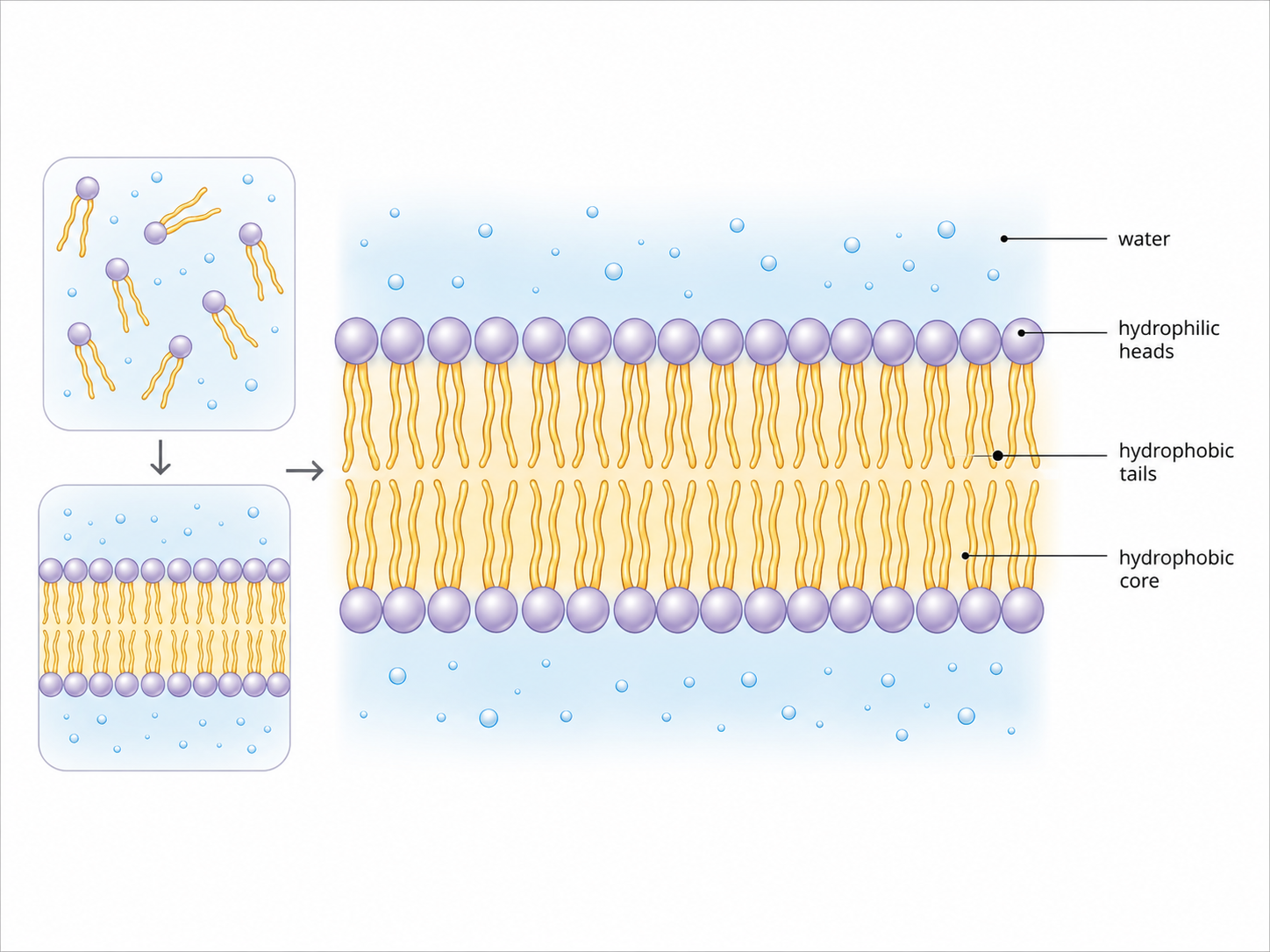
Phospholipids are amphipathic. Their phosphate heads are hydrophilic, while fatty acid tails are hydrophobic. In water, heads face the aqueous surroundings and tails turn away from water, so phospholipids self-assemble into monolayers or bilayers. A bilayer is stable because the hydrophobic core is shielded from water, making it the basic barrier of cell membranes.
Bilayers form because amphipathic phospholipids orient their heads toward water and tails away from water.
Label the phospholipid features that explain bilayer formation.
LabelLabel the phospholipid features that explain bilayer formation.
ChooseRecognize Steroids As Non-Polar Lipids
PracticeSteroids are lipids, but not because they have fatty acid tails. They have four fused carbon rings and are mostly non-polar. Because non-polar steroids can pass through the hydrophobic core of phospholipid bilayers, steroid hormones such as oestradiol and testosterone can diffuse through membranes and bind receptors inside target cells.
Which feature identifies a steroid lipid?
ChooseTransfer: Explain Structure To Function
Exam PracticeB1.1 becomes easy when every answer follows structure -> property -> function. Carbon skeletons and functional groups create molecular diversity. Condensation builds larger molecules and hydrolysis breaks them. Alpha-glucose stores energy as starch and glycogen; beta-glucose forms strong cellulose. Surface carbohydrates enable recognition. Lipids are hydrophobic, triglycerides store energy, phospholipids self-assemble into bilayers, and steroids cross membranes because they are mostly non-polar.
Match each structure to the function it explains.
MatchUse this for combined B1.1 questions asking why a carbohydrate or lipid has a particular biological role.
Use this for combined B1.1 questions asking why a carbohydrate or lipid has a particular biological role.
Carbon forms diverse skeletons with functional groups, allowing many biological molecules. Condensation builds larger molecules by forming covalent bonds and releasing water, while hydrolysis breaks polymers using water. Alpha-glucose forms starch and glycogen, whose insolubility, compactness and branching support glucose storage; beta-glucose forms straight cellulose chains hydrogen-bonded into strong fibres. Cell-surface carbohydrates on glycoproteins and glycolipids support recognition. Lipids are hydrophobic and not true polymers: triglycerides store concentrated energy, phospholipids are amphipathic and form bilayers, and non-polar steroids with four fused rings can diffuse through membranes.
Listing starch, cellulose, triglyceride, phospholipid, and steroid without explaining the structural reason for each function.