
Water Is The Medium
Water is a medium for life processes. Substances can dissolve in it, move through it, and react in it. This supports early life in oceans and modern cell chemistry in cytoplasm and body fluids.
Which sentence best explains why water is called a medium for life?
ChooseBonding Makes The Properties
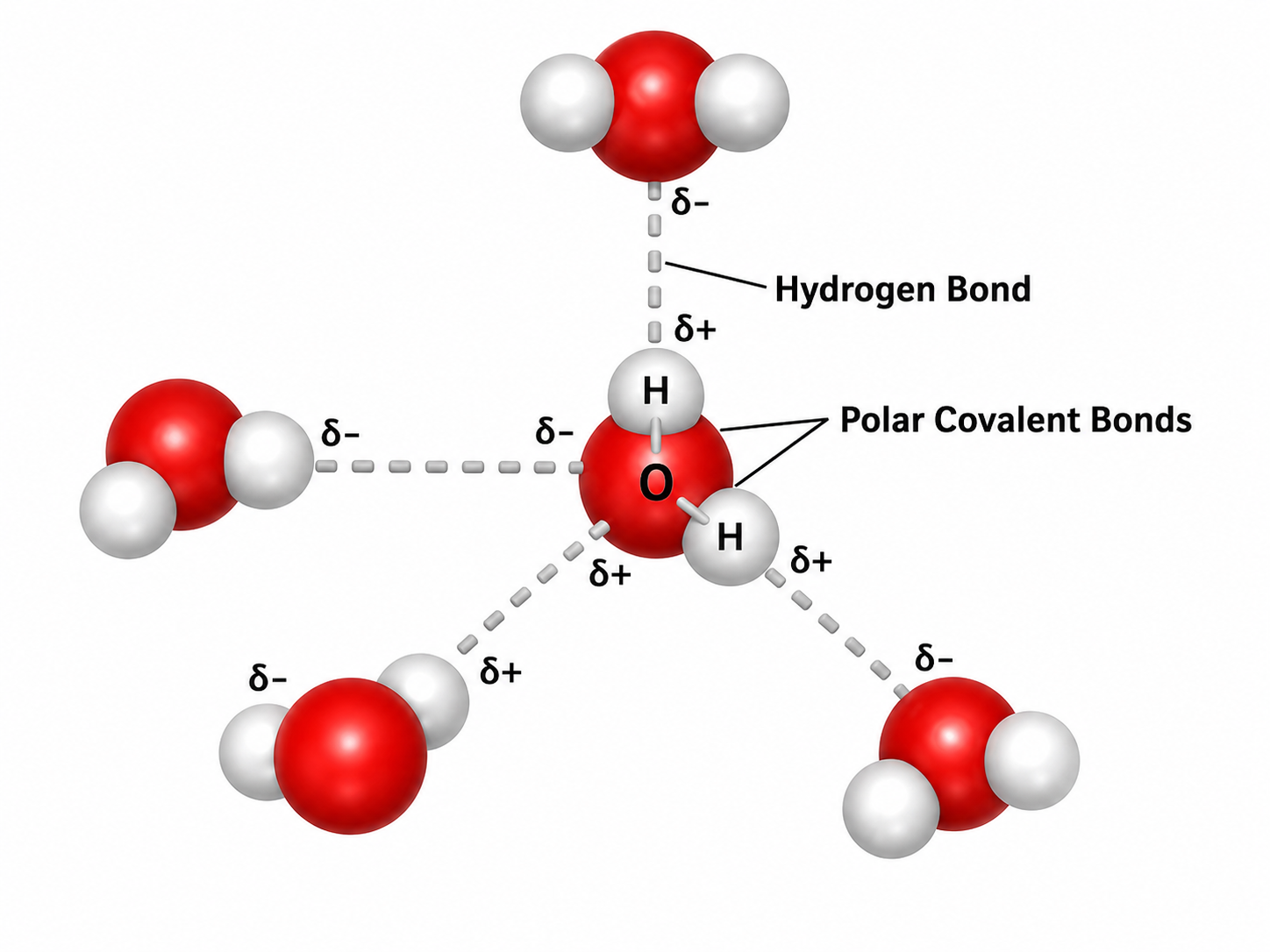
Inside one water molecule, oxygen and hydrogen are joined by O-H covalent bonds. Because the molecule is polar, neighbouring water molecules attract each other by hydrogen bonds. Those hydrogen bonds explain many unusual water properties.
The diagram separates bonds inside a water molecule from attractions between water molecules.
Label the diagram using the rule: inside one molecule or between molecules?
LabelLabel the diagram using the rule: inside one molecule or between molecules?
ChooseChoose Cohesion or Adhesion
Practice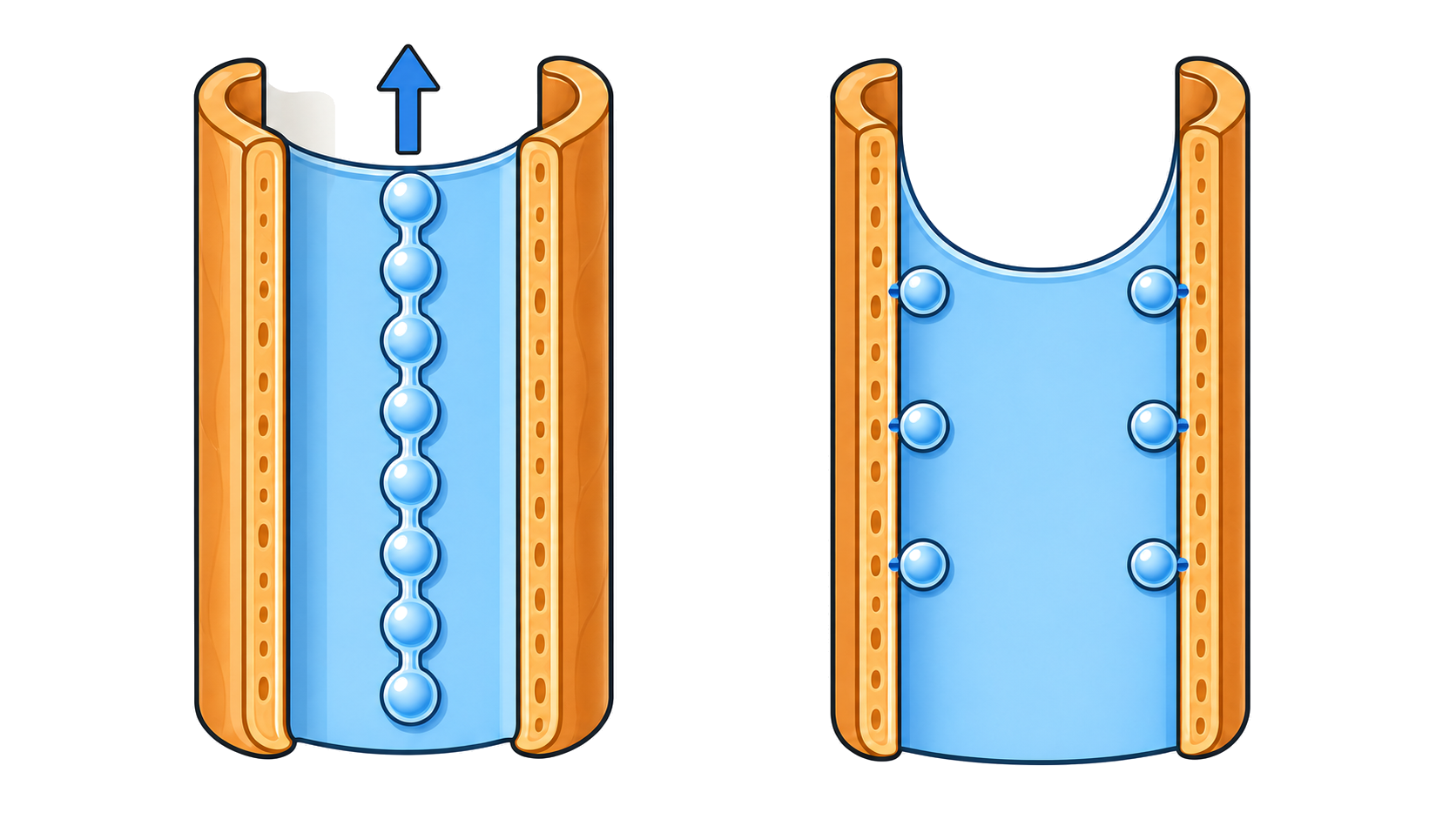
Choose the word by asking what water is attracted to: water-to-water is cohesion; water-to-surface is adhesion.
In IB answers, the mark usually comes from linking the attraction to the biological effect, not just naming the term.
Sort each example by the attraction that matters most.
SortUse this when a question asks why water forms droplets, supports surface organisms, moves in xylem, or rises in narrow spaces.
Use this when a question asks why water forms droplets, supports surface organisms, moves in xylem, or rises in narrow spaces.
Naming cohesion or adhesion without saying what is attracting what.
Solvent: What Dissolves And Why
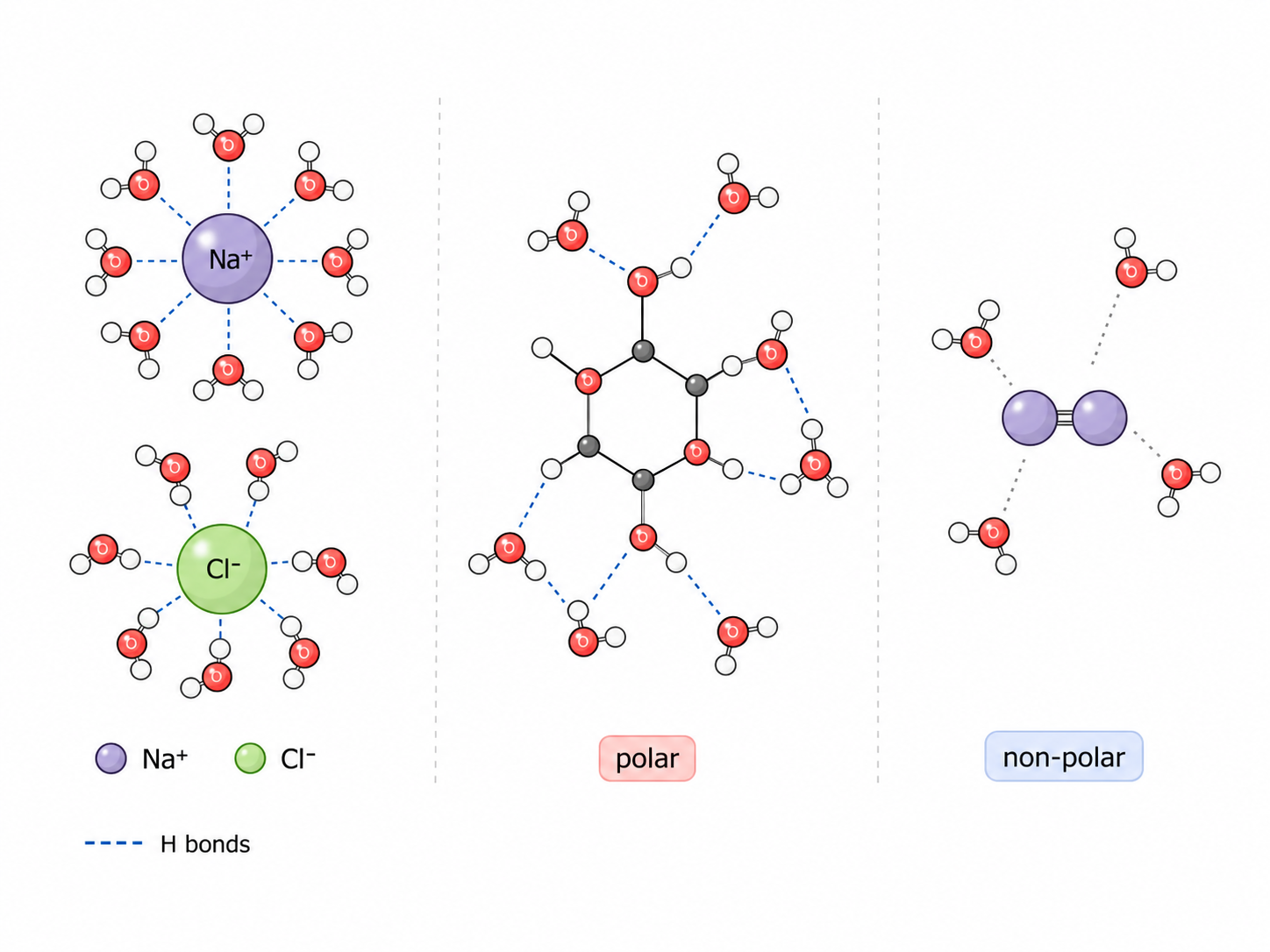
Water is a solvent when its partial charges can interact with the solute. Ions are surrounded by hydration shells. Polar molecules can hydrogen-bond with water. Non-polar molecules do not interact strongly, so they are hydrophobic and have low solubility.
Water dissolves charged or polar solutes better than non-polar molecules.
Match each case to the reason water helps or limits it.
MatchMatch each case to the reason water helps or limits it.
ChooseProperties Explain Adaptations
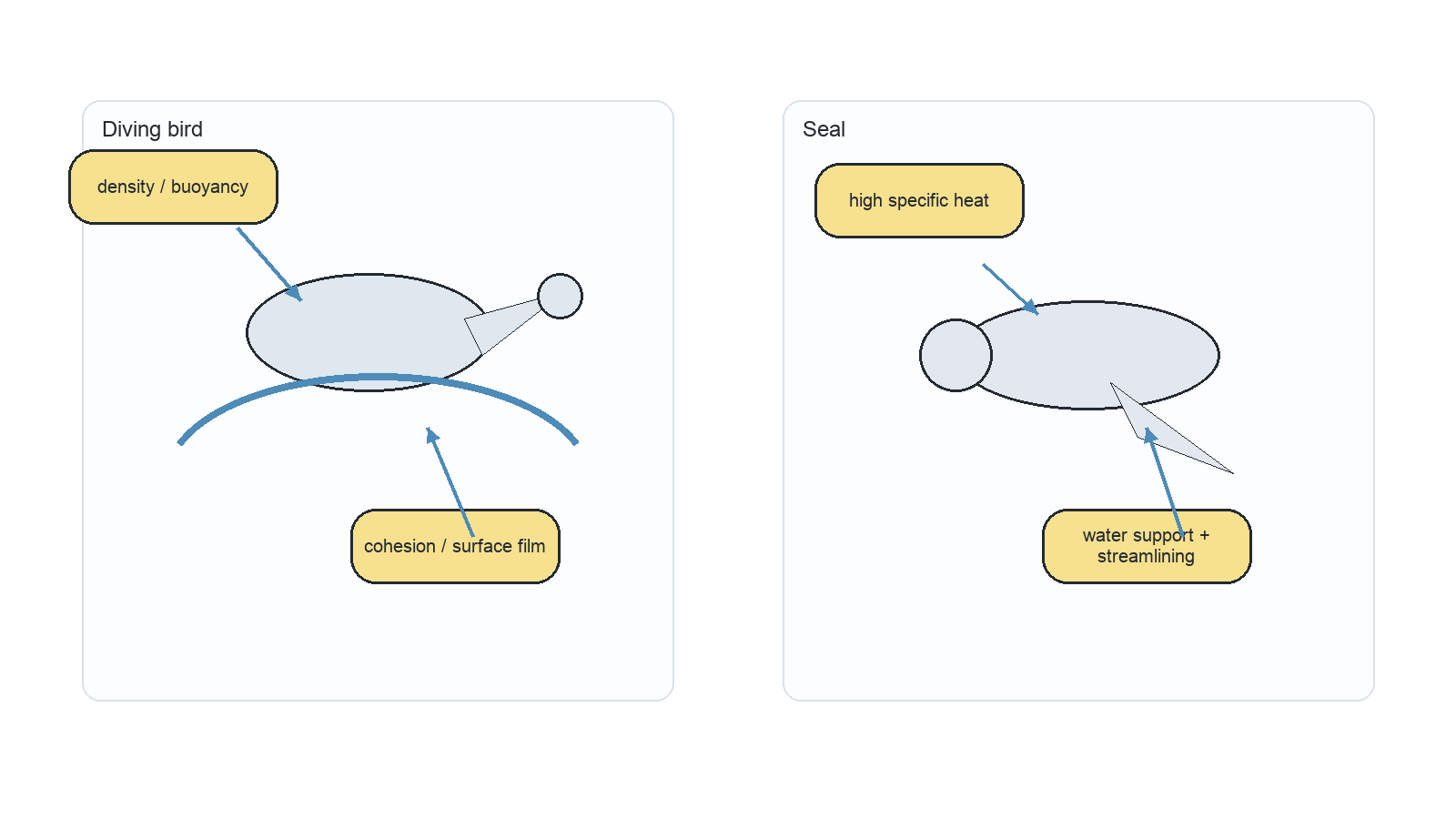
Aquatic-animal adaptations are explained by the relevant water property. High specific heat capacity stabilizes temperature. High thermal conductivity increases heat loss. Buoyancy supports bodies. Viscosity creates drag. The property should be linked directly to the adaptation.
Use the named water property first, then explain the adaptation it selects for.
Compare the loon and the seal using this sentence frame: Because water has ____, the animal needs _____.
CompareCompare the loon and the seal using this sentence frame: Because water has ____, the animal needs _____.
ChooseRemember The SL Water Chain
ReviewWater’s polar structure leads to hydrogen bonding. Hydrogen bonding and polarity create properties. Properties explain biological uses: transport, metabolism, temperature stability, xylem, and aquatic adaptations.
Match each water idea to the biological consequence it supports.
MatchBuild The SL Exam Answer
Exam PracticeUse this after retrieval when a question asks why water is important to organisms or how water properties support life. Short-answer writing belongs in the practice/question-bank flow; this card gives the answer framework.
Use this after retrieval when a question asks why water is important to organisms or how water properties support life. Short-answer writing belongs in the practice/question-bank flow; this card gives the answer framework.
Water is polar and forms hydrogen bonds, giving it properties useful to living organisms. Cohesion helps maintain continuous water columns in xylem, while water’s solvent properties allow ions and polar molecules to dissolve so they can be transported and used in metabolism. High specific heat capacity also helps aquatic environments remain temperature-stable.
The common mark loss is listing properties without explaining what they allow organisms to do. Use cause -> property -> consequence.