
Explain the Selection Chain
Natural selection is the mechanism that drives evolutionary change. It acts on heritable variation: individuals with variants better suited to a selection pressure survive and reproduce more, so the alleles linked to those traits become more common. Over many generations, this can produce adaptation, speciation, and biodiversity.
Order the natural selection chain.
OrderMake Variation First
Selection cannot choose between identical individuals. Mutation creates new alleles, especially when germ-line mutations are inherited. Meiosis and random fertilization create new combinations of existing alleles, giving selection different phenotypes to act on.
Sort the source of variation.
SortLink Overproduction to Selection
Overproduction matters because environments have limited resources. More offspring are produced than can survive, causing high mortality and competition for food, space, mates, and other resources. That competition creates selection because individuals differ in survival and reproduction.
Match each idea to its role in selection.
MatchSpot Abiotic Selection Pressures
Selection pressure does not have to be another organism. Abiotic factors such as temperature, drought, light, salinity, and pH can favour variants that tolerate those conditions. These pressures can be density-independent because they affect survival regardless of population density.
Sort each selection pressure.
SortDefine Fitness Correctly
Fitness does not mean strength or health in a general sense. In evolution, fitness means passing alleles to offspring in a particular environment. An individual with higher fitness survives and reproduces more successfully, so its alleles are better represented in the next generation.
Spot the error: the fittest organism is always the strongest individual.
Spot ErrorsReject Acquired Inheritance
Natural selection causes evolution only if the selected trait is heritable. Acquired characteristics developed during an individual’s life are not inherited through DNA base sequences. Selection changes populations when inherited alleles affect survival or reproduction.
Spot the error: an animal stretches its neck during life, so its offspring inherit a longer neck.
Spot ErrorsBalance Mates and Predators
Sexual selection favours traits that increase mating success, even if they carry survival costs. Displays, ornaments, colours, and behaviours can be selected when they improve mate choice or competition for mates. The key exam move is to weigh mating advantage against possible predation or energy cost.
A bright male display attracts mates but also predators. What decides whether it spreads?
DecisionRead Endler's Guppy Data
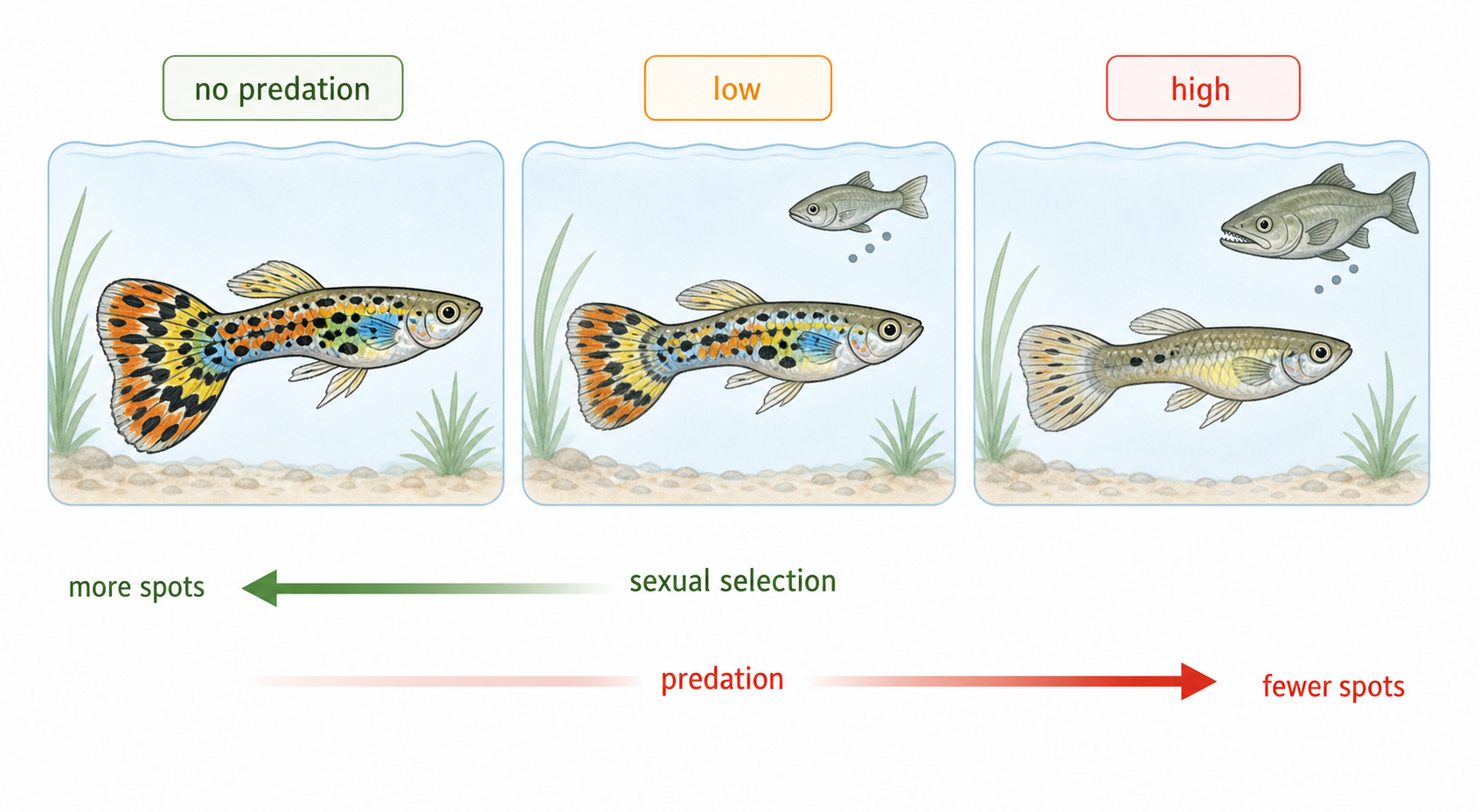
Endler’s guppy experiments modelled selection by controlling selection pressures. Predation pressure selected against conspicuous colour patterns, while mate choice could favour them. The evidence is powerful because changing the predation environment changed colour patterns over generations.
Endler's model shows a trade-off: bright colour can attract mates but also predators.
Match the guppy evidence to the selection idea.
MatchMatch the guppy evidence to the selection idea.
ChooseDefine the Gene Pool
A gene pool contains all genes and alleles in an interbreeding population. Evolution can be measured as changes in allele frequencies over generations, not by saying that individuals evolve. This is the HL bridge from Darwin’s selection to population genetics.
Which statement measures evolution most precisely?
ChooseCompare Isolated Populations
Allele frequency is the proportion of a specific allele in the gene pool. When populations are geographically isolated, they can experience different selection pressures, mutation, drift, or migration patterns. Over time, their allele frequencies can diverge.
Order the divergence logic.
OrderConnect Darwin to Alleles
Neo-Darwinism combines Darwinian natural selection with Mendelian genetics. Mutation and recombination generate genetic variation; selection increases alleles linked to higher survival or reproduction. This explains how selection on phenotypes produces allele-frequency change in a gene pool.
Match each neo-Darwinian component to its role.
MatchIdentify Selection Graphs
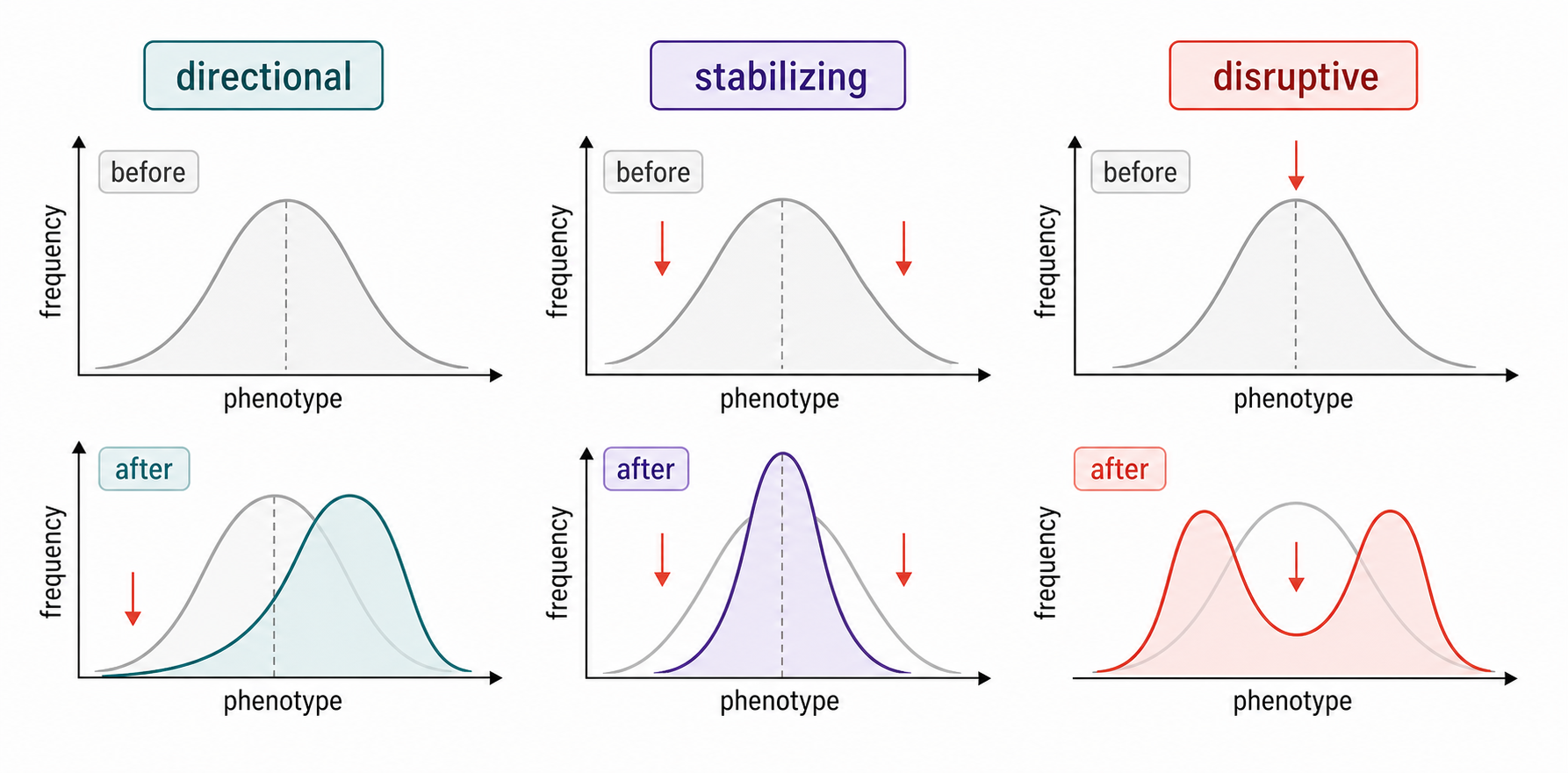
Selection patterns describe which phenotypes are favoured. Directional selection favours one extreme and shifts the mean. Stabilizing selection favours intermediate phenotypes and reduces extremes. Disruptive selection favours both extremes and selects against intermediates.
Read the graph by asking which phenotype range is favoured and which is selected against.
Match each graph pattern to the selection type.
MatchMatch each graph pattern to the selection type.
ChooseCalculate Hardy-Weinberg
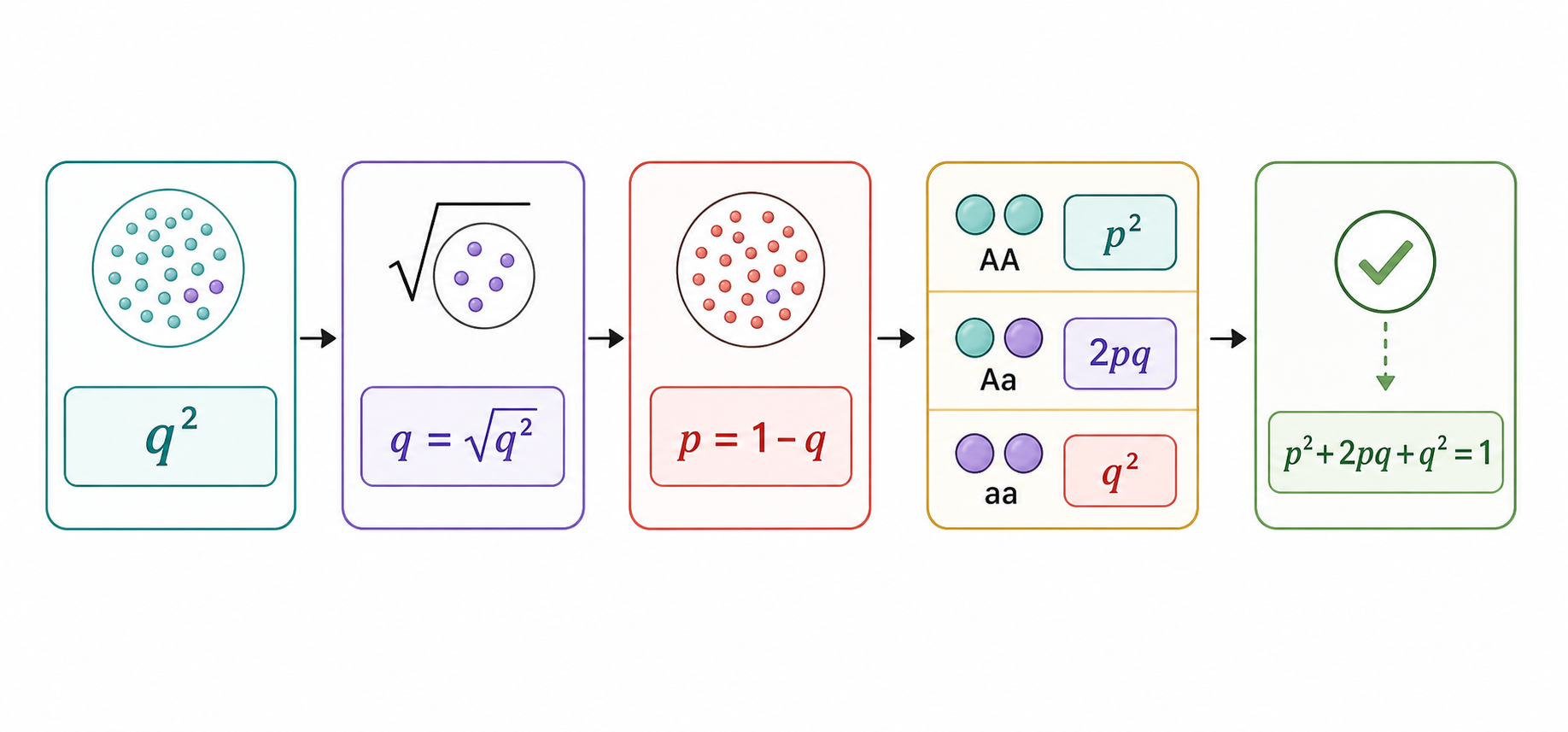
Hardy-Weinberg equations calculate allele and genotype frequencies when a population is in genetic equilibrium. For two alleles, p + q = 1 and p2 + 2pq + q2 = 1. Use p and q for allele frequencies; use p2, 2pq, and q2 for genotype frequencies.
Most Hardy-Weinberg mistakes happen at the first step: q² is not q.
Match each Hardy-Weinberg term to its meaning.
MatchMatch each Hardy-Weinberg term to its meaning.
ChooseTest Genetic Equilibrium
Hardy-Weinberg equilibrium is a null model. It requires a large population, random mating, and no selection, mutation, migration, or drift. If observed genotype frequencies deviate from expected frequencies, an evolutionary force may be acting.
Spot the error: Hardy-Weinberg equilibrium can hold while strong selection is changing survival.
Spot ErrorsSeparate Artificial and Natural Selection
Artificial selection deliberately chooses parents with desired heritable traits. It produces directed change in crops, livestock, and pets because humans decide which individuals reproduce. Natural selection is driven by environmental pressures, although resistance can arise unintentionally when human actions create a selection pressure.
Sort each example.
SortRetrieve the Core Natural Selection Route
ReviewCore D4.1 examples follow the same causal route: heritable variation exists, a selection pressure acts, individuals differ in fitness, and alleles linked to higher reproduction become more common. Endler’s guppies and sexual selection are evidence versions of the same chain.
Match each retrieval cue to its exam-use meaning.
MatchRetrieve the HL Population Genetics Route
ReviewHL D4.1 turns selection into measurable population genetics. A gene pool changes when allele frequencies shift. Hardy-Weinberg gives a no-evolution baseline; selection graphs, isolated populations, artificial selection, and resistance show how forces move populations away from that baseline.
Match each retrieval cue to its exam-use meaning.
MatchTransfer: Explain Core Natural Selection
Exam PracticeCore natural-selection exam answers should never stop at “the best adapted survive.” They need the chain: heritable variation exists, a named pressure acts, some individuals have higher fitness, and their alleles become more common over generations. Use this for abiotic pressure, overproduction, sexual selection, and Endler-style data.
Explain how a selection pressure can cause evolutionary change in a population.
Explain how a selection pressure can cause evolutionary change in a population.
ChooseMatch each exam move to the mark it earns.
MatchTransfer: Explain HL Population Genetics
Exam PracticeHL population-genetics questions ask students to quantify or model evolution. The answer starts with the gene pool and allele frequencies, then uses the model or selection graph to decide whether the population is at equilibrium or being shifted by selection, mutation, migration, drift, artificial selection, or isolation.
Use allele-frequency data, selection models, or Hardy-Weinberg expectations to explain evolutionary change.
Use allele-frequency data, selection models, or Hardy-Weinberg expectations to explain evolutionary change.
ChooseMatch each exam move to the mark it earns.
Match