EduNinja
IB Biology HL/Notes/D1.2 Protein synthesis

IB Biology HLD1.2 Protein synthesisNotes

Transcribe DNA Into mRNA
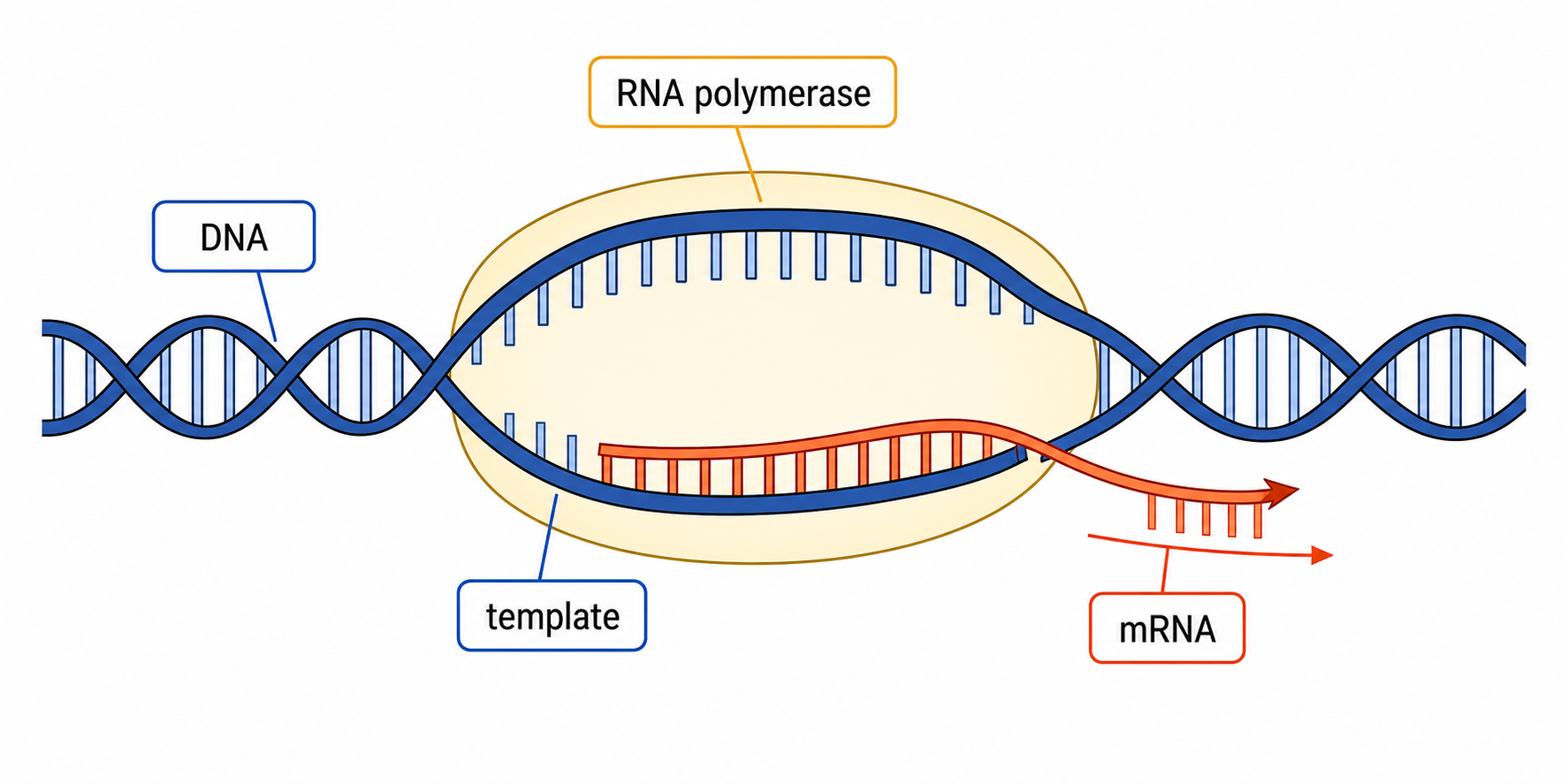
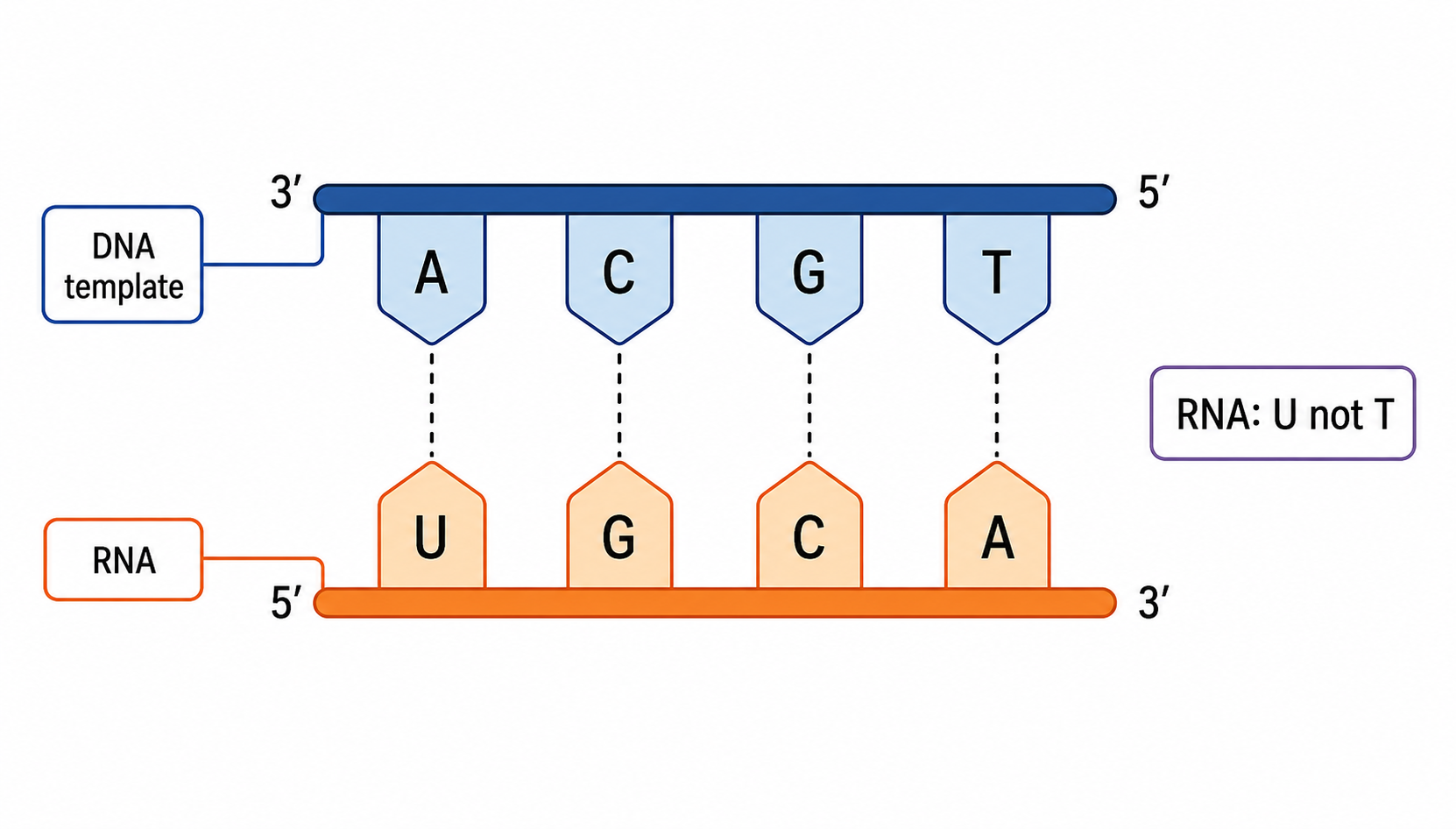
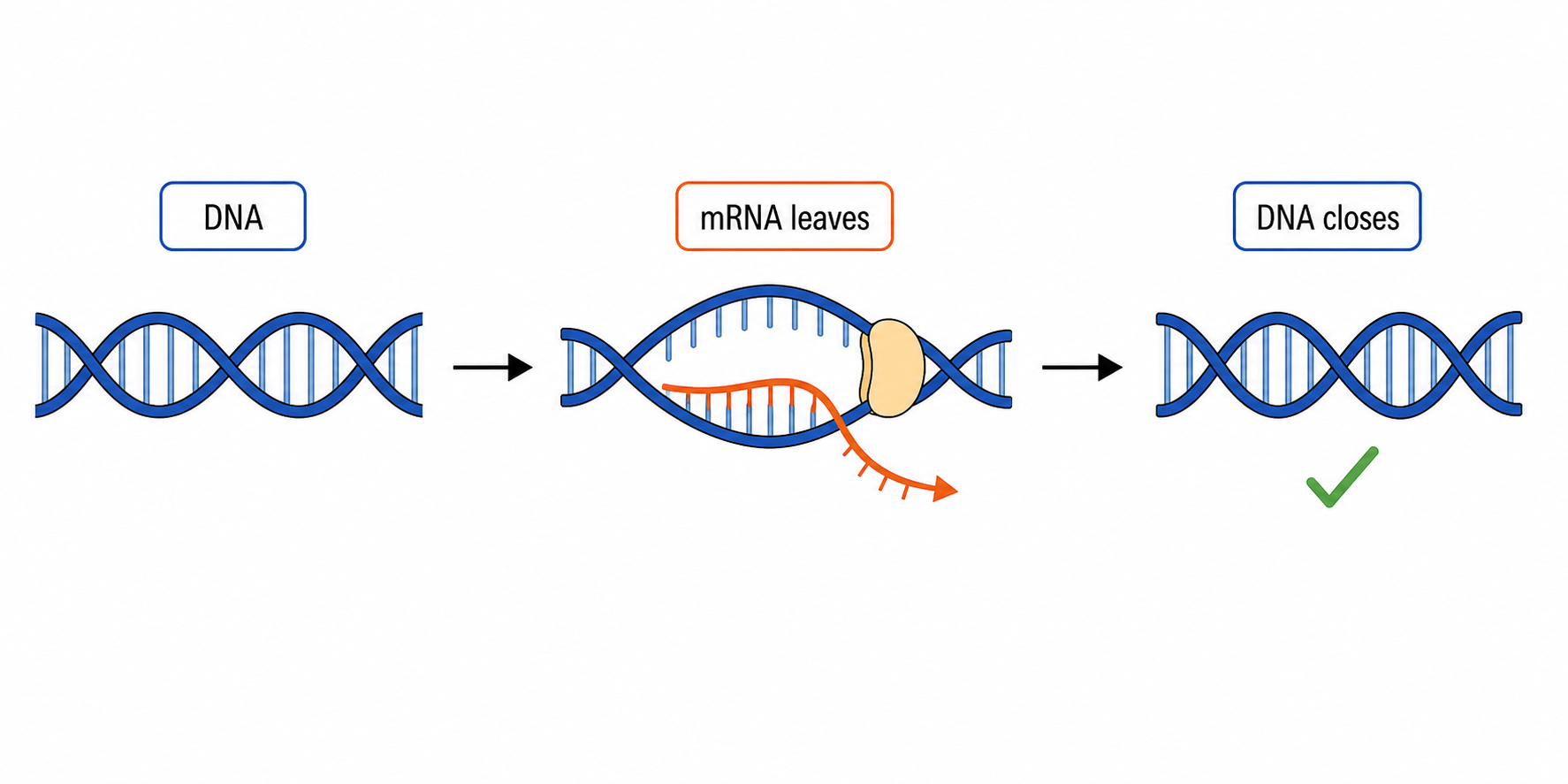
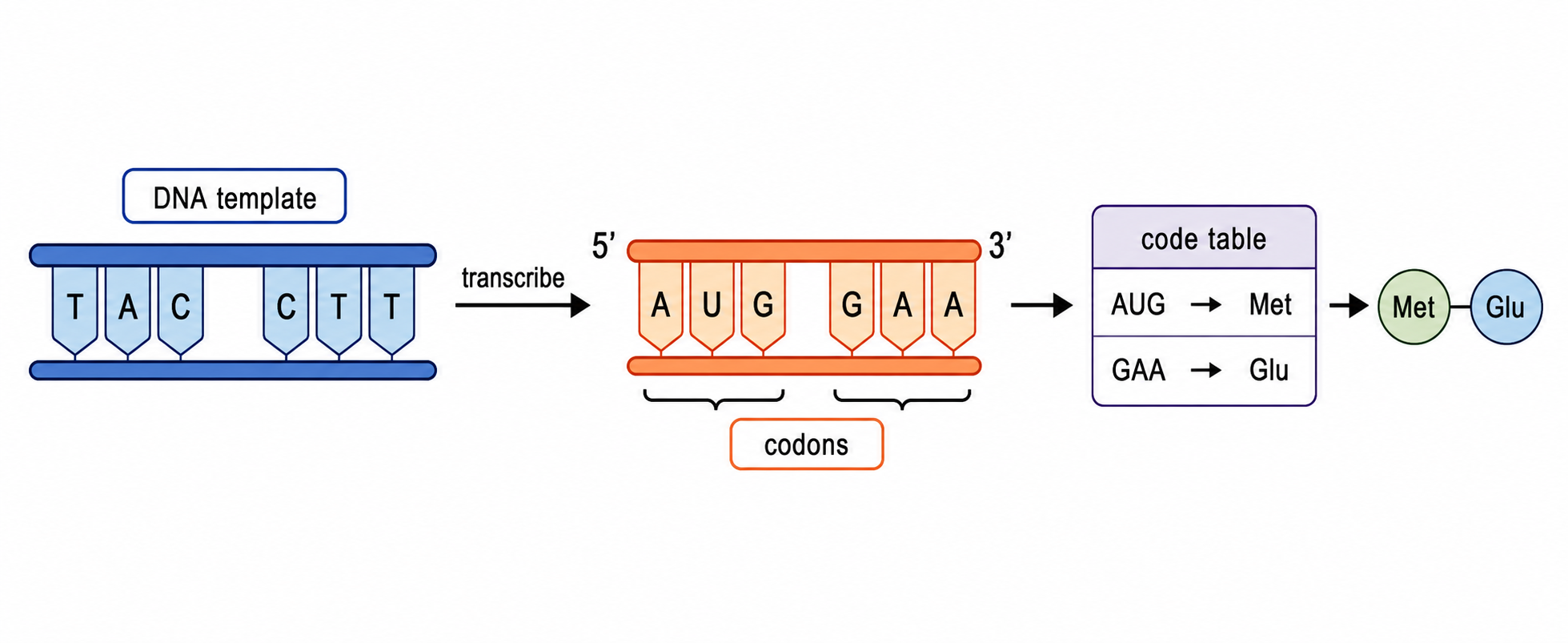
Transcription is the copying step that makes mRNA from a gene. RNA polymerase uses the DNA template strand to synthesize a complementary RNA strand, so the gene information becomes a mobile mRNA copy that can be translated at a ribosome.

Transcription makes mRNA as a mobile copy of gene information.
RNA polymerase synthesizes RNA complementary to the DNA template strand.
The DNA remains as the stored information; mRNA is the working copy.

mRNA is the mobile copy of gene information.

Put transcription in order.

Order
1
DNA template strand is read
2
RNA polymerase binds a gene region
3
RNA polymerase joins RNA nucleotides
4
mRNA carries the gene information away
5
free RNA nucleotides base-pair with the template

Put transcription in order.

Choose
RNA polymerase binds a gene region
DNA template strand is read
free RNA nucleotides base-pair with the template
RNA polymerase joins RNA nucleotides
mRNA carries the gene information away

Use RNA Base Pairing

During transcription, free RNA nucleotides align with the DNA template by complementary base pairing and hydrogen bonding. The exam trap is uracil: DNA adenine pairs with RNA uracil, while cytosine pairs with guanine.

Free RNA nucleotides align by complementary base pairing and hydrogen bonding.
DNA adenine pairs with RNA uracil.
Cytosine pairs with guanine.

RNA uses uracil during transcription.

A DNA template triplet is TAC. What mRNA codon is made?

Choose

A DNA template triplet is TAC. What mRNA codon is made?

Choose

Keep the DNA Template Stable

The DNA template is read during transcription, but its base sequence is not altered. Temporary base pairing guides RNA synthesis, while the DNA sugar-phosphate backbone and base pairing preserve the stored genetic information.

DNA template strands are transcribed without altering the base sequence.
Sugar-phosphate backbone and base pairing preserve genetic information.
A gene can be transcribed repeatedly without being used up.

The DNA template is read, not rewritten.

Spot the error: transcription changes the DNA sequence into RNA.

Spot Errors

Spot the error: transcription changes the DNA sequence into RNA.

Choose

Control Gene Expression

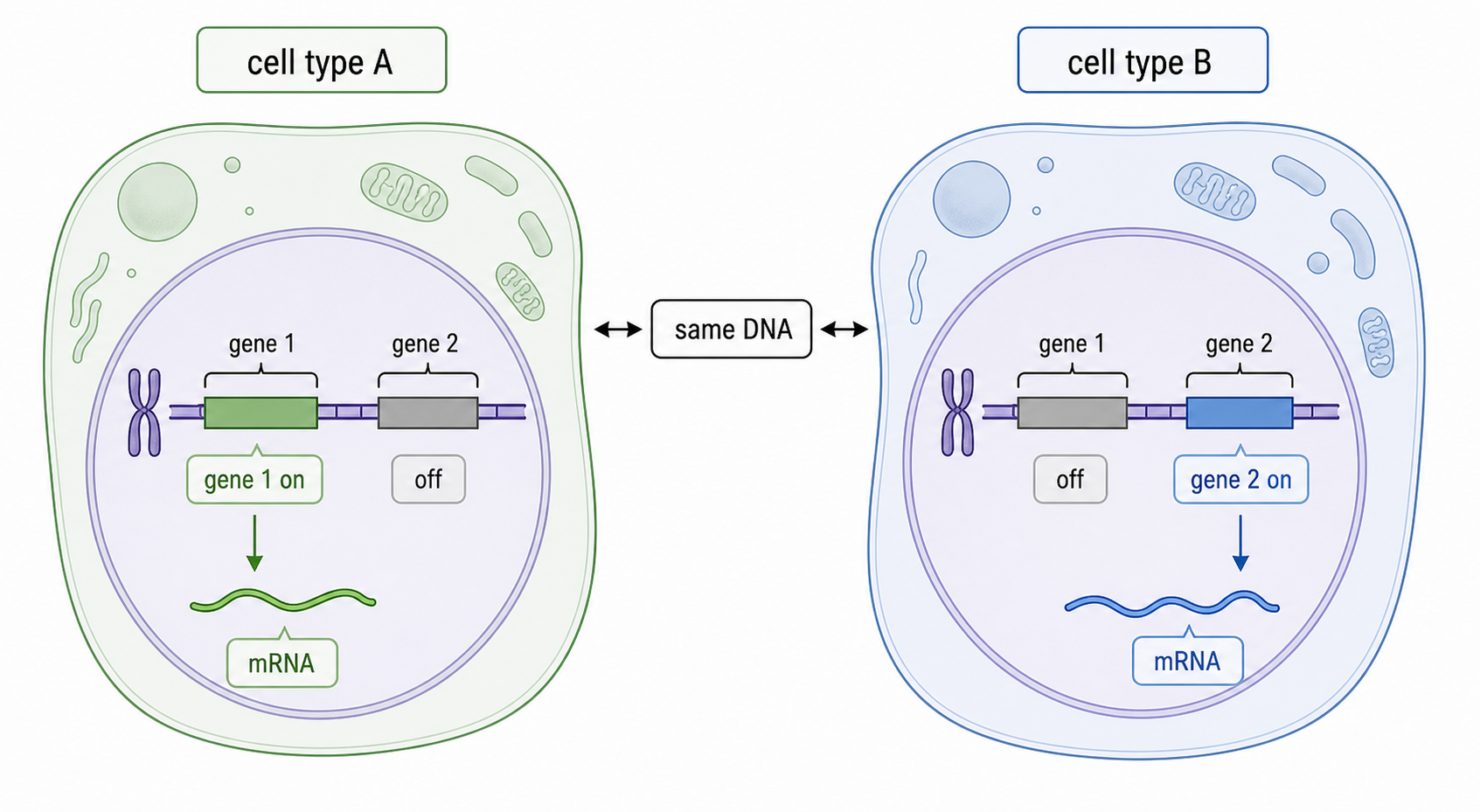
Transcription is the first stage of gene expression because a gene must be transcribed before its protein can be made. Cells regulate which genes are transcribed according to tissue type, developmental stage, and signals, so different cells can make different proteins from the same genome.

Transcription is the first stage of gene expression.
Cells regulate which genes are transcribed according to tissue, stage, and signals.
Gene expression control begins by deciding which genes become mRNA.

Gene expression starts with transcription choice.

Sort each statement.

Sort
Unsorted
4
gene expressed
0
gene not expressed now
0

Sort each statement.

Choose
gene is transcribed into mRNA
RNA polymerase does not transcribe the gene
signal activates transcription
no mRNA is made from the gene

Translate mRNA Into Polypeptide

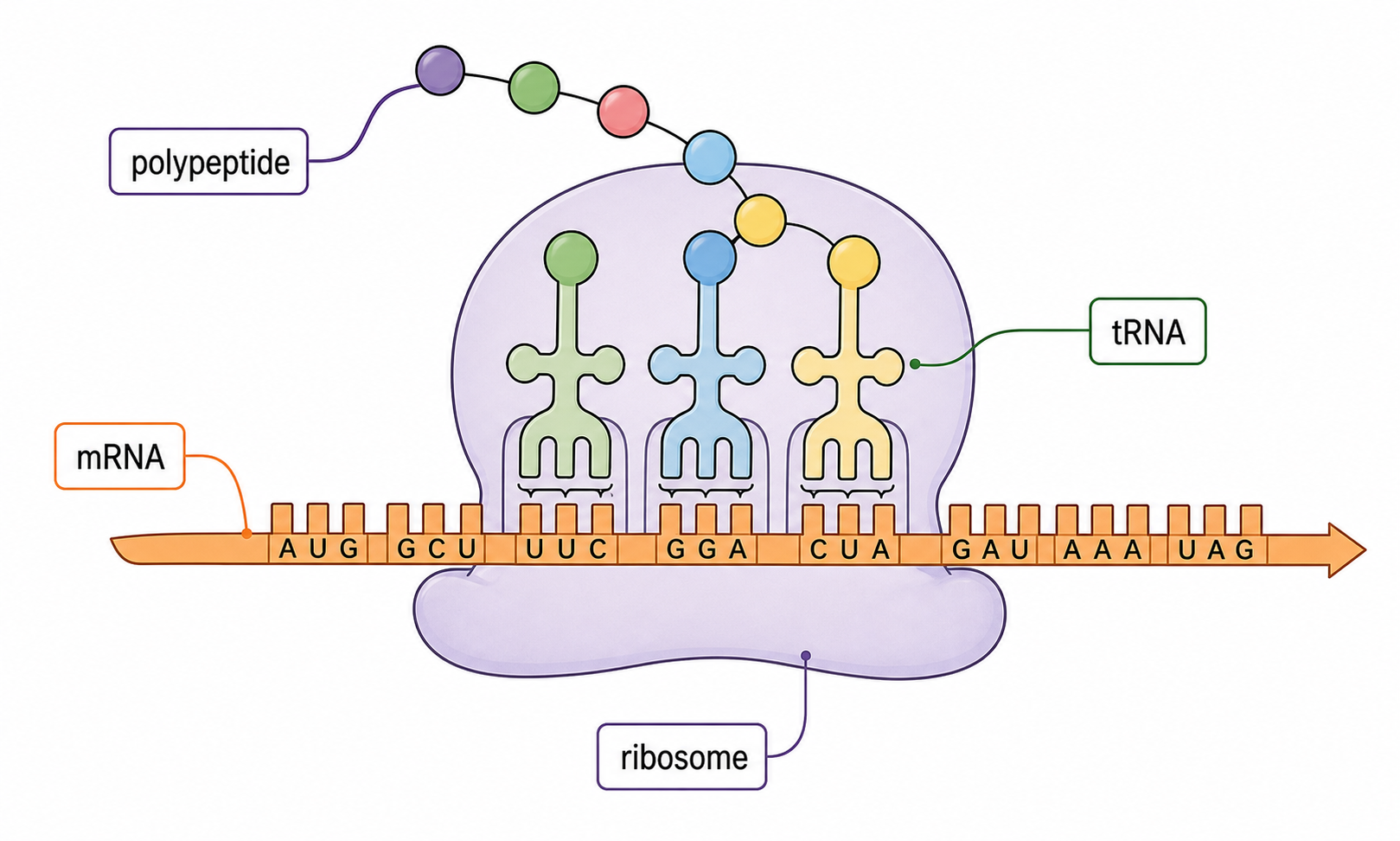
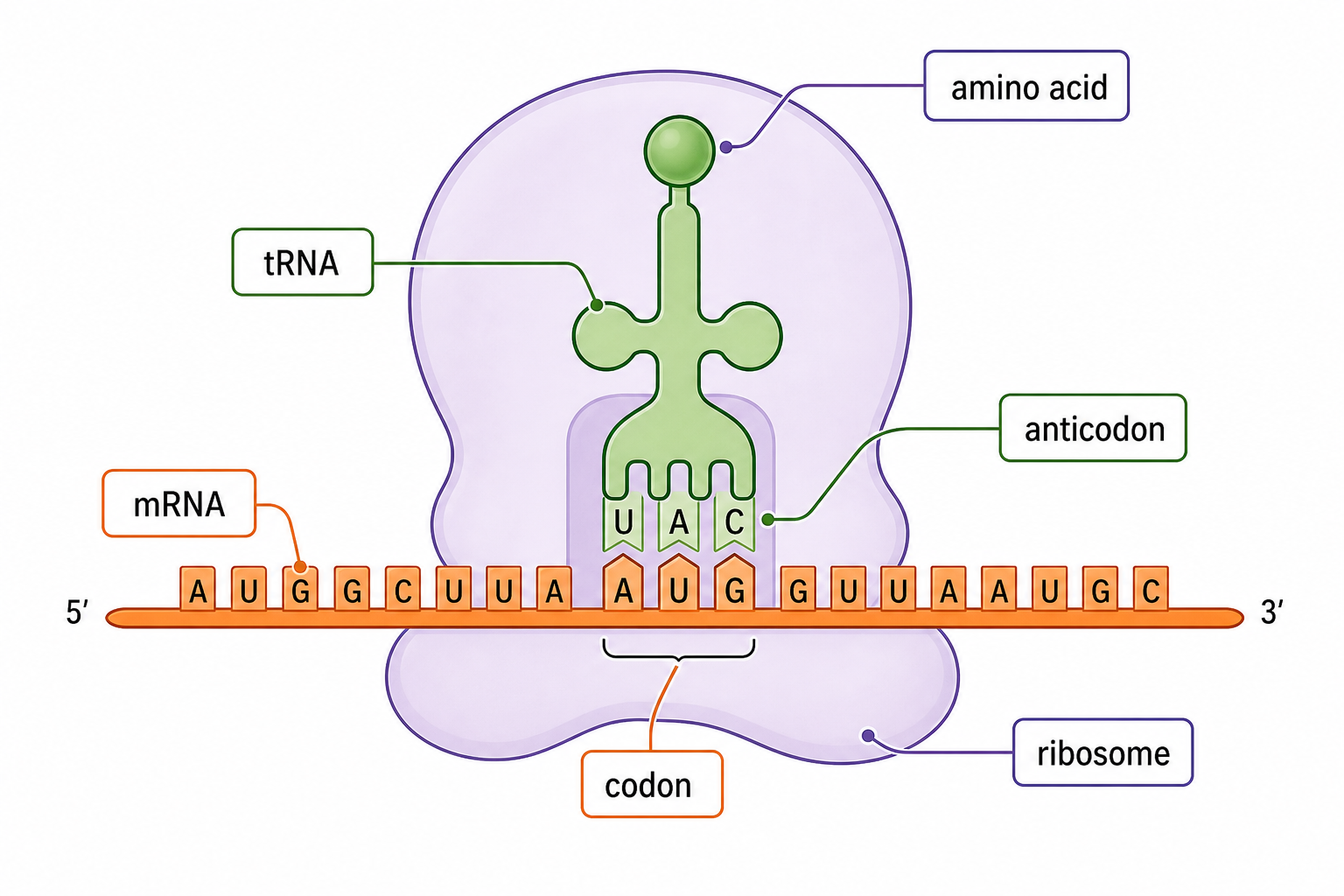
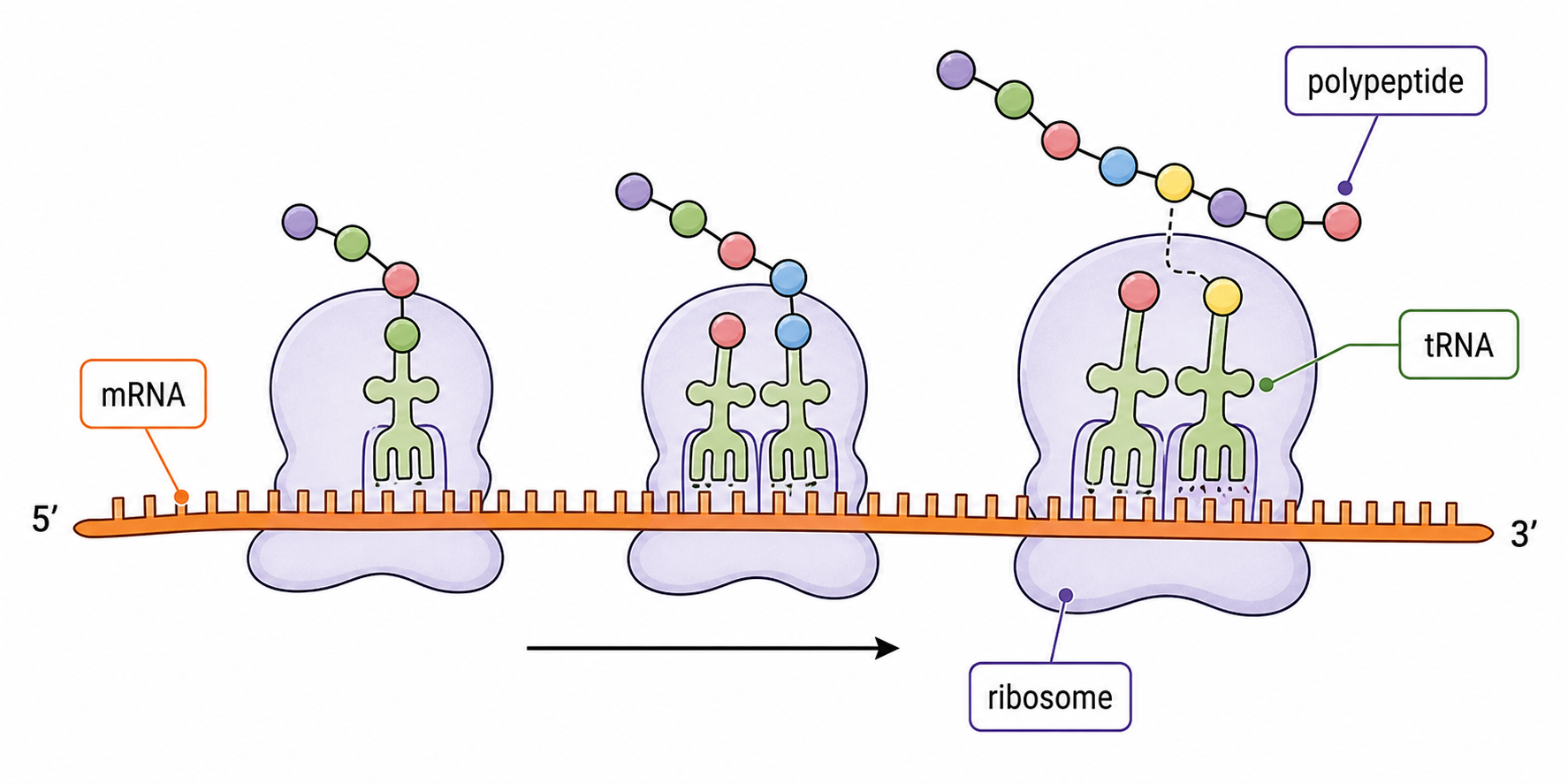
Translation is the decoding step at the ribosome. The ribosome reads mRNA codons, and the order of codons determines the order of amino acids in the growing polypeptide.

Translation decodes mRNA at ribosomes to synthesize polypeptides.
mRNA codon order determines amino acid sequence.
Codon sequence becomes primary structure.

mRNA codon order determines polypeptide order.

Put translation information flow in order.

Order
1
peptide bonds form
2
mRNA codons enter ribosome
3
amino acids are positioned
4
polypeptide sequence grows
5
tRNA anticodons pair with codons

Put translation information flow in order.

Choose
mRNA codons enter ribosome
tRNA anticodons pair with codons
amino acids are positioned
peptide bonds form
polypeptide sequence grows

Assign mRNA, tRNA, and Ribosome Jobs

Translation needs three jobs working together: mRNA provides codons, tRNA carries activated amino acids and has anticodons, and the ribosome holds mRNA and tRNAs in position so peptide bonds can form.

mRNA provides codons.
tRNA carries activated amino acids with anticodons.
Ribosomes hold mRNA and tRNAs so peptide bonds can form.

Each translation component has a different role.

Match each translation component to its role.

Match
Reasons
0/3

Match each translation component to its role.

Choose
mRNA
tRNA
ribosome

Pair Codon and Anticodon

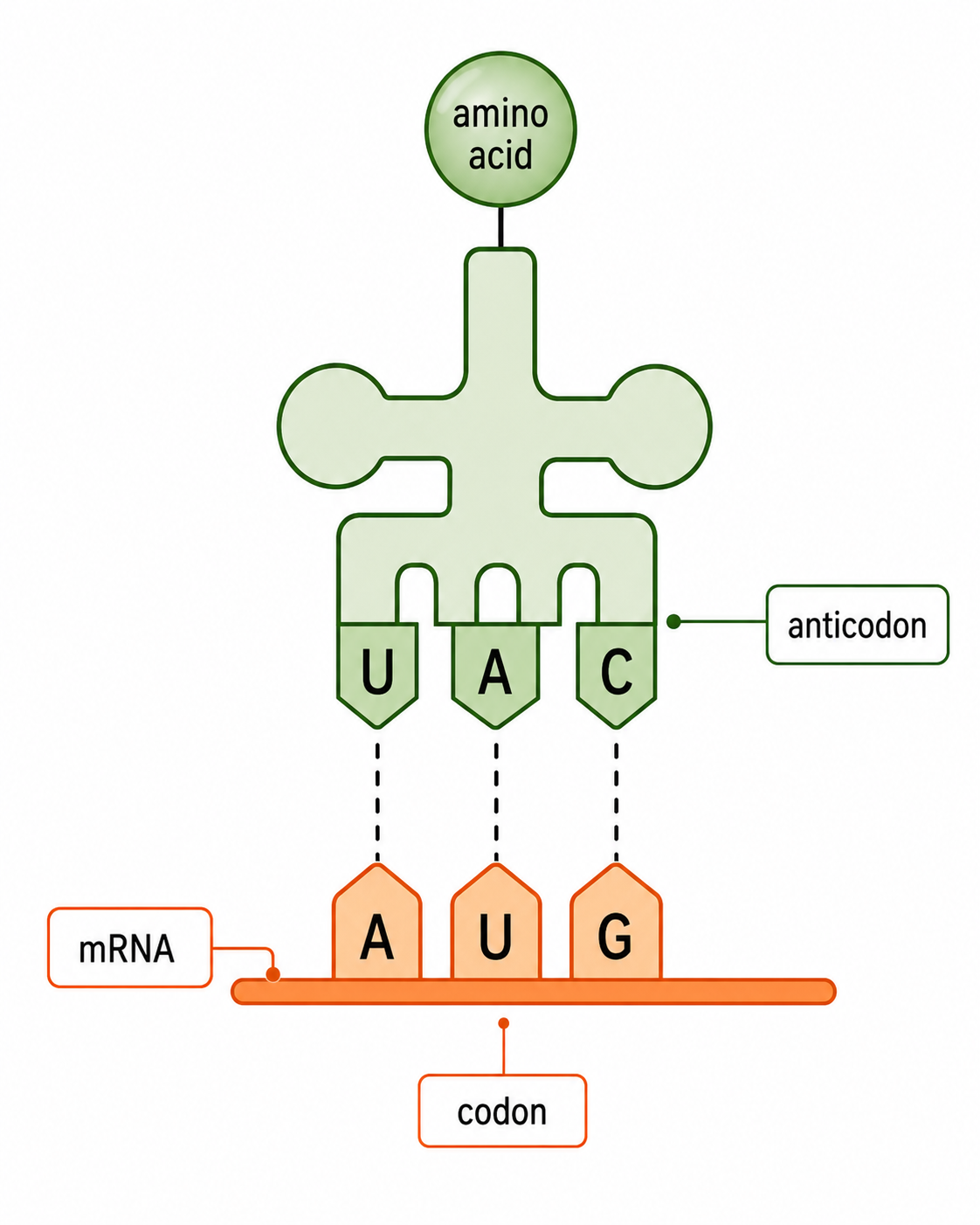
Correct translation depends on two matching steps. A tRNA anticodon pairs with a complementary mRNA codon by hydrogen bonding, and that tRNA is attached to a specific amino acid, so the correct amino acid is added to the growing polypeptide.

tRNA anticodons pair with complementary mRNA codons by hydrogen bonding.
Specific tRNA-amino acid attachment helps ensure correct amino acid addition.
Codon-anticodon pairing turns nucleic acid sequence into amino acid sequence.

Anticodon pairing positions the correct amino acid.

An mRNA codon is AUG. Which anticodon pairs with it?

Choose

An mRNA codon is AUG. Which anticodon pairs with it?

Choose

Decode Genetic Code Features

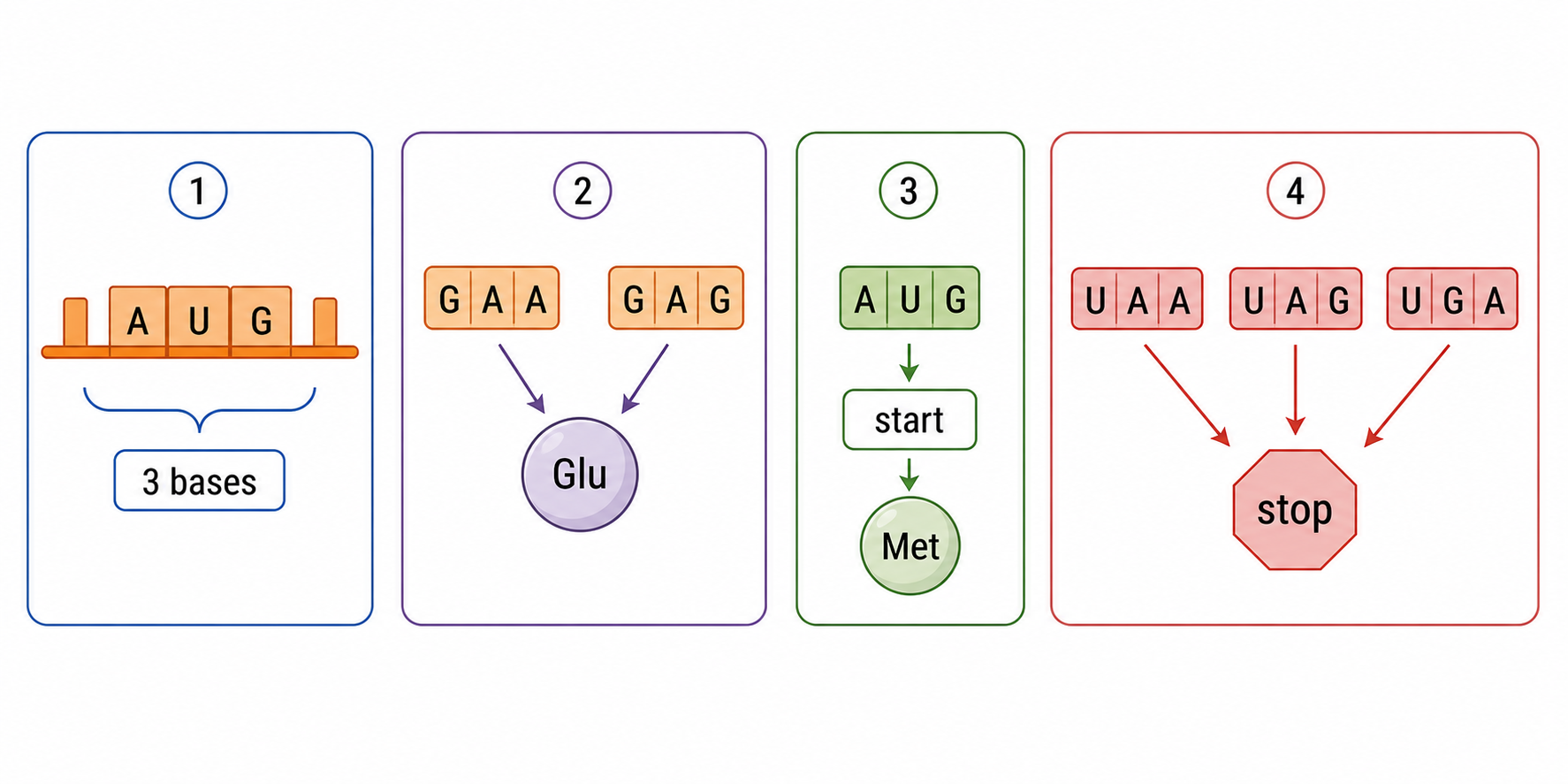
The genetic code describes how mRNA codons are read. It is triplet because three bases make one codon, degenerate because several codons can specify the same amino acid, and almost universal because most organisms use the same code; codons can specify amino acids, a start signal, or stop signals.

The genetic code is triplet, degenerate, and almost universal.
Codons specify amino acids, a start signal, or stop signals.
Degenerate means redundancy, not random meaning.

The genetic code is a rulebook for mRNA codons.

Match each genetic-code feature.

Match
Reasons
0/3

Match each genetic-code feature.

Choose
Triplet
Degenerate
Almost universal

Use the Genetic Code Table

Practice

Genetic code tables use mRNA codons, not DNA triplets. If a question gives template DNA, first transcribe it into complementary mRNA, then read the mRNA codons 5' to 3' to find amino acids.

Genetic code tables use mRNA codons, not DNA triplets.
Convert template DNA to mRNA first, then read codons 5' to 3'.
This avoids the common DNA-versus-mRNA table error.

The code table reads mRNA.

Put the code-table workflow in order.

Order
1
read mRNA codons 5 to 3
2
split mRNA into codons
3
transcribe complementary mRNA
4
identify the DNA template strand
5
use the genetic code table to identify amino acids

Put the code-table workflow in order.

Choose
identify the DNA template strand
transcribe complementary mRNA
split mRNA into codons
read mRNA codons 5 to 3
use the genetic code table to identify amino acids

Elongate the Polypeptide

During elongation, the ribosome moves along mRNA one codon at a time from start to stop. tRNAs bring amino acids, peptide bonds join them, and multiple ribosomes can translate the same mRNA at once as a polysome.

Ribosomes move along mRNA one codon at a time from start to stop.
Peptide bonds join amino acids.
Multiple ribosomes can form a polysome.

Elongation adds amino acids codon by codon.

Put translation elongation in order.

Order
1
peptide bond forms
2
ribosome moves one codon
3
ribosome reads the next codon
4
process repeats until a stop codon
5
matching tRNA enters with amino acid

Put translation elongation in order.

Choose
ribosome reads the next codon
matching tRNA enters with amino acid
peptide bond forms
ribosome moves one codon
process repeats until a stop codon

Link Mutation to Protein Change

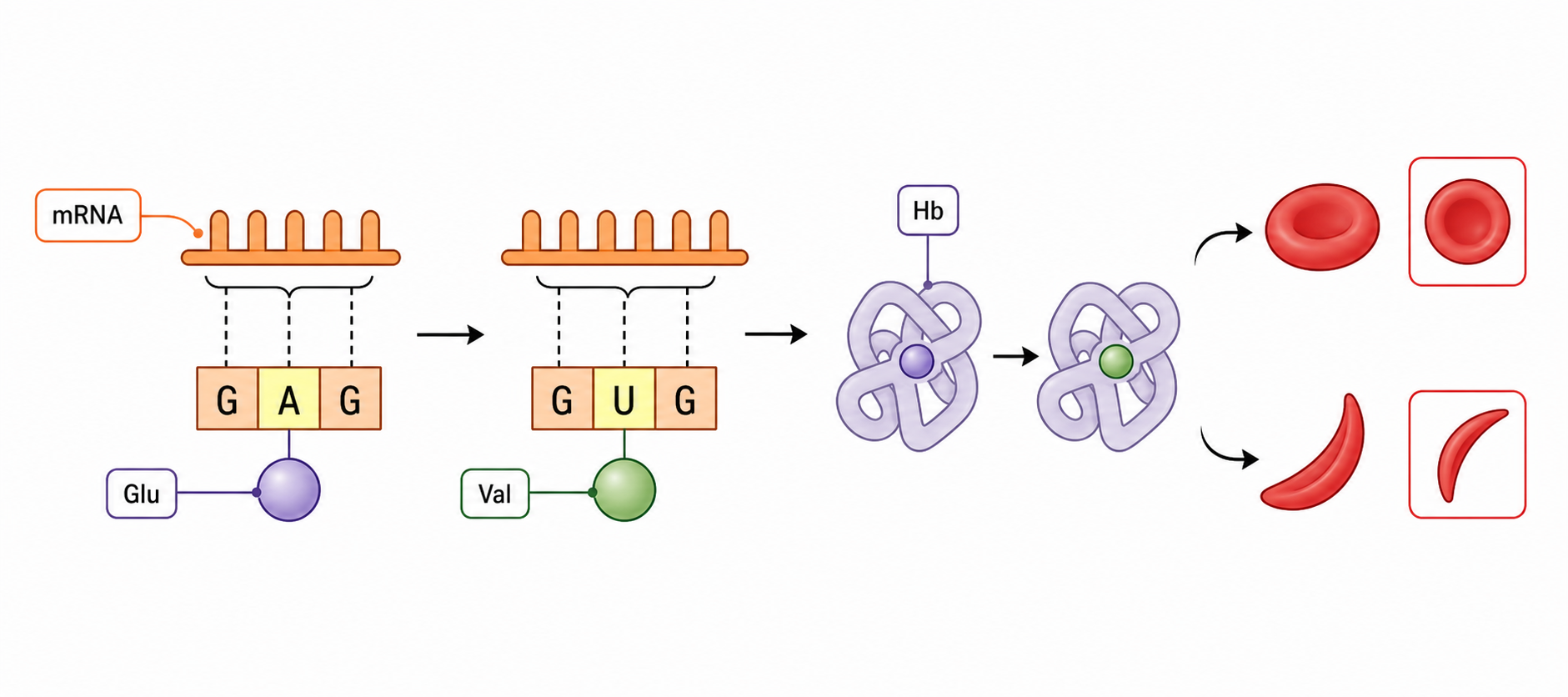
A mutation can change a DNA base sequence, which can change an mRNA codon and therefore the amino acid sequence. A changed primary structure may alter protein folding and function; sickle-cell haemoglobin is the key example of an amino acid change affecting haemoglobin structure.

Mutations can change codons and therefore amino acid sequence.
Changed primary structure may alter folding and function.
Sickle-cell haemoglobin is the named example.

Protein effects depend on sequence and folding.

Put the mutation effect chain in order.

Order
1
mRNA codon may change
2
DNA base sequence changes
3
primary structure changes
4
folding or function may change
5
different amino acid may be added

Put the mutation effect chain in order.

Choose
DNA base sequence changes
mRNA codon may change
different amino acid may be added
primary structure changes
folding or function may change

Read and Build 5' to 3'

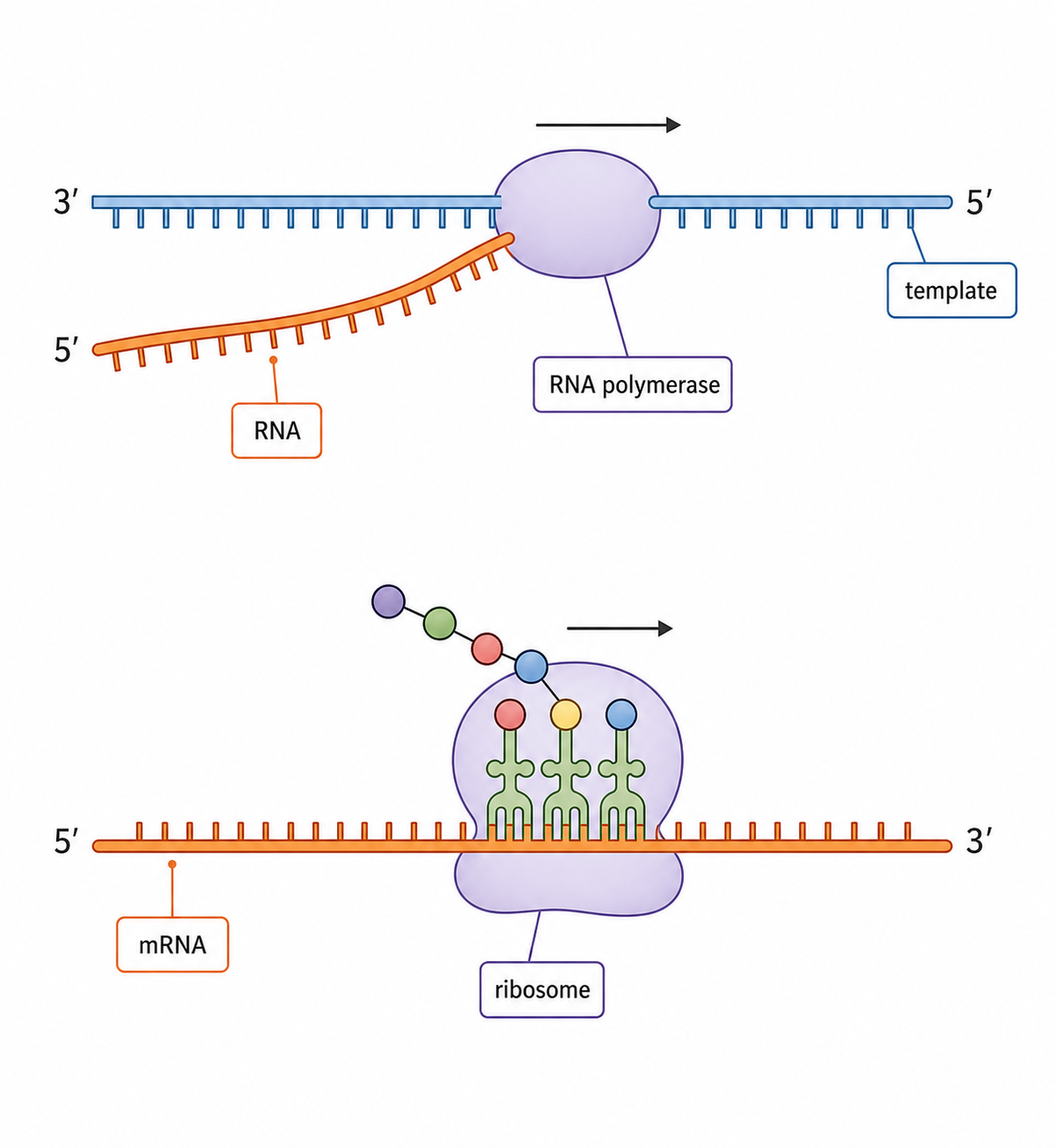
RNA polymerase reads the template DNA strand 3' to 5' while synthesizing RNA 5' to 3'. Ribosomes also translate mRNA codons in the 5' to 3' direction, so directionality controls which sequence is read and how codons are ordered.

RNA polymerase reads template DNA 3' to 5'.
RNA polymerase synthesizes RNA 5' to 3'.
Ribosomes translate mRNA codons in the 5' to 3' direction.

Direction tells you which sequence is read.

Label the directions of transcription and translation.

Label
Labels
3

Label the directions of transcription and translation.

Choose

Start Transcription at a Promoter

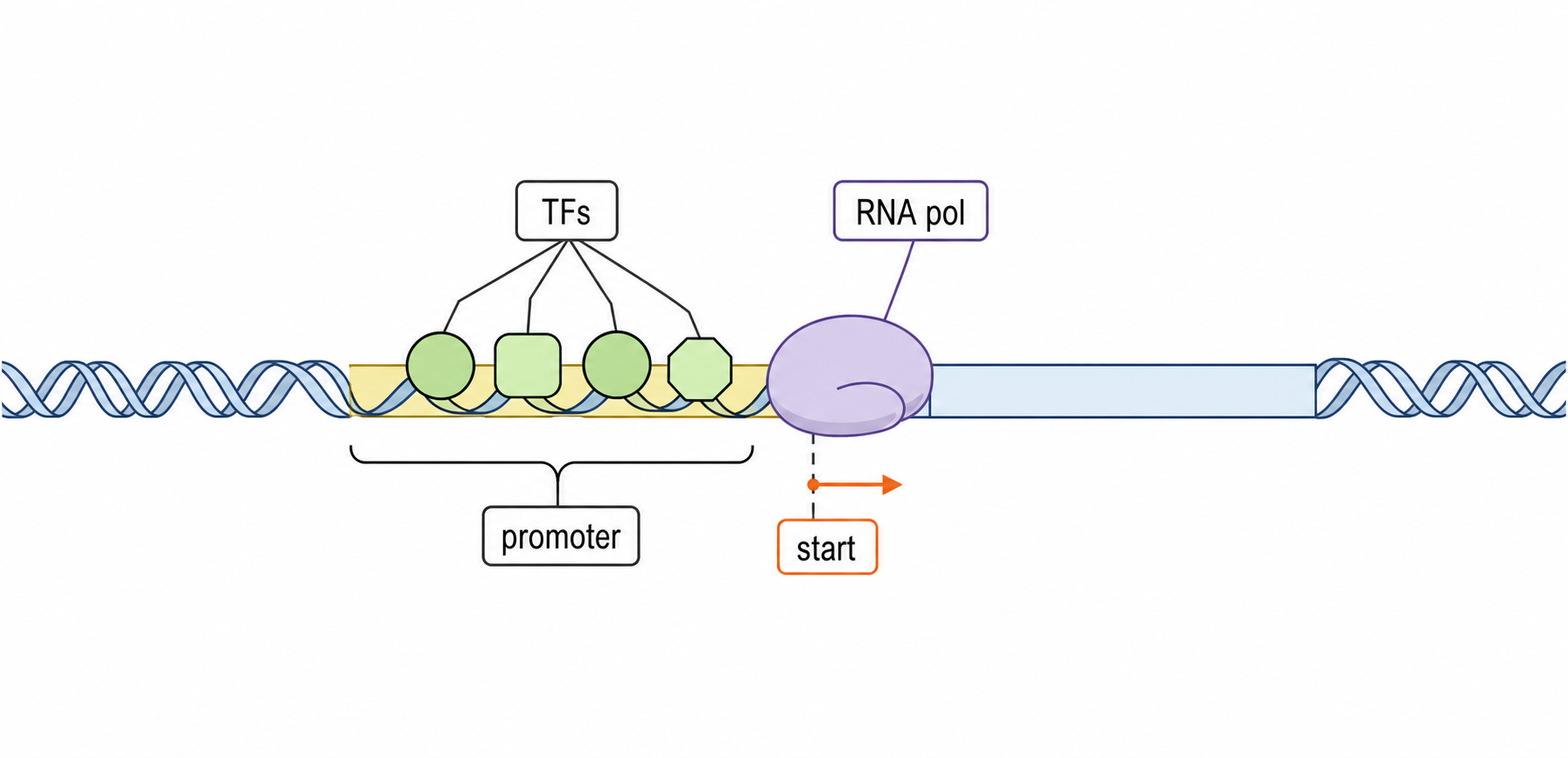
A promoter is a DNA sequence that marks where transcription should start and which direction it should proceed. In eukaryotes, transcription factors help RNA polymerase bind to the promoter and initiate transcription of the correct gene region.

Promoters mark transcription start regions and orientation.
Transcription factors help RNA polymerase bind and initiate in eukaryotes.
Promoters are control sequences, not amino acid coding sequences.

Promoters help start transcription in the right place and direction.

Match each initiation component.

Match
Reasons
0/3

Match each initiation component.

Choose
Promoter
Transcription factors
RNA polymerase

Classify Non-coding DNA

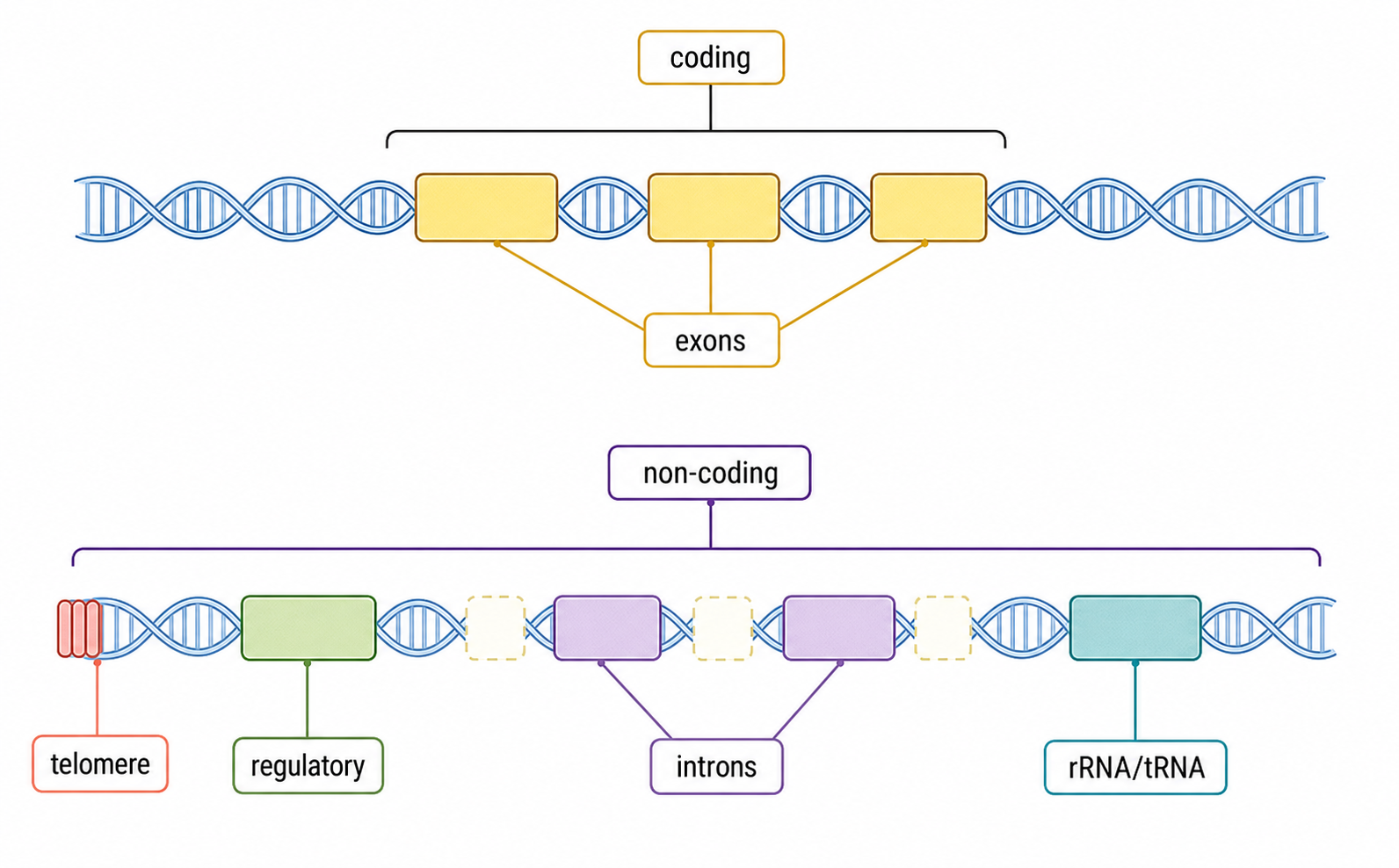
Non-coding DNA does not code for polypeptide amino acid sequences, but it can still be functional. Examples include introns, regulatory sequences, telomeres, rRNA genes, and tRNA genes.

Non-coding DNA does not code for polypeptide amino acid sequences.
Includes introns, regulatory sequences, telomeres, rRNA genes, and tRNA genes.
Non-coding does not mean useless.

Non-coding DNA can still have functions.

Sort each DNA sequence.

Sort
Unsorted
6
codes for polypeptide amino acid sequence
0
non-coding DNA
0

Sort each DNA sequence.

Choose
exon translated into amino acid sequence
intron
regulatory sequence
telomere
rRNA gene
tRNA gene

Process Eukaryotic pre-mRNA

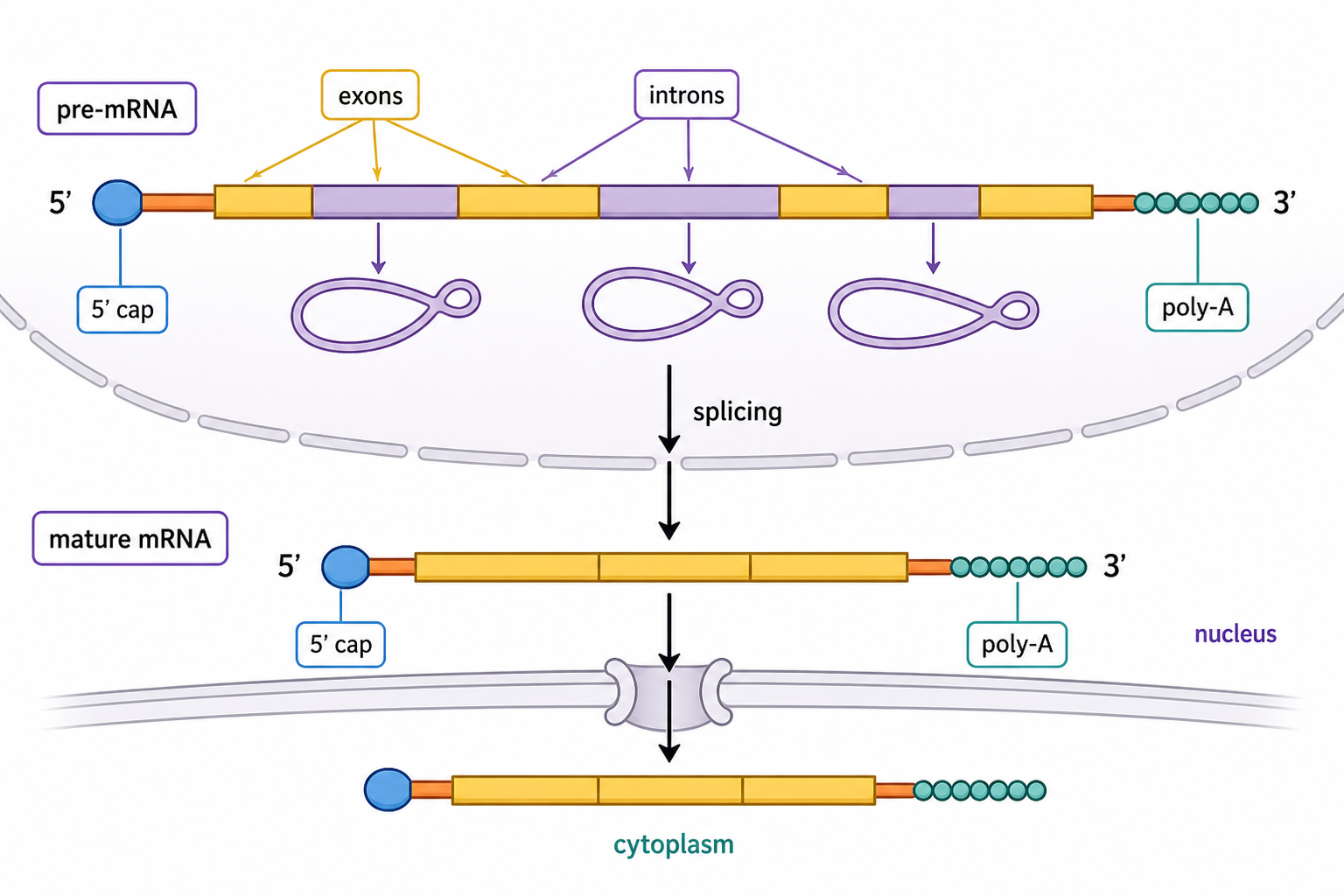
In eukaryotes, the first RNA product is pre-mRNA, not immediately a finished message. Before export and translation, processing adds a 5' cap, adds a poly-A tail, and removes introns by splicing to produce mature mRNA.

Eukaryotic pre-mRNA is modified before export and translation.
Processing adds a 5' cap and poly-A tail.
Splicing removes introns.

Processing prepares eukaryotic mRNA.

Put mRNA processing in order.

Order
1
5 cap is added
2
poly-A tail is added
3
pre-mRNA is transcribed
4
introns are removed by splicing
5
mature mRNA is ready for export and translation

Put mRNA processing in order.

Choose
pre-mRNA is transcribed
5 cap is added
poly-A tail is added
introns are removed by splicing
mature mRNA is ready for export and translation

Use Alternative Splicing

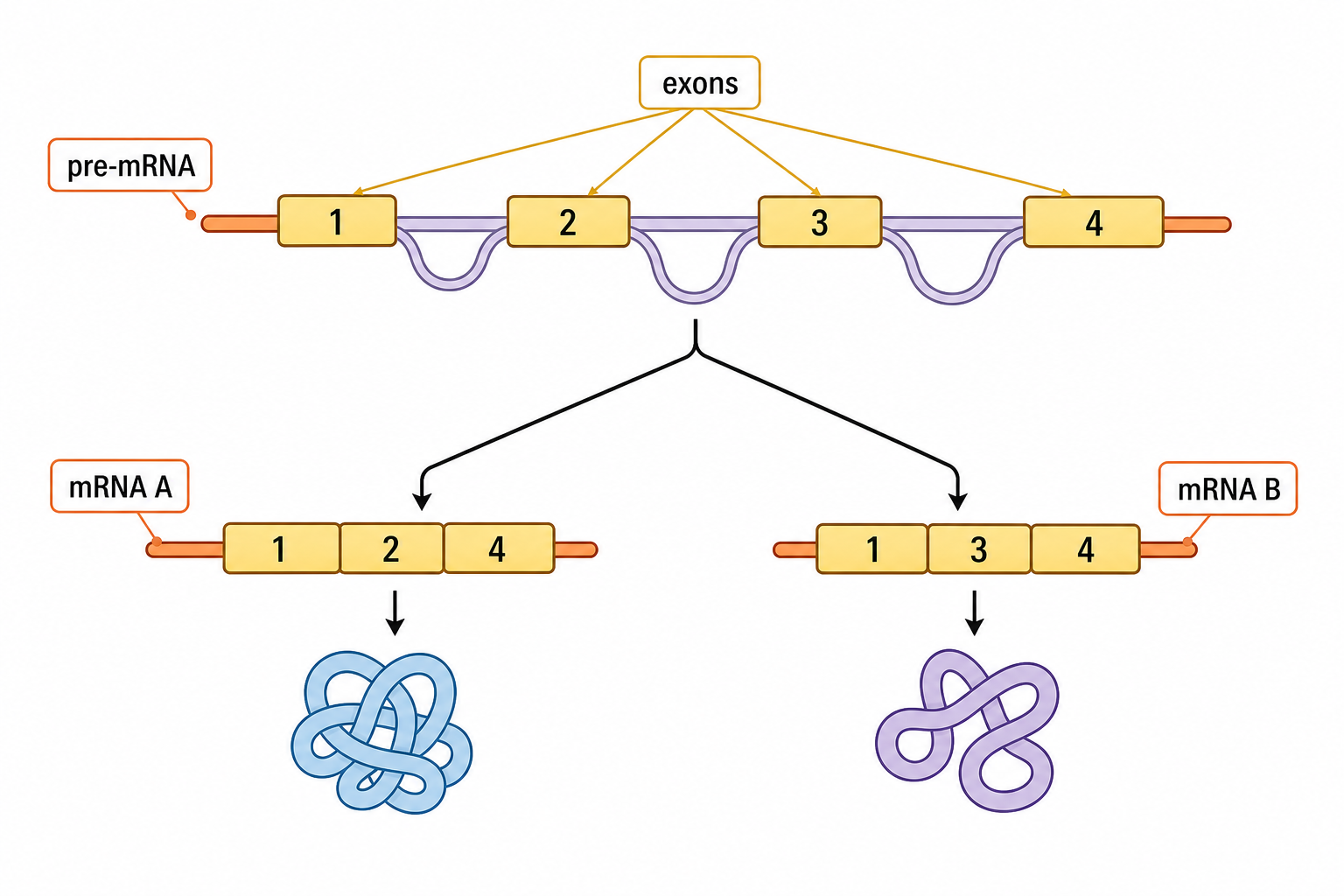
Alternative splicing means different exon combinations can be joined from the same pre-mRNA. This lets one gene produce multiple protein variants in different cells or developmental stages.

Alternative splicing joins different exon combinations from one pre-mRNA.
One gene can produce multiple protein variants in different cells or stages.
Protein diversity can increase without adding another gene.

Different exon combinations can produce different proteins.

A cell includes exon 2 but another cell skips exon 2 from the same pre-mRNA. Predict the consequence.

Predict

A cell includes exon 2 but another cell skips exon 2 from the same pre-mRNA. Predict the consequence.

Choose

Initiate Translation at AUG

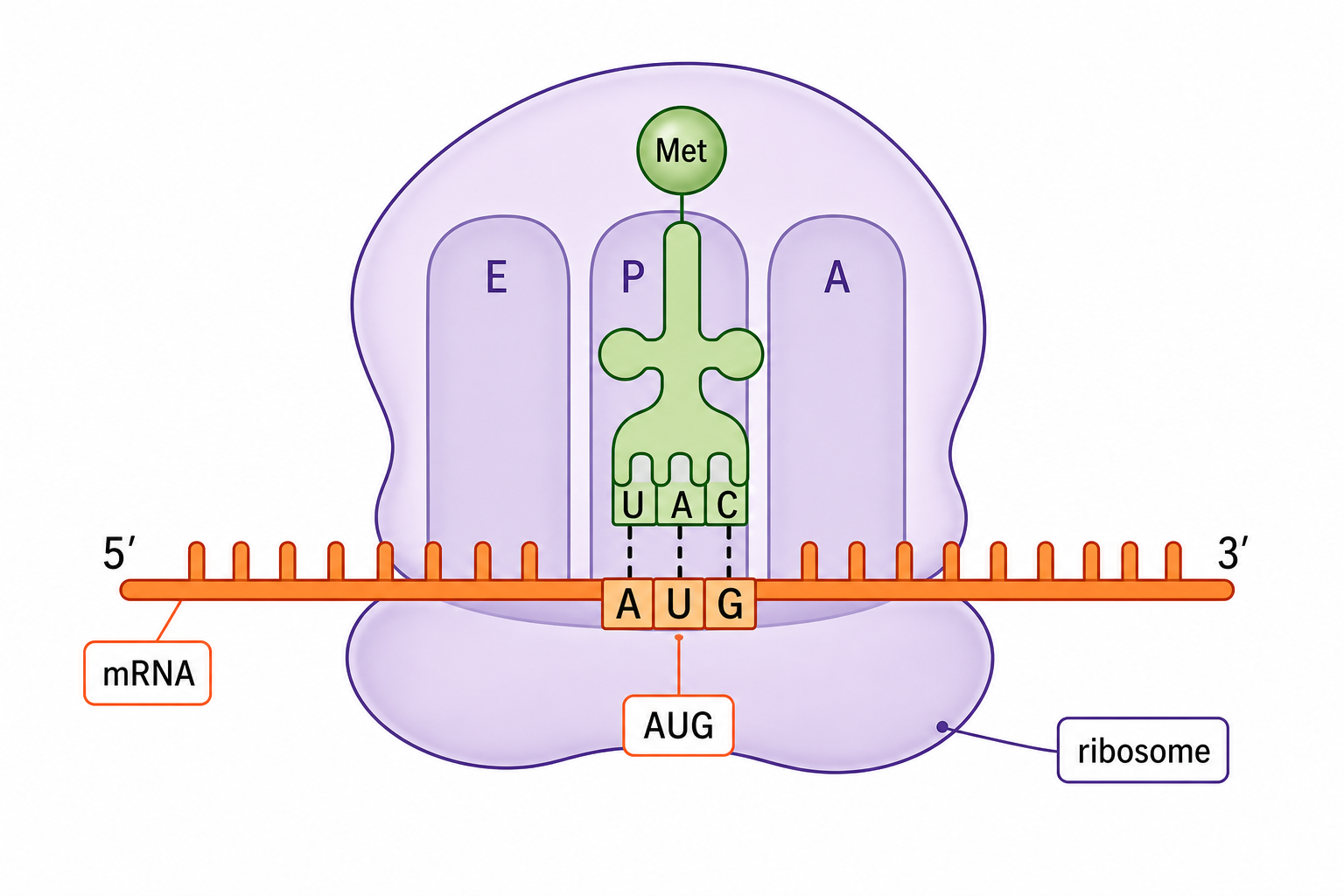
Translation initiation starts at the AUG start codon. Ribosomal subunits assemble there, the initiator tRNA enters the P site, and the A, P, and E sites organize tRNA entry, peptide holding/transfer, and exit.

Translation initiation assembles ribosomal subunits at the start codon AUG.
Initiator tRNA enters the P site.
A, P, and E sites organize tRNA movement.

Initiation sets the reading frame.

Label the translation initiation complex.

Label
Labels
5

Label the translation initiation complex.

Choose

Modify the Polypeptide

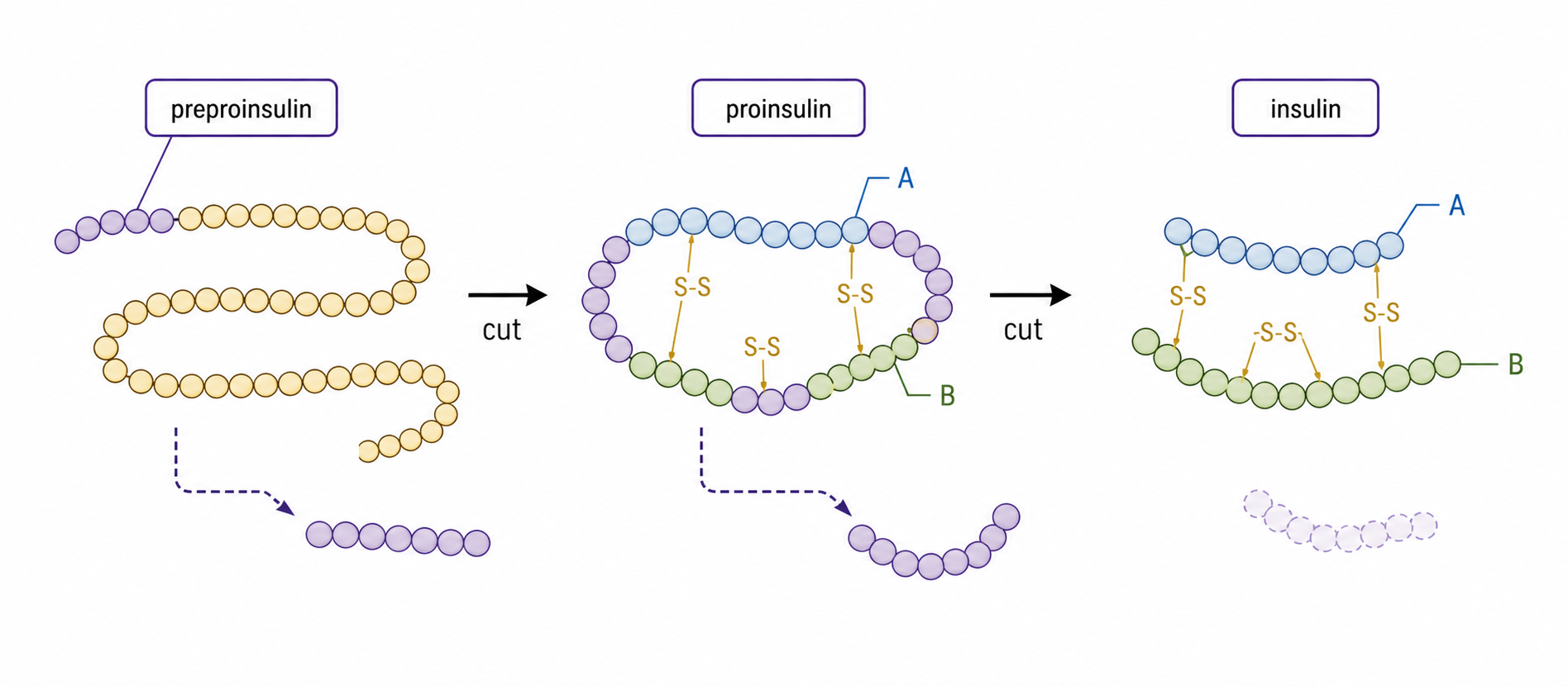
A newly made polypeptide is not always the final active protein. Polypeptides may be folded, cleaved, or chemically modified; preproinsulin processing into active insulin is the key example.

Newly made polypeptides may be folded, cleaved, or chemically modified.
Preproinsulin processing to active insulin is a key example.
Translation makes a polypeptide; modification can make it functional.

Post-translational processing can activate proteins.

Which statement best explains preproinsulin processing?

Choose

Which statement best explains preproinsulin processing?

Choose

Recycle Amino Acids with Proteasomes

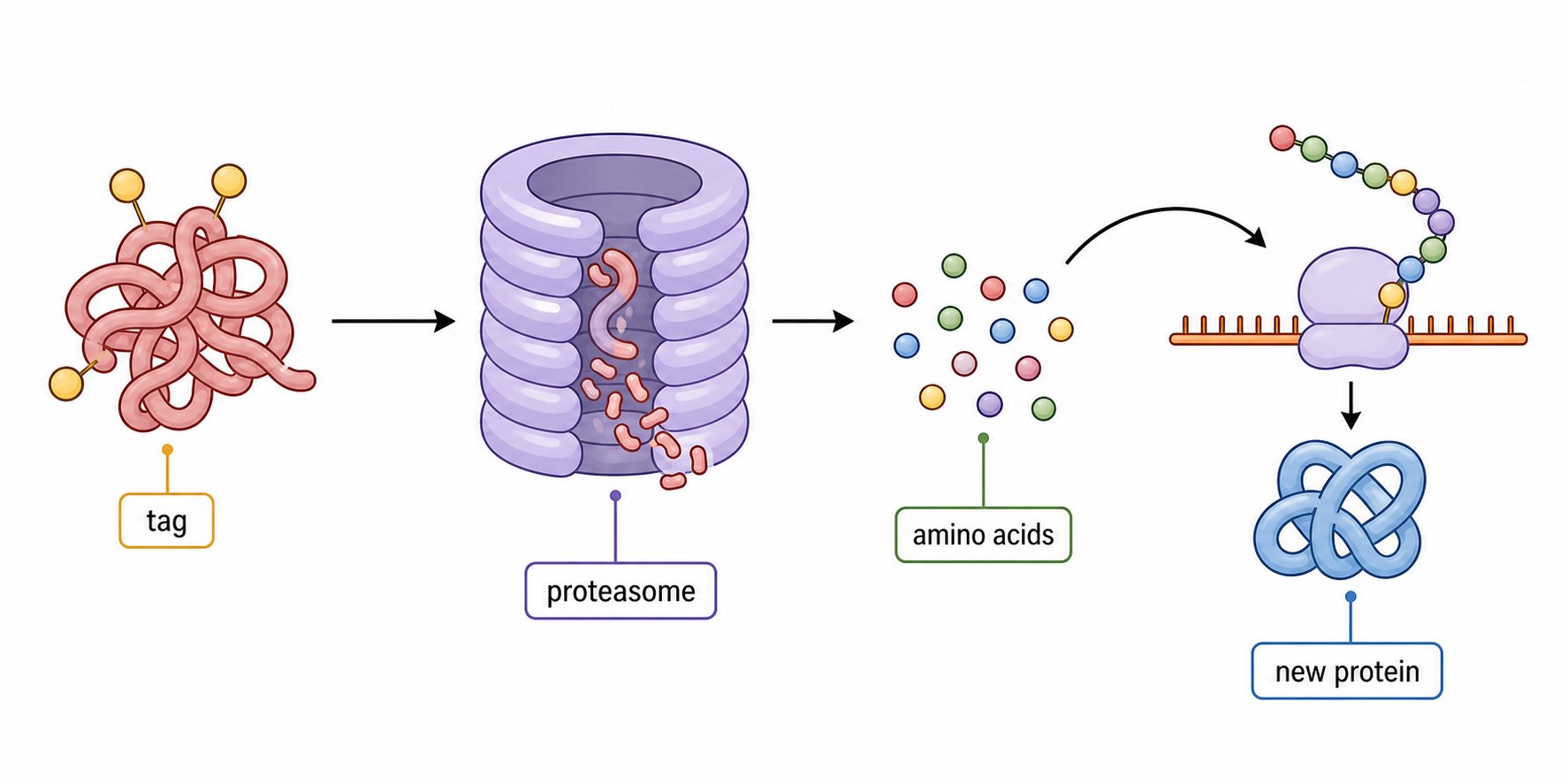
Proteasomes degrade proteins that are tagged, damaged, or no longer needed. This releases amino acids for new protein synthesis and helps maintain proteome quality control.

Proteasomes degrade tagged, damaged, or unneeded proteins.
Amino acid recycling supports new protein synthesis and proteome quality control.
Protein synthesis also depends on removing and recycling old proteins.

Proteasomes connect protein breakdown to new synthesis.

Match each proteasome step.

Match
Reasons
0/3

Match each proteasome step.

Choose
Tagged/damaged protein
Proteasome
Amino acids

Transfer: Explain Core Protein Synthesis

Exam Practice

Transcription makes mRNA as a mobile copy of gene information; RNA polymerase synthesizes RNA complementary to the DNA template strand. Free RNA nucleotides align by complementary base pairing and hydrogen bonding; DNA adenine pairs with RNA uracil and cytosine pairs with guanine. DNA template strands are transcribed without altering the base sequence; the sugar-phosphate backbone and base pairing preserve genetic information. Transcription is the first stage of gene expression; cells regulate which genes are transcribed according to tissue, stage, and signals. Translation decodes mRNA at ribosomes to synthesize polypeptides; mRNA codon order determines amino acid sequence. mRNA provides codons, tRNA carries activated amino acids with anticodons, and ribosomes hold mRNA and tRNAs so peptide bonds can form. tRNA anticodons pair with complementary mRNA codons by hydrogen bonding; specific tRNA-amino acid attachment helps ensure correct amino acid addition. The genetic code is triplet, degenerate, and almost universal; codons specify amino acids, a start signal, or stop signals. Genetic code tables use mRNA codons, not DNA triplets; convert template DNA to mRNA first, then read codons 5' to 3'. Ribosomes move along mRNA one codon at a time from start to stop; peptide bonds join amino acids and multiple ribosomes can form a polysome. Mutations can change codons and therefore amino acid sequence; changed primary structure may alter folding and function, such as sickle-cell haemoglobin.

Transcription makes mRNA as a mobile copy of gene information; RNA polymerase synthesizes RNA complementary to the DNA template strand.
Free RNA nucleotides align by complementary base pairing and hydrogen bonding; DNA adenine pairs with RNA uracil and cytosine pairs with guanine.
DNA template strands are transcribed without altering the base sequence; the sugar-phosphate backbone and base pairing preserve genetic information.
Transcription is the first stage of gene expression; cells regulate which genes are transcribed according to tissue, stage, and signals.
Translation decodes mRNA at ribosomes to synthesize polypeptides; mRNA codon order determines amino acid sequence.
mRNA provides codons, tRNA carries activated amino acids with anticodons, and ribosomes hold mRNA and tRNAs so peptide bonds can form.
tRNA anticodons pair with complementary mRNA codons by hydrogen bonding; specific tRNA-amino acid attachment helps ensure correct amino acid addition.
The genetic code is triplet, degenerate, and almost universal; codons specify amino acids, a start signal, or stop signals.
Genetic code tables use mRNA codons, not DNA triplets; convert template DNA to mRNA first, then read codons 5' to 3'.
Ribosomes move along mRNA one codon at a time from start to stop; peptide bonds join amino acids and multiple ribosomes can form a polysome.
Mutations can change codons and therefore amino acid sequence; changed primary structure may alter folding and function, such as sickle-cell haemoglobin.

Put the answer frame in order.

Order
1
make mRNA from a DNA template by transcription
2
use the genetic code table from mRNA codons read 5 to 3
3
keep DNA unchanged while using RNA base-pairing rules
4
link mutations to amino acid sequence, folding, and function
5
regulate transcription as the first stage of gene expression
6
translate mRNA at ribosomes using mRNA, tRNA, anticodons, and peptide bonds

Use this for SL/core questions about transcription, RNA base pairing, gene expression, translation, tRNA/ribosome roles, genetic code table use, elongation, and mutation effects.

Transcription makes mRNA as a mobile copy of gene information; RNA polymerase synthesizes RNA complementary to the DNA template strand.
Free RNA nucleotides align by complementary base pairing and hydrogen bonding; DNA adenine pairs with RNA uracil and cytosine pairs with guanine.
DNA template strands are transcribed without altering the base sequence; the sugar-phosphate backbone and base pairing preserve genetic information.
Transcription is the first stage of gene expression; cells regulate which genes are transcribed according to tissue, stage, and signals.
Translation decodes mRNA at ribosomes to synthesize polypeptides; mRNA codon order determines amino acid sequence.
mRNA provides codons, tRNA carries activated amino acids with anticodons, and ribosomes hold mRNA and tRNAs so peptide bonds can form.
tRNA anticodons pair with complementary mRNA codons by hydrogen bonding; specific tRNA-amino acid attachment helps ensure correct amino acid addition.
The genetic code is triplet, degenerate, and almost universal; codons specify amino acids, a start signal, or stop signals.
Genetic code tables use mRNA codons, not DNA triplets; convert template DNA to mRNA first, then read codons 5' to 3'.
Ribosomes move along mRNA one codon at a time from start to stop; peptide bonds join amino acids and multiple ribosomes can form a polysome.
Mutations can change codons and therefore amino acid sequence; changed primary structure may alter folding and function, such as sickle-cell haemoglobin.

Use this for SL/core questions about transcription, RNA base pairing, gene expression, translation, tRNA/ribosome roles, genetic code table use, elongation, and mutation effects.

Common loss: reading DNA triplets directly in a code table, swapping codon and anticodon, or naming mutation without linking codon, amino acid, primary structure, folding, and function.

Transfer: Explain HL Protein Synthesis Details

Exam Practice

RNA polymerase reads template DNA 3' to 5' and synthesizes RNA 5' to 3'; ribosomes translate mRNA codons in the 5' to 3' direction. Promoters mark transcription start regions and orientation; transcription factors help RNA polymerase bind and initiate in eukaryotes. Non-coding DNA does not code for polypeptide amino acid sequences and includes introns, regulatory sequences, telomeres, rRNA genes, and tRNA genes. Eukaryotic pre-mRNA is modified before export and translation by adding a 5' cap and poly-A tail and removing introns by splicing. Alternative splicing joins different exon combinations from one pre-mRNA, so one gene can produce multiple protein variants in different cells or stages. Translation initiation assembles ribosomal subunits at the start codon AUG; initiator tRNA enters the P site and A, P, and E sites organize tRNA movement. Newly made polypeptides may be folded, cleaved, or chemically modified; preproinsulin processing to active insulin is a key example. Proteasomes degrade tagged, damaged, or unneeded proteins; amino acid recycling supports new protein synthesis and proteome quality control.

RNA polymerase reads template DNA 3' to 5' and synthesizes RNA 5' to 3'; ribosomes translate mRNA codons in the 5' to 3' direction.
Promoters mark transcription start regions and orientation; transcription factors help RNA polymerase bind and initiate in eukaryotes.
Non-coding DNA does not code for polypeptide amino acid sequences and includes introns, regulatory sequences, telomeres, rRNA genes, and tRNA genes.
Eukaryotic pre-mRNA is modified before export and translation by adding a 5' cap and poly-A tail and removing introns by splicing.
Alternative splicing joins different exon combinations from one pre-mRNA, so one gene can produce multiple protein variants in different cells or stages.
Translation initiation assembles ribosomal subunits at the start codon AUG; initiator tRNA enters the P site and A, P, and E sites organize tRNA movement.
Newly made polypeptides may be folded, cleaved, or chemically modified; preproinsulin processing to active insulin is a key example.
Proteasomes degrade tagged, damaged, or unneeded proteins; amino acid recycling supports new protein synthesis and proteome quality control.

Put the answer frame in order.

Order
1
separate coding from non-coding DNA functions
2
initiate translation at AUG with initiator tRNA in the P site
3
process eukaryotic pre-mRNA with cap, poly-A tail, and splicing
4
use alternative splicing to explain multiple protein variants
5
apply 3' to 5' template reading and 5' to 3' RNA synthesis/translation
6
start transcription at promoters using transcription factors and RNA polymerase
7
modify polypeptides such as preproinsulin and recycle amino acids using proteasomes

Use this for HL questions about transcription/translation directionality, promoters, transcription factors, non-coding DNA, post-transcriptional modification, alternative splicing, translation initiation, polypeptide modification, and proteasomes.

RNA polymerase reads template DNA 3' to 5' and synthesizes RNA 5' to 3'; ribosomes translate mRNA codons in the 5' to 3' direction.
Promoters mark transcription start regions and orientation; transcription factors help RNA polymerase bind and initiate in eukaryotes.
Non-coding DNA does not code for polypeptide amino acid sequences and includes introns, regulatory sequences, telomeres, rRNA genes, and tRNA genes.
Eukaryotic pre-mRNA is modified before export and translation by adding a 5' cap and poly-A tail and removing introns by splicing.
Alternative splicing joins different exon combinations from one pre-mRNA, so one gene can produce multiple protein variants in different cells or stages.
Translation initiation assembles ribosomal subunits at the start codon AUG; initiator tRNA enters the P site and A, P, and E sites organize tRNA movement.
Newly made polypeptides may be folded, cleaved, or chemically modified; preproinsulin processing to active insulin is a key example.
Proteasomes degrade tagged, damaged, or unneeded proteins; amino acid recycling supports new protein synthesis and proteome quality control.

Use this for HL questions about transcription/translation directionality, promoters, transcription factors, non-coding DNA, post-transcriptional modification, alternative splicing, translation initiation, polypeptide modification, and proteasomes.

Common loss: treating non-coding DNA as useless, forgetting that code tables use mRNA, mixing up cap/tail/splicing, or saying proteasomes synthesize proteins.