
Why DNA Must Replicate
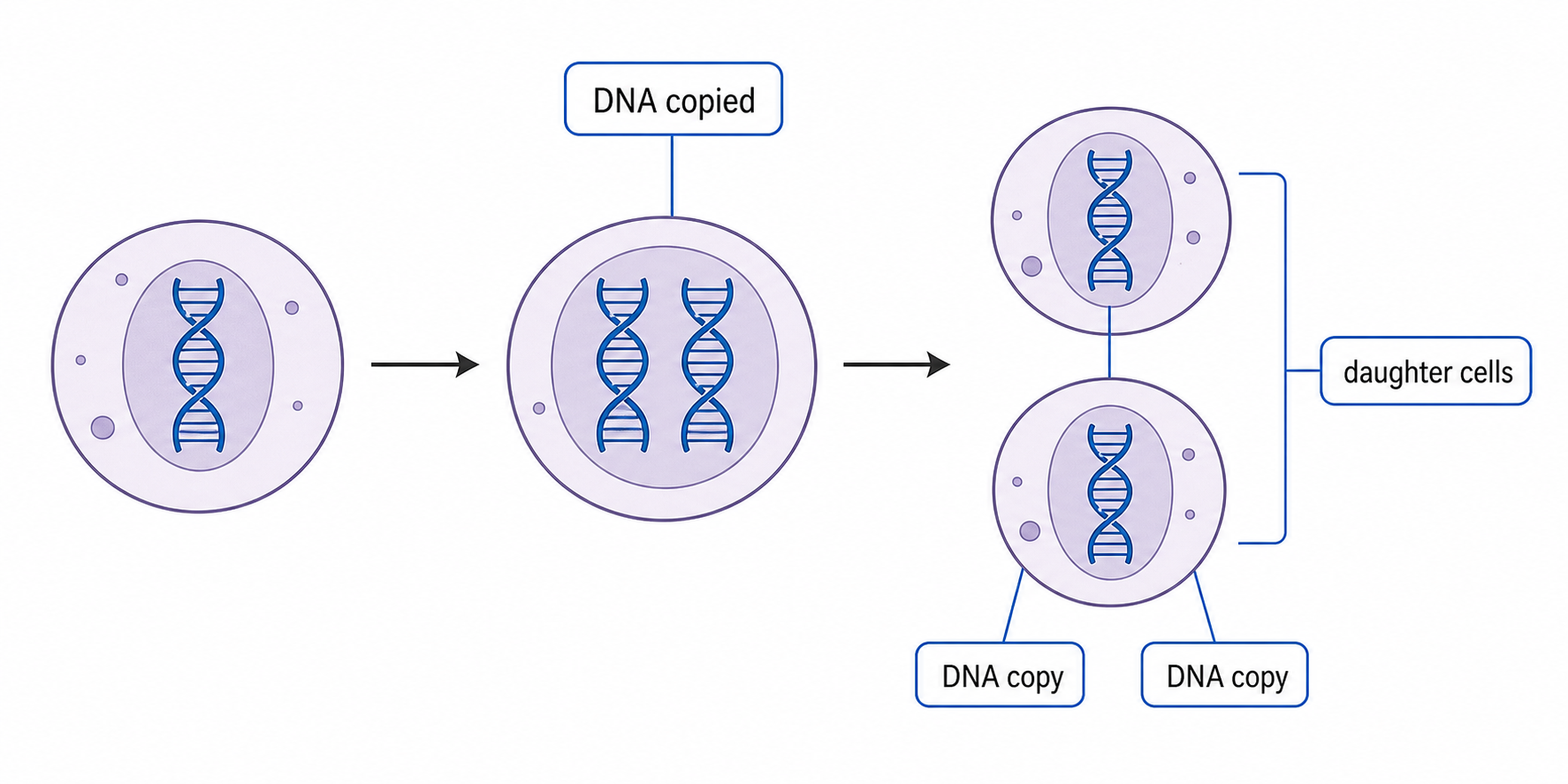
DNA replication happens before cell division so each new cell can receive a complete copy of the genetic information. This is why replication matters for reproduction, growth, and tissue replacement: it maintains genetic continuity rather than making each division genetically random.
Replication prepares genetic continuity before division.
Put the purpose of replication in order.
OrderPut the purpose of replication in order.
ChooseBuild the Semi-Conservative Model
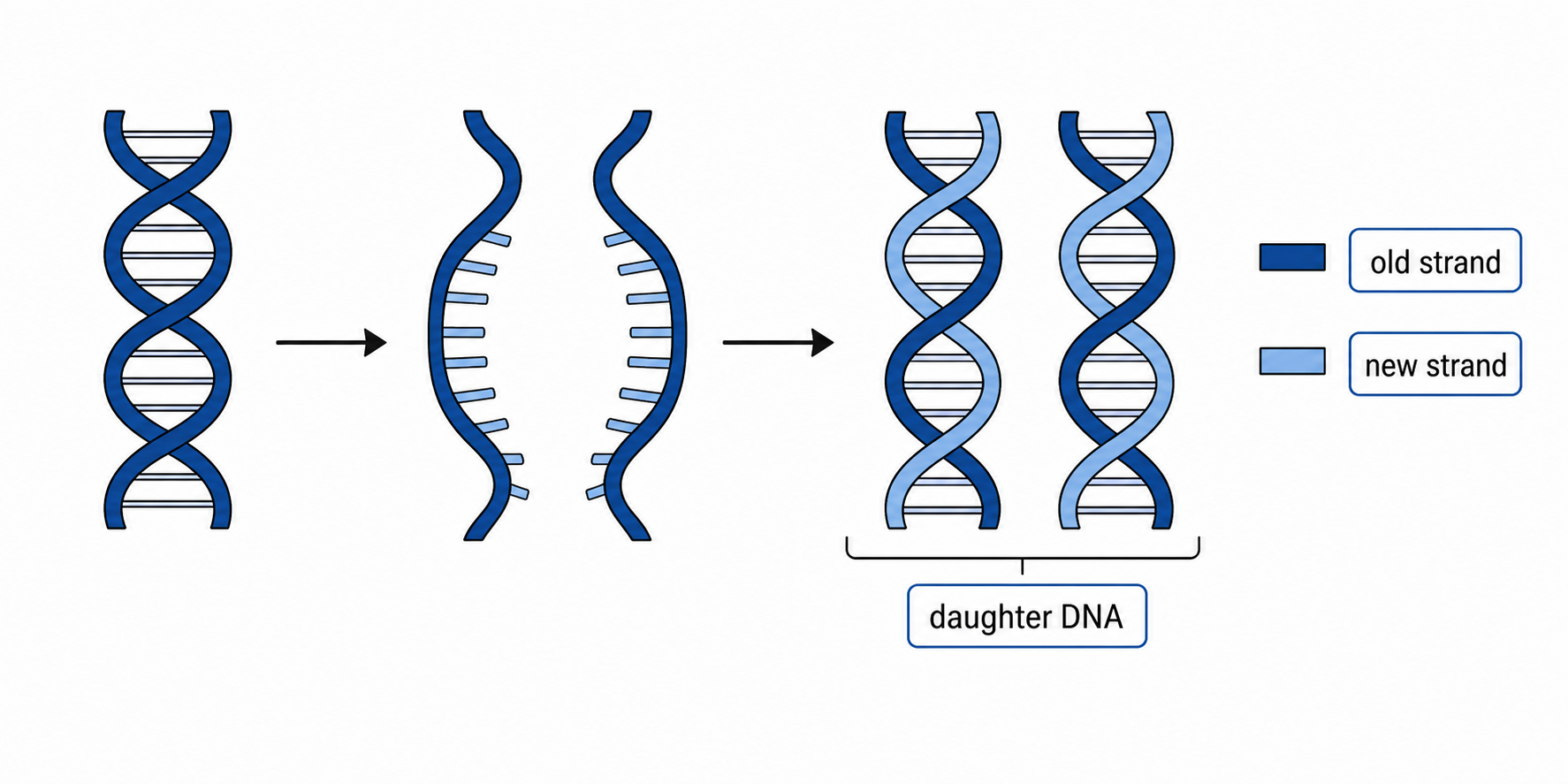
Semi-conservative replication means each daughter DNA molecule contains one original strand and one newly synthesized strand. Complementary base pairing explains the copying accuracy, and Meselson-Stahl isotope evidence supports this model by showing hybrid DNA after one generation and hybrid plus light DNA after two generations.
Each daughter DNA conserves one parental strand.
Which diagram would support semi-conservative replication after one round?
ChooseWhich diagram would support semi-conservative replication after one round?
ChooseAssign Helicase and DNA Polymerase
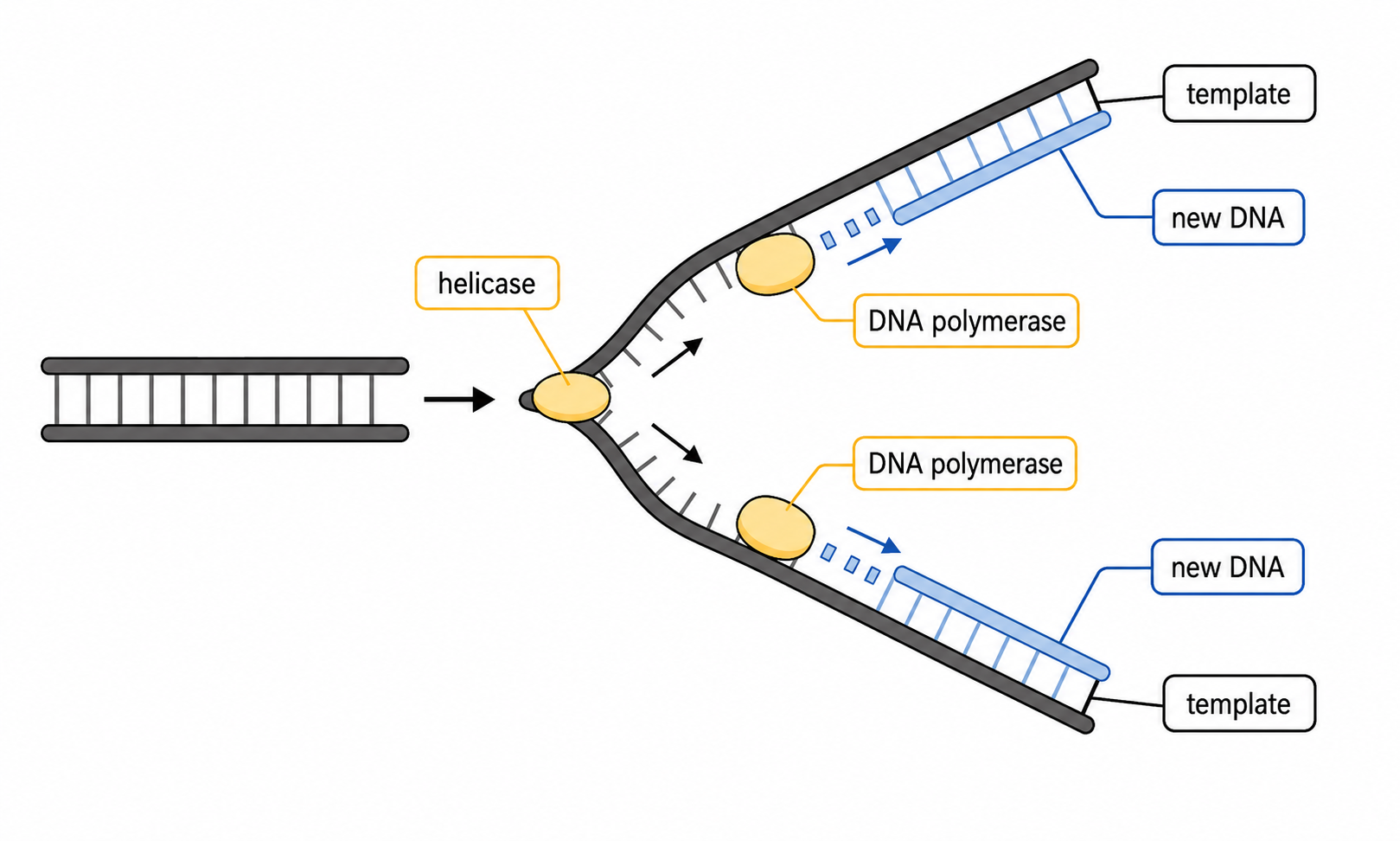
At the replication fork, helicase unwinds DNA by breaking hydrogen bonds between the two strands. DNA polymerase then joins complementary nucleotides to build new strands, using base pairing to copy the original templates accurately.
Open the template first, then build the complementary strand.
Label the enzyme jobs at the replication fork.
LabelLabel the enzyme jobs at the replication fork.
ChooseAmplify Then Separate DNA
Practice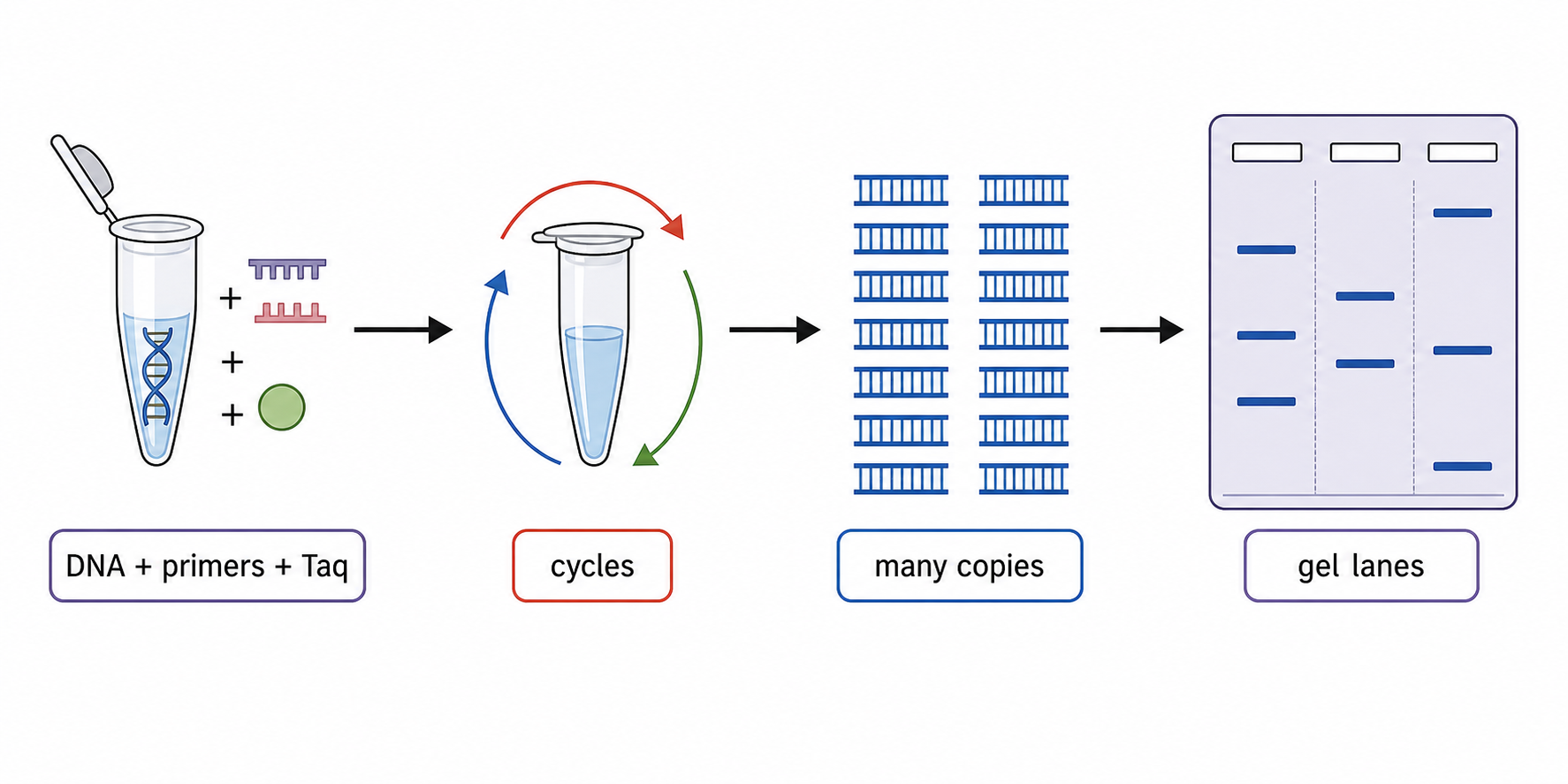
PCR and gel electrophoresis are a workflow, not the same technique. PCR amplifies a selected DNA sequence using primers, temperature cycles, and Taq polymerase; gel electrophoresis then separates DNA fragments by size and charge, with smaller fragments moving further through the gel.
Amplify first, then separate and compare.
Put the DNA analysis workflow in order.
OrderPut the DNA analysis workflow in order.
ChooseUse DNA Profiles in Real Cases
Practice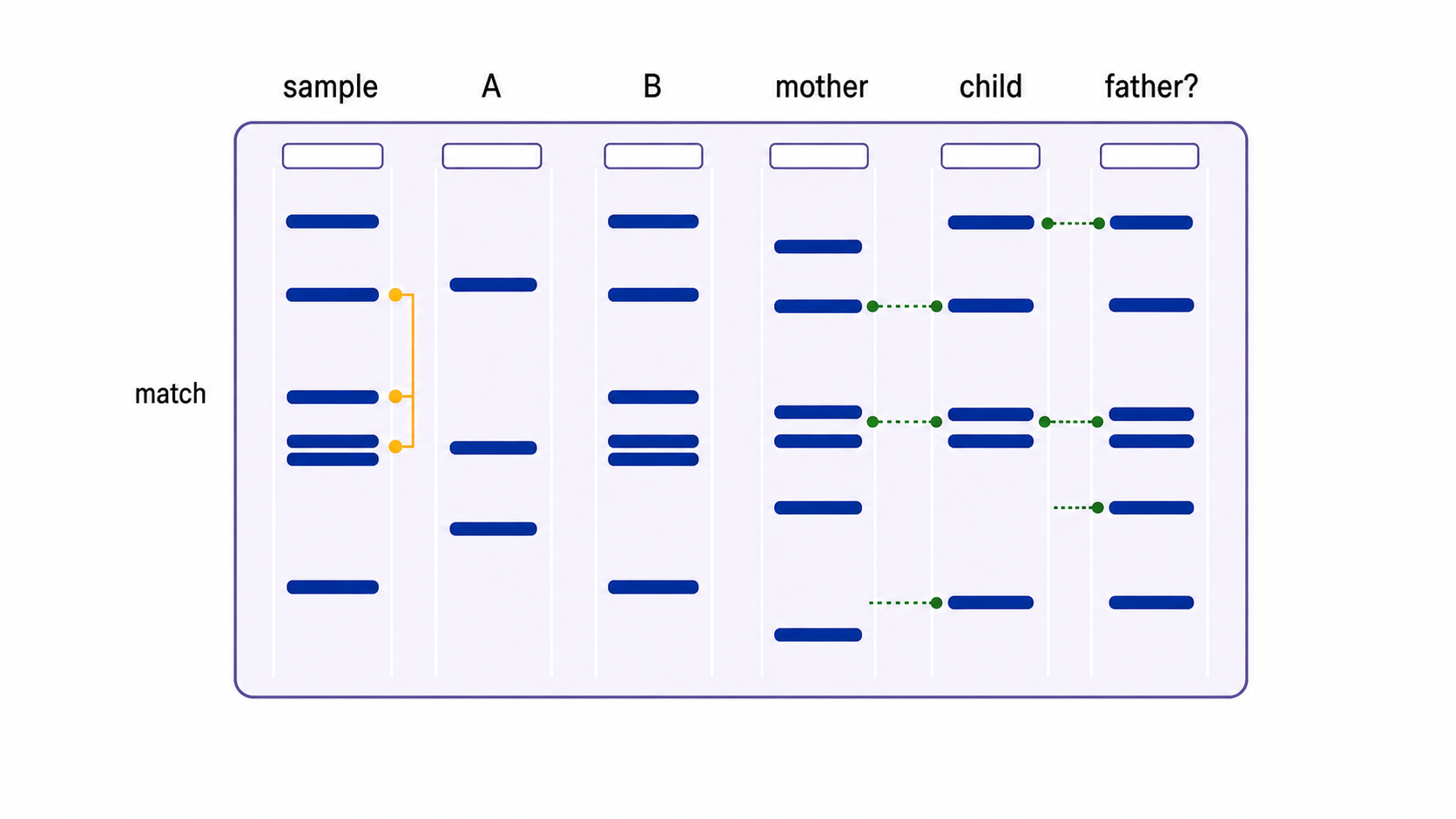
DNA profiling uses PCR and gel electrophoresis to compare DNA fragment patterns. In forensic identification, a sample profile can be compared with suspect profiles; in paternity testing, a child's bands should be explainable by inheritance from the biological parents.
DNA profiles use band-pattern evidence.
Compare the band patterns in two DNA profiles.
CompareCompare the band patterns in two DNA profiles.
ChooseRead 5 Prime to 3 Prime Direction
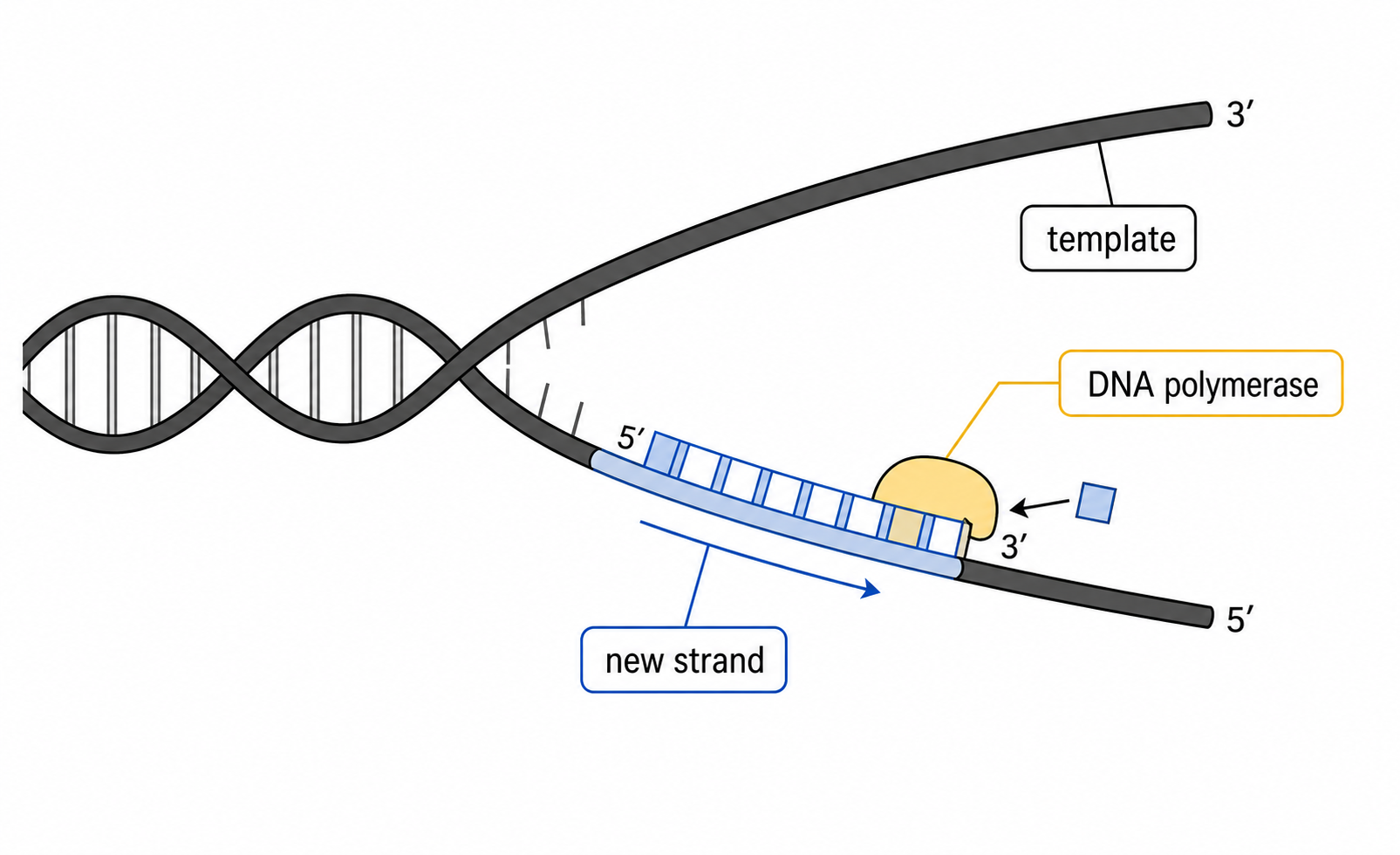
DNA strands have 5' and 3' ends, so they are directional. DNA polymerase can only add nucleotides to the 3' end of a growing strand, which means every new DNA strand is synthesized 5' to 3'.
Polymerase direction creates strand asymmetry.
Label the 5 prime and 3 prime ends and the polymerase addition site.
LabelLabel the 5 prime and 3 prime ends and the polymerase addition site.
ChooseSeparate Leading and Lagging Strands
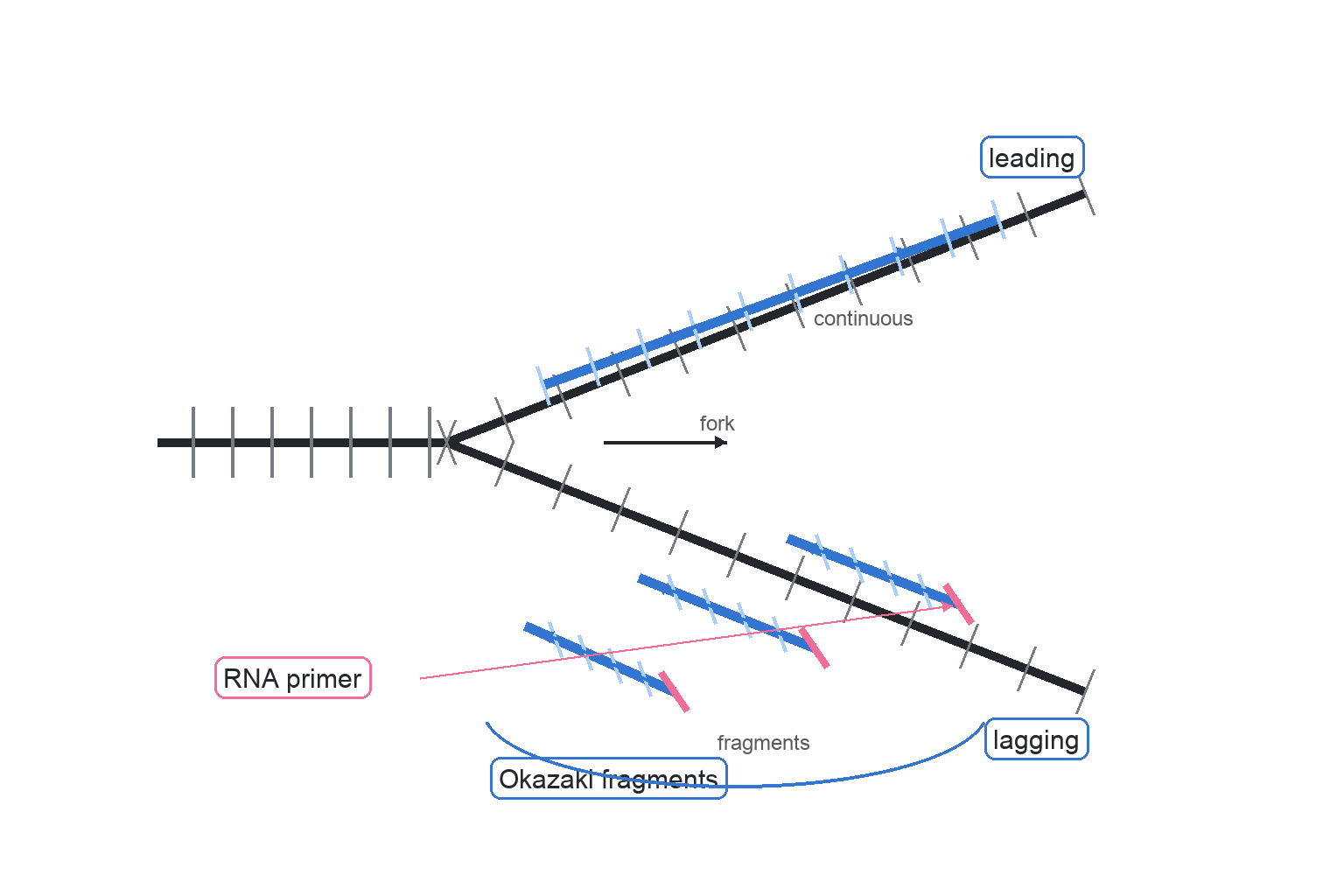
Leading and lagging strands exist because DNA polymerase only builds 5' to 3' while the two templates are antiparallel. The leading strand is synthesized continuously toward the replication fork; the lagging strand is synthesized discontinuously away from the fork as Okazaki fragments, each started by an RNA primer.
Both strands synthesize 5 to 3, but one must be fragmented.
Sort each feature.
SortSort each feature.
ChooseCoordinate the Replication Enzymes
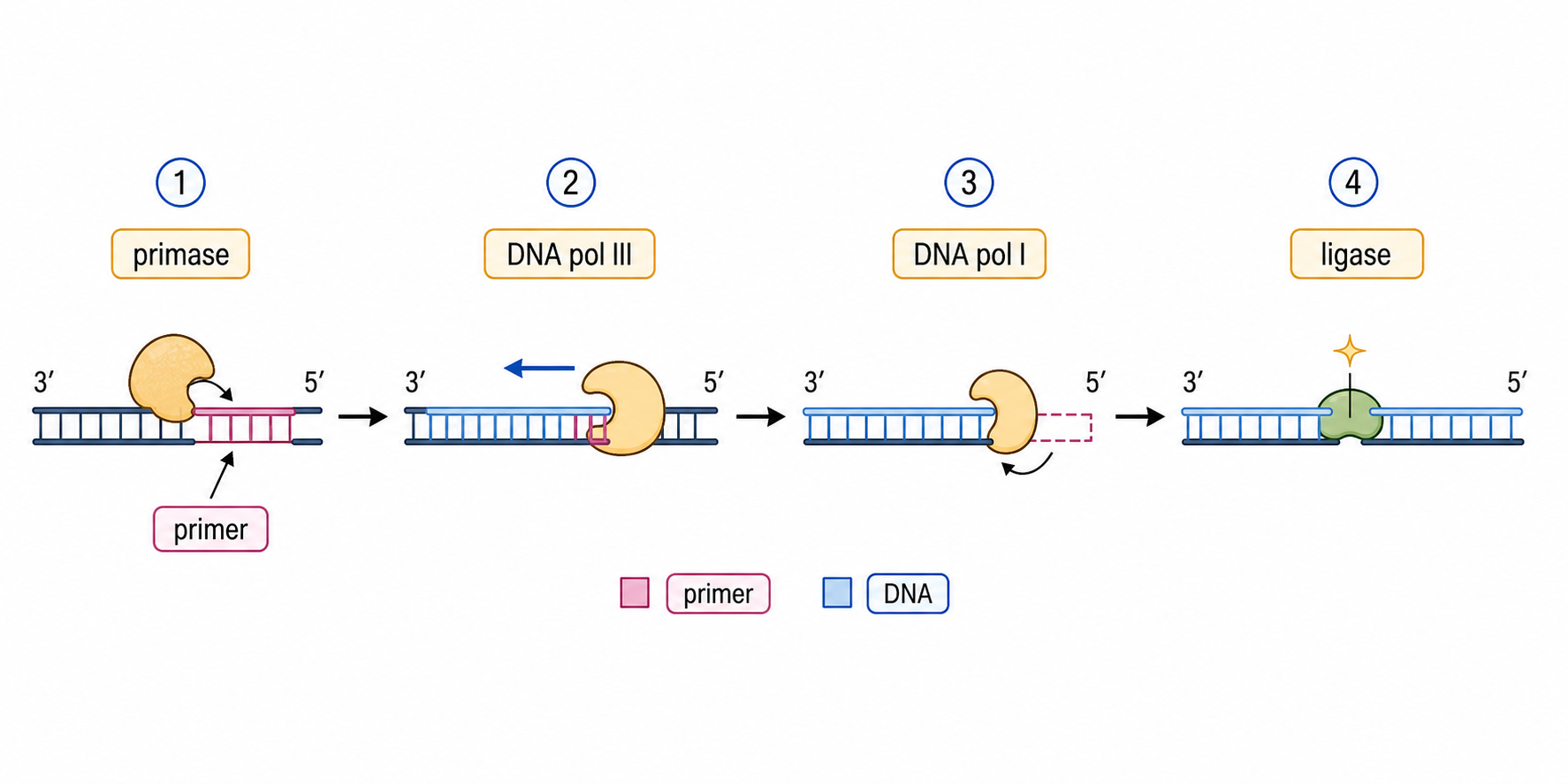
In the prokaryotic model, replication enzymes do different jobs in a sequence. Primase makes RNA primers, DNA polymerase III extends new DNA from the primer, DNA polymerase I removes RNA primers and replaces them with DNA, and ligase joins fragments by sealing the sugar-phosphate backbone.
Each enzyme has a different job in the replication sequence.
Put the prokaryotic enzyme jobs in order.
OrderPut the prokaryotic enzyme jobs in order.
ChooseProofread Before Mutations Persist
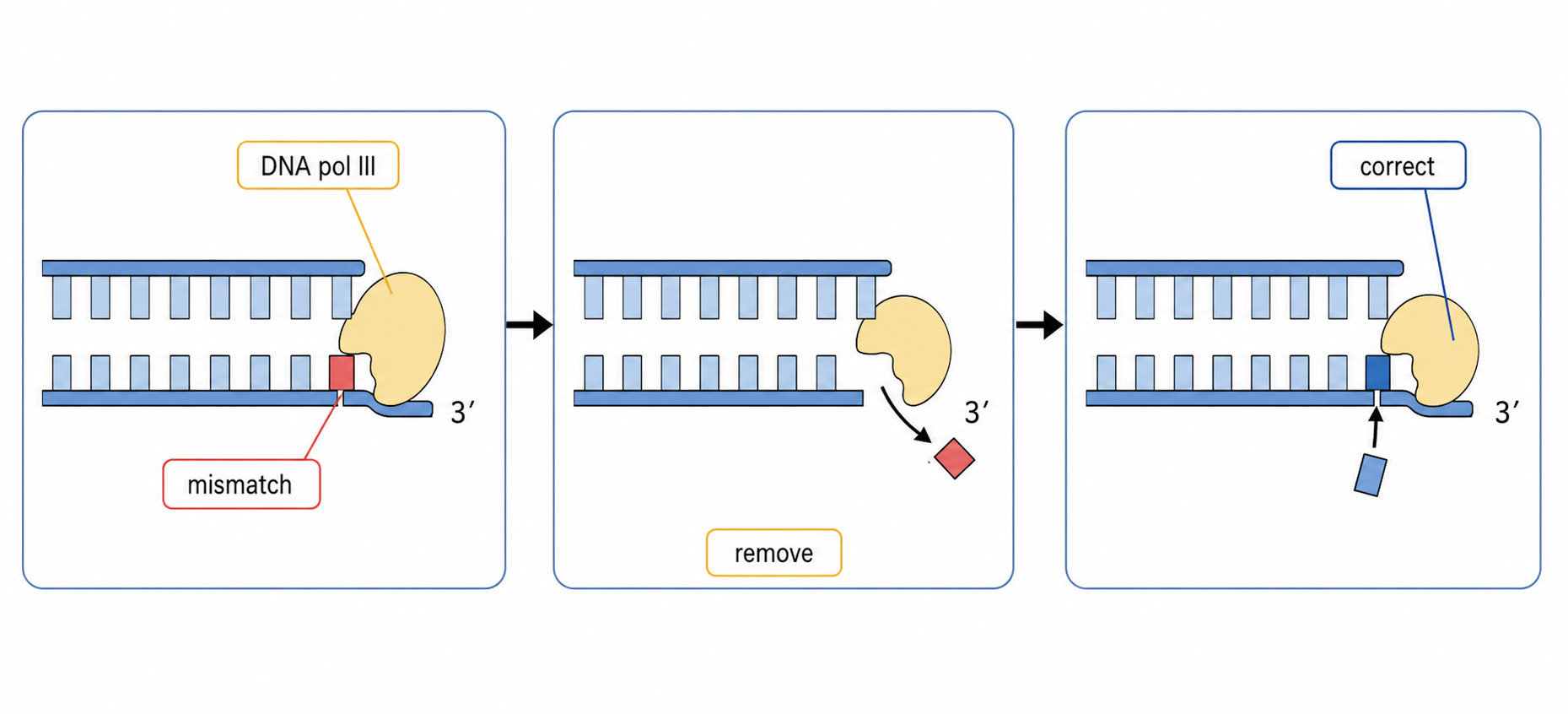
DNA proofreading catches some copying errors before they become permanent mutations. DNA polymerase III can remove mismatched nucleotides from the 3' end of the growing strand, then continue synthesis with the correct base, which improves copying accuracy.
Proofreading corrects mismatches before synthesis continues.
Spot the error in this answer: DNA polymerase III only adds nucleotides; mistakes remain until after replication.
Spot ErrorsSpot the error in this answer: DNA polymerase III only adds nucleotides; mistakes remain until after replication.
ChooseTransfer: Explain Core DNA Replication
Exam PracticeDNA replication produces exact DNA copies before cell division and maintains genetic continuity for reproduction, growth, and tissue replacement. Semi-conservative replication gives each new DNA molecule one original strand and one new strand; complementary base pairing and Meselson-Stahl isotope evidence support the model. Helicase unwinds DNA and breaks hydrogen bonds; DNA polymerase joins complementary nucleotides to build new strands. PCR amplifies selected DNA using primers, temperature cycles, and Taq polymerase; gel electrophoresis separates DNA fragments by size and charge. PCR and gel electrophoresis support DNA profiling for forensic identification and paternity testing.
Put the answer frame in order.
OrderUse this for SL/core questions about DNA copying, semi-conservative replication, helicase/polymerase roles, PCR, gel electrophoresis, and DNA profiling.
Use this for SL/core questions about DNA copying, semi-conservative replication, helicase/polymerase roles, PCR, gel electrophoresis, and DNA profiling.
Common loss: saying DNA copies itself without explaining semi-conservative copying, enzyme roles, or the difference between PCR and gel electrophoresis.
Transfer: Explain HL Replication Details
Exam PracticeDNA strands have 5' and 3' ends; DNA polymerase adds nucleotides to the 3' end, so new DNA forms 5' to 3'. Leading strand synthesis is continuous; lagging strand synthesis is discontinuous as Okazaki fragments using repeated RNA primers. In the prokaryotic model, primase starts, DNA polymerase III extends, DNA polymerase I replaces primers, and ligase joins fragments. DNA polymerase III removes mismatched nucleotides from the 3' end; proofreading improves copying accuracy and reduces mutations.
Put the answer frame in order.
OrderUse this for HL questions about DNA polymerase directionality, leading and lagging strands, prokaryotic enzyme functions, Okazaki fragments, and proofreading.
Use this for HL questions about DNA polymerase directionality, leading and lagging strands, prokaryotic enzyme functions, Okazaki fragments, and proofreading.
Common loss: saying the lagging strand is made 3 to 5, mixing up DNA polymerase I and III, or forgetting that proofreading removes mismatches from the 3 prime end.